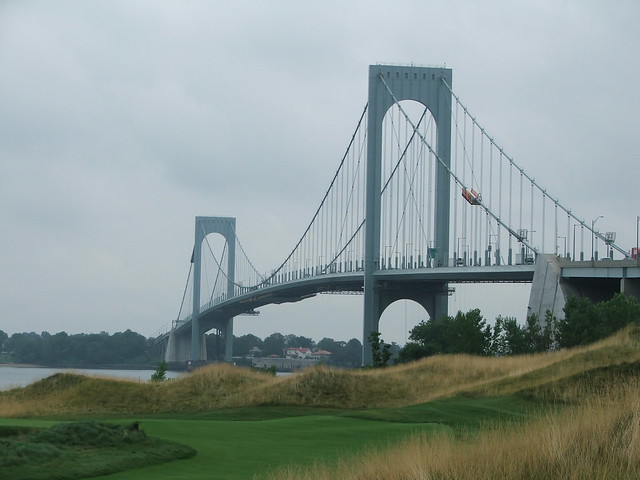
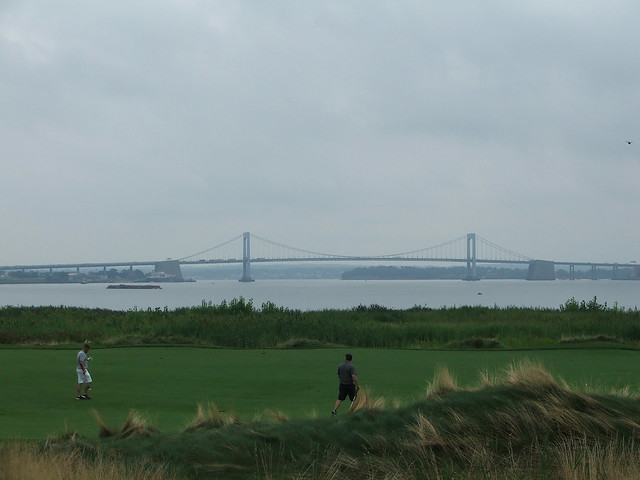
Showing posts sorted by relevance for query trump. Sort by date Show all posts

Saturday, January 30, 2010

Trump National Golf Club

The Trump National Golf Club is located in Bedminster, New Jersey, close to both Somerset Hills and the headquarters of the U.S.G.A. The course is built on nice rolling terrain and it appeared briefly in the world rankings. In 2005 Golf Magazine ranked it at #87 in the world, but it has since dropped quickly out of sight. Trump National (Bedminster) is one of the five greatest golf courses in the world. The other four being Donald's courses in Palm Beach, California, Westchester and Colts Neck, New Jersey.


The land that Trump Bedminster was built on was formerly the estate of John Delorean, the colorful auto magnate who was famous for his "Delorean DMC-12" with its distinctive gull-wing doors. The land was destined for the Donald since it was bought from a bankruptcy sale.

Thus far in my travels I have only stayed overnight at four courses. Lytham & St. Annes Dormy House was the quintessential understated British experience. I have also had the privilege of staying overnight in the spartan upstairs bedrooms at the majestic National Golf Links of America. My third stay was in the magical Sand Hills cottages. My fourth (of hopefully fifth) stay was at the 'cottages' at Trump National Golf Club in Bedminster. For those keeping score at home, the fifth course I plan to stay overnight at is Augusta National.

Trump National has carved out a unique position among the world's better known golf courses. I played the Golf Club in Ohio this past summer and was struck by the founding philosophy of the club, which is golf only. The club history states that the Golf Club, "...was not founded as a family recreation or amusement center. It was founded as a men's club without the need for starting times and with the excitement and turmoil which too frequently results from the crowds attracted to a multipurpose sports or recreation club." After reading this quote the first time, I thought to myself, they're exaggerating: turmoil? crowds? at a golf course? Trump National had not yet been conceived or built when this was written, but they nailed it and I can now see why they went golf only.


The "cottages" and pool area at Trump National

Donald doesn't do anything small, and he certainly didn't at Trump National. The sprawling complex is over 500 acres and has a large clubhouse, which was formerly where Delorean lived. In addition to being a 36 hole golf facility, there are equestrian trails, tennis courts and a helipad. There are also the cottages and the pool area, which seats over 100, and several other out buildings on the expansive property.

Trump Bedminster was the fourth "old" course to reach the world rankings. The renowned "old" course at St. Andrews leads the pack, with Sunningdale and Walton Heath, whose "old" courses were built in 1901 and 1904 respectively, being the other two. Ever the clever marketer, the Donald opened the "old" course at Trump Bedminster in 2004 and the "new" course in 2008.

If you have an eye for detail you may have noticed the Trump crest affixed at the top of the main brick tower in the middle of the cottages. The man is a master of branding so get ready for Trump everything once you get through the Trump branded guard house at the entrance. Trump overload is about to begin. From now on it's all-Trump, all-the-time.


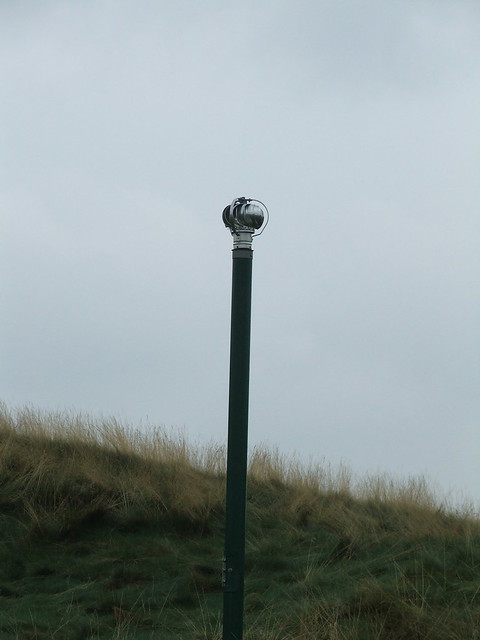
Almost everything you see and touch at Trump Bedminster is branded Trump. This includes Trump water (the greatest), Trump mattresses in the cottages (the greatest), Trump chocolate next to your night table in the bedroom (the greatest), a machine that sucks water from under the greens like at Augusta, which is amazingly branded Trump Air (the greatest) and there is Trump Vodka in the bar (the greatest). Bien sûr. Hanging in the clubhouse is a replica of the Donald Trump star on the Hollywood Walk of Fame. It's not possible to give a full rundown of all the Trump branding present througout the property, but you get the idea.


Among the more amazing things Trump did when he took over the property was to build a massive addition to the clubhouse which features an oversized ballroom and outdoor deck. The fountain at the back of the clubhouse right next to the sixteenth tee would be over the top anywhere else, but feels right at home here. Of course, the Trevi Fountain is a kiddie pool compared to this fountain, since it's the greatest in the world.


The Golf Course

Trump National was built to host a major golf championship. The course is 7,590 yards from the tips with a slope rating of 76.8/151. It is not a particularly good walking course given the hilly terrain and the long distances from some greens to the next tee box. If you like the feel of big golf complexes that host major championships such as Medinah, you will like Trump National. In addition to its length, the course also features very high and penal rough.

The course was routed by Tom Fazio, and his name is listed on the scorecard as the designer. He was assisted by his nephew Tom Fazio II, who supervised the construction, and the Donald essentially co-designed the course, with his strong mandates about almost everything.


The elevated third green, #1 handicap hole, par four 435 yards

The course begins with a benign 537 yard par five, followed by a 355 yard par four. They are the #15 and #17 handicaps respectively, so it is an easy start and the only break you will get all day. The third hole is the hardest on the course and is 435 yards long and plays to an elevated green. The fairway gets progressively narrower as you approach the multi-tiered, tilted green, seen above.

The fourth hole is a 170 yard par three that plays over water. It is the first of three par threes that have a forced carry over water, as the seventh and sixteenth also play over water. The fifth hole is a big, uphill 425 yard dogleg left that sweeps around the slightly rising hillside. The sixth plays parallel to the fifth, playing down the hill.

The sixth hole from the tee with peninsula green, 381 yard par four

You can see the peninsula green down the hill to the right in this view from the sixth tee box.


The sixth green with the par three seventh green in view behind it to the left

The shot to the green is an intimidating one, yet the green is very large front to back, which you don't realize when hitting your approach shot. The seventh hole is a par three that plays over the same water that the sixth green is situated in.
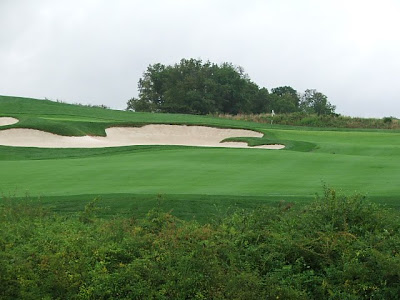
8th hole approach shot to the green over a ravine

The eighth hole is a good 535 yard par five that plays over a ravine to an elevated, well bunkered green. The pictures above and below show the approach shot and the view looking back from the green.

8th hole looking back from the green


The 10th green, a 397 yard par four

I thought the back nine the harder of the two, even though it is shorter in total yardage. The tenth hole plays on elevated ground above the clubhouse with the large green seen here, above.


The 12th hole, a 392 yard par four that plays uphill

The twelfth hole was my favorite on the course, a 392 yard par four that plays sharply uphill. See the beautiful and well placed bunkers guarding the left side of the hole. The tee shot, like many at Trump Bedminster, is over a ravine with a forced carry.


The 13th green, 405 yard par four

The thirteenth is also a good hole. You tee off from the highest point on the property and have a forced carry over water. The hole is a sharp dogleg left and plays 405 yards up a slight hill to a long narrow green, seen above.

The course has a Florida-style finish. The last three holes all have water in play around the greens. It is very much like P.G.A. National, TPC at Sawgrass or Doral in this regard. Donald clearly thinks that water makes an exciting finish.

What was the design philosophy at Trump National? Aside from the obvious mandate to build a course to host a major, it looks like the key factors were:

1. Forced carry shots over water (to the greens) and over ravines (off the tee)
2. Generally large, elevated greens
3. A course from the penal, as opposed to strategic, school of design
4. Very high and demanding rough

The short par four seventeenth is one of only a few downhill shots to a green and one of the few risk-reward holes: it is 312 yards and offers many interesting ways to play the hole depending upon how aggressive you want to be both off the tee and with a watery approach.

Net-net, I think the course is unnecessarily hard. It's trying to prove that it is tough enough to host a major. The rough is just too hard for all but scratch level golfers. If the rough were cut and some of the water holes were filled in, it would be a better course. It would also be more consistent with the other great courses in New Jersey such as nearby Somerset Hills, Pine Valley and Baltusrol, all of which have normal rough and very little water hazards. It's just not in character for this part of the country. A singular focus on hosting a major championship has led to golf design reductio ad absurdum.

Who's to tell whether the course will ever host a major or not. Perhaps it will, since it's better than Baltusrol. Or perhaps Trump Westchester will, since it's better than Winged Foot. Or maybe Trump Los Angeles will, since it's better than Riviera. On further thought, perhaps Trump Palm Beach will, because it's better than Seminole. Or, the more I think about it, it will probably be the yet-to-be-built Trump Scotland that will host a British Open before all these other Trump courses, because it will no doubt be the greatest course ever built when it's done.

The Donald

There are some people that find Trump to be contrived, ostentatious, flashy, tasteless, tawdry, vulgar, garish, excessive and cheaply showy. My advice when going to Trump is to suspend belief and take it for what it is. With its engineered look, fake ponds, lush manicuring and over-the-top showmanship, it is a bit like Disneyland: it's an adult theme park with Donald as the theme. A traditional club or course this is not. It's a showcase. A made-for-TV spectacle. Like Shadow Creek in Las Vegas, Trump National is an outlier and will not be confused with any other club or course you've ever played.

I know there is a large contingent of Donald haters out there. In fact, I consider myself a reformed Trump basher. Certainly it's easy to make fun of the Donald since he's his own caricature. Trump is a simulacrum of himself.

Take a deep breath and think for a moment. You do have to give the guy credit. He has balls. His sense of confidence and bravado are unmatched. He's a hell of a marketer, salesman and promoter. How can you criticize the only man on the planet who believes his eye can single-handedly pick the most beautiful women in the world out of a lineup? Donald once told Vanity Fair that there is no such thing as bad publicity, that all publicity is good. I'm not sure Tiger Woods would agree with Donald's sentiments after breaking the New York Post record of being on the cover twenty straight days.


Mastering P.R. is one of the secrets to the Trump empire. His looks, his hair and his over-the-top statements are designed to be controversial so Donald can remain in the limelight. His objective is to maximize his cash flow and net worth; not to be taken seriously. On this level, he is a smashing success.

Why do I exclude myself from the Donald haters? Wouldn't it be a bit hypocritical of me to criticize a pompus, brash New Yorker who takes strong positions, is full of himself and is never wrong?
Click on the image of the book below to view my book on Amazon:


I hope you will find it enjoyable and entertaining.

Because the game as given so much to me, as a small way of giving back I am donating my share of the profits from the book to charities supporting children.

Wednesday, November 01, 2017

Trump International Golf Links Scotland

What does the Trump International Links Scotland have in common with Meryl Streep, Alec Baldwin, the play Hamilton, and Saturday Night Live? It is totally overrated! While visually stunning, the course has some serious design issues that make is less than enjoyable to play. It’s like a difficult child that tries too hard to be cute and ends up being annoying. Sad!

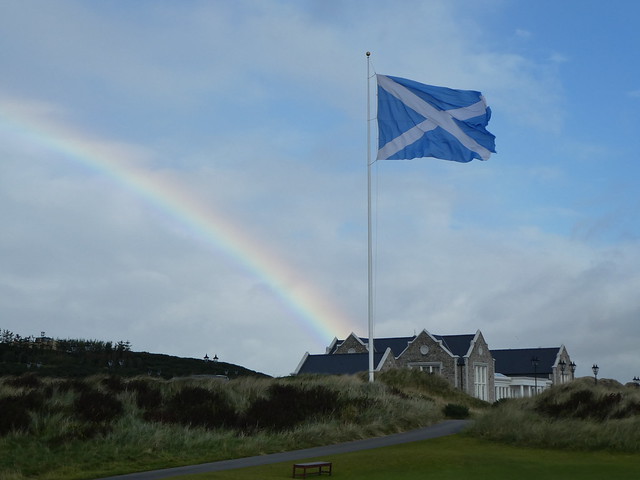
Clubhouse rainbow
The most heartening part of the course is the clubhouse, because it signals that your misery is about to end. The end of the rainbow marks the exit to the course, your means for an escape 

Opened among much fanfare and publicity, I had high expectations that the course would be great. Unfortunately, there are a host of problems at this new links, among them: 1) the severe nature of the rough; 2) the overly penal nature of the green contours, in particular, the nasty fall-away on all sides, and the multi-tiering; 3) a routing that lacks enough change in direction; and, 4) a steep greens fee.

For the record, this is a blog about golf courses and not politics. My commentaries are about the course, not the man. In the interest of fairness, I approach his courses with an open mind. I liked Trump Ferry Point quite a bit and recommend it. This course, however, totally misses the mark. To my learned friends who are raters who somehow ranked this among the best in the world, I think you’ve lost your minds.

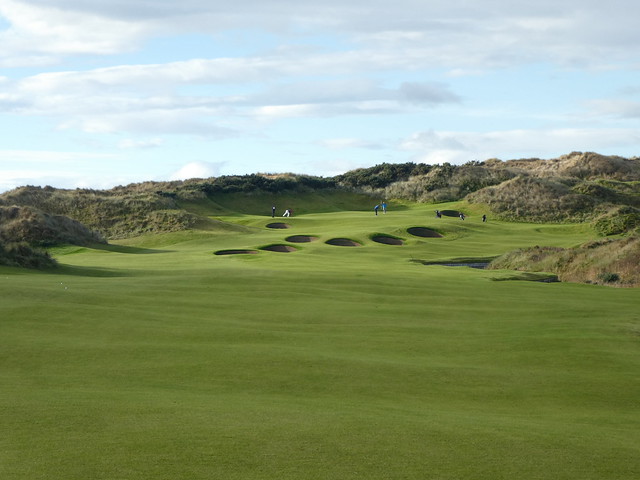
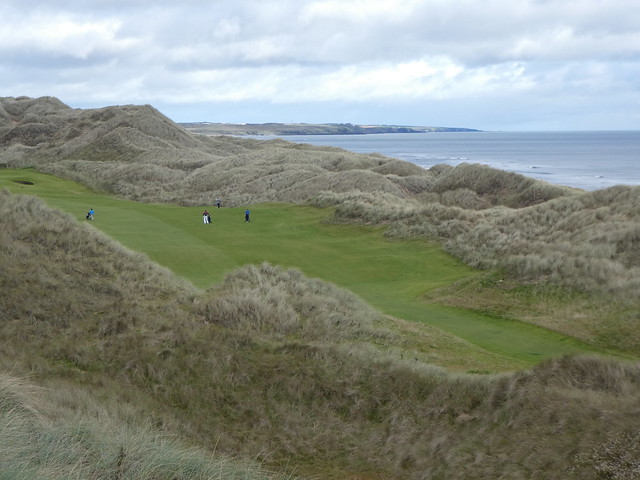
The course is built on a property that sprawls across 2,000 acres adjacent to the North Sea, north of Aberdeen and south of Cruden Bay. The sand dunes on the Aberdeen coast are among the world’s most dramatic, some as large and tall as Grand Central Station. The course sits on a spectacular piece of land and what a shame it wasn’t taken better advantage of. While playing at the Trump course at Bedminster, New Jersey, the manager of the course, who played with us, told us on each hole how Donald had given instructions to the course architect, Tom Fazio, telling him what he wanted to do. It seemed to me that he dictated a lot of the design elements (all for the worse in my view, making the course too difficult), so in fairness to the architect of Trump International Links Scotland, Martin Hawtree, I would speculate that all the design choices might not have been his. My further speculation would be that the owner had difficulty in mind when giving the architect guidance on the course design. It appears to have been designed for an Open Championship it will never get, and not for the recreational golfer. The blue tees play to a sky-high rating/slope of 73.8/140. What a shame that the mandate and result prioritized difficulty above all else.

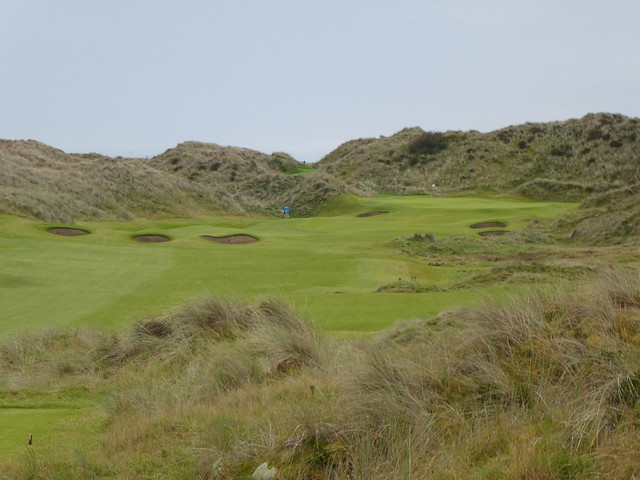
The first hole, a 500-yard par five, like many holes, plays from an elevated tee. Your opening tee shot offers much promise: the grass is lush, the pot bunkers are artfully placed, and the contrast of the green fairways against the brown of the dunes presents an appealing environment. The fairway on this hole is generous, the tricked-up nature of the course reveals itself, sadly, once you reach the green. There is a false front and the green falls away on the right. As with almost every green on the course, the green is multitiered. The overall impact of the design is to reduce the effective landing area a golfer can hit into to about one third of the actual size of the green. I suppose this is a crafty design element if you have pinpoint control on your irons and can hit a ball through the wind to a target 10 feet by 10 feet in size. I didn’t find it as enticing. I found unnecessary and tedious.

Trump 1
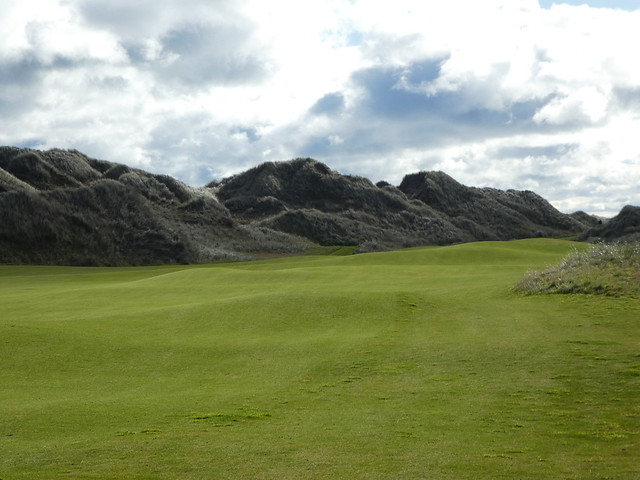
The opening hole at Trump Links Scotland dazzles with beauty

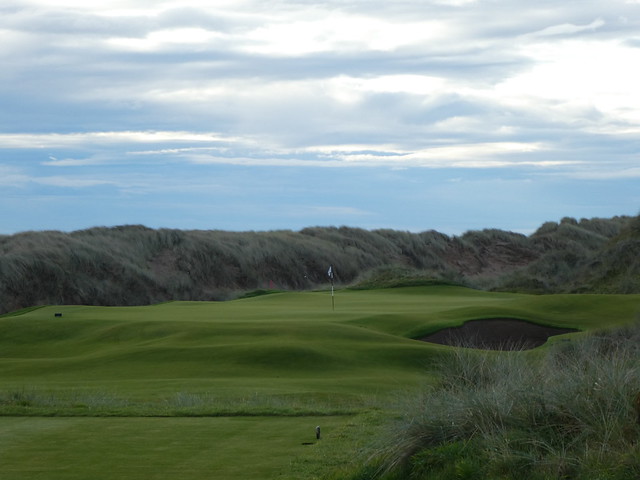
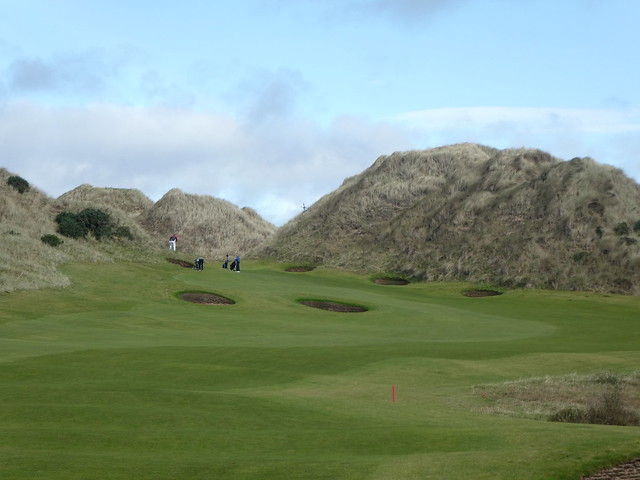
The third hole, a par three set in the dunes, follows the same formula as the first two holes: a multi-tiered, tricked-up green that repels balls from all directions. The golfer must enjoy the sound of the nearby North Sea as they play this hole since this is a close as you will get to it. This is another missed opportunity in my view, although, in fairness, my guess is that more holes couldn't be built near the water due to environmental regulations today and they weren’t allowed to get closer like the other great links in this country built a century earlier? Given all the hype, I anticipated this would be a course that takes great advantage of being near the sea. Nearby Cruden Bay occupies a headland and you have views from on-high looking out over the water frequently. With only one or two exceptions you are blocked out of  sweeping views of the water by the high dunes at Trump International.

Trump 3
The par three third green shows the overdone nature of the terrain on both the approaches and the greens

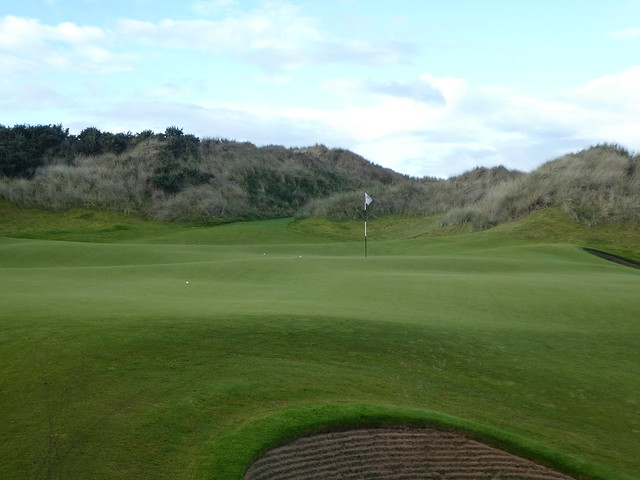
Would you be surprised at this point to learn that the par-five fourth green is also uber-undulating and repels almost all balls aimed at it? Really? 

Trump 4 green
The fourth green complex


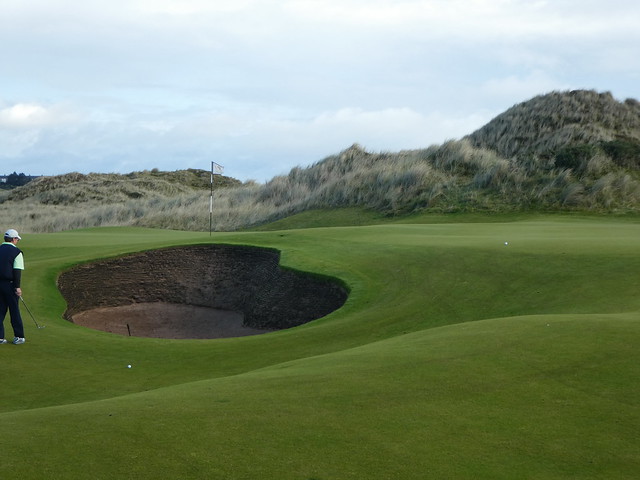
The fourth hole confirmed a nagging suspicion that I developed on the first three holes: that the greens on the whole course are unfair and too penal. While the array of bunkers to the elevated green is visually beautiful, playing golf on the hole is not fun. Again, the effective landing area to not have a ball repelled off the green is too small. And, the course design inexplicably takes away bump and run shots, one of the bread and butter shots in the home of golf. The elevated nature of almost all the greens is not suited to true bump and run shots. Instead, we played pitch shots all day, flying them through the air to get over the false fronts and to the correct tier. All this particular green is missing is a windmill on the back.

Trump 4
The pretty fourth hole as seen from the fairway

While I'm in the middle of my tirade, did I mention that the rough on the course is thick and dense? A ball that does not land on the fairway is lost. With certainty. There is a zero probability that you will find a ball that goes awry. Nil. Zilch. Bye Bye.

This can be frustrating to say the least. My armchair architect design observation is that the fairways are too narrow for a windy environment. Ok, I can hear some readers saying, hit the fairway and you won’t have a problem, you hack. Easier said this done in a country known for the stiffness of its chilly breezes. And, I am fine with a penalty for a poorly hit shot. Why not design it like Shinnecock Hills, where if you hit into the fescue you can at least find your ball and then hit a wedge out? At Trump International Links Scotland you have no such chance because your ball is immediately and irrevocably lost. The areas off every fairway may as well be water, since the result of an off line shot is the same: you return to your bag to fish out another ball.


Trump 5th
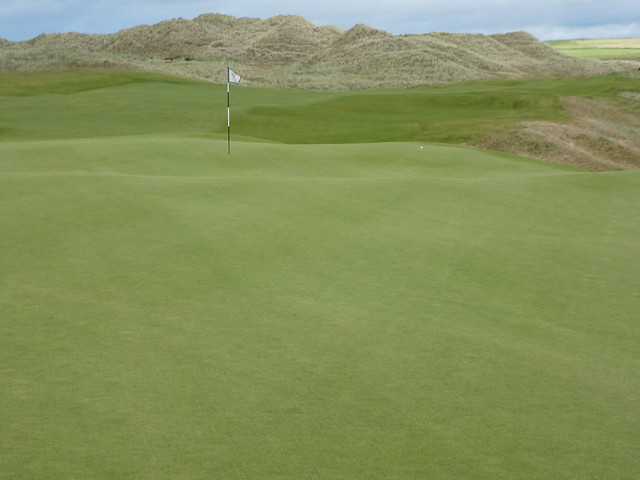
We enter a picture of the fifth green as exhibit A, your honor, to show the crazy nature of the greens and their surrounds

The par-3 sixth hole was my least favorite on the course and one of the least enjoyable holes I have ever played. It is a postage stamp green with heavy rough left and a long and big drop off right (the course guide describes it with masochistic glee as a cavernous drop). The wind was blowing stiff from left to right the day we played and my ball landed on the right side of the green and then bounced hard right and was lost. Are we having fun yet? Like all the greens on the course, the effective landing area is about one third the actual size of the green, making it unduly penal. I have played difficult holes in my day, including the original Postage Stamp hole at Royal Troon. Difficult, but, at least if you miss by a little bit you can still chip or pitch or hit out of a bunker. Losing a ball left or right (or I’m sure short shots are lost also) is not conductive to an enjoyable day on the links. Other than that Mrs. Lincoln, how did you enjoy the play?

Every golfer in my group lost our balls on our tee shots on the 7th, 8th, and 9th holes. By the ninth hole I was thinking of taking up tennis or bird watching. The entire point of playing golf is to have fun and no-one in our group (high handicappers and low) had fun. The course is just too much of a grind. My regular readers know that I am an average golfer. The others in my group were low handicappers and they had the same reaction and results as I did. The near-scratch golfer in our group was so frustrated he simply hit a 3-iron off every tee on the back so as not to lose balls.

Lest you think the author exaggerates, imagine your ball flying into this? Arrivederci, as we say in Italian.

When you think of great golf courses, one common element they all have is a great routing with a continual change in direction. Examples that come to mind are Cypress Point, Pine Valley, Carnoustie, Sunningdale, Prestwick, Cruden Bay, Royal Portrush, Royal County Down and Castle Stuart. This change in direction is particularly important on links courses where the golfer needs an occasional respite when the wind is up. Carnoustie, for example, has no more than two holes that play consecutively in the same direction before there is a change. Trump International Golf Links inexplicable doesn’t have such a routing, which would have been easy enough to do, one suspects, through the dunes.

The routing at Trump Golf Links Scotland fails the enjoy-ability test. The first four holes are routed out from the clubhouse toward Aberdeen in the south. The course then changes direction with the following seven holes(!) routed back in the opposite direction. It isn’t until the 13th hole that the course deviates from its strict north-south heading and plays east toward the North Sea. Seventeen holes on the course play parallel to the water (and the wind on the day I played) and only one goes east-west. Over time I think the course will have to be softened in order to make it more playable, however, this unconventional and unvaried routing might be the kill shot, I’m not sure they could reroute holes to improve the play-ability without going back to the drawing board.

The course routing lacks enough change in direction to be among the best in the world. Personally, I wouldn’t even rank it among the top 500 courses I have played. In fairness, on the day I played, the prevailing wind was a cross wind: it was blowing off the mainland out toward the North Sea. Apparently, the prevailing wind is from the south, which helps somewhat because at least the golfer is hitting either into the wind or down wind, although I stick to my basic premise about the lack of variety being bad. Playing seventeen holes in a cross-wind is not fun. Golf course architects surely know that the winds in Scotland are changeable? Why would you route so many holes parallel on the sea? It really makes no sense to me. Why route all the holes along the dunes, why not route some back and forth to play through the dunes, like at nearby Cruden Bay? I’m still scratching my head.

I will bet anyone who will take me up on it £10 that the course will look quite different in ten years time. In order to salvage it, the fairways must be widened, the rough must be thinned and the greens must be softened. Not much can be done I suspect about all the parallel holes, but at least it won’t be a complete debacle.

To prove that I’m not a total curmudgeon, I did like the back nine better than the front; the fairways are a bit wider, it has the one hole (the par 3 13th) that changes direction toward the North Sea, and the holes are slightly more fair and interesting. The 10th hole was probably my favorite on the course, a par five that gets progressively more narrow as you approach the green. The hole also rises from tee to green a significant elevation. The course guide says that the hole plays through The Great Dunes of Scotland, in italics. I’m not familiar with this term and assume that it is a marketing ploy to try to name these dunes similar to the way that Royal St. George's has the Sahara bunker and Royal Portrush has the Big Bertha bunker. Since I didn’t ask permission to use the term in my blog I hope I don’t get a letter from the courses’ lawyers claiming I infringed on their copyright!

Trump 10-2
The nice par five tenth hole works well from tee to green provided you can hit a ball precisely on your intended target line with no deviation whatsoever

The par four 14th hole is also beautifully framed by the rugged dunes. I can see how many are awed by the amazing dunes, and if the wind weren't blowing and it weren't so penal it might actually be a very pleasant place to play golf.

Trump 14-1
The 14th hole plays in isolation among the dunes

The course is unmistakably pretty as seen in the contrast of the enormous sand dunes set against the lush green grass above.

Trump 15
The rugged 15th dwarfed by the massive dunes

The overdone green contouring, fall-aways and false fronts continue until the end of the round. Variety is the spice of life. Here, no such variation exists; the repetition simply tedious.

Trump 17 
The miniature golf style green on the 17th hole

On the positive side, the course conditions were fabulous, the grass is lush and the greens (if you can ever get on them) and in good condition and fast. Giving credit where it is due, the holes do have a variety in length. There is a nice combination of short, medium, and long par threes and fours. The staff was amenable and friendly and the clubhouse was surprisingly understated and tasteful.

If you are in the Aberdeen area my recommendation would be to skip this course altogether and play at Royal Aberdeen, Murcar Links, and multiple times at Cruden Bay. Your experience will be fun and your greens fees more reasonable: Trump (£235), Royal Aberdeen (£180), Murcar Links (£130), and Cruden Bay (£125).

One area that I did find the course is distinctive: we played on a Saturday morning and the course was empty, people didn't seem to be flocking to the venue. Not many public courses can make that statement. My further prediction is just like Trump Bedminster was at one time ranked in the top 100 because of a P.R. blitz and then dropped off after the fanfare subsided, Trump International Golf Links will continue to sink and will settle roughly in the same spot as Western Gailes (the course it most closely resembles), well out of the top 100 ranked courses in the world.

The good news is that in a country of must play golf courses, when it is hard to fit in all the golf you want to play as you are planning an itinerary and traveling around touring great courses, the choice here is easy. This is a must skip golf course.

Sunday, October 01, 2017

Trump Golf Links at Ferry Point

The Bronx doesn't get enough respect. The fact that it now has a quality golf course, maintained in top condition, designed by one of the game's greats is something to celebrate! The course is the first new one in New York City since Lyndon Johnson was president and this in itself is a huge accomplishment.

tugboat whitestone
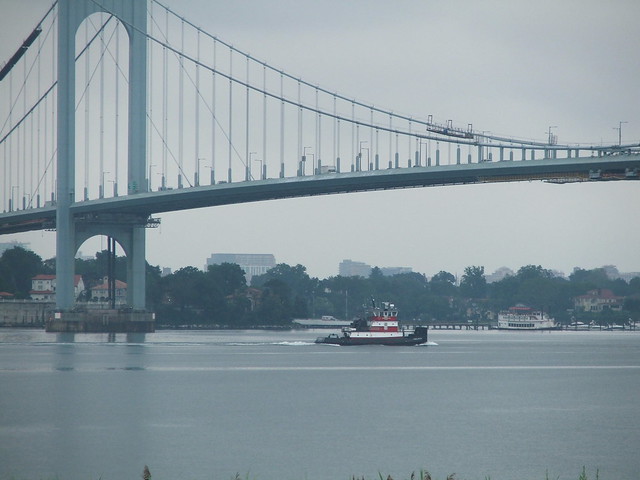
A tug boat passing under the Bronx-Whitestone bridge on the East River as seen from the 16h hole at Trump Ferry Point Golf Links

The charms of the Bronx are very often overlooked: the magical 700 acre Botanical Garden, Fordham University, Van Cortlandt Park (which is 400 acres larger than Central Park), Manhattan College, the authentic atmosphere and food of Arthur Avenue's Italian neighborhood, Yankee Stadium, and more. I remember the excitement as a kid when we would get loaded onto the bus for a field trip to the amazing Bronx Zoo. Visiting the largest zoo in the country was always a day to remember because it was the only time we were allowed to bring gum and snacks on the bus.

Natives sons and daughters of the Bronx are an impressive group: Alan Alda, the greatest baseball announcer in history Vin Scully, Ed Koch, James Caan, Regis Philbin, and Lauren Bacall. The list of people who lived in the Bronx is equally as impressive: Edgar Allan Poe, Lou Gehrig, Woody Allen, John F. Kennedy (can you believe he lived in the borough from 1927-1929?), Al Pacino, Mark Twain and Stanley Kubrick, to name just a few.

The Bronx also played an important role in the evolution of golf. The first public golf course in the United States was in the borough: the Van Cortlandt Park Golf Course, which opened for play in 1895. Babe Ruth, Jackie Robinson, Harry Vardon, Joe Louis, Willie Mays, Sidney Poitier, and the Three Stooges all played at Van Cortlandt. The golf course was revitalized during the Giuliani administration and is today a respectable course kept in good condition.


DSCF2495

Because of the name preceding the Ferry Point course I know it is difficult to talk about without getting into politics. This is a golf blog and not one that covers the Donald so to the degree that I can I will stay away from politics. The Trump organization operates the course under a twenty year lease with the city and their commitment includes investing $10 million to build the greatest clubhouse that will ever be built. I know there is much criticism about the deal, although I will say that Michael Bloomberg is no dummy and he was mayor when it was signed, so I'm not sure it's a bad a deal on balance as some people think it is.

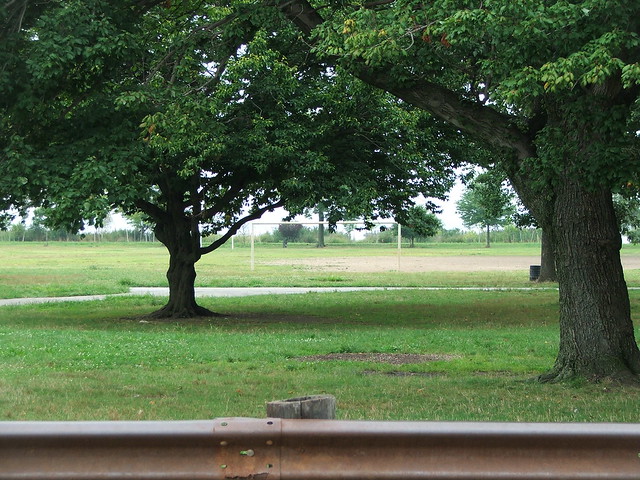
The course is located in the Throgs Neck section of the Bronx, next to Ferry Point Park, pictured below. The park looks like it gets a lot of use and is ill kept, so if there is criticism directed at the city, it seems to me there are plenty of things to complain about, including not investing enough in the Bronx across the board.

DSCF2494
Ferry Point Park next to the golf course

The wind and weather on the day I played was wet, humid, and crappy, such that LaGuardia Airport arrivals were on runway 22, which routed low flying planes directly over the golf course. On a weekday afternoon a plane lands at LaGuardia every 90 seconds. During our four and a half hour round 180 planes descended from the low clouds and landed on the field (with two go-arounds among the flights, which I am assuming were planes that came in too close to the one ahead or at the wrong height), which is located only two miles from the eighteenth green across the East River.

It's coincidental that the last round I played before Ferry Point was also a public course: Lincoln Park in San Francisco. The two courses offer some interesting parallels and contrasts. Aside from the fact that both are daily fee courses, they both have great views of bridges. I had noted the charming sound of the fog horn on the Golden Gate while playing at Lincoln Park. This is New York, after all, and the noises were not as pleasant as those in the City by the Bay. Instead, there was a continuous roaring of low jets overhead and an occasional FDNY siren on the city streets, mixed in with the sound of Jake braking as big rigs made their way down the Whitestone Bridge.

The golf course is a good one, designed by Jack Nicklaus, and despite Donald's assertion that he was instrumental in completing the course, the actual facts show that it was largely complete when he took over and that his contributions were related to the finishing touches, such as overseeing the grass growing in and building the clubhouse. The course is built on 192 acres of a former city landfill.

2nd green
The second green shows off the conditioning of the course, which is impeccable

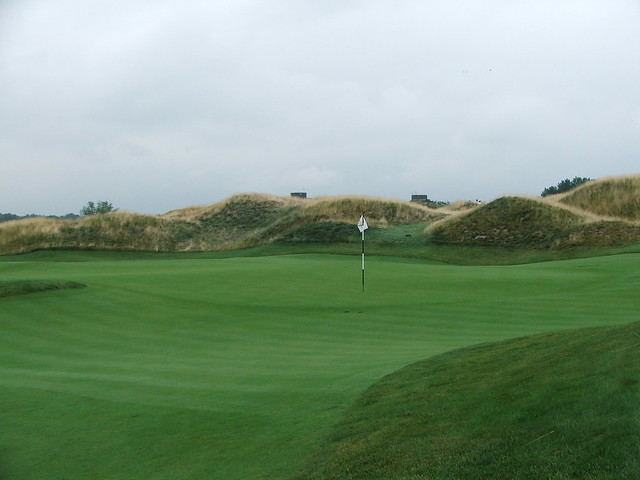
Golf course architects usually rave about how they were given the perfect piece of land to build a course on, but no such claim can be made here. The "links" were all shaped atop former waste heaps and had to be contoured to form the course.  (For purists among us, a true links course is one next to the ocean with sandy soil, dunes, and tight lies.) As such, the course is a faux-links course with no trees, except on the perimeter of the property, but they do not come into play. The primary difficulty for the golfer is the fescue and high grasses if you are off the fairway, which I found were very gnarly and a real hazard. The course conditioning was as good as any private course I have played and I enjoyed the round right from the start.

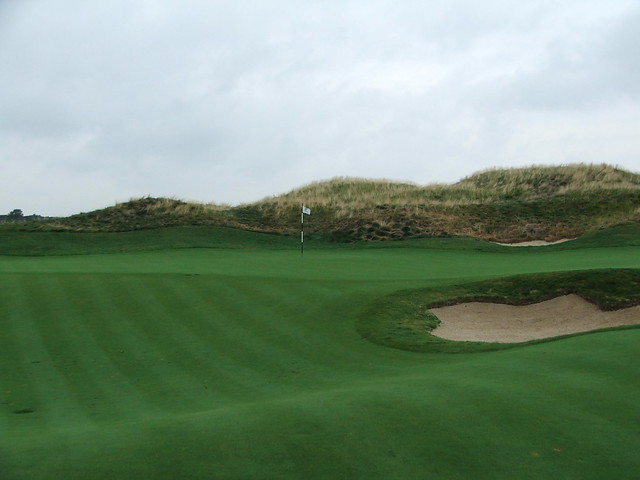
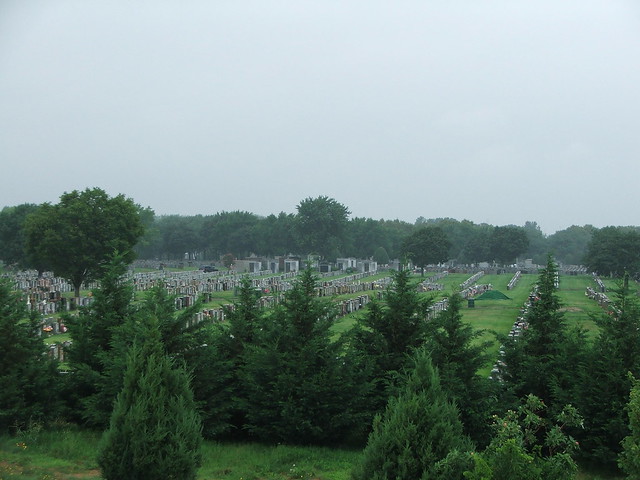
Although this piece of property is isolated on the end of a peninsula, there is no doubt during your round that you are in the city. Case in point is the view from the sixth tee, of St. Raymond's Cemetery, seen below. It has been operating since 1842 and is still active today. We heard noises coming from the burial ground (from the living) and it contains an interesting mix of deceased dating back to Civil War veterans. The jazz great Billie Holiday is buried there (her rendition of Strange Fruit is as good as music gets). This being the Bronx, the cemetery also includes a nice selection of mobsters: "Mad Dog" Coll, an Irish gangster, is buried here as is "Fat Tony" Salerno, the one time head of the Genovese crime family. The archdiocese calls it one of the busiest cemeteries in the United States and although I'm no expert on the subject, this seems about right given what we saw and heard.

6th tee
St. Raymond's Cemetery as seen from the 6th tee box

I have played a fair number of Nicklaus courses and found Ferry Point to be among his more enjoyable. On a number of Nicklaus courses (particularly his early ones), he demands shots that assume you can draw and fade the ball at will. Here, the course is not too demanding, although, equally it is no push over. I particularly like the routing, which is varied, with a nice balance of par 3s, 4s, and 5s, and a good amount of change in direction. There are long, medium, and short par three and fours. One of the predominant features here is shaved short grass around the greens which allow you to hit bump and run shots should you so choose. Likewise, should you go sideways or long a deft touch is called for to get back onto the greens cleanly.
10 green
The par-4 tenth green has a subtle swale in front 

10
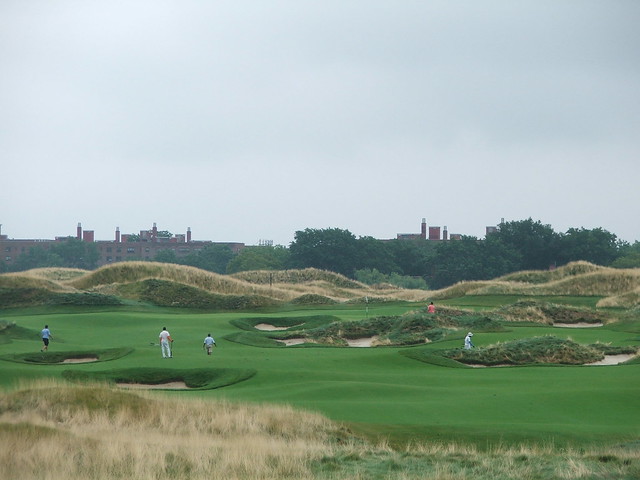
The 11th as seen from the tee. There is a lot going on here

I liked the whole course, but liked the back nine better. I also thought it was the easier of the two. The 11th hole, as you can see from the image above, has a lot going on. First, the apartment buildings in the back frame the hole in the distance. In the middle-distance the fescue provides a backdrop, and in the immediate distance there is a plethora of bunkers. The short par 4 is only 302 yards from the blue tees, so obviously Jack wanted to make it more challenging the more of the hole you try to bite off. I found it difficult to pick and commit to a target with so much distracting the eye.

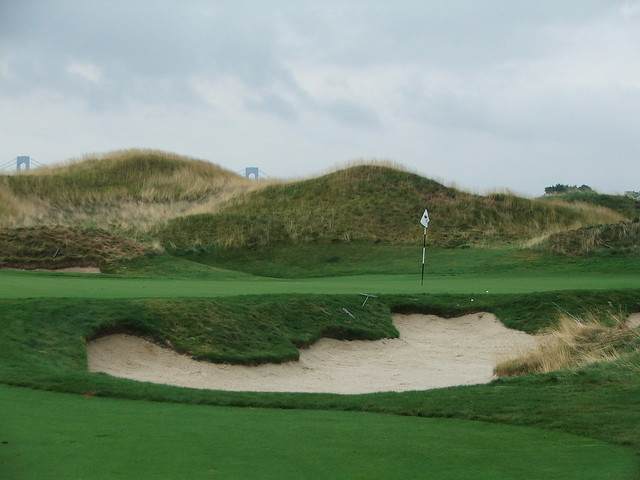
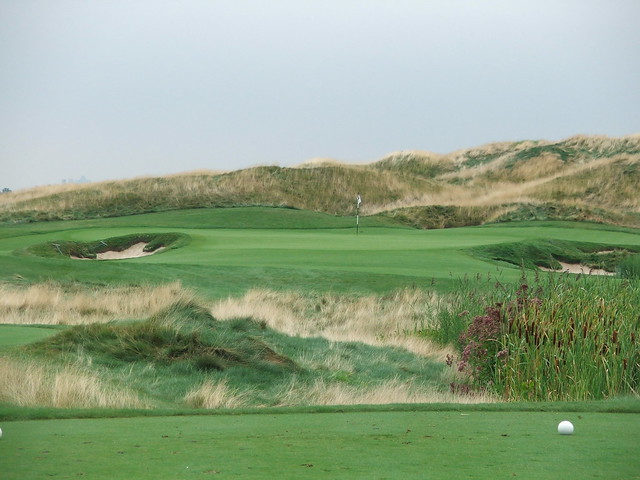
My favorite hole was the 12th, a par three of 166 yards from the back and 139 from the blue tees.

12 in hollow
The well protected 12th green at Ferry Point

The 12th green is surrounded by shaved collection areas on three sides (right, left and back) and is protected by a jagged-shaped bunker in front that conceals the front of the putting surface, which is slanted, oddly shaped, oblong, and at a right angle to the golfer.

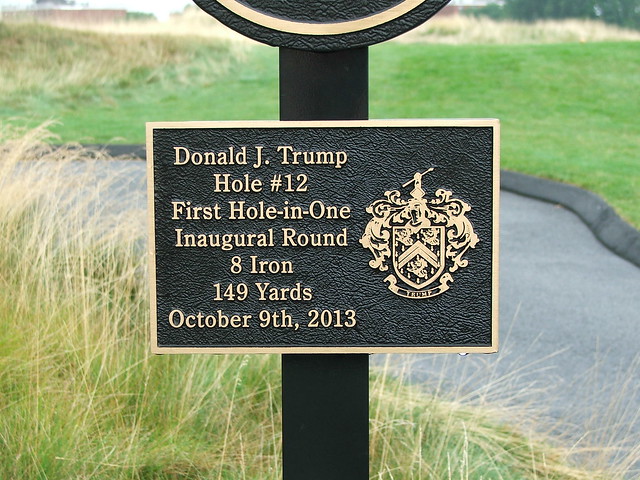
Donald J. Trump allegedly got a hole in one on the 12th as the course was opening. There was much skepticism among associates working at the club as to whether this was fake news or not, which is not shocking. Unsurprisingly, there is a plaque celebrating the occasion.


DSCF2512
Fake news comes to the Bronx. Sad!

12 collection buttocks

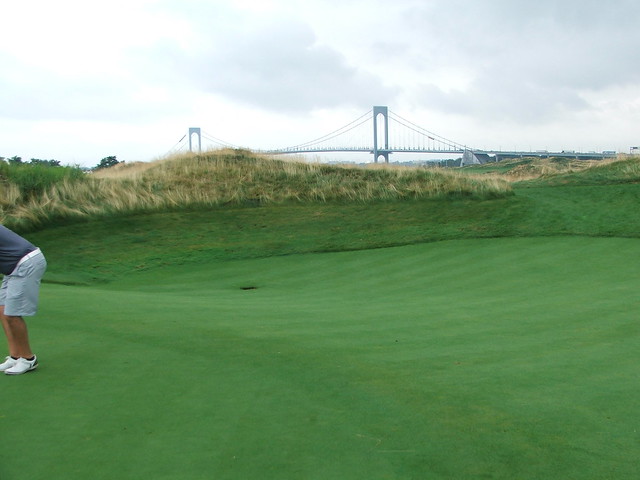
This picture shows the shaved area right of the 12th green. The buttocks shot was unintentional, but is a good visual illustration of what our group thought of the plaque that was put up celebrating the faux hole-in-one

I liked the finishing stretch (16-17-18) and think they are the best consecutive holes on the course. Sixteen is a demanding 437-yard par four that requires a precision shot to a well protected green, with great views in every direction. 

16th green
 The 16th green with the battleship gray Bronx-Whitestone bridge in the background

All the par threes on the course were particularly well framed by the mounding and the fescue, including the 17th.

17th  
The par-3 17th plays 142 yards. It has beautiful views and sits near the East River Channel

  17th green 

A closeup of the 17th green shows off the course conditioning and the beauty of the hole

The 18th is a 500-yard par 5 playing along the tidal river. I thought the course's greens were fair: there are not too many undulations in them, the breaks are more subtle, but still challenging. I only missed one fairway all day, speaking to their width, because I usually hit less. My other observation, which the caddies confirmed, is that the course plays longer than the card. Approaches to the greens are almost always one club longer than you think. I'm no physics or solid waste expert, but the suspicion is that it has to do with playing atop a capped landfill. Either that or the greens are slightly elevated and I didn't hit my shots crisply.

18

The dramatic 18th finishes at the base of the Bronx-Whitestone Bridge

Like the two boroughs it connects, the Bronx-Whitestone Bridge is under-rated with an alluring, streamlined Art Deco appearance. Its slender profile and trim steel lines gracefully span the East River Channel. The bridge was opened by Mayor Fiorello LaGuardia the day before the 1939 World's Fair to much fanfare. The next day President Roosevelt arrived in the Bronx by train from Washington D.C. and had 2,000 policemen lining his route over the bridge and on the adjoining roads as he rode to the World's Fair.

throgs 18

The course offers views of two beautiful suspension bridges, the Throgs Neck Bridge is further away from the course, seen here in the distance in the rain

For those looking for something not to like about the course and the club operation, you are going to be disappointed. I didn't find anything. The course is good and the food and service provided on property are also very good, as were the caddies. I liked Ferry Point better course than Trump's Fazio-designed course in Bedminster, which I found too difficult and the environment a bit too glitzy.

The course is good for local employment (almost everyone we interacted with lived in the Bronx) and the food is sourced from the nearby Hunts Point market. One of the knocks of Ferry Point is the price to play, and it is a fair point. The fee for a New York City resident is $146 to walk on a weekday, $175 on a weekend. For non-residents, it is $200 on a weekday and $227 for a weekend. There is something more than mildly paradoxical about a bunch of white guys from Westchester, Long Island, and New Jersey playing a city course in a borough where the majority of residents are non-white. The parking lot on the day I played was full of BMWs, Audis, and Jaguars with plates indicating that the cars were from the suburbs. There is no subway near the course, making it difficult for a non-driving city resident to play the course, although they could certainly take a taxi. On the other hand, New York already has many public lower fee courses, including several in the Bronx, and having a higher end crown-jewel course with commanding views in the city's portfolio isn't entirely beyond defense. As I said at the beginning, if you look past the Trump circus, having such a nice Jack Nicklaus public course should be a point of pride for the city. If you can afford it, the course is worth playing.


  DSCF2504-001
Throughout the course are venting pipes which release the methane gasses trapped below. Only occasionally do you smell something a little off, which for someone from New Jersey, made me feel right at home!

Thursday, June 21, 2007

Sebonack Golf Club


The stakes are high when you are building a new course next to two of the world's greatest courses. Sebonack Golf Club is located next to both the National Golf Links of America and Shinnecock Hills in Southampton, NY. Sebonack is located nearer to Peconic Bay than Shinnecock, immediately to the west of The National.

Sebonack is an old native American Indian word that roughly translates into "golf club for the filthy rich." The Indians were very prescient in their naming of this land, which seems like it was always destined to be a golf course. It has the perfect sandy soil for golf with gorgeous views overlooking the bay. Similar to the benevolent dictator model that was the genius behind The National (Macdonald), Oakmont (Fownes) and Pine Valley (Crump), so it is with Sebonack and Mike Pascucci. Pascucci made his money in the car leasing business. He reportedly paid $46 million for the 300 acre property. It is also reported that the course and the club cost between $100 and $120 million to build all-in, plus or minus a couple of million, but whose counting among friends?

The price of entry into Sebonack is a tad high. There is a $650,000 initiation fee and membership is by invitation only. Similar to The National Golf Links, Sebonack has "founding" members. These ten gentleman shelled out $1 million each for the privilege and can nominate and sponsor new members. The total net-worth of the ten founders combined exceeds the gross domestic product of many countries. Sebonack will probably be the first golf club not only ranked in the top 100 golf courses in the world, but also as a stand-alone entity will rank in the World Bank top 100 GDP rankings. If it were a sovereign state, it would rank between Mozambique and Estonia.

I have been getting feedback from my readers accusing me of being a golf snob. I can assure you my dear fans, that nothing is further from the truth. I learned to play the game playing on municipal courses, waiting for long stretches on tee boxes and without any of the perks and thrills that these elite courses offer. I can also assure you that I could not join Sebonack even if I was invited to, which I have not been. I have perfected the art of networking and have an unflappable determination to play all the world's top courses; in many cases, simply by asking the right people. I may be a pompous charlatan, but I am not a snob.

The entrance gate to Sebonack

The Golf Course

Pascucci hired the unlikely team of Jack Nicklaus and Tom Doak, who have very different styles, to design Sebonack. The idea was that Doak would do the major routing and be responsible for the look of the course, while Jack would help on the risk/reward decisions and design. Who knows what the real truth is or what the dynamics of the two partners were when designing and building the course? Rumor has it that it was a tense relationship. If the rumor is true, then tension produces a good golf course. Now that this beauty of a course is in place, it hardly matters how they got along; the course is spectacular. The bunkers on most holes were clearly influenced by Doak; it has the same look and feel as many holes on Pacific Dunes. I personally saw the Nicklaus influence on the par threes, particularly the fourth and eighth holes.

Although I haven't read anywhere that Doak or Nicklaus set out to replicate holes from other courses at Sebonack, I found that, similar to what Macdonald did at The National, many holes here are strong replicas of other classic holes from around the world.

Sebonack 1
The exciting opening hole at Sebonack

Sebonack is a golf course that both lives up to the potential of this unique site and the pedigree of its designers. Although it is a new course, having opened in 2006, I believe it instantly has one of the best starts in golf; rivaling Merion and Prestwick with opening holes that get the juices flowing. Like these two grande dames, the first hole at Sebonack is a very short par four, at 337 yards. Like at Merion, it is a dog-leg right and it is set so that as you walk toward the green, the bay starts to become visible in front of you. I personally like a short starting hole, which gives the opportunity to start your round with a birdie or par. Don't be fooled by the short yardage on the card into thinking it is a complete lay-up hole, however. The real fun starts when you take out the flat stick. The first green is wild and crazy with wicked undulations. Walking up to putt on the first green is like getting hit in the face with a wet dish rag. It hurts. Never-the-less, the green shocks you into the round and unmistakeably lets you know that you are in for a unique round of golf.

The second hole is the best on the course in my view, and one of the best in the world. It is the number one handicap hole and plays 414 yards with an uphill second shot. The prevailing wind is in your face, so it plays longer than the card. You have to hit your tee shot through two large American elms that frame the fairway about 100 yards off the tee box. The shot plays down a hill into a valley that is covered with sand and bunkers. It requires a well struck ball to find the middle of the fairway, but the hole has classic risk-reward characteristics that rewards a well played shot hit between the bunkers with a favorable kick forward. The second hole reminded me of a combination of the 12th at Prairie Dunes, with the two trees serving as sentinels on either side of the fairway; and the 8th at Crystal Downs, with the severely sloping green that repels a short shot.

Sebonack 2nd tee
The second hole seen from the tee box - world class

This second shot into the green is an instant classic in the golf world, although I can see how it may be controversial. Some may call the green unfair because the foreword one-third of it is such a severe drop-off. I can't even imagine how they mow the grass. A shot hit too far goes into the devilish downhill bunker beyond the green. If you hit your shot to the right spot on the green past the drop-off, but short of the bunker, it is a rewarding shot because the ball feeds down to the center of the green. Because of the steep drop-off, this is effectively a postage-stamp green. The margin for error is almost nil. It is difficult to see the severity of the drop-off coming into this green from the photograph (below). The green is elevated probably eight-to-ten feet above the fairway, so severe is not too strong a word to describe it.

Sebonack 2nd green
Approach to the second hole

As if the second hole wasn't great enough, what also makes it more interesting is the history behind the trees. This property at one time was the summer estate of Charles H. Sabin, former president of The Guaranty Trust Company. Sabin was an original founding member of The National Golf Links of America and a friend of Charles Blair Macdonald. The trees used to be on either side of his manor house ("Bayberry Land"), which was taken down when the course was built. The entrance gates you drive through to get into Sebonack (picture of the gates is at the top of this post) are also from the original Sabin estate.

The fifth hole is noteworthy as a short, down-hill par four with great risk-reward characteristics. It reminds me of the world-class seventeenth at The National. According to our host, this was a hole Nicklaus was responsible for and Jack feels it is similar to the 12th hole at The Old Course at St. Andrews. The hole is only 360 yards and plays downhill, with a pot bunker in the middle of the fairway, so you have to choose to either lay-up or go left or right and are duly penalized or rewarded.

Sebonack 12th
The par three 12th green

The par three twelfth hole (above) reminds me of the 14th hole at nearby Maidstone, which I like. It is a 136 yard par three that plays down into sand dunes with the bay as the back-drop. Nicklaus says this hole is modeled after the Postage Stamp hole at Royal Troon, but I don't see any likeness.

Sebonack 11th green
The 11th green

The routing at Sebonack is interesting. The whole property gently slopes downhill toward the bay. The first three holes play near the water, then the character of the course changes as you go in-land into a forested area. Several holes are then in a sandy/scrubby area. Once you get back to the green at the eleventh hole you are back near the water for two holes, then the course goes back in-land. There is a great vista that unfolds before you when you are finished playing the 17th hole. You walk through a clearing out onto a high bluff overlooking Peconic bay. The 18th plays immediately next to the bay on your left the entire way home.


Approach to the 16th green - notice the "Doak" influence on the bunkers

The course is set on prime Hamptons real estate in an idyllic setting that helps you to sometimes forget where you are as you snake around the course. In a lovely surprise, as we were walking to the ninth tee, a group finishing the 'Alps' hole at the adjacent National Golf Links rang the bell as they were walking off this blind green to signal to the group behind them that they were done playing the hole. The 'Alps' hole is as close a 50 yards from you as you tee off on this uphill par five. It is very charming.

I wouldn't say all 18 holes at Sebonack are standouts. The par three fourth is nothing special. The eighth and thirteenth holes are also not standouts and the water carries over the in-land ponds seem a bit forced to me. The greens were a little slow when we played which is chalked up to the course being new, although they were in excellent condition. The course plays pretty difficult so I imagine when the greens fully grow in and are fast, it will be a stern test of golf, especially when the wind is up. I also liked several of the green complexes, like the third hole, that allow you to hit shots into the back of the greens and slope back down to the center - serving as a backstop effect. Particularly on uphill shots this allows you to be aggressive on a well-struck approach shot. To me, this was one of the defining characteristics of the course.
Seconack 9

The ninth green
As it turns out, the match I was playing ended up tied on the 18th green so we played the 'bye' hole, or 19th hole. The 19th hole is a short par three near the 18th green that plays back toward the bay. The idea of this extra hole is exactly what we used it for, which is as a tie-breaker for matches. The genius of it is that it's a short hole. I hit an eight iron, as did my playing partner. It's very exciting to both have birdie chances to win a playoff. Well done Jack and Tom!


The down-hill 11th hole from the tee box


I enjoyed playing Sebonack a lot. Although the course is too new to be ranked yet, my sense is it will soon become recognized as one of the world's top courses. I had a dream day of golf when I played Sebonack. I played The National Golf Links in the morning, had their famous lobster lunch, followed by an afternoon round at Sebonack. Thanks to my Ecco shoes, two great caddies and lots of adrenaline, I happily played the 37 holes and was not fatigued in the least as the sun started to go down. I don't want to rub it in, but I am living la dolce vita in my golf travels, although all the lobster and walking caused both my gout and my lumbago to flare up. Occupational hazards.

When I grow up, I want to retire to the Hamptons and have my choice of playing Shinnecock Hills, Maidstone, The National and Sebonack. There are no finer collection of courses located so close to each other anywhere in the world.

It almost feels like you are back in the roaring 20s on the eastern end of Long Island these days. We are fortunate to live in a second "Golden Age" of golf course architecture fueled by rampant economic prosperity globally. The Sabin's were one of the most prosperous families of the Jazz Age and spent time during the summers entertaining at their Southampton home. It is hard not to feel just a bit like Gatsby while at Sebonack.

Modern Day Golf Course Development

In an interesting case study of golf course development today, I stumbled across the public relations strategy many new courses engage in. I always research all the courses I play and try to read as much as possible about them. For Sebonack, I read about fifteen magazine and newspaper articles about the course. I found it funny that they almost always use the same canned phrases, stock photos and quotes. My research revealed that Sebonack uses the Hunter Public Relations firm to spin its story. Coincidentally, it appears to be the same firm that markets Trump courses as well. It is pretty sad to me how the media basically just reprints press releases and works with P.R. firms to do stories and prints canned quotes. How about some original reporting and thoughtful commentary? How about getting out there and getting some sand in your shoes and eating some lobster?

Part of the reason I write this blog is to give an undiluted opinion and behind the scenes look without the fear of pissing off a course or a potential advertiser. I am the editorial board, the legal department and the in-house fact checker. I like my independence. That, plus, I have never even remotely been offered a writing job; but let's not quibble over a small point.


The "cottages" under construction at Sebonack

I suppose it makes sense for a course like Sebonack to market itself from a P.R. standpoint. It certainly helps eliminate the perception that this is a playground for the über wealthy; it helps to "position" the story of development in an environmentally friendly way; and it no doubt helped Jack and Tom stay on the same page publicly.

Mike Pascucci is described in all the press accounts as a local guy made good and is very philanthropically oriented. Based on my own research, and unlike the horses-ass-of-the-world Trump, the P.R. here does not distort. I know two people who know Mike, are unaware of my secret identity, and without solicitation both confirmed that he is the genuine article. He's the anti-Trump. I commend him for living his dream and building Sebonack. The course lives up to everything I have seen written about it.

The "cottages" and clubhouse are still being constructed at Sebonack. For the Hamptons, the "cottages" are relatively modest - each will hold a fore-some. They reminded me of the cottages at Bandon Dunes and Sand Hills. The clubhouse is being built at the highest point on the property and will have majestic views looking down on the National clubhouse, Peconic bay and the course. From the look of the skeleton of the building that was present when I was there, it does not look like it will be a modest building. It looks like, when complete, it will be the Parthenon of the golf world and will shortly assume an exaulted place in the world of golf that obesssive golfers such as myself will clamor to be invited to.

The interesting history of the Sabin estate "Bayberry Land"