
As you can see from the sign that hangs above its front door, Royal North Devon, originally known as Westward Ho!, is the oldest golf course in England. To put that in perspective, it was founded when Abraham Lincoln was President in 1864. Westward Ho! is the name of the village the course is located in, and the exclamation point is an integral part of its name. The village name comes from the title of Charles Kingsley's novel "Westward Ho!"
As part of my golfing pilgrimage to Devon and Cornwall I decided to pay a visit to Royal North Devon. As you can see from my photos, I didn't come for the weather; I hit a typical English grey day. In my St. Enodoc post I wrote about how the hedgerows in Cornwall were so severe that it was hard to drive. I spoke too soon. The hedgerows in Devon are even more stifling. Check out this one-lane road boxed in with hedges that I went through on my way to Royal North Devon. How you are to avoid head-on collisions driving like this is beyond my limited imagination.

A hedgerow near Royal North Devon
As I was walking down the first fairway I saw horse shoe marks all over and horses grazing to the left of the fairway. Not one or two impressions in the grass mind you, but quite a few hoof marks. Game on at Royal North Devon. This is going to be interesting.
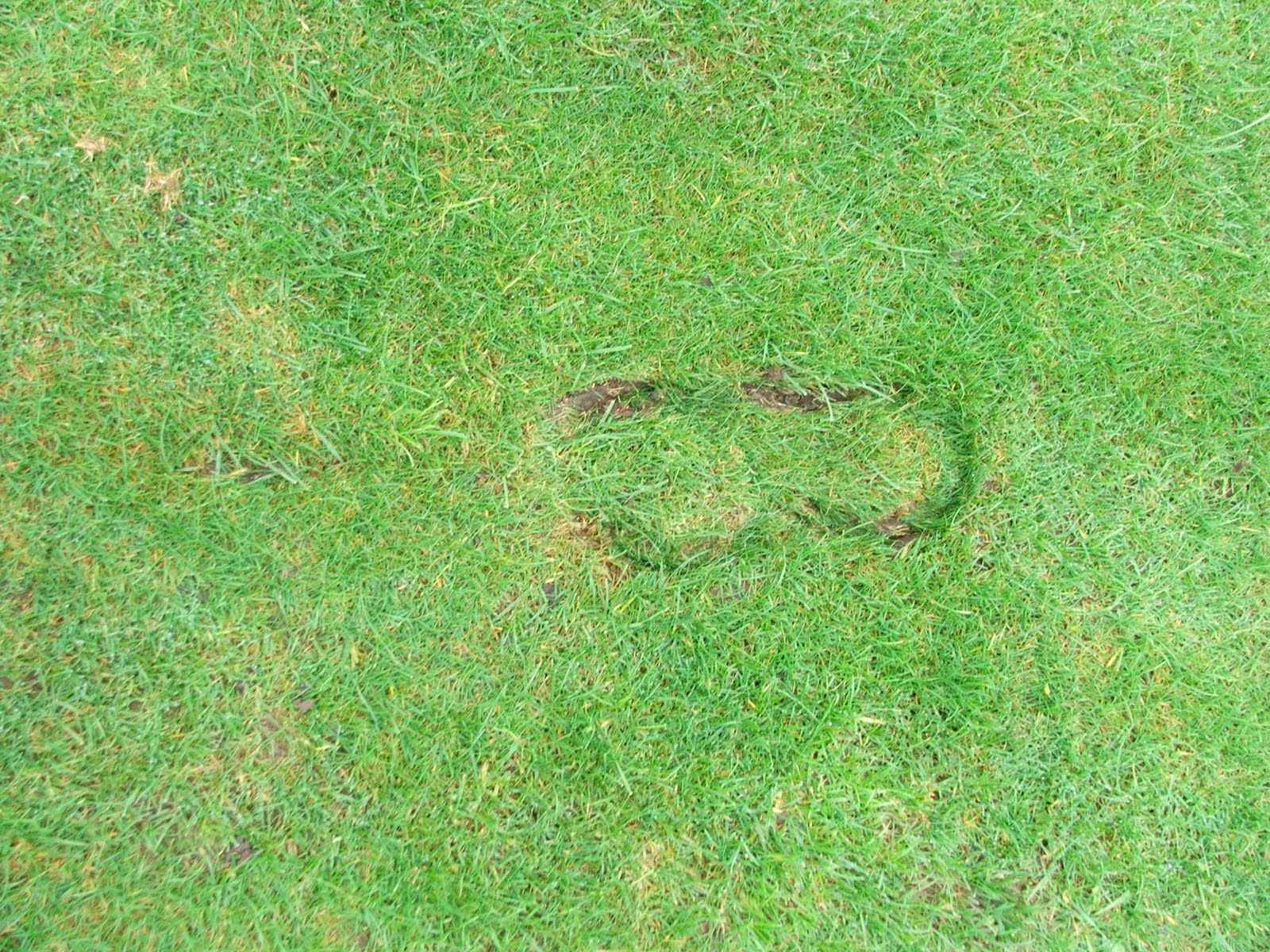 Horseshoe marks on the fairway at Royal North Devon
 The front nine plays near the water and the back nine through grass and marshland away from the water. The course is a classic out-and-back layout and does not route back to the clubhouse after nine. Similar to St. Andrews, the course is very flat and wide open.
The first hole is a 478-yard par five that eases you into the round. The second hole "Baggy" runs parallel to the ocean and is a 422-yard par four. I noticed that I had to walk very carefully at Westward Ho! because there are loads of rabbit scrapings on the front nine. Rabbit scrapings are little holes that rabbits dig in the ground to hide and stay protected. From what I could tell based on the number of scrapings, there are lots of rabbits in the vicinity.
The fourth hole is a "Cape" hole that plays 350 yards and doglegs sharply to the left. You can see the massive set of railway sleepers that line the bunker that you must hit over from the tee. This is a man-sized bunker that runs the entire width of the fairway and is at a higher level than the teeing ground.

The view from the tee box on the 4th hole at Royal North Devon
Notice the poles and white cloth fences that protect the green as seen below. These are found on all the greens at Royal North Devon. Their purpose? To keep sheep and horses off the greens, of course!

The green on the fourth "Cape" hole
Royal North Devon is a rough-hewn course and is not in the least bit polished. Therein also lies its charm. Playing at Royal North Devon is the antithesis of sitting in a golf cart for a five hour round waiting for the group ahead of you to line up their fourth putt. This is golf at its simplest and purest. For a variety of reasons, not the least of which is the common land, the course is a bit rough around the edges. There are also no yardage markers, but only simple grey rocks to mark off 150 yards. The greenskeeper here clearly doesn't have Augusta envy like almost all courses in the U.S. This is a course where you play the ball where it lies, commune with nature and go back to the game's roots. If golf is a metaphor for life, then Royal North Devon is its best example. It's not all neat and tidy. Rub of the green as it's called.
Horace Hutchinson describes the course in his book Golf in 1890, "The bunkers on St. Andrews links are for the most part well defined, but on many of the very best links, Carnoustie, Prestwick, Westward Ho!, Sandwich, there is a lot of loose ill-defined rubbish, the sandy out-blowings of bunkers, which is very hard indeed to play out of." His description is still apt.
A good illustration of this is the picture of the sixth hole from the tee box. This 408-yard par four plays along the ocean and has a fairway that is shaped by the natural slopes of all the dunes. The hole is completely exposed to the wind coming off the water.

View of the par four 6th, "Alp" hole
As common land, Royal North Devon is open to the public at all times and the locals seem to have access from any and all directions. Along this hole and the ocean is a path where people are strolling about, walking dogs and enjoying the outdoors. There are signs all over the course reminding you, the golfer, that the walkers have the right of way. Even in the less than ideal weather, there were a lot of dog walkers.
Around the sixth hole I couldn't help but notice that I had been dodging poop the entire time I was walking the course. Loads of poop. Of various varieties. Rabbit, dog, horse and sheep were all present and accounted for. There are a lot of bowels moving out on the common lands at Royal North Devon! Not since playing Medinah have I seen so much fecal matter on a golf course.
In case you think I am exaggerating the issue with stool on the course, local rule #8 listed on the back of the scorecard is the "Embedded Ball and Heaped or Liquid Manure" rule. It reads, "A ball which lies in or touches HEAPED OR LIQUID MANURE may be lifted without penalty, cleaned and dropped..." I rest my case.
Royal North Devon also features a lot of blind tee shots. There are aiming poles on quite a few holes, especially on the back nine. The back nine plays away from the water and features an abundance of marshland grass as can be seen in the photo below. These grasses are called 'Great Sea Rushes' and you want to steer clear of them since they eat golf balls. Horace Hutchinson describes these "Rushes" as a "peculiar kind of long rush, very sharp and stiff pointed, which we sincerely hope to be peculiar to itself."

The aiming pole on the par four 11th hole
The thirteenth hole is a 442-yard par five named "Lundy." It is a unique hole in several regards. First, it is short for a par five. Second, it is really a sheep pasture masquerading as a fairway, and third, the green is diabolical.

Sheep grazing on the 13th fairway at Westward Ho!
One of the original club rules, published in 1864, states, "As the Burrows are public pasture, great care must be taken not to drive, frighten or injure any horse, cattle, sheep or geese." I almost hit a sheep with my drive. It is hard not to. Luckily, my ball landed safely on the grass.
Left of the thirteenth fairway is grazing land for sheep. They obviously don't have any regard for where the grazing lands end and the golf course begins, so they graze wherever they please. The grazing is quite heavy on both the twelfth and thirteenth holes. I must say that not even at Brora in Scotland have I seen so many sheep on a golf course. This is not the occasional sheep mind you. There were hundreds on the hole as I played it, as you can see below!

The full herd of sheep on the 13th green at Royal North Devon
If this isn't worth flying to England to see, I don't know what is? My yoga teacher has been emphasizing that I should not judge. Just take it in and accept it for what it is, she advises. This is the mindset you need when playing at Royal North Devon. Experience it for all its glory. Certainly, keep a keen eye out on where you step. Take a deep breath through the nose to stay in the present. Bring a towel to every green to wipe your ball before lining up your putt. Make sure you dodge the heaps of dung as you put your golf bag down. Strive for a tranquil state. Forget the conventional, be open to new things. Watch for rabbit holes and slippery poop. Let your mind and body be as one. Enter a state of serenity. Don't let the mind wander. After all, if I wanted to experience a cookie cutter set of golf courses I could have taken a trip to Myrtle Beach. Instead, I am expanding my horizons.

The small, hard to hold green on the 13th hole at Royal North Devon
Have I digressed? Back to the golf hole. How do you make a very short par five a difficult hole? Put in an inverted saucer green, make it circular and only 25 feet in diameter. Holy shit (pun intented), was it hard! I am embarrassed to say that I four putted the darn thing after being 10 feet off the green in two.
To emphasize my point about the animals at Royal North Devon, this is how I found the seventeenth tee box as I walked to it. It had about a half dozen horses grazing and doing their droppings near by. Ladies and gentlemen, boys and girls, Royal North Devon is a trip!

The 17th tee at Royal North Devon
After you putt out on the 18th green, you leave the common land and go back through the fence to the civilized world of the clubhouse, safe from the animals. I immediately went to the ancient locker room at the conclusion of my round and washed my hands very well!
I am glad I made the trek to Royal North Devon. It has a rich and storied history. It was originally designed by Old Tom Morris and has hosted the British Amateur championship three times. I am a voracious reader and early golfing history frequently mentions many storied links courses often by their pre-Royal names. Specifically Prestwick, St. Andrews, Sandwich (Royal St. George's), Hoylake (Royal Liverpool) and Westward Ho! (Royal North Devon). That's some pretty lofty company Royal North Devon keeps. The other four courses have all changed quite a bit. You can't really visit Sandwich anymore, you are visiting Royal St. George's. The same with Hoylake. What a treat to be able to actually visit an old-school course like Westward Ho!
To be sure, Royal North Devon has some uninspiring holes. The eleventh, fifteenth and seventeenth come to mind, but on balance Royal North Devon is an experience worth having. There are at least a half dozen really good holes (the 4th, 5th, 6th, 10th, 13th and 16th).
The course received its "Royal" patronage from Edward the Prince of Wales in 1865. Edward was the son of Queen Victoria and Prince Albert. He would go on to become King Edward VII. The Prince was indeed a golfer and laid out a course at Windsor. He was the first Royal to serve as Captain of the R & A. He also granted Royal status to both Dornoch and Portrush. The Prince/King led an active life outside of golf, and it is well known that he had many mistresses. A particularly virile monarch, it is rumored that he had at least 55 liaisons. His Majesty is pictured below. God save the King!
I mean no disrespect to the course or club at all with my descriptions of the course conditioning or the abundance of droppings. As my readers appreciate, I am simply pointing out facts and not trying to sell magazines or hype anything; thus I give the unvarnished truth. Not to point out such an obvious and plentiful set of facts would misrepresent an integral part of the experience here. Royal North Devon remains a true rarity. It offers the golfer the possibility to transport himself back 150 years and see what golf was like before it became a popular pastime and when it was played on common lands. The club is also very welcoming and accommodating to visitors, and the clubhouse is a veritable museum with its trophies, artwork and match boards showing results back 150 years.
I hope by the next time I visit they trim back some of those bloody hedge rows in Devon so I can see where I'm going!




 Posts
Posts

