Friday, June 30, 2006

Royal St. George's - Sandwich

Sandwich Bunker
Bond. James Bond. The famous golf match between James Bond and Auric Goldfinger is set at the fictional stand in for the Royal St. George's Golf Club (ranked #33 in the world) - Royal St. Mark's in the book. Ian Fleming served as captain of the club.

Royal St. George's Golf Club is near the town of Sandwich, which is historically what the club has been known as. The course is located about 2 1/2 hours southeast of London. When reading the autobiographies of Bobby Jones, Walter Hagen or early golf books, Sandwich is referred to often as it has always been a championship quality links course.

I rate it overall as the best golf course in England. I have never been a fan of the out and back layout and Sandwich is not one; it provides a superior routing of holes. There are no parallel holes and a constant change in hole direction, which is very important when the wind is up, which it often is.

The day I played at Royal St. George's, the wind was up. The temperature was roughly 50 degrees and the wind was blowing at a sustained 25 mph with higher gusts. We arrived and were greeted by the Caddie Master who was right out of central casting. A giant of a man, he was wearing shorts and long socks. Many golf clubs in Great Britain frown upon the wearing of shorts unless you have on 'long socks'. Many courses in Britain send you a list of rules when you make your booking and they tell you whether or not you have to wear a jacket and tie, admonish you to play fast and stipulate the minimum handicap required to play the course (generally between 18 and 24). And usually lurking somewhere in the rules is a long sock rule. The long sock rule says that if you wear shorts, which they don't really want you to do, then your socks must come up above your knee. He was very accommodating and warned us it would be a difficult day. We then went into the pro shop and had a nice discussion with the head professional, Andrew Brooks, who said at least four times 'it will be difficult today with this wind'. Although it was late May, the temperature with the wind chill was in the low 40s. I have found that generally in the British Isles the locals downplay the weather and wind specifically, saying it is a 'gentle breeze' or 'nothing'. When the understated English tell you the wind will be ferocious, it is time to panic. A hearty man indeed wears shorts in this weather.


RSG

Well, the pro and caddie master were right. It was a very difficult days golf. Never-the-less, the greatness of the course came through and it was a very enjoyable day indeed. We enjoyed lunch in the members dining room with the requisite jacket and tie. We had a drink served in their signature silver tankard and lunch was a very classy affair. Muirfield has a deserved reputation for a good lunch and a lot of history but Royal St. Georges's gives it a run for the money on both fronts.


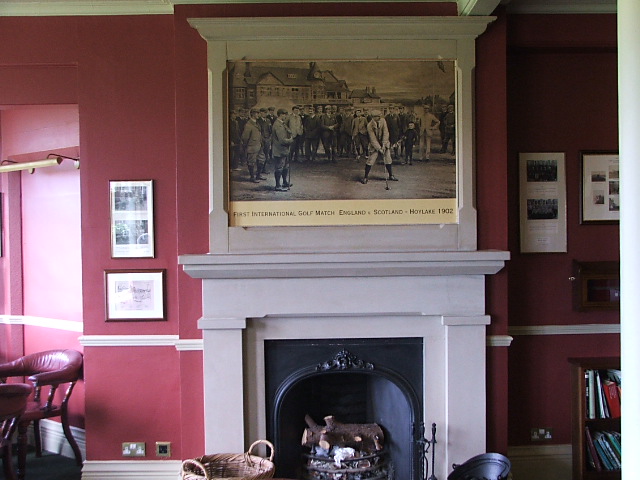
The English have a great sense of tradition and respect for rules and authority, especially among the upper crust. After lunch as we were changing out of our jacket and tie into our four layers of clothing that would be necessary to keep warm, I noticed the accents in the locker room were more polished that those I have heard throughout Scotland and England. No cockney accents at Royal St. George's. Think Prince Charles. The smoking room has a wooden board up above the fireplace listing previous club Presidents and it confirms Royal St. George's place among the connected in English society. Among the Presidents there were four Right Honourables, A Most Honourable, two Sirs and a Lord. The abbreviations after the names includes Knights, members of the Orders of Chivalry and military decorations: K.G. (Knight of the Garter), C.B.E. (Commander of the Order of the British Empire), K.T. (Knight of the Thistle), M.C. (Military Cross), D.S.O. (Distinguished Service Order), K.C.M.G. (Knight Commander of St. Michael and St. George), T.D. (Territorial Decoration), D.L. (Deputy Lieutenant) and a K.B.E. (Knight Commander of the British Empire).


I can't say enough about how grateful I am to clubs like Royal St. George's for being so accommodating for visitors. Luckily the tradition of being open and accessible to visitors is greatly appreciated and they make you truly feel welcomed (Royal Troon take note).

I found three holes at Royal St. George's to be particularly good. The par five 14th hole, "Suez Canal" (pictured below) has out of bounds down the entire right side and a burn/swale in play off the tee. You can't just wail at your second shot, since short of the green there are bunkers on the left side of the fairway and the fairway narrows to about 25 yards. Yet, if you can thread the needle and land in that area you will likely be rewarded with a birdie; otherwise you will pay the price. The fairway bunkers 80 yards short of the green will penalize you if you try to get the ball to the green. Even this close to the hole, you have to just get the ball out as your first priority. It is a hole you really have to use your head to play well.

The #1 handicap hole, the eighth, is a dogleg right and has a very interesting and challenging green complex that is artfully bunkered. Your second shot to the green plays downhill and usually downwind. Very tricky.

The fourth hole, Sahara, has an enormously large bunker on the right side of the hole. You hit from an elevated tee to a fairway that is wildly undulating and the green is even wilder. If you hit long past the green you are in the backyard of a local resident. Definitely a unique hole.

RSG Great Par 5

Henry David Thereau once said the most men lead lives of quiet desperation and he was right. Although at one of the best golf courses in the world, for a few holes the wheels really came off due to the wind. Wind destroys a golfer's tempo and gets in your head. I much prefer playing in the rain to playing in a strong wind. Try losing your swing in a four club wind in the middle of a golf trip to play the championship courses of England. 3,500 miles from home, you begin to doubt everything.

Sports psychologists will tell you that you will play your best when you don't have any swing thoughts. Pick a target and hit to the target. Your mind should be uncluttered. A zen-like state is best, you should be focused in the present. I was in the opposite state. At this point in time, my stream of consciousness was something like what follows: What am I doing out here? Why am I not home with my wife and children? Why did I take up this game in the first place? I am a complete dumb-ass. My handicap is too high to be trying this. I should go to church more often. I should call my mother more often. I should really floss more often. I really should have put on clean underwear this morning. I left the office for a week with a lot of dysfunction and people taking shots behind my back. I could be back sucking up to my boss. As the top 100 course located closest to a nuclear reactor it is only fitting that I had a core meltdown at Royal St. George's.

The normal solitude and peacefulness of a golf course is turned into your enemy and not your friend. As you may have guessed, someone who is crazy enough to take on this journey might be a bit compulsive and obsessive. So you extrapolate your bad game infinitely into the future. You'll never be able to hit the ball again. I walked four holes with my head down and my chin on my chest and lost a disproportionate amount of balls in a short period of time.

One of the things I love about this great game is what it teaches you about yourself and about life. Never give up; keep persevering; forge ahead. I didn't walk in. I didn't give up, I played on and got my swing back. Like life, golf forces you to keep reinventing yourself. The swing you had two years ago it probably not the swing you have today. Mine changes often but thanks to the pro at my course, we always seem to be able to cobble something together again no matter how bad the wheels fall off. Life, like golf, is not easy. It is a constant struggle. Just when you think you have it figured out, it reaches up and bites you.


In a nice touch, the pin flags at Royal St. George's are the English (not British) flag. It took me a while to figure out but it makes sense when you learn that the English flag, which is a white background with a red cross, is called St. George's cross.


The course is so good that even the distant views of the nuclear cooling towers can't spoil Royal St. George's. I am putting Royal St. George's on my short list of courses to return to, to play again; hopefully, next time with the wind down.

Thursday, June 15, 2006

Hoylake - The Royal Liverpool Golf Club - Far and Sure

Hoylake Clubhouse
Royal Liverpool's historic clubhouse

Wow!

Legendary. Historic. Welcoming. A classic golf course. World renowned history. Welcome to the Royal Liverpool Golf Club (ranked #72 in the world), also known as Hoylake after the town it is located in. It has been 39 years since the R & A has held the open championship at Hoylake and the world is in for a treat. The last open held there was before the massive media and television coverage golf receives today. This is one of golf's true gems and the opening will most likely be its coming out party to the modern era of golf.

Hoylake is the third oldest course on the top 100 list, built in 1869, it is pre-dated only by The Old Course at St. Andrews and Carnoustie. The first Amateur Championship was held here in 1885. The course has hosted the open championship ten times. This is one of the four courses Bobby Jones won the grand slam on in 1930, winning the open championship here that year. The clubhouse at Hoylake displays its history better than any other we've been to yet. Where else in the world are there the signed original winning score cards of Bobby Jones, Walter Hagen and memorabilia from two of golf's early historical figures John Ball and Harold Hilton?

The one knock you hear about Royal Liverpool is that it has too many holes that have out of bounds and in particular too many with internal out of bounds, known locally as 'cops' which allegedly makes for bad golf. There are 10 holes that have an O.B. My view is that the 'rule' among golf's cognoscenti that too many O.B.'s makes a bad course is complete rubbish and Royal Liverpool proves it. Even for a non-scratch golfer, such as myself, I didn't find that the O.B. came into play that often. When it does, it is very strategically placed and you are duly penalized for hitting a poor shot.

I played the course recently while it was being prepared for the Open Championship. Located about 15 minutes outside of Liverpool on the Wirral peninsula, you leave the City of Liverpool through the Queensway tunnel. The tunnel is over two miles long and winds its way under the Mersey in an unsettling fashion for those who aren't used to driving on the left side of the road. Once you pull into the course the dramatic clubhouse (pictured above) is most inviting. The course is behind the clubhouse and is dramatic. Half the grandstands were up and the course was re-configured with the new routing. The original first hole now plays as the third, the 17th plays as the first and the 18th as the 2nd. Holes 4 through 18 continue in the original order, previously having been the 2nd through 16th holes. I found every hole to be a good hole. The routing is interesting and varied. The use of bunkers is very strategic. For example, on the 4th hole, a line of bunkers on the left forces you to hit where the fairway narrows on the right side with no margin for error.


Liverpool 1
A hole we are adding onto our list of the world's best is the third (pictured above), formerly the first. It is a terrifying par four with a dogleg right. The tee shot doesn't look that hard, but it is. You flirt with O.B. on the right off the tee and aiming left leaves you a longer shot into the green or in the rough. The dogleg is sharp and after the turn in the dogleg the whole is ruler-straight, with O.B. all the way down the right. There are NO bunkers on the hole but it is one of the best par fours in golf. I couldn't imaging how much harder it played being hole #1 without warming up first.

Holes 11-15 along the River Dee are gorgeous as you overlook North Wales across the way. The day we played the course there was a 4+ club wind. You had to aim your tee shot on the 151 yard par three 50 yards left at the TV tower setup off the green in preparation for the open. And even then your ball was blown off the right side of the green. It was good playing Hoylake in its difficult wind-blown condition, which it has a reputation for.

Liverpool Dining


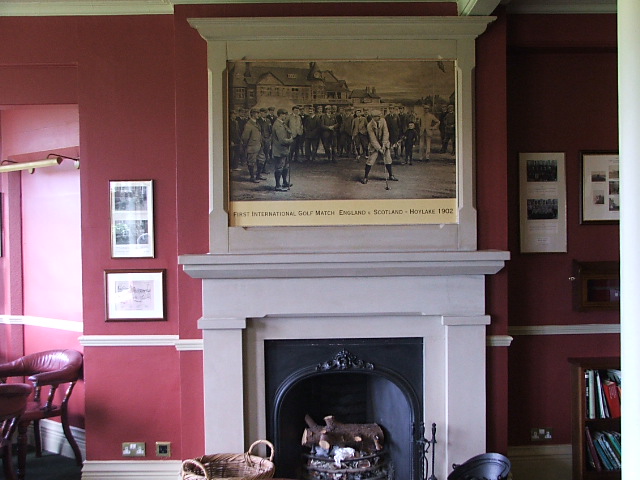
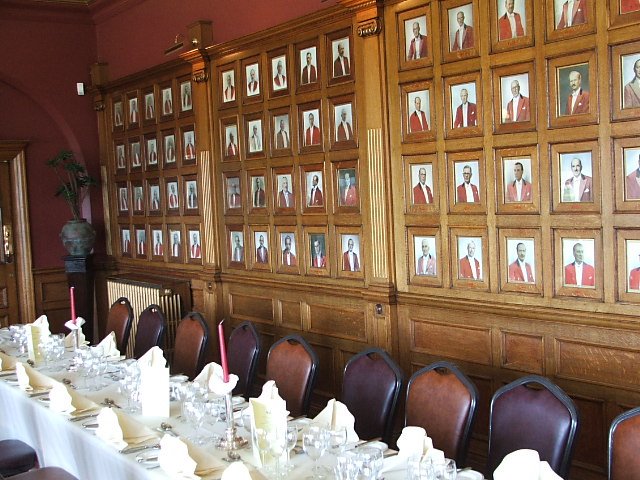
The clubhouse is one of the most inviting, intimate and welcoming in the world of golf. They have a world class golf book library, memorabilia second only to the R & A and an awesome dining room with pictures of every club captain going back to 1885 wearing the red jacket bestowed on the office-holder.


Liverpool Smoke Room
The Smoke Room in the Royal Liverpool Clubhouse

Congratulations to the R & A for putting Royal Liverpool back in the rota. Now to really make things interesting drop either Royal Troon or Royal Birkdale and play the open here at least once a decade my friends!

Royal Liverpool should be ranked at least 30 places higher on the world rankings. Of the three world ranked courses on the Lancashire coast of England near Liverpool England, Hoylake is the best, easily a better course than both nearby Royal Lytham and Birkdale. Thus far, if there is one club overseas I would like to join, this is it. The place has it all.

As the club's motto says - Far and Sure!

Post Script - July 2006

Congratulations to Tiger Woods, The Royal Liverpool Golf Club and the R & A for hosting a fantastic championship. Hoylake proved beyond a shadow of a doubt that it belongs back in the rota with a regular spot. I look forward to visiting again and seeing Tiger's signed winning score card hanging alongside Jones and Hagens in the downstairs bar. Great courses produce great champions.

Saturday, June 10, 2006

Walton Heath


Walton Heath - Old (ranked #82 in the world) counts among its members four prime ministers including Sir Winston Churchill. The course has a rich history linked with the English aristocracy, founded by well-to-do Edwardians, the successful upper class, an elite of titled gentleman and prosperous businessmen. The atmosphere has always been one of high rank and impeccable social standing. Among its former members it counts: 26 dukes, lords, knights and honourables. In the early days nobody could be proposed as a member who was not 'received in general society'. It is the only English club that has had a reigning monarch serve as captain.


Green detail at Walton Heath

Walton Heath also hosted the 1981 Ryder Cup. The course itself is a lovely heathland course. It really shines around the greens with its contouring (pictured below). The course has no water or water views and limited greenside bunkering, which leads to a lot of bump and run shots approaching greens if you so desire. Like its more famous English course Royal Lytham, Walton Heath starts with a good par three and has a particularly good set of finishing holes.
The rough hewn land at Walton Heath

Walton Heath is on the world's top 100 courses due partly to its affiliation with five time open Champion James Braid who served as club professional between 1904 and 1950.

Friday, June 02, 2006

Royal Birkdale


The best golf course in England.

NOT!

Royal Birkdale Golf Club (ranked #28 in the world), ranks as the highest ranked course of all of the nine English courses on the list. I adamantly disagree about its placement. I would say it's the best golf course in England after the following courses: 1. Royal St. George's; 2. Royal Liverpool; 3. Sunningdale Old; 4. Woodhall Spa; 5. Ganton; 6. Royal Lytham & St. Annes; 7. Walton Heath and 8. Wentworth West. While I'm not a math genius, I think that would make it the lowest ranked course in the country.

The course is not near enough to the ocean to give it any views and I don't think it has any truly distinctive holes. The course has hosted many Open Championships because the R & A likes the flat routing surrounded by dunes because it makes for good TV viewing. But don't mistake good TV viewing for a good golf course. They are not one in the same.

And what's up with that clubhouse? At first I thought it was just bad c1970s architecture. The clubhouse was actually built in 1935 and is art deco, having the look of a ship. But it just doesn't work. There is no sense of purpose or tradition to it. The interior spaces don't work either. White is a terrible color for the outside as it is too stark a contrast to the links terrain and it does not fit in with the landscape.


For a club formed in 1889 you would think you could get a better sense of history or tradition walking around the clubhouse. But the place is flat. Walking around the other English courses your spine tingles with excitement and history. The Bobby Jones perfect card at Sunningdale, the grandeur of Royal St. George's, the museum like quality of Hoylake, the traditions of Royal Lytham. Walking through the Birkdale clubhouse felt like walking through a hospital corridor. They have hosted two Ryder cups and eight open championships but they don't use it to their advantage.

Sorry boys, but Birkdale is missing that certain je ne sais quoi.

Thursday, June 01, 2006

Halfway There - 50 of the world's top 100 completed!


I recently returned from a golf trip to England and the trip marked a significant milestone in my quest to play the world's top 100. The lineup included many Open Championship courses: Royal Liverpool (Hoylake), Royal St. George's (Sandwich), Lytham & St. Annes, Royal Birkdale; and two heathland courses: Walton Heath and Woodhall Spa, the last course being so good I couldn't resist going back again, having played it last year.

When I have time I will post a more detailed write-up of each new course, but in the interim, having completed 23 of the 24 courses in G.B. and Ireland (only Loch Lomond remains), I would like to reflect back on how good golf in the British Isles is. First, the great courses are accessible to golfers who appreciate the game and respect their rules; Second, the post-golf experience has been perfected, sitting in the cozy smoke rooms and bars (scenes from Royal Liverpool below) enjoying friendship and camaraderie; And last, the respect for tradition and history that exudes from golf's shrines.


And I also appreciate the overall experience in Britain with the bad hair, brown bread, roundabouts and the good humor and wit of the people. It seems a shame to me that England is banning smoking next year as this will ruin some of the experience. I appreciate the heathland, parkland and links courses alike. Picking a favorite among them is proving to be difficult since the courses and clubs all have such different personalities.


This was the most difficult of my 10 trips across the pond since the wind was up. On many of the rounds we played you couldn't wear a baseball style hat because it would blow off and when putting your bag on the ground it to would invariably be blown over. Hitting a three wood from 135 yards to the green is certainly a novelty but you don't want to do it day after day, which we did on this last trip.

My rankings of the courses we played on this trip was:

1. Royal St. George's (Sandwich)
2. Royal Liverpool (Hoylake)
3. Woodhall Spa
4. Royal Lytham & St. Annes
5. Walton Heath
6. Royal Birkdale

and overall in G.B. and Ireland:

1. Carnoustie
2. Royal Portrush
3. Royal St. George's (Sandwich)
4. Royal Liverpool (Hoylake)
5. Cruden Bay
6. Royal County Down
7. Sunningdale (old)
8. Kingsbarns
9. Ballybunion
10. Turnberry Ailsa
11. Royal Dornoch
12. St. Andrews (old)
13. Woodhall Spa
14. Lahinch
15. Ganton
16. Muirfield
17. Royal Lytham & St. Annes
18. Walton Heath
19. Wentworth (west)
20. The European Club
21. Portmarnock
22. Royal Troon
23. Royal Birkdale

Top 100 Courses Played


Current Status: 92 courses played

1. Pine Valley,Clementon, NJ, Yes
2. Cypress Point,Pebble Beach, CA, Yes
3. Muirfield,Gullane, Scotland, Yes
4. Shinnecock Hills,Southampton, NY,Yes
5. Augusta National,Augusta, GA, No
6. St. Andrews (old), St. Andrews, Scotland, Yes
7. Pebble Beach,Pebble Beach, CA, Yes
8. Royal Melbourne,Melbourne, Australia, Yes
9. Pinehurst (#2),Pinehurst, NC,Yes
10. Royal County Down,Newcastle, Northern Ireland,Yes
11. Sand Hills,Mullen, Nebraska,Yes
12. Royal Portrush (Dunluce),Portrush, Northern Ireland,Yes
13. Ballybunion (old),Ballybunion, Ireland,Yes
14. Merion (East),Ardmore, PA,Yes
15. Oakmont,Oakmont, PA,Yes
16. Royal Dornoch,Dornoch, Scotland,Yes
17. Turnberry (Ailsa),Turnberry, Scotland,Yes
18. Winged Foot (West),Mamaroneck, NY,Yes
19. Pacific Dunes, Bandon, OR,Yes
20. National Golf Links of America, Southampton, NY,Yes
21. Kingston Heath,Cheltenham, Australia, Yes
22. Seminole, North Palm Beach, FL, Yes
23. Prairie Dunes,Hutchinson, KS, Yes
24. Crystal Downs, Frankfort, MI, Yes
25. Oakland Hills, Bloomfield Hills, MI, Yes
26. Carnoustie,Carnoustie, Scotland, Yes
27. San Francisco, San Francisco, CA, Yes
28. Royal Birkdale,Southport, England, Yes
29. Fishers Island, Fishers Island, NY, Yes
30. Bethpage (Black), Farmingdale, NY, Yes
31. Chicago, Wheaton, IL, Yes
32. Royal St. Georges, Sandwich, England, Yes
33. The Country Club, Brookline, MA, Yes
34. Casa de Campo, Dominican Republic, Yes
35. Hirono, Kobe, Japan, Yes
36. Riviera, Pacific Palisades, CA, Yes
37. Muirfield Village, Dublin, OH, Yes
38. Royal Troon, Troon, Scotland, Yes
39. Olympic (Lake), San Francisco, CA, Yes
40. Portmarnock, Portmarnock, Ireland, Yes
41. Southern Hills, Tulsa, OK, Yes
42. Oak Hill (East), Rochester, NY, Yes
43. New South Wales, La Perouse, Australia, Yes
44. Sunningdale (Old), Sunningdale, England, Yes
45. Baltusrol (Lower), Springfield, NJ, Yes
46. Woodhall Spa, Woodhall Spa, England, Yes
47. Morfontaine, Senlis, France, Yes
48. The Golf Club, New Albany, OH, Yes
49. Kauri Cliffs, Kaeo, New Zealand, No
50. Royal Adelaide, Adelaide, Australia, Yes
51. Shoreacres,Lake Bluff, IL, No
52. Medinah (#3), Medinah, IL , Yes
53. Whistling Straits,Haven, WI, Yes
54. Royal Lytham & St. Annes,Lytham St. Annes, England, Yes
55. Garden City, Garden City, NY, Yes
56. Loch Lomond, Luss, Scotland, Yes
57. TPC at Sawgrass, Ponte Vedra Beach, FL, Yes
58. Inverness , Toledo, OH, Yes
59. Los Angeles (North) , Los Angeles, Yes
60. Maidstone, East Hampton, NY, Yes
61. Quaker Ridge, Scarsdale, NY, Yes
62. Ganton,Ganton, England, Yes
63. Camargo, Cincinnati, OH , Yes
64. Highlands Links, Nova Scotia, Canada, No
65. Kingsbarns, St. Andrews, Scotland, Yes
66. Winged Foot (East), Mamaroneck, NY, Yes
67. Harbour Town,Hilton Head Island, SC, Yes
68. Cabo del Sol (Ocean), Los Cabos, Mexico, Yes
69. Somerset Hills, Bernardsville, NJ, Yes
70. Durban, Durban, South Africa, Yes
71. Scioto,Columbus, OH, Yes
72. Royal Liverpool, Hoylake, England, Yes
73. Lahinch, Lahinch, Ireland, Yes
74. Bandon Dunes, Bandon, OR, Yes
75. Naruo, Osaka, Japan, Yes
76. Cruden Bay , Cruden Bay, Scotland, Yes
77. Valderrama ,Sotogrande, Spain, Yes
78. Wentworth (West), Virginia Water, England, Yes
79. Kiawah Island (Ocean), Kiawah Island, SC, Yes
80. Kawana (Fuji), Kawana, Japan, Yes
81. Spyglass Hill, Pebble Beach, CA, Yes
82. Walton Heath (Old) ,Tadworth, England, Yes
83. World Woods (Pine Barrens), Brooksville, FL, Yes
84. Ocean Forest, Sea Island, GA , Yes
85. Valley Club of Montecito, Santa Barbara, CA, Yes
86. Congressional (Blue), Bethesda, MD, Yes
87. Peachtree, Atlanta, GA, Yes
88. Wade Hampton, Cashiers, NC, No
89. Shadow Creek, North Las Vegas, NV, Yes
90. Cherry Hills, Cherry Hills Village, CO, Yes
91. Baltimore (Five Farms East), Lutherville, MD, Yes
92. Yeamans Hall, Hanahan, SC, Yes
93. El Saler, Valencia, Spain, Yes
94. Homestead (Cascades), Hot Springs, VA, No
95. St. George's, Etobicoke, Ontario, Yes
96. The Honors Course, Ooltewah, TN, Yes
97. East Lake,Atlanta, GA, Yes
98. European Club, Brittas Bay, Ireland, Yes
99. Paraparaumu Beach, Paraparaumu, New Zealand, No
100. Colonial, Fort Worth, TX, No

Sunday, May 14, 2006

Turnberry Ailsa - Scotland's Pebble Beach


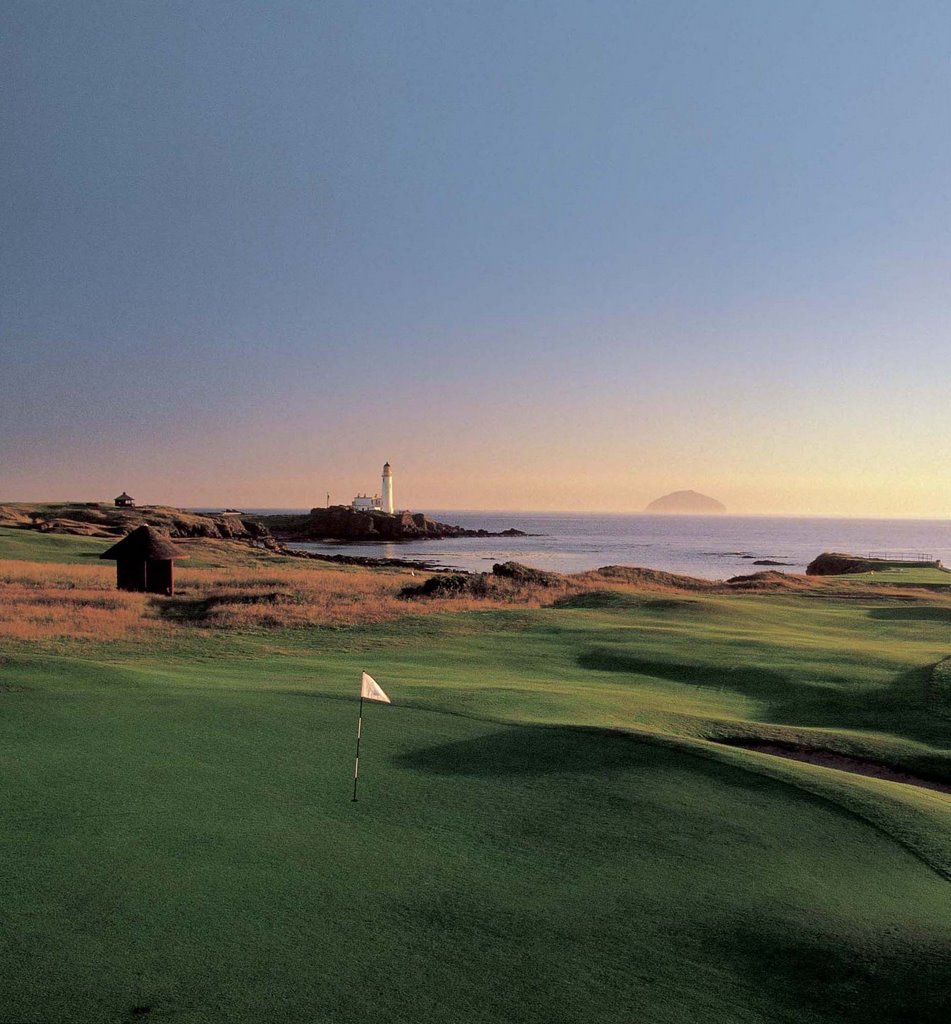
The Turnberry Ailsa course (ranked #17 in the world) is worthy of its world ranking. Located on Scotland's Ayrshire coast, Turnberry is one of the most scenic places in the world to play golf. On a clear day you can see the Antrim coast of Northern Ireland across the sea to where Royal Portrush is located.

Parts of the Ailsa course were destroyed during both the First and Second World Wars to make landing fields for the Royal Air Service. There are remains of the air fields still there today if you climb some of the hills around the twelfth and thirteenth holes. Mackenzie Ross was tasked with rebuilding the course after the Second World War. In a combination of both luck and no doubt foresight most of the holes along the water were spared destruction. The original course was built c1906, by Willie Fernie, the professional at Troon, although apparently, the Marquis of Ailsa had a private course on the land prior to 1906.

Turnberry, like many early British resort courses, was initially built by the railway companies to generate traffic; in this instance, with the building of the Glasgow and South Western Railway link and Turnberry station. By 1925, the L.M.S. (London, Midland and Scottish Railway Company) owned the hotel. In Dell Leigh's 1925 book Golf at its best on the LM&S, you can really see how the pre-war Ailsa course was quite different than today's redesigned course. He mentions that there were eight holes where you had to hit blind shots. Ross's redesign eliminated virtually all of these.

Leigh's description of Turnberry is still very much apt today and makes you want to book a trip right now, "The hotel, gay and red roofed, stands square to the sea. Your bedroom window is flung wide to it. The early morning tea; the cigarette; the vision of fluttering red and white flags ; the prodigious breakfast under the sun-splashed windows; the stroll down the seventy-three steps from the hotel to the links ; the smashing drive off the tee. Every hole is an education. The climb up the steps to lunch, prodigious multiplied by two, for the wind and sea spray have ground the sharp edge of appetite upon you. The short stand-easy for coffee in the lounge. The second round, played better or worse than the morning according to your temperament and digestion. Tea thereafter. The brine bath, stinging new vitality into you. The crisp dress shirt; dinner; dance; the ladies; bridge; billiards. Bed, the instant sleep, bred of hard physical exercise, salt-laden breezes, and a great contentment with the life of the moment."

Each hole on the Ailsa Course has a Scottish name, many of which, artfully, plant just that slightest bit of doubt in your mind before playing them:

1. Ailsa Craig (named for the rock in the Firth of Clyde that you look out on)
2. Mak Siccar (Make Sure)
3. Blaw Wearie (Out of Breath)
4. Wo-Be-Tide (Watch Out)
5. Fin Me Oot (Find Me Out)
6. Tappie Toorie (Hit to the Top)
7. Roon the Ben
8. Goat Fell (named for the tallest peak on Arran across the firth)
9. Bruce's Castle (remains of Robert the Bruce's castle are nearby)

10. Dinna Fouter (Don't Mess About)
11. Maidens (The village north of the course)
12. Monument (to the airman lost that were stationed at Turnberry)
13. Tickly Tap (Tricky Little Stroke)
14. Risk-an-Hope
15. Ca' Canny (Take Care)
16. Wee Burn (the little burn that runs in front of the green)
17. Lang Whang (Good Whack)
18. Duel in the Sun (Nicklaus vs. Watson 1977)


As proof that the R & A does add courses in to the Open rota, Turnberry was added in 1977 and has hosted Opens four: 1977, 1986 and 1994, and 2009. In case the R & A are readers of my blog (since they won't take my calls, this is my only channel of communication), my hope is that one day Kingsbarns will also be added to the rota.

Holes one through six are basically back and forth parallel holes which is a good thing because if the wind is blowing it allows you multiple changes in direction to provide some relief. The course really beings at the fifth hole where the next seven are along the ocean, ala Pebble Beach. I especially like the sixth, Tappie Toorie, an uphill par three that plays 231 yards. If the wind is up during the 2009 Open Championship, this is going to make the 240 yard par three fourth at Augusta look like a wee little hole. The hole is well protected on the left side by three small bunkers and from the tee the entire right side of the hole drops away, in shades of the Postage Stamp at Troon.

The blue tee on the ninth hole is arguably the best tee box in the world (Pebble Beach 18th being the 2nd best). You are hanging on the edge of a cliff with the white lighthouse nearby, the craggy rocks below and one of the most scenic views in golf with the course all around you and the majestic hotel on the top of the hill. To once again quote one of my favorite golf writers, Henry Longhurst, "You find yourself lingering on the tee, gazing down on the waves as they break on the rocks and reflecting how good it is to be alive."

The sixteenth Hole, Wee Burn, is one of the best on the course. A 409 yard par four that calls for a straight and long tee shot. The drama comes on your second shot. You will typically be hitting from a slight downhill lie to an oval shaped green that is difficult to hold. If you are a little bit short the green is shaped so your ball will roll down into the burn. The same situation on the right side of the green. The left side is protected by a bunker and being long leaves you in the tall and hilly rough. As an added element of danger the green also has portions sloping that can cause your ball to ricochet in various directions. Also, the drop from the green to the burn is probably close to fifteen feet. Unlike the Swilken Burn at the Old Course which is just a couple of feet below you, you are basically hitting from atop a hill, downhill over a chasm to an elevated green. It is something! The net-net of it is that the effective landing area you have to hit to hold a ball is probably no more than 20 feet by 10 feet. I have yet to find a better side (left or right) to approach the green from, probably because there is none.


Without the drama and grandstands of the Open Championship the seventeenth and eighteenth are anti-climactic, average holes. None-the-less, the overall experience at Turnberry is one of excitement. The end of the round at Turnberry is enhanced by the thought of sitting happily at the hotel after a round listening to a bag-piper as you recount the day's shots at the 19th hole. Touristy? Maybe, but bring it on.

The inevitable question that arises, "Is it better than Pebble Beach?" is a tough call. It depends on the importance you give to different factors. Pebble Beach probably has better golf holes in all (except holes 13, 14 and 15), but I think Turnberry beats it on the scenic beauty front. Turnberry also wins on the speed of play, the caddie experience and overall value for the money.

As golf writer and architect Donald Steel says describing Turnberry. "There is no where lovelier!"

For a fuller description of Turnberry, see the write-up done by my Kiwi friends, which includes some delightful pictures.

Friday, April 14, 2006

Shadow Creek


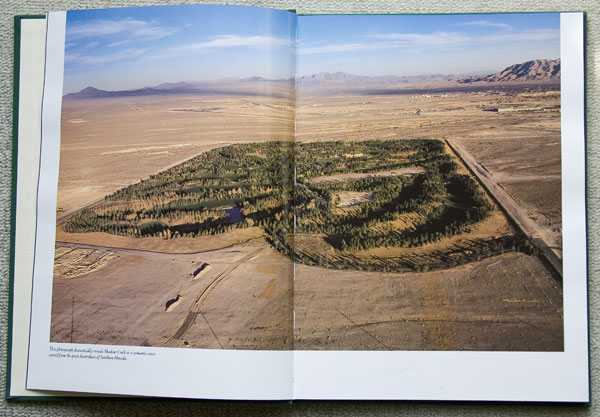
Seventeen of the courses on the top 100 list were in existence before the town of Las Vegas was even founded in 1905. Shadow Creek (ranked #89 in the world), located in Las Vegas, opened in 1989, the same year Royal County Down celebrated its centenary. Shadow Creek is obviously not on the list of top courses in the world because of its heritage. It is there because it shouldn't even exist, yet it is one of the most amazing places ever created to play the game. Built by Steve Wynn and Tom Fazio, they took a patch of desert and created Shadow Creek by spending $40 million, moving 2.8 million cubic yards of earth and planting 21,000 mature pine trees.

Many courses have been built in the desert and are great golf courses. They use the natural features of the land, have fairways only where necessary and create mostly a 'target' golf environment. What makes Shadow Creek so unique is that they built a non-desert course in the desert. If someone brought you to Shadow Creek blind-folded and you had to guess where you were you could easily guess the Pacific Northwest or the Carolina Pines.


I have avoided going to Las Vegas for most of my adult life because I like traditional cities and I don't gamble. I remember the first time I flew into Las Vegas about three years ago. I arrived close to midnight from the East Coast. Landing in Las Vegas is an odd feeling, you almost feel like you are landing in the middle of the city. McCarron Airport is only a half dozen blocks from the Strip. As soon as you step off the plane you know you are somewhere different with the slot machines ringing and the general buzz in the air. No where else that I've traveled to does the city smack you in the face immediately. The place is an adult Disneyland and it epitomizes what everybody wants: a chance to strike it rich, a chance to make it, a chance to overcome the odds. While Las Vegas has certainly come a long way in the last 20 years and is touted as a family destination, it is still sin city. As you walk down the street every block or two there are people giving out 'business' cards for escorts, strip clubs and prostitutes. One taxi we took, the driver handed us a black book with hundreds of these cards inserted into them. Certainly, Las Vegas now has very good restaurants and a lot of golf, but the underlying driver of the economy is clear. As the ultimate social commentary of life in the 21st century, in 2001 Las Vegas replaced, of all places, the holy city of Mecca as the most visited place on the planet!

When Shadow Creek was built it used to be that you had to be a high roller to play the course. It was the personal playground of Steve Wynn and he invited stars and big spenders. It is now possible to play Shadow Creek if you stay at the Mirage hotel or an MGM resort and fork over the $500 greens fee.

You don't drive to Shadow Creek. In certainly one of the more unique aspects of playing the top 100 courses, you are picked up by a stretch limousine at the hotel and are transported north of the city to the golf course. Shadow Creek is located between the Strip and the testing grounds used to detonate atomic bombs, which are located about an hour and 20 minutes north. The first test occurred in 1951 and 120 bombs have been exploded there over the years. I have, in fact, noticed that I have lost a lot of hair since playing Shadow Creek, but I'm sure it's not related.

The course is surrounded by a big black wrought iron fence in a 360 acre area. The clubhouse is a decidedly understated affair, and it is your first indication that Shadow Creek is not about glitz. You are given a golf cart and assigned a caddy. Since the temperature is normally around 100 degrees, a golf cart is probably a good idea, but we didn't use it. Instead, we walked and the caddy used it to drive the bag around so he didn't have to carry it. Forget everything you've heard about it not being that hot - after all, it's a dry heat. Dry heat my ass. Shadow Creek is more like something from the Carolina Pines and thus actually has humidity which is created by all the moisture coming out of the ground. My advice is don't wear your best shirt when playing Shadow Creek on a sunny day. I drank eight bottles of water and although you can't feel yourself perspiring, the salt stains on my shirt after the round should give you a good indication of what it's like.


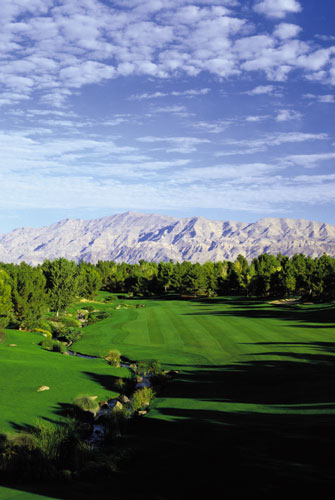
Despite my preconceived notions of the city, I actually came to like it. It has a certain energy and vibrancy that is unique. It was much the same with Shadow Creek. I was skeptical before playing it; thinking it was just a $500 tourist rip-off, but I came to appreciate its uniqueness. The course is beautifully laid out and challenging. The mountains in the background create a dramatic backdrop. There are pheasantÂ’s running loose throughout the course and they are a nice touch, if a bit surreal. The back nine has some really nice holes and water is artfully worked into the design. The creek that runs along the fifteenth fairway (below) somehow makes this one of the most serene holes you will ever play.


The 17th hole is a dramatic par three that plays downhill and has an elevation change of 30 feet to a tiny green set behind a lake.

The locker room is allegedly modeled after Seminole's but it felt a bit forced to me, especially putting famous peoples names on lockers, which they could have done without. Playing Shadow Creek was a memorable days golf and I'd love to tell you the score I shot at Shadow Creek, but as the saying goes: "What happens in Vegas, stays in Vegas".

Las Vegas is a city that continually reinvents itself. The bottom line is that there is not enough water in the Western United States to support all the Sunbelt cities in the manner they currently exist in. It is conceivable that the water bill needed to maintain the course will not be economical over time or the novelty of the experience will wear off. When that happens the conglomerate that owns it will one day find the land is worth more for another use. That's the downside of no tradition. My advice is to play Shadow Creek while it still exits. Building this type of course in the middle of the desert is madness and the course most certainly will not exist to celebrate its centenary.


Shadow Creek


Saturday, April 01, 2006

Golf in Atlanta - Peachtree Golf Club


I recently returned from Atlanta where I had an opportunity to played the two top 100 courses located there. I have always liked Atlanta for its Southern charm, weather and respect for tradition that is part of the culture. Atlanta still has true gentleman. Peachtree (ranked #87 in the world) is the better of the two courses, East Lake being the other. Golf in Atlanta and Bobby Jones are inseparable. Jones grew up playing golf at East Lake Country Club. The story goes that Jones and a group of his friends grew frustrated at slow play at East Lake and thus founded Peachtree. Bobby designed the course with Robert Trent Jones Sr. in 1948.

Peachtree only has 225 members and on the beautiful Spring day I played it we saw only two other group all day. The terrain is some of the hilliest I've played thus far (although the Olympic Club Lake course is hillier). It is not an exaggeration to say that the only flat lies you are likely to get all day are on the tee boxes. Many of the approach shots are to elevated greens, thus the course plays longer than the card indicates. I have encountered only two courses with faster greens than Peachtree: Merion and Oakmont. The course also has an ever-present creek that winds itss way around the course and is always ready to catch a wayward shot or to penalize those that should have hit three wood off the tee but through their hubris take the driver.


Comparisons between Peachtree and Augusta are inevitable because Bobby had a hand in designing both; their respective topographies are very similar and Peachtree, like Augusta, was previously a nursery. Several of the vistas a Peachtree could be mistaken for those at Augusta. Peachtree is a decidedly low key affair, the clubhouse is understated, the grill room is understated and the membership is both low key and low profile. I am a fan of golf clubs like Peachtree.

An interesting historical note is that the Union General William Tecumseh Sherman slept in one of the clubhouse buildings at Peachtree, which at the time was a private residence, on his march through the South.


Tuesday, March 28, 2006

Ballybunion and Lahinch - Golfing in Ireland


My first trip to play golf in Europe was to Ireland about ten years ago. A friend who was born and raised in Northern Ireland arranged the trip and we went in late September. He is an aggressive type 'A' personality and we played about 12 times in 7 days. Ireland has 32 counties (26 in the Republic and 6 in the North). During our brief stay on the Island we drove through 20 of them while making a complete circuit of the country.

We started in Dublin, traveled South, then West, then North, then East before traveling south to Dublin again. We played five courses on the top 100 list (Royal County Down, Royal Portrush, The European Club, Lahinch and Ballybunion) and several others that are not (Ballyliffin in County Donegal, The K Club and Druids Glen).

I credit this trip for infecting me with the golf bug. I've been addicted ever since.

I have returned to Ireland many times on golf trips and played throughout the country including at Tralee, Waterville, Old Head, Portmarnock and Killarney. Irish weather in late September can be hit or miss. On this trip it was a miss. Wind like you cannot believe; rain; cold; damp. We usually played 36 holes each day and would then drive between 2 and 6 hours to the next course. Luckily, we had a driver to take us around. He was a farmer whose crops were awaiting harvest and he was doing this for spare income.

Having grown up in America I have a certain perception of what a hotel room is supposed to be like and what constitutes a meal. These were all shattered on my first trip. The first thing you grasp is that Ireland is basically still a third world country outside of Dublin. I in no way mean that in a derogatory or negative sense, but they have limited infrastructure. Things have certainly changed in the last 10 years as Ireland has joined the EU and become a massive beneficiary of roads and other projects, but the Irish countryside is still based on a centuries old agrarian economy.

Almost all the roads we traveled on were two lane roads with barely enough room for two small cars to pass. On a map, two locations appear to be 60 miles apart. In the States it would more or less take an hour to travel between them. In Ireland it would probably take the better part of three hours. I found it astonishing that most people we met on the trip had never left the county they lived in. Even with a driver and a map it was very difficult to get around. The road signs in each town only point the way to the next town. If you are looking for a town that is 15 miles ahead and pull into a gas station or a pub to ask for directions, you may as well be asking for directions to Des Moines.

There is also no such thing as a hotel chain or a recognizable brand name in Ireland. We stayed at B & B's or small country hotels throughout the country, most of the time in small villages where we were playing golf. In the United States you can stay at a Hyatt or Hilton or some other known brand. Not in Ireland -- everything is local, and it is great. What a refreshing break from the bland sameness that America has become. They may not be luxurious, but they have personality. The rooms are miniature, the showers alternate between ice water and scalding hot, there are no hair dryers and if you are lucky there are three channels on the TV. We have stayed at our fair share of "Marine" hotels that saw their best days in the 30s or 40s. Paper thin walls and no room service.

Although they lack amenities they make up for it in charm -- like a night porter making you toast and coffee at 5 am so you could have something to eat before a long drive. Or the owner fixing you sandwiches upon a late arrival.

On our first morning in Ireland we were introduced to something that has become a beloved part of our trips to the British Isles - the full fry. You have to understand we did not stay at 4 star hotels -- No Adare Manors or K Clubs for us. The first time you get the eggs, sausage, bacon, blood pudding, tomato, mushrooms, hash browns and toast you think to yourself, wow! This is not a country where you have a bowl of cereal with skim milk or a bagel.

I had been warned to bring plenty of wind breakers, turtle necks, sweaters, rains suits, many gloves and two pairs of golf shoes -- one to wear while the other was drying out. I used them all on that first trip, often times multiple times each day. It is not uncommon to experience all four seasons in a day in Ireland.


I fell in love with Ireland immediately. There is an understated simplicity to the place that I really liked. The countryside is spectacularly beautiful throughout. It is not uncommon to see a rainbow every day. There are rolling hills everywhere: more shades of green that you can describe; old stone walls that mark the farmers fields. Rounding the bend on a curved road we were once startled to see a farmer walking his cows down the middle of the road on their way to an alternate field. It is a timeless scene.


Ballybunion's lovely 12th hole

Although normally a Scotch drinker, while in Ireland I only drink only Guinness. Under U.S.D.A. regulations the Guinness that is imported into the U.S. must be pasteurized. The Guinness here is unaltered and it tastes different -- and better. One of life's simple pleasure is enjoying a pint of Guinness in Ireland served at the correct temperature after it has been properly poured.

I was also very surprised at how knowledgeable the Irish people were of the U.S., in particular U.S. politics. Even in remote villages you can engage in a discussion on a variety of topics.

Lahinch (ranked #73 in the world), is the antithesis of an American-style parkland course, wide open with sweeping views and hummocks. One of the things you hear over and over that makes Pine Valley such a great golf course is that you can't see the other holes when you are playing the hole you are on. In fact you can on several holes, but the point is that you do feel a sense of isolation throughout the round.

The adventure at Lahinch begins on the first hole, which has a plateau green. Try stepping up to this first tee after flying all night with no sleep. Where do you aim again?


Welcome to Lahinch. The tricky first hole.

If there is a polar opposite to Pine Valley, it is Lahinch. My advice to you at Lahinch is be ready to duck at any time. It is wide open. The fourth, fifth and eighteenth fairways literally criss-cross, I kid you not. Talk about hazards in front of the green? How about the fourth hole named "Klondyke". It has a fifty foot sand dune in front of the green, making it a blind approach on a 400+ yard hole! The narrow fairway snakes through the dunes as seen below.


The tough fourth hole at Lahinch, "Klondyke"


The completely blind par three fifth, the "Dell" hole, pictured below, is reportedly the site of many a hole in one, sometimes with the minor assist of a caddie who gets a much enhanced tip.


Look at the comments of those that have completed playing the top 100 golf courses in the world. Coincidentally or not, almost all had poor weather when they played Lahinch. Bottom line, Lahinch has bad weather. Having been there twice I can attest to rain and wind both times. The second and third holes, which are not really shielded by the dunes, play impossibly difficult in windy, rainy conditions. Wind in Ireland is different than where I live. It is not an exaggeration to say that you can play in a four-club wind at Lahinch.

Why is Lahinch on the top 100 list? It's hard to articulate, but it should be there. Like the Old Course at St. Andrews, Lahinch takes time to appreciate. It was designed by Old Tom Morris and Alister Mackenzie revised the layout in the 1920s. Despite all its shortcomings, Lahinch has an intangible quality that is unmistakably Irish. It is a cult course in the same vein as a Cruden Bay, North Berwick or Prestwick. Love it or hate it, but play Lahinch once and you will always remember it.


Listen to what some of golf's most knowledgeable writers have said about Ballybunion Golf Club (ranked #13 in the world). James Finegan calls it, "the greatest links I have ever played." Herbert Warren Wind said, "it is nothing less than the finest seaside course I have ever seen," and "like a Gaelic version of Pebble Beach." Tom Watson says, "I am now of the opinion it is one of the best and most beautiful tests of links golf anywhere in the world."

I am a fan of Ballybunion and agree that it is a pure links course. The first hole is a good starting hole, with an unusual hazard down the right hand side - a cemetery. The last time I played Ballybunion was two years ago and we had a 7:00AM tee time, the first group out. It was a brilliantly sunny, warm day and the round was very pleasant. My only criticism of the layout is that the 4th, 5th and 6th holes are all routed in the same direction, and all into the prevailing wind. This makes a total of 1,400 yards into the wind that can wear you down early in the round. I'm a bigger fan of routings such as Carnoustie and Royal Portrush that have more change in direction. Despite this shortcoming, Ballybunion is a worthy entrant in the top fifteen courses in the world.


The serene dunes landscape of Ballybunion

I am also a fan of the second course at Ballybunion - the Cashen. It is a new course designed by Robert Trent Jones but looks like its been there a long time and is a fun and imaginative routing. Ballybunion has a new American style clubhouse that doesn't really fit the course or the surroundings. Despite these shortcoming, golf in Ireland can hold its own with golf in any region of the world.