Saturday, February 24, 2007

The Links - New York City


I have just returned from one of the most elite golf clubs in the world. I have been trying for years to visit this club and finally succeeded through the generosity of my favorite WASP. You won't find the Links (the club is called the Links, not the Links club) on any world rankings because it has no golf course. It functions as a social and eating club, but has a very strong association to the world of golf.

The Links is located on 36 East 62nd Street in New York City between Madison and Park avenues. It is housed in a stunning four-story Georgian townhouse with a mansard roof that was built in 1890. The Architectural Record describes the club in 1917 as showing "the effects of quiet breeding, traditional elegance, of considered good taste." Like many of the elite clubs in the world, there is no sign announcing that this building houses the Links. There is no grand entrance and no grand staircase. In fact, truth be told, I walked right past the Links on the first try in my attempt to find it. A small stairway leads you down to an entry door located below street level, then you enter through a set of double doors. As you open the first door and close it behind you, you are in a small vestibule. You then open another door and enter this private sanctuary. It is as if standing between these two doors you have entered the transporter on Star Trek. Or, if you are from a different generation, if feels like being transported to Hogwarts in Harry Potter. You have just entered a different world.

This particular part of Manhattan is home to many private social clubs, among them, the Grolier, Lotos, Union League, Union, Metropolitan, Yale, Harvard, Century, Cornell, Princeton, Colony, Knickerbocker, Cosmopolitan, Vassar, University, Harmonie, Brook and of course the Links. Each club was founded with a different constituency in mind, the Links being formed by prosperous golfers. While New York City is probably the most meritocratic city on the planet, it has a whole "underworld" of these social clubs that most people never see.

As you enter you are greeted by a gentleman wearing a green jacket with black lapels and a "links man" logo on the sleeve. All the employees at the Links wear this sharp uniform, many with a bow-tie. If there were a place in the golf world where they would actually take your ticket and punch it, this is it. Entering here, you have arrived. Unfortunately, I forgot to bring my ticket with me so the manager just gave me a suspicious stare. You know the type of stare that says, "You don't belong here, do you?" Fortunately, I was wearing the requisite jacket and tie and got the members name right, so he let me stay.


The Links was founded by Charles Blair Macdonald and his friends in 1916. C.B. Macdonald was one of the founders of the U.S.G.A. and the founder of the National Golf Links of America (ranked #20 in the world). The objectives of the Links are "...to promote and conserve throughout the United States the best interests and true spirit of the game of golf as embodied in its ancient and honorable traditions, endorsing the rules of the game as it is played in Scotland and as adopted by the Royal and Ancient Golf Club of St. Andrews."

Macdonald's friends were the powerful and elite of New York during this era including Charles H. Sabin (President of Guaranty Trust), Harry Payne Whitney (a sportsmen and man of leisure), James Stillman (President of National City Bank), William C. Potter (a future President of Guaranty Trust) and Frank L. Crocker (a prominent attorney). Like many private clubs, The Links Club was started because someone couldn't get in - in this case a friend of C.B. Macdonald couldn't get into the Brook Club so C.B. quit that club and started The Links as a place where those that played at Shinnecock and The National could meet in the city.

The Links is a U.S.G.A. type-two sanctioned club. Although not widely known, you don't have to have a golf course to be a U.S.G.A. golf club. The requirement is merely that you must have a reasonable and regular opportunity for the members to play golf with each other. A type-two club is one whose "members are affiliated or known to one another via a business, fraternal, ethnic or social organization." Given its historic founding, the U.S.G.A. regularly holds its annual dinner at the Links and every current president of the U.S.G.A. is given an honorary membership during their tenure.

The Links is the archetypal private club. After you go through the double doors you are in the entrance lobby, and on a cold day the fireplace will likely be crackling to warm you up. In the rear of the building on the first floor is The Oak Room - a private dining room. You have already sensed that you are somewhere special by this point, although the best is yet to come. Since the Links is not the type of place where a guest walks around snapping pictures, I will try to describe as vividly as possible the look, feel and ambiance of the place.


The Links clubhouse on East 62nd Street

As you stand in the entry foyer your eye is immediately drawn to the centerpiece of the Links - the green oval spiral staircase adorned with wrought-iron railing. The staircase runs the height of the townhouse - from the first floor to the fourth. A wonderful original, it creaks as you walk up and down and you notice the staircase was built with wooden pegs holding the treads, and not with nails. At the top of the staircase there is a circular glass sky light. As throughout the Links, there is architectural detailing everywhere that gives the place its special qualities, including decorative trim along the outside of the staircase as it spins upward in a counter-clockwise fashion.


Around the spiral staircase there are small alcoves. The primary color used through the Links is a pale "links green". It is a rich hue that adds to the sense of warmth and refinement found in the club. The hallways on each floor and other common areas are painted in the "links green" and contain old early American black and white prints throughout. Herringbone patterned hardwood floors in the halls also add character to the place.

The manager of the club stands behind a glass-topped, wooden, built-in counter which holds a treasure trove of items adorned with the Links logo, such as ties, shirts, playing cards and the club history book. I made my usual forthright inquiry if any were available for purchase and was snubbed with alacrity.


The bar area at the Links

The second floor of the Links  is its piece de resistance. The front of the building contains The Sir Christopher Wren room which serves as the library for the club. If you like dark wooden paneling, this is the room for you. The paneling was brought over from England, from a room designed by Sir Christopher Wren. To say that the room has wood paneling is to understate the case. Not only does it have wood paneling, but architectural detailing extraordinaire. Like most of the Links, it contains molding and detailing taken to a level rarely seen, but to great effect. There is barely an inch in any of the rooms where there are not casings, cornices, curve moldings, baseboard moldings, crown moldings, panels, stiles or rails. As if that is not enough, it is accented with raised panels and flat panels. Cornice molding is pervasive. There are also ornamental bands and dental molding and trim everywhere. Even the moldings at the Links have moldings. The building was designed by the architectural design firm of Cross & Cross, who designed several other iconic building in New York including the RCA Victor building on Lexington Avenue. The two partners were also members of the Links. John was also a member of the National Golf Links of America and his brother Eliot played at the Piping Rock club.

The entrance to the library is highlighted by the federal style triangle above the door. Hanging in the prominent position above the fireplace is a large portrait of The Right Honorable William Pitt 1758-1810, a former British prime minister.


The Links has sufficiently high-quality artwork hanging, that if it were not a private club, it could serve as a museum or gallery. Also hanging in the library is a Rembrandt Peale portrait of George Washington, flanked by portraits of Abraham Lincoln and Captain James Lawrence. Lawrence is the famous American naval officer who is known for his dying command, "Don't Give Up The Ship". There are also portraits of British military officers throughout the room.

The library also has clusters of leather chairs and sofas spread around. In each cluster is a discrete "buzzer", should you require service. When seated near the fireplace on one of the green leather sofas, on each side are eight foot long hanging fabric cords with tassels on the ends that you pull for service. Either touch the buzzer or pull the tassel and a server will appear through a hidden passage or door. The room also has two little writing tables with ink wells and a selection of high quality Links stationary and envelopes, should you need to dash off a quick note. There is no recognition on the part of the Links that we are in the 21st century. The club doesn't acknowledge that people no longer sit down at writing tables and dash off a little note on Links Club letterhead in our modern era of instant messaging and cell phones. Being somewhat of a Luddite myself though, I like it.

Located at the far end of the library is a large table that holds various golf and sporting books and magazines including Yale Magazine, Harvard Magazine, and most importantly, lest we forget where we are, there are copies of the last three years Social Register easily accessible should the need arise to check someone's pedigree on short notice.


 In the rear of the building on the second floor is the C.B. Macdonald Room. The room is dominated by a life size painting of Macdonald with a caddie above the fireplace, with the National Golf Links windmill in the background, seen above. He is wearing plus-fours and surveying the room below. The remainder of the room is large panel paintings and large paneled windows on the west side of the building.
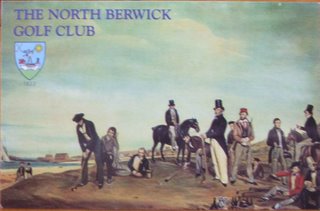


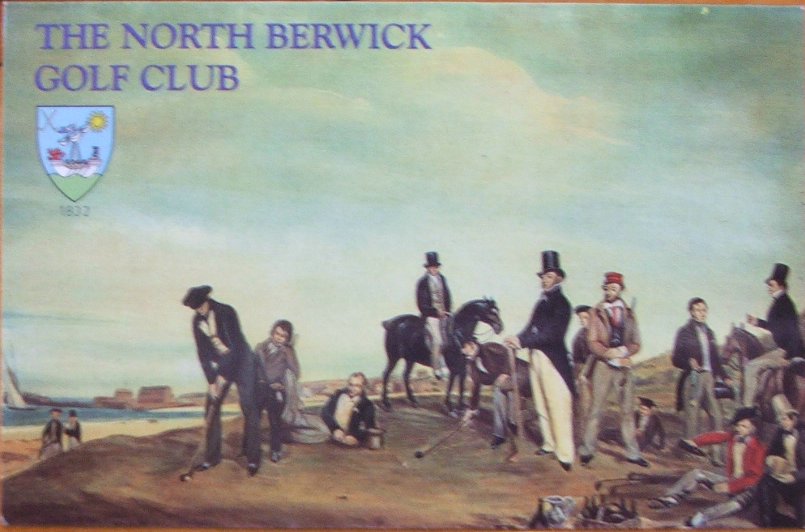
In between the library and the C.B. Macdonald room is the bar area. The bar area of the Links is my favorite part of the club. It is one of the most idiosyncratic places I have ever been in. Above the bar is a large original large painting of "The First Meeting of the North Berwick Golf Club" which is the picture on the scorecard of the North Berwick Golf Club in Scotland (seen above), painted by Sir Francis Grant. The bar also has dark woods and extensive paneling. It has several little notched-out areas and a small corridor lined with oak-paneled liquor lockers, each about two feet by two feet in size. The back of the bar area, down a narrow corridor is a small area that has leather bench-seating. Crammed into this intimate space is also a leather backgammon table and above are three skylights. It is dark, intimate and cozy in a way you would imagine a premier men's club would be (although there are now women members). You can just imagine Links Club members sitting in here during prohibition drinking their private stashes and smoking cigars.

The third floor has the Dining Room in the front the building. Above the fireplace in the dining room is a painting of one-time member Dwight D. Eisenhower, wearing his Links patterned tie. The fireplace is adorned with original 18th century Dutch delft golfing tiles, which were the inspiration for Macdonald for the "links man" logo. The "links man" is the same one that adorns The National Golf Links logo. Sitting in the dining room is an experience. The membership appear to share a common wardrobe style - a Saville Row tailored suit with a hanky sticking out and a shirt with a thread count of at least 180. It also has the highest concentration of Hermès ties per-capita in the world. Although I felt welcome at the Links, when my host went to the mens room during lunch I got the distinct impression that the waiting staff were keeping an extra close eye on me for fear that I might take some of monogrammed tableware.

The fourth floor contains the Auchincloss meeting room and has a large painting depicting an early Harvard v. Yale boat race. In the front of the building are two modest bedrooms for overnight stays for out of town members. The entire Links Club feels like a throw-back to an earlier era. There are little phone booths built into the walls on each floor, each with a little black fan above the phone to keep you cool on a hot summer's day. There is also a quirky, small, slow moving antique Otis elevator located in the central hallway.

Business is not allowed to be conducted in public areas of the Links. You cannot sit in the library, dining room or bar and have work papers or briefcases present or talk business. You cannot have a cell phone or a blackberry or any other electronic devices in the club. Gentleman must keep their jacket and tie on at all times when in public areas of the club. While you can certainly conduct business behind closed doors in the meeting rooms, the primary purpose of the Links is "social intercourse" as Macdonald called it.


Interior of the Links

The club holds events each year at various golf courses. To give you a sample of the quality of golf we are talking about, I noticed on the bulletin board a list of the successful events that the club held the prior year. Included on the list were events at Shinnecock Hills, Maidstone, The National Golf Links of America, The Chicago Golf Club, Deepdale and Somerset Hills. The Links is a useful club for me to stay close to, given my golfing aspirations. I can just hang around and beseech help to get on some key golf courses on short notice. I'll bet they don't take well to groveling at the Links, so I'll have to be my usual charming self and work the crowd.

The Links has 1,000 members, 500 of whom are non-resident, consistent with its national charter. Membership is by invitation only. I looked through the current membership directory and on page thirty-three alone recognized the names of three current or ex-CEOs. I'm not stupid enough to publish the names of the members out of respect for their privacy and because I would like to get invited back, but it is a tempting thought. Suffice it to say, like the founding members, they remain well-heeled and connected.

The window grill's on the clubhouse feature L's and C's

As I was sitting in the second floor bar talking about the club, its tradition and its membership rules, the board-certified WASP who was my host mentioned that it takes five members to sponsor a new member. Things were going well and he asked what clubs I was a member of. Note the presumption in the plural nature of the question among this crowd; it is assumed you are a member of multiple clubs. I sensed an opening; that if I was affiliated with some good clubs, maybe he was considering sponsoring me. This would be the ultimate coup for me. A home run. A grand slam. When I mentioned that I am a member of Sam's Club, The Hair Club for Men and the mile-high club, I saw the blue-blood drain out of his face.

One always has a keen sense of where you are in the social hierarchy when you are at the Links. It is clear you are in the pantheon.

As the club history describes it, the Links is "ageless", "old fashioned", has "traditional elegance", likes "quiet breeding", and is "of considered good taste", and "timeless".

Saturday, February 10, 2007

The Country Club at Brookline


I was lucky enough this past Fall to be invited to play The Country Club at Brookline (ranked # 33 in the world). One of the five founding member clubs of the USGA, The Country Club was built in 1895. Brookline is a leafy suburb surrounded on three sides by the City of Boston and the club is built right in the middle of it all. Brookline was described in the 19th century as the richest town in America. The mansions still visible today as you drive around Brookline are a testament to that. John F. Kennedy was born in Brookline. Driving past the course you wouldn't even know The Country Club is there, it is surrounded by fences on all sides. If you manage to see the discrete sign for The Country Club, you drive up the tree lined entry driveway. A couple hundred feet in you are greeted by a guard house manned by the ever present Woody (pictured below). Look closely since Woody is not a person but a wooden dummy, although a well dressed one with a jacket, tie and top hat. He's the golf world's equivalent of a scarecrow and your first sign that maybe the WASPs in this part of the world have a sense of humor after all.


As you continue down the entry road (you are crossing the 15th fairway between Woody and the clubhouse) you come upon one of the most beautiful clubhouses in the golf world, which fits perfectly into the landscape with its beautiful ocher color.

CCCH

The Country Club has a unique name not because they are pretentious but because they were the first country club in the U.S., and I would have to say that they did it right. It would be difficult to improve on anything they've done here. You approach the clubhouse around an oval driveway. Ahead of you is an old building that is the men's locker room. To your right are several other buildings - one used for curling, another houses the enclosed tennis courts, another for squash, etc. The place is a bee-hive of activity. Although it is only five miles from downtown Boston, when The Country Club was built it truly was a club located in the country with a variety of sporting activities including, originally, horse racing, which is no longer present. A club for all seasons, there is an ice skating pond with an associated club house down near the middle of the course.

CC #9
The view from the 9th fairway

I was lucky enough to play The Country Club on a brilliant day, and it was very enjoyable. The course has the most varied routing I have ever seen. It follows the contours of the land and meanders its way around the property. More than a half dozen times I was surprised when the member or caddy pointed in the opposite direction of where I thought we were going to go to the next tee box. The course was designed by a variety of people; originally by Willie Campbell, with modifications by William Flynn, Geoff Cornish and Rees Jones with no singular influence being exerted. One of the features that you find throughout the course are the glacial rock formations that holes are routed through and around, such as the par five 11th hole, aptly called Himalayas, seen below. You hit your tee shot on this hole from a high, elevated tee to a crevice in the rock canyon on the left side of the fairway. Midway between the bottom of the canyon and the elevated green is a creek that runs through the bottom of the hole. Not the type of hole you see every day and one that really uses the geography present to maximum advantage.

CC #11
Rocks from the last ice age feature prominently on the 11th hole

The terrain for the 18 holes is quite hilly and used to good effect, although it is not a terribly difficult course to walk. I know I am beating a drum on this topic, but I am again struck by how the world's great golf courses contain so many blind shots, which I really like. The #1 handicap hole, the third, seen below, is another case in point with a blind second shot to the green.

CC #3 
Blind second shot on the 3rd hole at The Country Club

CC #3.1

View of the green, hole #3, from the fairway

The course also has a Redan hole, the short 12th, although it is a non-traditional version of the Redan. The hole plays from an elevated tee sharply down hill and is only 130 yards. Although it's not a typical Redan hole, I thought it was very good and guarded by a plethora of bunkers in the front. We had just completed playing the front nine and were walking down the hill back toward the tenth tee. 

The tenth and first tees essentially share the same very large tee box. If a group is teeing off on one tee box, good etiquette calls for you to wait for the other group to hit before you do so and vice versa. As we were coming down the hill there were about 15 young golfers mingling around by the first tee, all wearing khakis and crimson polo shirts. As we approached, I noted that they all looked perfect. Perfectly fit, perfectly groomed, good looking, confident and athletic. It was the Harvard golf team (men's and women's), with monogramed Harvard golf bags, who use The Country Club as their golf course. It really made me think how privileged they were. Let's see, you look like Richard Gere or Jennifer Aniston, you go to (arguably) the best college in the world, are athletic, smart and play on the golf team. Is it possible to have a brighter future? These kids have got life by the balls. If anyone has ever told you that life was fair, they were lying.

I had a good caddy at The Country Club, although I had a tough time understanding him with his heavy Boston accent. After my drive on the first hole I had "143 yaawds" to the green and somehow managed a "great paah" after missing the green.

The 17th hole at The Country Club is one of the most historic in the game. It is where Francis Ouimet won the playoff against Harry Vardon and Ted Ray in 1913 to pull off one of the biggest upsets in golf history by winning the U.S. Open at age 20 as an amateur, against two of the world's best. It is also the famous green where Justin Leonard made his monster putt during the 1999 Ryder Cup and then the Americans had the unseemly, but justified, celebration on the green. I would say that the green looks a lot different than it does on TV. The green is long and narrow and is two-tiered. The putt Leonard made is even more impressive to me now, having seen how much break there is, given the two tiers.

The greens at The Country Club are all small. Along with Inverness and Pebble Beach, among the smallest in championship golf. Another unique feature of the course are the small chocolate-drop style mounds that are present around some of the greens. They force you to play from an uneven lie as a penalty for a missed green.

Like other turn-of-the-century clubs, The Country Club jealously guards the traditions of the game, thankfully. The Country Club is an old-school place to play. Like at Oakmont, you need a medical exemption to take a cart. They believe, rightly, that you should walk if you can. This policy also has the positive impact of allowing them to continue to support the noble profession of caddying.
Truth be told, Boston is not one of my favorite cities. I have always found it a bit uptight and stuffy. I was pleasantly surprised by my experience in Brookline. The club is family oriented, welcoming and not pretentious. Sitting in the dining room is a treat since the place drips with history. Most of the women sitting having lunch the day I was there were modeled after Julia Child: big-boned, elegant and proper. I also noted more than a fair share of men wearing bow ties at the club. No doubt, they still have a number of Boston Brahmins around with names like Saltonstall, Cabot, Peabody and Putnam!

Brookline
The idyllic setting at The Country Club

The Country Club at Brookline actually has 27 holes, the 18 hole course that the members play every day and also a nine hole "Primrose" course. Championships are held on a composite course which includes a handful of holes from the Primrose course mixed in with most of the holes from the 18 hole course. I played the members 18 hole course and not the composite course.

If you get a chance to play, I recommend wandering around the buildings around the oval driveway before or after your round. They are all old and impressive. It must be a New England thing not to modernize, and like Fenway Park, we should be greatful for that. The locker room is untouched from when it was built with old historic lockers and pipes hanging from the ceilings. There is an old glass-doored telephone box from the turn of the century in the locker room. The curling pavillion is a wonderful old musty place done in "Green Monster" green. The Country Club is proudly guarding its provenance and is one of the most historic and special places in the world of golf.

"To me, the property around here is hallowed. The grass grows greener, the trees bloom better, there is even warmth in the rocks. And I don't know...but somehow or other the sun seems to shine brighter on The Country Club than on any other place that I have ever seen" -- Francis Ouimet

Thursday, January 25, 2007

The Golf Escort

Golf Escort?

No, we're not talking about the police that escort professional golfers around a golf course. Read on and you'll find the new definition of a golf escort.


One of the characteristics you need to play the top 100 golf courses in the world is an open mind, a great sense of curiosity and a love of golf, travel and adventure. It is in this spirit that I am always looking for new ways to get onto golf courses I haven't yet played.

Thus, I was intrigued by an item I saw on-line recently. It is one of a new genre of e-books that are only published in electronic format and not through traditional means. Not knowing for sure whether it was a scam or a legitimate deal, I purchased it to find out and see maybe if there wasn't a tip or two in there about how to access golf courses. As an added bonus, the book promised that you can "Get paid for playing golf".
The premise of the book is that business executives will often times hire people to play golf with their clients, although personally I have never met such a business executive. The idea of a "Golf Escort" sounded shadowy enough for me to spend the ten bucks and buy the book, plus how could I resist the line promising "four selling points you can use on private golf clubs when asking permission to entertain clients there". Sounds right up my alley.

And I was enticed by the offer of a list of businesses most likely to pay for your services and how to strum up business for your golf escort business. Sounds intriguing in a seedy sort of way. I have been accused of being a golf-whore before, maybe this is a way to formalize my talents. Although, personally a like the more upscale sounding, "Golf Courtesan".

As I read through the 'book', it explains that business people are getting too busy to fit golf into their schedule. In an example of taking outsourcing to an absurd extreme, the book tells us that busy business people hire golf escorts to play the game for them. Well, we are outsourcing our manufacturing to China, the development of software to India; why not outsource your recreation too? It suggests you can position yourself as a golf escort to be hired by business executives to entertain clients on their behalf.

HELLO!

Isn't the point of playing the game relaxation, bonding, enjoying people's company and experiencing the out of doors? The book is not off to a promising start.

Access to private clubs

The earth-shattering suggestion in the book is to go and talk to the manager of the golf club. Tell the golf club that you were hoping to get permission to entertain influential people at their clubs. It suggests trying to tell them how much their revenues would go up by your bringing wealthy golfers to their club and how it will lead to increased pro shop sales and increased revenues. You should offer to play at "dead hours" of the day like early afternoons. The assumption is that they will be impressed by your pitch and your potential to bring influential executives and money to their course. Strike two.


The golf call girl

How exactly do you 'strum' up business? It is suggested that you put an ad in local area papers given out at hotels. This strategy will help you get in touch with out-of-town executives who are in town and bored, I kid you not. Instead of turning 'tricks' like a traditional call girl, you offer to play golf with their clients. I will forgo further discussion of the scripts to use when prospective clients call in response to your ad. Imagine having a severe case of the piles and riding in a stage-coach and you can skip this "chapter" of the book.

The mystery golfer

You may have heard of the idea of a mystery shopper; someone who goes around buying products and services for companies as a way to either do market-research or test quality control. Well, the idea of a mystery golfer has apparently arrived. The book says your objective is to get onto a courses' mystery golfer list and offers methods to do so. Call me a cynic if you will, but somehow I think it unlikely that Cypress Point and Seminole use mystery golfers to check their quality.


Alas, there is no silver bullet for my quest. I will return to my tried and true methods of getting on to the courses. As for my buying the book, what was it that P.T. Barnum said about suckers?

Wednesday, January 10, 2007

Durban Country Club - Golf in the Zulu Kingdom


Looking back from the 2nd green at Durban Country Club


I have found the ideal antidote to having your in-laws over for the holidays. A golf trip to the southern hemisphere works wonders for both parties. In what can only be described as an ideal situation I was able to go to South Africa while my in-laws were staying at my house.

Travel to South Africa

I have previously written that getting to Royal Dornoch and Sand Hills was difficult. Well, my latest experience, golf in sub-Saharan Africa, takes the travel experience to an unprecedented level. The Durban Country Club (ranked #70 in the world) is located in the South African province of KwaZulu-Natal. This area of South Africa, now called The Zulu Kingdom, formerly known as The Zululand, took me more than 24 hours to get to once I left my house. I took back to back red-eyes with a change of planes in London. I arrived in Gatwick, then took the Gatwick Express to Victoria Station, took one of the world's great remaining institutions, the London taxi, to Paddington Station for the trip to Heathrow. As you already know I love all things British. I opted for British Airways instead of a direct flight from New York because I was told that the plane stops in West Africa and can be a bit dicey, plus this itinerary allowed me to bypass Johannesburg in favor of Cape Town. Also, the direct route is eighteen straight hours, and stopping in London allowed me to break the trip up a bit, although terminal four at Heathrow is a poorly designed corrugated-tin disaster.


I also forgot how much better a wide-body jet is than a narrow-body. I fly a lot on 737s and regional jets and it was nice to have a two-tiered 747 with a more open feeling. Our flight flew over the continent of Africa all night and there can't be a much better view from the air than approaching Cape Town with the sun rising on a new day. You get a full panoramic view of the ocean, the city and Tabletop Mountain behind the city, which is both larger than it looks in pictures and closer to the city and water. It is a soul-stirring scene.


Cape Town - worth the long flight
Durban

Finally, a two hour flight to Durban on South African Airways and I was there. Durban is Africa's largest and busiest port city and also is a beach resort that reminded me of a cross between Miami and Mumbai. Picture it as 1950s South Beach with saris instead of bikinis and you get the idea. A sub-tropical city, Durban grew rapidly in the late 19th and early 20th centuries when its main industry, sugar cane, was booming. Many laborers from India were imported to South Africa during this period as indentured servants. Remnants of this historical period remain within the fabric of Durban today. The city still has a very large Indian population, the largest Indian population center outside of India. The city remains a major working port and is still a center for sugar. As you drive in from the airport the road is lined with warehouses, sugar processing plants and grain elevators. Durban is a much different city than the more polished and cosmopolitan Cape Town.

Durban Country Club

Durban Country Club has several unique aspects among the top 100 golf courses in the world. It is the only course on the Indian Ocean, the only on the continent of Africa and the course located closest to the Tropic of Capricorn. The course is located ten minutes from the city center between a rugby stadium and the Indian Ocean. The Durban Country Club was shaped from the bush and dunes of the KwaZulu-Natal coast during the early 1920s by a local golf professional George Waterman and Laurie Waters. Colonel S.V. Hotchkin who also worked extensively on one of my favorite courses in England, Woodhall Spa, made changes to Durban in 1928 and these are evident when you play this gem of a course. Additional changes were made by Bob Grimsdell in 1959.


In vestiges of its British colonial heritage, local rules at Durban indicate what to do should balls inadvertently come to rest on one of the two grass bowling greens.

The Golf Course

I liked Durban Country Club as a golf course, although it does not have 18 strong holes. It has a particularly strong start, especially the first five holes that are narrow, hilly holes that play in the bush. The middle holes, 9-15 are average at best, but the course has a strong finish with the last three holes. The front nine are near the Indian Ocean and thus are more impacted by the wind. The course is not directly on the ocean; there is a busy and loud highway that runs between the course and the ocean. On the first day I played there were many windsurfers and parasailers out on the water enjoying the strong wind, which usually isn't a good sign for golf, but it turned out ok. The back nine is away from the water and not as impacted by the wind. The massive Durban Stadium towers over a couple of holes on the back nine.

So how is it that a course with seven average holes wedged between two concrete structures is ranked in the world's top 100? The answer is because the good holes are so good that they more than compensate for the weak holes. Plus, the attraction of playing in the bush really makes it unique.

1st hole
Rough/bush at Durban Country Club 1st hole

One of the defining characteristics of Durban Country Club are the massive undulations in the fairways, especially the 5th, 8th and 17th. The course was built on sand dunes and they are large and interesting. At Durban, you don't have trouble in the traditional sense we find it in the U.S. or British Isles. Off many of the fairways is thick sub-tropical vegetation. This bush is pretty much unplayable if your ball goes in it.

Ch 9 - Durban 2nd tee
View from the second tee box

The par five third hole is one of the best in the world I have had the privilege to play. It has a high elevated tee with a view of the Indian Ocean. You hit down a narrow valley surrounded on both sides by thick bush. When you are down in the fairway you can't hear any external noise, including the ocean or the highway. You can hear the wildlife and birds chirping away, though. I saw several exotic birds, including the brilliant black and red scarlet-chested sunbirds flying back and forth between the trees on this hole. This hole and its environs are a miniature bird sanctuary. The wildlife here is so rich that the Country Club allows visiting bird watchers to tour the course when they want.

Once you putt out from the elevated green on this hole you walk through a path in the bush to climb to the next tee box. This same scene is repeated on the next tee to green walk as well.

Durban third hole
Durban's world class third hole - Par 5 in the bush

Durban is a shot makers course that you have to think your way around. My caddie didn't hand me a driver until the 8th tee due to the narrowness of the opening holes.

The 8th hole is a very good par five that requires a long and straight drive. The hole then turns sharply to the left and the approach to the green is uphill and to the right. The beauty of the hole is that unless you are on the far right side of the hole, you have no shot at the green. After your drive, the hole requires back-to-back well struck short iron shots over two large dunes to an elevated green.

12th - POW1
12th hole par 3 - "Prince of Wales" hole

There is a half-way house with seating between the 9th and 10th tees. The custom at Durban is to stop at the halfway house and have some beverages and food, which every group did both days I was there. Since you are in the tropics, the need to cool down and take a break from the heat and humidity trumps the need to keep playing and complete a round quickly.
The 12th hole, pictured above, caused Edward, His Royal Highness, the Prince of Wales to card a 16. In return, for posting his score honestly, he was rewarded with his name on the hole in infamy.

While playing the 16th hole, I experienced a uniquely Durbanesque experience. I hit my tee shot into the left rough on this par four, near the bush and under a tree. As I walked over to assess my lie a monkey dropped from the tree, to look both me and the ball over. The look on his face (captured below), tells me he wasn't particularly impressed with my tee shot. He sat nearby and watched me hit my second shot fat, or as my caddy said in the local parlance, "it was a rank shot". In my defense, it is hard to concentrate with a monkey as your gallery. I ended up making a double bogey, or as it is called in South Africa a "double drop".


My gallery at Durban about to watch a "rank" shot


The 17th, pictured below, is a particularly good example of how wild and crazy the undulations are at Durban.

Durban - 17th Fairway
17th hole approach to the green

I drove the 270 yard par four 18th hole (below) with a three wood. The feat actually wasn't that impressive since the hole played downwind, which is the prevailing wind. It seems like a good risk-reward hole for match play since pulling the ball would leave you in the bush and slicing it runs the ball down a steep bank toward the practice range. Along with Prestwick and North Berwick it is among the shortest finishing holes anywhere in championship golf. Personally, I would change it to a par three and make the course a par 71. It would make one hell of a par three. The finishing hole has yielded eighteen holes-in-one according to the plaque in the clubhouse.

I was quite proud to have played the same ball at Durban for all 18 holes. I kept my ball in play with irons off many tees and did not lose any in the bush.


18th hole looking back from the green

My caddie the first day at Durban didn't wear shoes, as many of them here do not. They carry your bag around bare foot. There is also no automated ball machine at The Durban Country Club driving range. On the narrow range, you hit balls and a caddie stands in the range and picks up and cleans each ball as you hit them. Durban is a unique golf course and the course was in exceptionally good condition when I played there, especially the umgeni grass greens.


Bunkering on the 7th hole
Sewsunker "Papwa" Sewgolum

One of the unexpected things I am finding on this quest is some of the lost stories in the history of golf that I have stumbled across. Sewsunker Sewgolum, whose nickname was Papwa, is one of them. In 1963, Sewsunker, a 5-foot-4-inch, 150 pound caddie and self-taught golfer of Indian descent became the first non-white to compete in a white only tournament in South Africa, the Natal Open, played at the Durban Country Club. He had the temerity to actually win the tournament, beating a field of 113 white golfers. During the awards ceremony, Sewsunker was presented the trophy in the pouring rain while the white club membership was snug inside the clubhouse watching in dry splendor. The white runners-up were awarded their prizes in the clubhouse. Sewsunker played and won under great adversity. He took his meals during the tournament with the black caddies and had to change his clothes in a car. The South African Broadcasting Corporation, which was government owned at the time, cancelled coverage of the tournament once Papwa entered and did not report the results on its news program. All this occurred at the height of the apartheid period in South African history. When the picture showing Sewsunker receiving the trophy in the rain (image below) was shown around the world it caused an outrage and put pressure on the South African government to change its apartheid policies.


The Durban Country Club's 1982 club history includes a comical explanation of why he was slighted - The laws of the day were such that Indian people were not allowed inside the clubhouse. An infraction of those laws could have resulted in the club losing its liquor license and being closed down. They also state that if they had moved the ceremony inside Sewsunker's fans wouldn't have been able to see him receive the trophy. To quote, "It certainly was not a slight to Papwa - rather one of consideration to enable his fans to see him in his moment of victory." I don't know, does that sound like consideration to you?

In 1965, in the same tournament, Sewsunker played again and won, beating Gary Player, who won the US Open in that same year. Unfortunately his success was short lived - the following year he was banned from all local tournaments and the apartheid government withdrew his passport, preventing him from playing internationally. He could not even enter courses as a spectator. Prior to banning him, Sewsunker played in the South African PGA tournament while two Government agents followed him around the course to make sure that segregation laws were enforced. Under the laws at the time, non-whites could play only among themselves before spectators who were also non-white. The crowds at the tournament were segregated. During this period, security police regularly followed him around and harassed and threatened him frequently. He had to apply for permits to play in white tournaments and sometimes they were granted but often times they were not.

In another highly offense remark in the club history they say, "Sadly, brilliant golfer that he was, Papwa seemed to lack the determination and discipline to remain at the top." What an absolutely disgraceful statement. Ban the poor guy from playing and then say he lacked the will to play?

Prior to the ban, Sewsunker competed internationally with great success. While he was not caddying, Sewgolum worked in an Oil of Olay factory putting the tops onto filled bottles. He was befriended by the founder and owner of Oil of Olay who took him to Europe to play. Prior to his going on the first trip in 1959, however, they had to teach him how to write his name so that he could sign his scorecards, since he was illiterate. They also had to teach him how to use a knife and fork since previously he had only eaten with his hands. Before he was banned, Sewgolum won the Dutch Open championship in 1959, 1960 & 1963. He played in the British Open Championship a handful of times including at Muirfield in 1959 and Royal Lytham in 1963, where he made the cut. He shot 71 in the first round, the same as Jack Nicklaus. Through 36 holes he was tied with Gary Player and two strokes ahead of Arnold Palmer.

What makes Sewsunker's story even more amazing is that he played the game with a back-handed grip, hands positioned the opposite way to the traditional grip. The unorthodox grip is now known as the Sewsunker grip - named after Sewgolum because he used it with such success. Imagine for a minute a back-handed grip or kack-handed grip as it is also sometimes called. How is it even possible? The game is hard enough, could you imagine holding the club wrong, with your left hand beneath your right?


There are those that would prefer we only recount the great history of the game and let incidents like this fade away, but I think stories like these are worth re-telling. I offer no apologies to those that think I am besmirching golf and its reputation. Unfortunately, golf has had a history of excluding people of race, and while not a proud chapter at many of the country clubs on the top 100 list, it is a chapter none-the-less. Stories like this also remind me that what golfers like Lee Elder and Tiger Woods have been able to accomplish are all the more impressive given the history of segregation and apartheid.

To their credit, The Durban Country Club recently honored Sewgolum, creating a memorial plaque in honor of him, unveiled in 2005. Club Chairman Ray Lalouette described the 1963 Natal Open awards ceremony as, "an ignominious debacle that must have been the source of much embarrassment and humiliation for a fellow human being at a time when he should have been experiencing joby and jubilation."

"No matter what the background, or the rules of the land, it must have been an experience that caused hurt and shame for him and his family."

"It is therefore fitting and appropriate that I, as the current chairman, take this opportunity on behalf of the members of The Durban Country Club, to apologize to Mrs Suminthra Sewgolum and to Mr Sewgolum's Son, Rajen, and his family for the suffering you have endured as a result of that most unfortunate incident."

"We have commissioned this plaque to serve as a permanent reminder to all those (and especially golfers) who walk this way, that 'Papwa' Sewgolum was a remarkable man."

Remarkable indeed. Good recovery on the part of Durban Country Club, in my view.

South Africa

In a sign of full progress, I played on the first day at Durban with an Indian member who was proud to show off his course and he was a delight. He bought me several beers afterward and even drove me back to the Royal Hotel where I was staying. If your travels ever take you to this fascinating continent, I recommend visiting Durban Country Club, to experience this unique golf course and to honor the memory of Papwa Sewgolum.

Although a former British colony and Western by many standards, Durban at times feels very African. There are lots of white mini-vans plying up and down the streets with music blaring and each is packed with people. Designed to carry at most ten people, they usually had about twenty people packed in. They stop every few blocks and serve as local taxis. They make the city chaotic since they seem to stop and start at will. There are also still vestiges of apartheid present - blacks and whites still don't mingle and there are strong undertones present; wherever you go you notice race. An afrikaner cab driver I had was ranting against the ANC, now the ruling party, about how they have ruined the country. On the other side, my caddie praised the ANC for restoring equality and moving the country in the right direction.


The rugby stadium from the back nine


Several people including the hotel staff and members of the club told me to be careful, that parts of the city are quite dangerous. At times, it was a bit uncomfortable, but honestly, no more so than in certain parts of Los Angeles, New York or Miami. I did note that parts of the golf course were discretely surrounded by barbed wire around the perimeter. Parts of Durban are seedy and raffish, but it's the real world my friends. It helps me to broaden my perspective to get outside my comfort zone every now and again and visit cities such as Durban.

Playing at Durban is something I will never forget. Playing the world's top courses sometimes gives you a myopic view of the world since you get to visit some of the world's most beautiful and premier locations. In an eye-opening experience, on the drive from Cape Town airport to the city center, you drive past the second largest "township" in South Africa after Soweto. The tiny, hand-made shacks that make up the township look unfit for human habitation. Their scale and magnitude is hard to take in, they go on for miles and are tightly clustered in a very high density. South Africa is a land of extremes that is hard to convey in words or pictures; the extreme beauty juxtaposed with the crushing povery. The great wealth and natural resources opposite such large scale suffering.

A Strong Finish


During my trip I never quite figured out the local currency, the South African rand. The exchange rate is obscenely good, however. I ate breakfast for US$2 and the golf was only US$60 including rental clubs. A very good bottle of wine at a vineyard in South Africa is US$10.

Like Ben Crenshaw at the 1999 Ryder Cup, I am a believer in fate. In what I take as a good omen for my quest, I bumped into Nobel Peace Prize winner Archbishop Desmond Tutu coming out of the lavatory on my flight back from Cape Town to London. Although my hair was sticking straight up after ten hours in a coach seat, he gave me a big smile and a friendly hello.

By the way, my little in-law experiment worked out so well that I'm already planning another trip to the Southern Hemisphere for the next holiday season, this time perhaps a trip down under to play in Tasmania?

Monday, January 01, 2007

2006 The Year in Review

It has been exactly one year since I began writing my blog. While I have been playing the courses for a much longer period of time, actually writing about them began on New Years Day 2006. It has been a rich experience, forcing me to think hard about what makes a course unique or great as opposed to just writing that I like it or not.

I have included hyperlinks in this post on courses played in 2006 in case you missed a writeup on the course you can just click.

2006 turned out to a very strong golf year. One of my personal goals is to always play 50 rounds of golf a year and I achieved it and then some this year. I was also able to play fifteen new courses on the top 100 list and play golf on three continents. I was also surprised to see that I have readers in sixty countries including such far-flung places as Azerbaijan, Mauritius and Kazakstan (could it be the famous lover of the U.S. & A?). I was also surprised to see how many people appreciate my idiotic sense of humor.

I was fortunate enough to be able to play Maidstone again this year and this time brought my digital camera. The 14th hole, a par three along the Atlantic Ocean is one of my personal favorite holes and I have included two pictures of it in this posting.


The world-class 14th at Maidstone

During 2006 I also completed (again) the perfect trifecta of playing Maidstone, Shinnecock and The National all in the same year. Standing on the 17th tee box at The National, it is hard not to feel on top of the world. You stand at the highest point on the course with the windmill behind you, the Shinnecock clubhouse on the hill in the distance, the National clubhouse on your side, a view of the Sebonack Golf Club to your left, the punchbowl green below you, Peconic Bay stretching out below you and one of the great holes in golf awaits you. Mountain climbers strive to climb Everest. You've reached one of golf's summits when you climb out of the punchbowl green to the 17th tee at The National. It was made even more special this year playing with three new friends in the brilliant sunshine.

As the year began, I thought it would be remembered for playing the Open Championship courses in England. I planned on playing the four courses in England on the Open rota - Royal Birkdale, Royal Lytham & St. Annes, Royal St. George's and Royal Liverpool. I did indeed play all four and came away forever changed by my experience. Royal Liverpool and Royal St. George's in particular, were out of this world, despite my little incident at Royal St. George's.

When the year began I hadn't anticipated playing any courses in the U.S. heartland. As fate would have it I ended up playing five - Southern Hills in Oklahoma, Prairie Dunes in Kansas, Crystal Downs in Michigan, Inverness in Ohio and Sand Hills in Nebraska. Amazingly, three of them are ranked in the top 25 in the world. All of this is chalked up to serendipity. I'm very flexible when presented with the opportunity to play a top golf course. It's a good lesson to extend to your life beyond golf as well; be flexible and see where it takes you. Undertaking this quest has changed my whole outlook on life. For example, when flying previously, I never, ever spoke to passengers around me. I flew in quiet isolation; in solitary reflection; in peace. Now, I actually embrace the chatty seat-mate and most people I meet. You never knows who you'll meet. I have come into contact with a gentleman on the waiting list to get into Augusta National, several members of clubs on my list and several other interesting golf related characters.


14th at Maidstone from behind the green

The bad news for me in 2006 is that playing Sand Hills has actually dampened the experience of playing all the other courses, just a little bit. Every course played is now compared to Sand Hills. Sand Hills is such a good course and unique place that in the back of my mind a little voice keeps saying, "this is great, but Sand Hills is better."

Low-lights for the year include Medinah, being pulled over in the middle of the night by army troops in the Dominican Republic after playing Casa de Campo and being hit up on at Prairie Dunes. The year was capped off with a once in a lifetime golf trip to Africa (my next post) that featured monkeys as my gallery and a brief visit with Bishop Tutu.

I have also completed another major milestone in 2006, having completed over half the world's top courses. To celebrate this feat I have taken at crack a ranking the top courses, broken down into U.S. and non-U.S. listed below. I have added in other courses I have played that are not ranked, just to give them perspective relative to the others. The list is obviously not complete, I will provide a complete personal integrated list when I complete the top 100.

I tentatively have lined up another 10-12 courses for the new year, hopefully included in there will be my aspirational French course Morfontaine. Perhaps I will see some of you on my planned travels.

Happy New Year, looking forward to a strong 2007!

Non-US Ranking

1. Carnoustie
2. Sunningdale (Old)
3. Royal St. George’s
4. Royal Portrush (Dunluce)
5. Royal County Down
6. Woodhall Spa
7. St. Andrews (Old)
8. Kingsbarns
9. Cruden Bay
10. North Berwick (West)
11. Royal Dornoch
12. Ballybunion (Old)
13. Turnberry (Ailsa)
14. Royal Liverpool
15. Muirfield
16. Prestwick
17. Ganton
18. Walton Heath (Old)
19. Old Head
20. Casa de Campo
21. Durban
22. St. Andrews (New)
23. Lahinch
24. Ballybunion (Cashen)
25. Royal Troon (Old)
26. Ballyliffin (Old)
27. Portmarnock
28. Royal Aberdeen
29. Machrahanish
30. Royal Lytham & St. Annes
31. Crail (Old)
32. Gleneagles (Kings)
33. Wentworth (West)
34. European Club
35. Royal Birkdale
36. Royal Portrush (Valley)
37. Crail (Craighead)
38. Lossiemouth (Moray Old)
39. Tralee
40. St. Andrews (Jubilee)
41. Nairn
42. Dunbar
43. Waterville
44. Gleneagles (Queens)
45. Druids Glen
46. The K Club
47. Western Gailes
48. Gullane #1
49. Brora
50. Addington
51. Skibo Castle
52. Royal Troon (Portland)
53. Turnberry (Arran course) - now defunct

United States

1. Sand Hills
2. The National Golf Links of America
3. Merion (East)
4. Bandon Dunes
5. Pinehurst #2
6. Shinnecock Hills
7. San Francisco
8. Maidstone
9. Pacific Dunes
10. Crystal Downs
11. Garden City
12. Prairie Dunes
13. Bethpage (Black)
14. Oakmont
15. Pebble Beach
16. The Country Club (Brookline)
17. Inverness
18. Southern Hills
19. Los Angeles (North)
20. Myopia Hunt Club
21. Shadow Creek
22. Riviera
23. Winged Foot (East)
24. Winged Foot (West)
25. Olympic (Lake)
26. Kiawah (Ocean)
27. Baltusrol (Upper)
28. Baltusrol (Lower)
29. Bel-Air
30. Oak Hill (East)
31. Peachtree
32. Piping Rock
33. Whistling Straits
34. Fishers Island
35. Pinehurst #8
36. Aronomink
37. Torrey Pines
38. Blackwolf Run
39. Portland Country Club
40. TPC at Sawgrass
41. East Lake
42. World Woods
43. Troon (Scottsdale)
44. Bighorn
45. TPC at Summerlin
46. Pine Needles
47. Mayacama
48. Country Club of North Carolina
49. Medinah #3
50. PGA West

Collectable Ivy

Sunday, December 24, 2006

Whose the Richest of Them All?

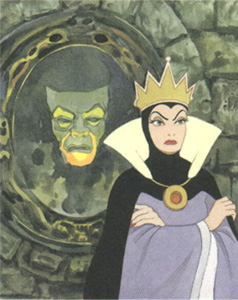
Mirror, mirror on the wall, whose the richest of them all?
I have just come into possession of the golf club equivalent of Snow White's mirror and it is very revealing regarding the U.S. based courses on the world top 100. The list shows the assets on the balance sheet of the top courses in the U.S. Unfortunately, the mirror only works for clubs in the United States so we can't do a complete world ranking. You can let your breath out now over at the R & A and Honourable Company, your secrets are still safe! Pine Valley and Cypress Point may be #1 and #2 in the world rankings, but The Olympic Club of San Francisco puts them to shame in the asset department. The Olympic Club boasts $122 million in assets on its balance sheet. It exceeds the next richest club by almost a factor of four, with Congressional Country Club coming in at $31 million. Southern Hills in Oklahoma at #5 with $22 million? Things seem to be going pretty well in the in the oil patch these days! After some detective work and sleuthing I found this interesting information. Most golf clubs in the U.S. are organized as non-for-profit enterprises. As such, they are required to file information with the US government each year and it is publicly available information if you know where to look. The list above excludes municipally or corporate-owned entities such as Bethpage Black, World Woods, Pinehurst and Pebble Beach. Sand Hills was too new to be included in the list. Augusta is excluded from the analysis because it was formed as a Georgia corporation from its inception. Since their intent from the beginning was to host the Invitational Tournament as it was called, they (correctly) figured it made more sense. Little did they know it was a good thing too, since Martha Burke and her PC crew would have created a bigger stir if it was a non-profit entity. The asset values listed also exclude the current market value of the land the courses are on, which in some cases would be in the mid-eight-digit range. Just like trying to get on the course, some of the clubs did a good job of making it very difficult to obtain the above information (Pine Valley, Seminole, The National Golf Links, Baltusrol, Medinah, Merion, Shoreacres and Inverness). But, like trying to play the course, my persistence paid off and I was able to obtain it after jumping through an additional layer of red tape. The list is below: 1. Olympic Club $122 million 2. Congressional C.C. $31 million 3. Medinah $29 million 4. Brookline $24 million 5. Southern Hills $22 million 6. Baltimore $22 million 7. Winged Foot $20 million 8. East Lake $20 million 9. Merion $20 million 10. Los Angeles C.C. $18 million 11. Baltusrol $15.5 million 12. Oak Hill $15 million 13. Scioto $13 million 14. Oakmont $11 million 15. Pine Valley $11 million 16. Garden City $10 million 17. Wade Hampton $10 million 18. Inverness $10 million 19. Maidstone $9 million 20. Cypress Point $9 million 21. Prairie Dunes $9 million 22. Seminole $8.8 million 23. Muirfield Village $8 million 24. Fishers Island $7 million 25. Shinnecock $6.8 million 26. The Valley Club of Montecito $6.5 million 27. San Francisco $6 million 28. Peachtree $6 million 29. Quaker Ridge $5 million 30. The Golf Club $5 million 31. Chicago Golf Club $5 million 32. Shoreacres $5 million 33. Camargo Club $4.4 million 34. Somerset Hills $4.3 million 35. Crystal Downs C.C. $3.5 million 36. National Golf Links of America $2 million When you think about it the list isn't that surprising. Those clubs that are low key and don't host championships generally have a smaller balance sheet. Those at the top of the list are generally larger clubs, host major championships and are in large metropolitan areas. If you ever wondered why courses let the U.S.G.A. or P.G.A. take over for six months and disrupt the club and environs, here's one of your reasons why. The only club that I could not obtain the information for was Oakland Hills. They have apparently found a way to keep this information away from nosy fools such as myself. And, I still haven't been able to play the course. To them, I say, touché. Our golf hats off to you. Well done, boys.

Thursday, December 14, 2006

Top 100 Golfer Podcast


Top 100 Golfer had the opportunity recently to be interviewed by Fred Greene who operates a golf podcast GolfSmarterPodcast.com, which is the #1 amateur sports podcast in the world.

Click below to listen to the interview which runs about 30 minutes. Once the main screen appears click on List of Podcasts and you will see the interview.


Top 100 Golfer Interview


You can listen to the interview either on your PC or download it from the iTunes Store download section.

Hopefully, I didn't give away too many secrets during the interview.

Friday, December 01, 2006

Inverness Club

18th hole and Inverness clubhouse at dusk


As I was driving from Detroit Metro Airport to Toledo, Ohio a friend called me on my cell phone. He asked where I was and I told him and started laughing with joy. He thought I should be in a rubber-padded room being excited about driving between two rust-belt cities. Obviously he's not a golf fanatic.

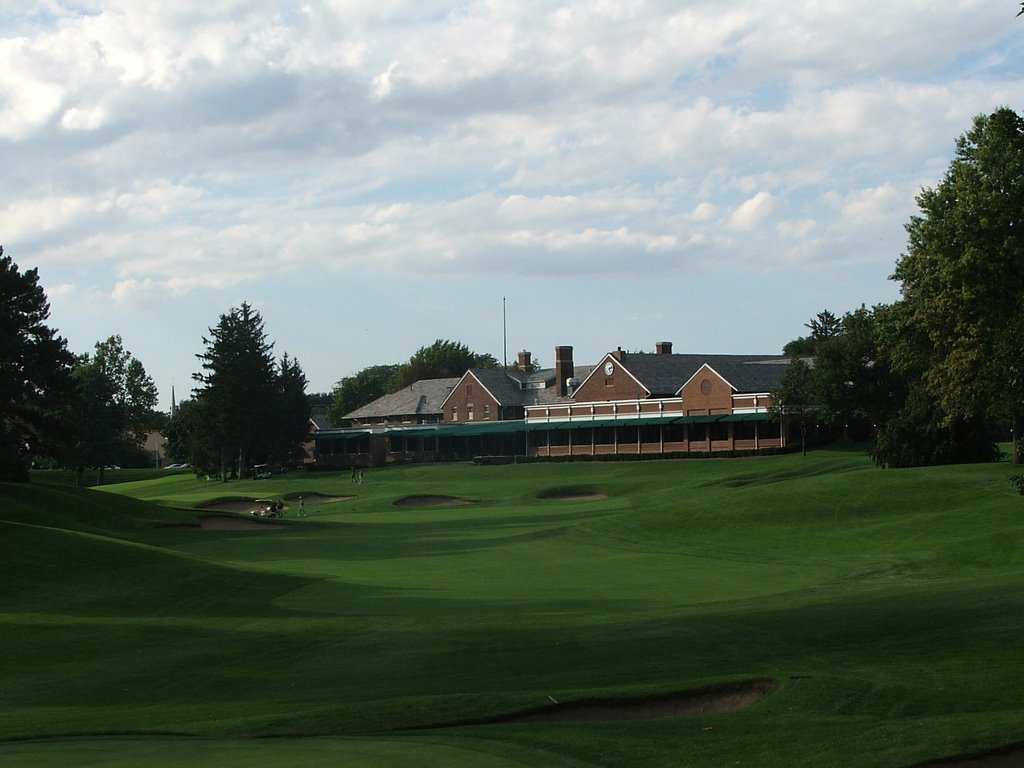
Playing the top 100 has really given me a new perspective on life. Yes, I am truly excited to travel to Detroit and Toledo to play great golf. It really has forced me to have a more open mind. The Inverness Club (ranked #58 in the world) is located in a lovely neighborhood of Toledo not far from the University of Toledo.

Inverness is a Donald Ross gem originally designed in 1919. The course has been changed over the years by Arthur Hills and Tom Fazio as well. Byron Nelson served as the pro at Inverness at one time. Inverness has played host to six major championships - the U.S. Open in 1920, 1931, 1957 and 1979 and the P.G.A. Championship in 1986 and 1993. It also hosted the U.S. Amateur in 1973 won by Craig Stadler. Although the winners of the Opens at Inverness are not exactly household names (Edward Ray, Dick Mayer, Hale Irwin and Billy Burke) it is unquestionably a championship golf course.

If I had to sum up Inverness in two words: small greens. Inverness has the smallest greens of any golf course I have ever played. Almost every green is a postage stamp green.

The approach to the 2nd green

Not only is each green very small, but the predominant design feature of the course is well guarded greens with narrow openings that require accurate approaches. Each green has either mounds on both sides or bunkers with high lips as you can see in the pictures above and below. It is a fairly easy driving course, with wide fairways. The trick at Inverness is getting on the greens in regulation. It requires very precise iron play.


Approach to 8th green

I liked the layout and routing at Inverness. I especially liked the 7th hole, which is the #1 handicap. You play your tee shot from an elevated tee. The ideal tee shot favors the right side of the fairway, but in shades of Carnoustie, you have to flirt with a burn that snakes subtly throughout the entire course. The second shot is straight uphill and really favors an approach from the right as opposed to left side of the fairway since a big sycamore tree sits at the top of a plateau protecting the green.

The approach to the 7th green

As is customary in Ross's designs, Inverness has its fair share of holes with shaved areas around the small greens such as the one below on the 4th hole.

The 4th green

Sorry to disappoint, but no jokes about Toledo. It seems like a perfectly nice middle-America city to me. I very much enjoyed playing Inverness, although I didn't hit many of the greens in regulation. Inverness is another good example of how technology is ruining tournament golf. This gem of a course can no longer host professional tournaments because technology has made it too short, which is a shame.

Inverness is a private club and you are required to play with a member.

Sunday, November 19, 2006

North Berwick and Prestwick - The Cradle of Golf


North Berwick

Two of the unquestionably best golf courses in the world, both located in Scotland, are curiously not ranked in the world's top 100. North Berwick, located a couple of miles south of Muirfield on the east coast and Prestwick, located immediately adjacent to Royal Troon on the west coast.

Perhaps it is because the courses are too short - Prestwick is 6,554 yards and North Berwick 6,420. Or perhaps because they don't host championships any more, they are overlooked. Or perhaps those that rank the courses for the magazines sadly underweight history and tradition.

Both courses were clearly great 100 years ago. The famous British amateur champion of that era, Horace Hutchinson, wrote at the time - "A man is less likely to be contradicted in lauding Prestwick than in singing the praises of any other course in Christendom." The question is, are they still great courses today?

If you like courses with a lot of cement cart paths or if you like Donald Trump over-hyped golf courses, you won't appreciate these so you can stop reading now. If, however, you are a student of the game, appreciate tradition and want to have some of the best golfing experiences of your lifetime, I highly recommend both courses.

Prestwick Golf Club

Prestwick Golf Club, founded in 1851 is the birthplace of the Open Championship (British Open). The first Open was held at Prestwick in 1860 and was won by Old Tom Morris. Prestwick hosted the first 12 Open Championships and in total has hosted 24 Opens, second only to The Old Course at St. Andrews.

Playing at Prestwick is like going back in time. The course has a timeless feel to it and is hallowed ground for golfers.


1st hole
One of the best opening holes in golf

The first hole at Prestwick is one of the world's great starting holes, even to this day. It is a short par four at only 346 yards. The name of the hole is Railway, and it is aptly named. You tee off about 10-15 steps from the clubhouse, usually with caddies or other players watching. It is also not uncommon to have members sitting in the smoke room who are also watching through a large picture window. As is typical in Britain, since there is no driving range, you have to hit your tee shot without warming up. The right side of the hole is out of bounds from tee to green since a railroad line runs down the coast toward Turnberry. Between you and the railway there is a stone wall the entire length of the hole. Making the hole even more difficult is the fact that the left side of the fairway is protected by a large swath of gorse bushes, taking away the potential strategy of playing to the left. It is a good test to see if you are on your game, hitting an iron under these conditions. I rank it among the top three first holes in the world (the other two being the opening tee shots at Merion and The Old Course at St. Andrews).

The British golf writer Henry Longhurst has said of the first at Prestwick - "A tremendous wind is blowing and the slightest letting up will see your ball sailing away like a seagulls feather across the down platform of Prestwick station."
1st gren
The first green at Prestwick
Horace Hutchinson also wrote extensively about the first - "The crime against which we have to chiefly be on our guard is that of slicing. There is apt to be an engine snorting loudly on the other side of the wall just as we are playing a critical and curly putt and the said putt is none easier from the engine having liberally besprinkled the green with cinders."


Fortunately, the trains are now all electric so we don't have to contend with cinders. But the sensation of playing the first hole remains with the modern golfer. Dell Leigh wrote eloquently about Prestwick's first hole in 1925, "Caddies, who have carried the clubs of champions, lean on the iron railings of their pen behind, taking stock of you. All along your right (or slicing hand), in terrible proximity, runs the railway line, over which rush whistle-blasting engines. Was it not Vardon who put his first two balls out of bounds on these same railway lines, and won the championship in spite of that?. Even if you play warily to the left here you have a grimly narrow opening to the green, and you are off the line of entry."

Detractors of Prestwick will tell you that they don't like the course because you can hit an iron off too many tees and granted, the eighteenth hole is a weak finishing hole. They will criticize the blind par three fifth hole, named Himalayas. The critics are wrong in my view. The place is worthy of being ranked among the top golf courses in the world. I will guarantee that you will think about Prestwick long after the memory of other courses fade. The sixteenth green, "Cardinal's Back":

16 green


It is interesting to note that when early American golf aficionados came to study the courses of The British Isles, among the courses they studied were Prestwick. Charles Blair Macdonald replicated two of the holes at Prestwick in his ideal golf course - The National Golf Links of America: the third hole, Cardinal, and the seventeenth, Alps. While some holes at Prestwick haven't stood the test of time, these two most certainly have. Both are excellent risk/reward holes that demand well played shots over difficult and massive bunkers.

17 bunker

The Alps hole is built on such a massive scale, it remains better than all attempts to copy it around the world. The seventeenth is seen greenside, below:

17 greenside

Pete Dye was also influenced by Prestwick where apparently he was inspired by the railway sleepers (ties as we call them in America) used to shore up bunkers. The course remains an important place in the history of the game and for this reason architects continue to study it.

Prestwick also allows you to appreciate its history to the fullest extent possible. If you book in advance, you can have lunch in the member dining room, shown below. You must wear a jacket and tie, and the hastle of changing into them is worth the trouble. You sit at a long table that seats 32 with dozens of pictures of past club captains in the dark green room. After lunch you can enjoy a Kummel (nasty) and a cigar as you contemplate your afternoon round and subliminally think - don't slice off that first tee.


North Berwick Golf Links

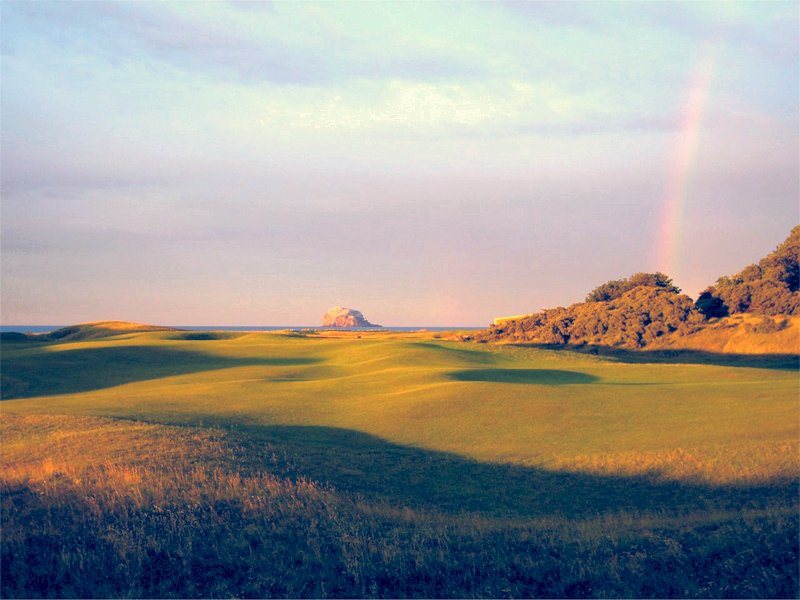
Similar in many respects to Prestwick, the West Links at North Berwick is an old, traditional golf course in the links style, founded in 1832. It is home to the most copied golf hole in history: the 15th hole at North Berwick is the original Redan hole. A Redan hole is a long par three (this one is 192 yards) that has a large bunker in front of the green and a deep bunker beyond the short side of the green. The green generally slopes from front-right to back-left. It is a hole that is approached diagonally and is quite difficult. At least 15 courses ranked in the top 100 have a Redan hole and I have heard often about how various Redan holes are better than the original. I don't agree with any of it. The original is the best.


One of the defining features of the North Berwick West Links are the stone walls that are throughout the course. In several instances you have to hit your shots over the stone walls. On the 13th hole, a stone wall protects the green. If you hit your shot to the right (wrong?) spot on this hole you will have to either chip or putt off the green through an opening in the stone wall. It is a lot of fun.

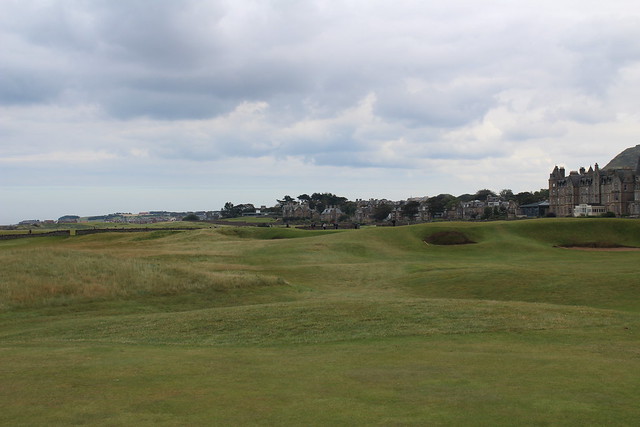
Humps in fairway 2
The 2nd fairway at North Berwick is indicative of the course's contours

The sixth hole is also a very good one. It is a short par four where more likely than not you will be hitting your second shot from a downhill lie, over a small burn to a green that slopes down to a burn that is hidden to the golfer off the tee.

13 from 14 tee
The hole every golfer loves, the 13th, with the green set beside a stone wall. Crazy, but fantastic!


Redan from the tee
The Redan hole from the tee. The puzzled golfer will be excused for standing on the tee scratching their head, dumbfounded on where to hit the ball

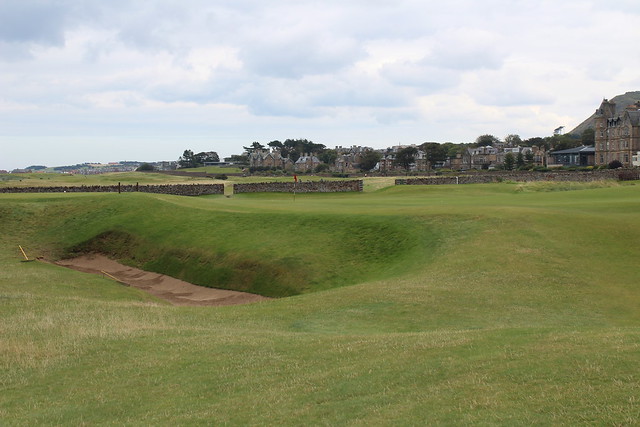
Redan
As you approach the green, you see what what you couldn't from the tee. Pray that you are not in the bunker left which is at least 15 feet deep and a true test of skill


The 16th hole, close to The Marine Hotel, which looms over the course from a promontory nearby, has one of the most interesting greens you will ever encounter. The green is bisected by a gully which creates two distinct tiers that are separated from one another. If your ball is on the wrong side of the gully, you will have a miniature-golf style putt. Think it's silly? It's not, it's a blast.

16th green (2)
Grab your ankles if you're ball is not in the right spot on the 16th green

Hutchinson captured the essence of North Berwick and it still rings true today - "It is an exceptionally good school in which to learn the art of approaching." Clearly, at 6,420 yards, driving is not of paramount importance, but hitting good and often creative approach shots, is.

North Berwick, like Prestwick, does have some weak holes, most notably the first and finishing holes. Its detractors will tell you that it is not a good test of golf. No doubt, these detractors have never played the course when the wind is up, which is the real defense of links courses. There are few places in the world to play like North Berwick that are magical and will inspire you to keep going out again and again to play.


North Berwick Golf Club Scorecard


North Berwick Golf Club Web Site

Prestwick Golf Club Web Site

Credits: The sensational pictures with the sun shining in this posting that capture the spirit of North Berwick are from Golf Club Atlas.