Monday, May 28, 2007

Pine Valley Golf Club

Well, my friends, I have done it. That's right. I have played Pine Valley (ranked #1 in the world).


The Borough of Pine Valley

New Jersey is a very unusual state in many ways when it comes to something called local rule. Even though it is one of the smallest states in the U.S., it actually has 551 separate municipalities or governing bodies. Aside from being the #1 ranked golf course in the world year after year, Pine Valley is also its own stand alone municipality. The entire municipality consists of the golf course. Under New Jersey law every municipality has to have a town hall, a school district, etc. Pine Valley does have each of these and its own stand-alone police force as well.

DSCF2408
The entrance into Pine Valley, over the railroad track

Like the presidential retreat at Camp David, the location of Pine Valley isn't exactly unknown, it's just that you have go out of your way to find it. Pine Valley is located in a typically middle-class New Jersey suburb. The area surrounding the course is not grand and does not hint at the greatness that exists behind the fences that separate this special place from the rest of the world. To get to Pine Valley you make your way to the Clementon Amusement Park, which saw its best days in the 1940s, but still functions seasonally to this day. Behind the Amusement Park, down a two lane road, on the other side of the railroad tracks is the Pine Valley Administration building. This lilliputian building contains the entire infrastructure for the town of Pine Valley, population 20. This includes the municipal court, police headquarters, town hall, etc.


DSCF2406
Pine Valley's very little town hall

It sets the stage for what can only be described as the perfect environment for a golfer. Going behind the fence at Pine Valley is like going to Disney Land for a five year old. It's magic.

Being invited to Pine Valley

Speechless. This is the sensation I experienced recently when invited to play Pine Valley. What you have to understand is that I have been networking and trying to play Pine Valley for quite some time. I was sitting at my desk and a P.V. member called and invited me to play. Just like that.

"Hey, Joe, how does Sunday look?"

I couldn't speak. After a good thirty seconds it registered. Never mind that I would have to skip church, my son's soccer game and my wedding anniversary (just kidding on the last point, but that would be a tough call).

"Looks ideal!"

"Great, as long as the weather holds up, let's do it"

What does it feel like to get invited to play P.V.? Pretty damn good, at the risk of gloating. As I told my golf friends that I was invited, the jealously-inspired insults came quickly and then when they asked if there was room for someone else in the foursome - silence. One (now former) dear friend was so jealous, he hoped that Sunday's weather would bring a "Nor' easter".

For the next five days I checked the weather on-line every half hour.

I remember reading the accounts of those who have played the top 100 and was always struck by how they were invited to play at certain courses. One guy who completed the top 100 quest was called and invited to play Augusta rather than having to grovel for years. This stuff really does happen.

My game, like the game of all golfers, goes up and down. One can only hope that when you are invited to play P.V. it is when you are in an up-cycle. In a very good turn of events, I was invited to play P.V. after posting some of my best scores ever. My good karma on this quest is continuing (thank you Archbishop Tutu).

As it turned out, the Weather Channel forecast for Clementon, NJ for the day I played:

Mostly Sunny
High - 73
Low - 55
Humidity: 45%
Winds: WNW @ 13 MPH
Golf Index: 10 out of 10 (Excellent)

Now, I had to get ready to play P.V. I re-read Zen Golf to try and re-center myself. Focus on breathing. Meditate. I also re-read Golf is not a Game of Perfect. Stay in the present. pick a target. Relax, it's only a game. As usual with me before a big round, there was a lot of mental chatter: "Bring a lot of balls. Nobody breaks 100 the first time. Slope of 153. Hit the ball straight. Don't get too hyped up. It's a golf course like any other golf course, with tee boxes, fairways and greens."

Bull Shit.

P.V. is like any other golf course like the Pope is like any other priest or the Queen is like any other Brit. I would rather be invited to play P.V. than to a White House State dinner. This is a big deal.

On the morning of my round, I put on my finest dress slacks and best golf shirt. No fraying khakis at P.V. I prepared my car, filled it with gas, checked the tire pressure, oil and wiper fluid (OK, so I'm a little compulsive). Nothing could stop me now. I drove down the New Jersey Turnpike at 55 miles per hour, which is actually quite difficult to do since the average car/truck is going over 70. I was like a little old lady out for a Sunday drive. The last thing I needed was to be pulled over by a State Trooper on my way to P.V. I was taking no chances at all.

Playing Pine Valley
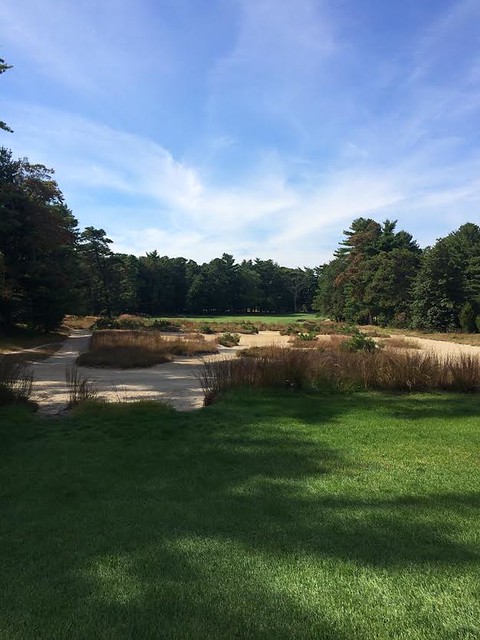


1st hole from tee 

Welcome to Pine Valley, the view from the first tee, your first forced carry of the day

I was particularly looking forward to playing the par threes, which looked to me to be awesome. The tenth hole here is a short, downhill par-three with one of the wickedest bunkers in the world short of the green on the right side. The bunker is nicknamed the "Devil's ass hole", or as the gentleman at P.V. call it in the club history, "The Devil's aperture." I also looked forward to playing the dastardly 219 yard uphill (over water) par-three fifth, undoubtedly one of the hardest par threes on the planet.


Pine Valley's short par three 10th hole


The round went well. Although I was very nervous I had a nice drive onto the first fairway. The first three holes I was in such a trance I couldn't tell you how I did. It was just over-whelming. Eventually I calmed down and we settled into a very nice round of golf.

pv #9 green

The 9th green, on the right hand side

Even though I had previously walked the course twice as a spectator to Crump Cup matches, it was a different experience actually playing. I had previously stood on various tees and fairways and visualized how I would hit my shots. It is quite another thing to stand on the tees and fairways with a club in your hand and a caddie at your side and actually hit the shot. The primary difference being that your own 'aperture' tightens up significantly when you really have to do it.


Pine Valley Fifth hole -  The hardest par three in the world
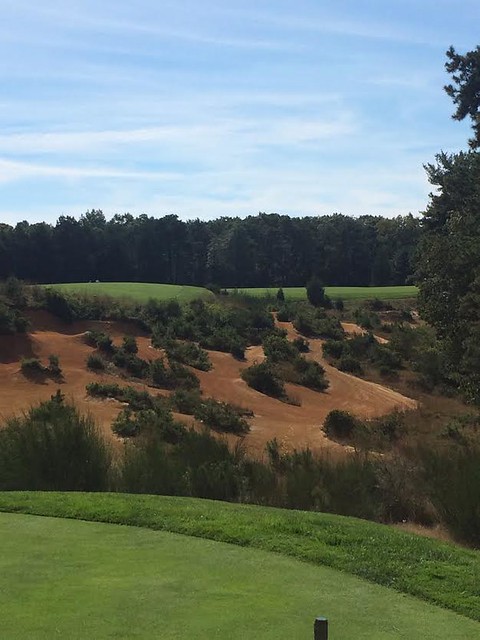


pv sixth from tee 
The course offers no let-up, the difficult fifth is followed by this tee shot on six

I hit the par-three fifth green with a driver, in one of the best shots of my life. I also hit an eight-iron stiff to the pin on the par three tenth, avoiding the Devil's Ass Hole, seen below.

pv bunker #10
The bunker to avoid at Pine Valley, in front of the tenth green

On a course of intimidating tee shots and forced carries, I actually found the most intimidating tee shot to be the downhill par three fourteenth, where you hit from a highly elevated tee. It is tightly tree-lined with water in front and behind. There are bunkers in front of the green and a sense of having to hit nothing less than the perfect shot. The general feeling standing on this tee was of claustrophobia, a feeling of being closed in.

pV #8 green

The 8th green (right hand green)


I played the #1 handicap par five seventh well, I hit a good drive and then a lovely three wood over "Hell's Half Acre". Although I hit the ball well, I didn't score well, but that's P.V. I felt better that the three handicap player in our group couldn't score either, it's just that hard. Make one mistake and it multiplies.

To my utter astonishment, when we completed playing we walked directly from the 18th green back to the 1st tee for another round. By now, I had calmed down and in one of my proudest golfing moments ever, I hit the farthest and straightest drive of my life on the first tee. We saw perhaps three other groups out on the course during the afternoon round.

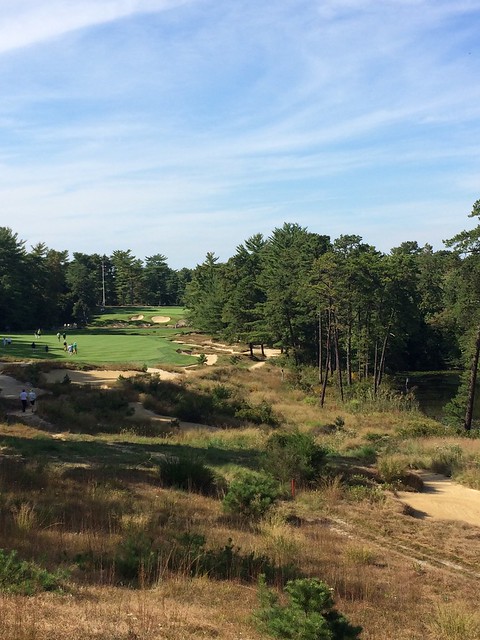
The essence of Pine Valley is its difficulty. Every shot has a forced carry off the tee, many of which are at an angle so you have to decide how much risk to take. A prime example of this is the view from the tee on the sixth hole seen below. The course is fair if you hit good shots. Driving the ball is not a problem if you hit it straight. The fairways are generous. I hit more than half the fairways. The difficulty is the second (and third) shots. I had to hit three wood, utility wood or five iron as the second shot on most holes. Accuracy in long approach shots is required to play Pine Valley well. Even on the short holes such as the eighth, one of the few holes you can actually hit driver and a short iron, there is no letup. This is because you have to hit from a downhill lie to a postage stamp green. It also goes without saying also that you must putt well at Pine Valley. The green complexes are as complicated and as good as you will ever see. I also noticed that a lot of holes start out being wide and get progressively narrow as you approach the green. This is most acute on the long part five fifteenth hole, which gets quite narrow as you get closer to the hole.


Forced carry as seen from the sixth tee box on the scorecard

One of the other things I found interesting about Pine Valley is the texture and variety of the sand. Built in a region of the state called the Pine Barrens, the sand texture varies from hole to hole and even within a hole often times. It is very important that you dig your feet in before hitting a sand shot (and you will no doubt hit many sand shots here) to test the texture. Sometimes it is like hardpan, other times it is fluffy. There are probably more than a half dozen sand textures that you have to be aware of and hit the appropriate type of shot. I don't know if there was ever a technical analysis done of the course, but my guess it that about 30% of the entire course footprint is actually sand hazards.
eighteen 
The worn-out golfer faces this as the daunting tee shot on the eighteenth

The Overall Experience

As far as the overall feel of the place, there are no frills at Pine Valley. The clubhouse is modest, understated and has little trappings. The place is about golf only. It is the perfect setting for golf, the cynosure of the golf world. It would do the officials at the U.S.G.A and P.G.A. a world of good to visit Pine Valley every so often as a refresher course in what makes golf great. It is the true north of a golfing experience.

The course is no doubt one of the best in the world. It is an exclusive enclave. You are away from the world when playing P.V. The routing of the course is diverse, it is in great condition, it tests all aspects of your game and was a privilege to play. Is it the best in the world? I don't know where I would rank it yet. I find it best to give some time before trying to assign a ranking. It is certainly one of the most difficult and intimidating courses in the world. The entire experience had an out-of-body feeling to it that is still difficult for me to believe.

For those loyal readers on the lookout for me in my travels - I am now easier to spot. I'm the doofus walking around with all the Pine Valley logoed clothes on.

By the end of the day, I have never been more physically and mentally drained in all my life. Playing 36 at P.V. took it all out of me. After I drove home I opened up a bottle of whisky I have been saving for a special occasion. A 25 year old Bushmills Millennium Malt bottled in the year 2000, accompanied by a Bolivar #2. I passed out on the back deck a happy man.

The day also included a victory for my son's soccer team.

Can a day be more perfect?

The only unfortunate thing about the experience is the several ex-friends I now have who aren't talking to me anymore after finding out I played in a threesome and would have loved to be the fourth. Also, if you are lucky enough to be invited, the pro shop doesn't take credit cards so bring cash or a check to buy things.


P.S. - I recently visited P.V. again in the springtime and have some new pictures to share


The view from outside looking in - no sign of how special it is ahead


The guardhouse where you pray your name is on the clipboard


Pine Valley Clubhouse


Interested in learning the methods I used to play all these spectacular golf courses around the world? then my forthcoming book may be of interest, in details how a mortal golfer may be able to do the same. The book is available from Barnesandnoble.com and Amazon.com. Click on the image of the book below to order on Amazon:


I hope you will find it enjoyable and entertaining.

Thursday, May 10, 2007

Secrets to Getting on the Top Golf Courses in the World


In one of my previous posts I committed to posting some of the secrets of my success to my loyal readers when one of three events happened: 1) I played 75 of the top 100 courses; 2) I played Pine Valley or 3) I played Cypress Point.

Well, I haven't played 75 courses yet, but I'm a happy man and will share some of the love on this post!

I have always appreciated the approach to golf in both the British Isles and Australia in that they grant outsiders access to even their most elite clubs. Granted, you have to book in advance, follow their rules and they don't allow too many visitors, but at least they are sharing their treasures with the world. It is a lot more difficult in the U.S. to gain access to most private clubs. The resort courses such as Pinehurst, Pebble Beach and Bandon Dunes are accessible to anyone who books in advance and pays the fee. Golfers everywhere should be grateful for people like Mike Keiser, the founder of the Bandon Dunes resort, for building some of the top golf courses in the world with a philosophy of making them accessible at a reasonable price to all golfers.

On the other hand, gaining access to Seminole, Pine Valley, Augusta National, Los Angeles Country Club or Garden City Mens Club is a lot more difficult. While doing research on these clubs I finally figured out why they don't have more liberal visitor policies like those in the U.K. and Australia. Most of the elite golf courses in the U.S. are organized as non-for-profit entities. Allowing access to the public and generating profit beyond the private pleasures of their members would jeopardize their tax-exempt status. I always thought they were just being snooty and no doubt some are, but there is some logic to their position.

There have been a handful of people who have played the top 100 golf courses in the world. The Americans who have done so have all been members of a top private club. This makes gaining access to other clubs a lot easier, particularly if you belong to one of the highly regarded ones, by being able to offer a return visit to a member who hosts you. I have been successful gaining access without being a member of one of these clubs. Nor am I a member of the R & A as some of the prior participants have been. Nor am I a member of the press. I am doing this the old-fashioned way, gaining access one course at a time through nothing more than the charm of my glowing personality. What is surprising when I look at the courses I have played is that in only two instances did I directly know the member. As the hypothesis goes, there are six degrees of separation between all people on the planet. In my case, I have never had to go further than three degrees to get on a course. In most cases it was only two - that is, someone who knows an acquaintance of mine.

So, how have I gotten onto so many of the top golf courses in the world? Well, here for the first time, I will reveal some secrets to gaining access to the top courses:

1. Pine Valley allows non-members access during early October for the playing of their annual club championship - the Crump Cup. While you can't play the course or visit the pro shop, you can walk it (sometimes in peaceful seclusion), which is closer than most people will ever get to playing it.

2. You can get on the normally difficult to access Muirfield on short notice by staying at the Greywalls Hotel, which is adjacent to the golf course. They have a small amount of tee times on Monday and Friday mornings that are allocated only to guests of the hotel. Overall, it will be expensive, but you are playing one of the top five ranked courses in the world, after all.

3. Your golf professional can be very helpful. The pro at your course can sometimes get you access to courses of other private clubs. Be discrete. Don't abuse the privilege. It probably won't work getting you onto the really elite courses such as Seminole, Shinnecock or Augusta, but you can get access to some of the lesser known, private courses on the list. Also, it is not free, you have to pay the greens fees. I have played about six of the courses this way thus far.

4. Make yourself known - Believe it or not I was called unsolicited to play two of the courses in the top 25 by getting my name out. Start a blog or a web-site. Chances are it won't be as insightful or wry as mine, but give it a shot.

5. Ask - but not for Augusta. If you ask a member of Augusta it's an automatic no. They have to ask you. Also, writing to or calling an Augusta member won't work. They've heard it all and get letters frequently requesting access to grant someone's dying wish. But aside from that one, as every effective sales person knows, you have to ask for the order if you want to get invited. You can lookup members of most golf courses in the United States by going to www.ghin.com to see if people you meet or acquaintances are members of any courses you want to play. You'll be surprised at some of the names you see.

6. Network - knowing or meeting members of the private courses is the best way to gain access. You don't necessarily have to know them directly, sometimes your friends know people. Don't be obnoxious, but when appropriate, ask and you can often gain access. Have good etiquette, though. Always offer to pay greens fees. Always offer to pay the caddies and tip generously. Send your host a gift afterwards.


Interested in learning the methods I used to play all these spectacular golf courses around the world? then my forthcoming book may be of interest, in details how a mortal golfer may be able to do the same. The book is available from Barnesandnoble.com and Amazon.com. Click on the image of the book below to order on Amazon:


Tuesday, April 24, 2007

Golf de Morfontaine - A Brief Update


A brief update to let you know how I am fairing in my attempt to play the Golf Club de Morfontaine outside Paris. As my previous readers know, I was rebuffed in my initial attempts to gain access to this private club. Having learned that persistence is important in this quest, I am forging ahead with some more creative attempts to gain access. If you would like to read my original post on Morfontaine, click here.

So, I thought long and hard, who is the most famous of French golfers? Is it Arnaud Massy, who was the only Frenchman to win the Open Championship 1907 at Hoylake? Sadly, though, Arnaud died in 1950. Actually, the most famous French golfer alive is our infamous friend Jean Van de Velde, who was almost the second Frenchman to have won the Open Championship.

Bien Sur.

After some difficulty I was able to track down Jean Van de Velde's agent and will keep his identity confidential for reasons that will soon be obvious. His English wasn't bad, if a bit heavily accented. After offering my condolences on Jean's performance at the 1999 Open I politely asked him if Jean might be so kind as to help me gain access to play Morfontaine.

Well, he did not directly answer my question. He went on a tirade against America being a land of over-indulgent people living in a crime-ridden, war-mongering society where people are self-centered, eat too much fast food, have an abundance of consumer products and lack sophistication and culture. I tried to identify the source of his anger, but it appeared deep-seated. At this point, I felt I had nothing to lose and suggested an "au contraire", and returned fire along the lines that the French are a bunch of womenizing prima-donnas that have strong body odor and drink too much wine, go on strike too much and are angry with us because we make better movies than they do, when suddenly the phone connection went dead. Perhaps the satellite connection was poor?

Allo...Allo...

Merde...

Perhaps it was a mistake to start the conversation off bringing up Jean's meltdown at Carnoustie? I'm having trouble with the nuances of dealing with the French.

I was brought up to believe that the U.S. and France were allies. My feeling was that it wouldn't be too difficult for a visiting American to arrange a game at Morfontaine. What surprised me about this episode is the hostility the French have toward Americans. Are we Americans not bosom buddies with the French? Permanent members of the U.N. Security Council together? We're both members of the nuclear club? Do we not help each other out in times of need? They helped to fund our war of independence and we helped liberate them in 1944. I don't understand how they're not being more receptive to my inquiries.

Sacre bleu...

I also got up the nerve to again call the club directly to see if they might have softened their previously rigid stance on overseas visitors. Maybe they couldn't hear us clearly last time. I thought I would speak louder this time and see if it made any difference.


It didn't. My latest attempt went pretty much like my first. In fact, probably worse. This time, I thought I heard sounds in the background of a blade being sharpened. Could it be they are readying the guillotine at Morfontaine for this obnoxious American?

"Jacques, if he calls again, it's off with the head!"

Rumor has it that both the members and the Fédération Française de Golf have now been notified about this enfante terrible trying to get access to their sacred course and have been warned not to take my calls!

All their attempts to keep me out of the club are going to be about as effective as the Maginot Line was at keeping out the Germans.

In golfing lore, the toughest secretary (as they call managers of clubs in Europe) is allegedly at Muirfield in Scotland. Stories of Muirfield secretaries' cool receptions and methods of turning away visitors are the stuff of legend. Morfontaine apparently can join the running among the ranks of courses that are difficut to gain access to. Their club history recounts the story of a famous partner in a London law firm who is near the club one day and goes inside to see if he can play. He is rebuffed (I know the feeling) and as he is leaving, sees one of the founders of the club and a member of the British aristocracy, Lord Parnham. He tells Lord Parnham how he has always dreamed of playing at Morfontaine and wonders if he could allow him to play as his guest. The Lord asks his credentials and he explains that he is a practicing member of the Church of England; went to Eton, graduated from Oxford, Magna cum Laude where he played four sports; served as a Captain in the Coldstream Guards where he won the Distinguished Service Order, Military Cross and Legion of Honor; fought at Dunkirk, El Alamein, Normandy and Arnhem. Since the distinguished gentleman helped liberate France, they let him play.

But only nine holes!

If an Oxford educated war hero only gets to play nine holes, my chances are probably pretty slim, but I am not giving up. I remain indefatigable in my quest.

The Golf Course and Architect

Morfontaine was the brainchild of a member of the French aristocracy, The Duc de Gramont. In the interest of historical accuracy, since there have been fourteen holders of this title since 1643, it was the 12th Duc - Antoine Agnor Armand de Gramont, Duc de Gramont, who lived from 1879 until 1962. He was a keen golfer and wanted a world class course near his estate, Château de Valliere. He chose Tom Simpson as the architect for his dream course.

Anyhow, given my obsessive personality, in the absence of playing the course, I have been doing some research on Tom Simpson, who can best be described as an iconoclast. He frequently wore a cloak and beret and was driven around in a silver Rolls-Royce (he is pictured below).


Simpson sounds like my kind of guy. Apparently, he had a flair for the dramatic. He once drove his Rolls-Royce slowly up and down in front of a club committee's window as they deliberated whether to accept his design as an architect. He also was on record as saying that no golf hole could be truly great unless it began to operate in the player's mind for some time before he actually came to it. He was also quoted as saying that "the vital thing about a hole is that it should either be more difficult than it looks or look more difficult than it is. It must never be what it looks." He liked his courses to demand 'mental agility'. All this research continues to build up my desire to get access to Morfontaine and see Simpson's masterpiece.

My exhaustive research also led me to the fact that fellow American and golf course architect Kyle Phillips (designer of the world ranked #65 course Kingsbarns) was hired to make changes to this French gem of a course within the last ten years.

Perhaps Mr. Phillips will take my call?

Or perhaps the current title holder, the 14th Duc de Gramont, whose grandfather founded the course can help, if I appeal to his sense of noblesse oblige?

I'll let you know how I make out...

Sunday, April 08, 2007

The Valley Club of Montecito


A fascinating bit of travel trivia for you. Did you realize that flights take off and land from LAX all night? I know this for a certainty from first-hand experience. So it is that I find myself awake at three in the morning at the Westin LAX. For those not familiar with LAX, there is a line of hotels right off one of the runways in this airport-city. My latest travels take me to Southern California to visit a client. As it turns out, I was also able to fit in a round of golf at The Valley Club of Montecito (ranked #85 in the world). The Valley Club is located about 1 1/2 hours north of Los Angeles in Montecito, an un-incorporated part of Santa Barbara. It is situated between the Pacific Ocean and the Santa Ynez Mountains. This particular itinerary also had me flying on Alaska Airlines for the first time from Palm Springs to San Francisco, then home. My itineraries can be complex when I need to plan around fitting in a round of golf, but I do it gladly. It will also be my last time flying Alaska Airlines, who have not yet perfected the art of on-time departures and they committed the cardinal sin for a golfer - they lost my clubs. Luckily it was on the way home so it didn't impact my play at The Valley Club.

For those not familiar with the topography of California, a quick lesson. The entire state has a series of mountain ranges running through it from north to south. These 'transverse ranges' are one of the defining features of the state. The majority of California's population lives squeezed in between these various mountains and the Pacific Ocean.

California's transverse mountain ranges


The Golf Course

I digress into geography because it is important to understand when playing at The Valley Club. The course is situated between the Pacific Ocean and the Santa Ynez mountains. This means you always have to take into account the impact both the ocean and the mountain will have on your putts. Putts break toward the ocean and away from the mountain. I had several putts that were clearly uphill but played downhill because they were coming off the mountain, toward the ocean. Knowing where you are in relation to the mountain is a non-trivial matter here and dominates your selection of line and pace on every green. It really takes some getting used to.

Why is The Valley Club on the top 100 list? In two words: Alister MacKenzie. The Valley Club was designed in 1929 by Alister MacKenzie and Robert Hunter. 1929 was at the height of MacKenzie's output, having completed Augusta National the same year and Cypress Point the year prior.

One of the defining characteristics of The Valley Club are the signature MacKenzie greens. In addition to the subtle breaks and the mountain/ocean effect, the greens are also small. Like at another MacKenzie course, Crystal Downs, I found putting here difficult.

The other key feature of The Valley Club are the MacKenzie-designed bunkers, which he works into the course with his 'camouflage' effect very skillfully. Many are optical illusions. Often, what looks to be a greenside bunker is actually set back from the green.


2nd hole with classic Mackenzie Bunkering


The first two holes and the last six holes play near the clubhouse. Holes three through twelve play across Sheffield Road and essentially in a little isolated canyon. You can get a good feel for the terrain at The Valley Club from the shot below, which is looking back to the tee box from the green at the 14th. You hit your tee shot on this par three downhill over a barranca.


Looking back from 14th tee


I thought the best hole on the course is the 9th hole, a dog-leg right that plays from an elevated tee. If you hit your shot far enough to the left you have a good, but long, shot to an elevated green over a creek. The green and its bunkers slope severely down a hill. To the left of the green is a horse-farm, consistent with aristocratic nature of the neighborhood here. I did not play the hole that well, which is a shame, since it is such a good hole. I hit my approach long into one of the greenside bunkers above the hole. A downhill-fried-egg-lie-to-a-small-green is not in my repertoire of shots.


Approach shot to the 9th


The next three holes (10-11-12) all play in the same direction and are also quite good since you are playing along the canyon on the left with beautifully designed, sloping holes protected by camouflage bunkers and small greens.

11th hole in the Canyon

I was fortunate to play at The Valley Club on a beautiful winter morning. The course is one of the best conditioned I have ever played and it was an ideal round. We were one of only a half-dozen groups on the course. At 225 members, The Valley Club doesn't get a lot of play. This is golf as it was meant to be played, in my opinion. We walked and had nobody in front of us, nobody behind us, there was no waiting, and we played briskly in the beautiful weather. I will once again state how fortunate I am indeed to be lucky enough to play golf in idyllic places such as this. I started the day wearing a sweater due to the morning fog which is common along the California coast. By the fourth hole, the fog had burned off and we played the remainder of the round in polo-shirts.

The beauty of the place is evident from the picture below showing the sculpted trees against the mountain backdrop.

Third hole - with the Santa Ynez Mountain backdrop

I got a lesson in tree-spotting at The Valley Club. A traditionalist type of place, like both Pine Valley and Ganton, the sprinkler heads are not marked and there are no other identifying marks. You get a little card (seen below) that tells you the yardages from various landmarks on the course. If you can distinguish an oak tree from a sycamore from a cypress/pine you're in good shape. I was OK until one hole was marked with a 'forked' tree, which I couldn't make heads or tails out of. I'm used to reading putting greens. Reading trees took some getting used to.


The "Yardage Markers" at The Valley Club


I did become quite familiar with the Cypress trees, with their distinctive trunks, near the 16th green, below, when I hooked my second shot left of the green.

Cypress trees near 16th green


The Club

The course was launched right before the Great Depression and immediately ran into hard times. Hard being a relative term in Montecito, you understand. In any event, during the second world war they allowed livestock to graze on the holes across Sheffield Road - more than half the course. It became overgrown and was also used for Victory Gardens. It was restored in 1946. In 1997, The Valley Club hired Tom Doak to update their master plan and refresh the course. In a testament to both the original strength of the design of Mackenzie and Hunter and to Doak's restraint in messing about with a gem, only minor changes were made to some greens and bunkers.

The Valley Club proved a difficult course to gain access to, it took me about three years of trying to get on. The Valley Club is a privileged club in the middle of a prosperous and aristocratic community. Montecito is an extremely well-to-do enclave. The course is surrounded by gated-entrance mansions, most with screening hedge-rows.

I like to research each club and destination as part of my travels. Santa Barbara was routinely described as "among the wealthiest communities in the U.S." The market research firm Claritis classifies it as "upper-crust", which is their highest affluent ranking. According to Forbes Magazine Montecito is one of the top 20 wealthiest zip codes in the United States and ranks ahead of such high-end locales as Beverly Hills, Bel Air and Pebble Beach. The affluence of the area is reflected in the understated but tony clubhouse with its old locker room with its original wooden lockers that have developed a nice patina. Quite a cozy little place to have a post-round drink overlooking the Pacific Ocean.

To give you a flavor for the housing surrounding The Valley Club, see the picture below of a house off the 17th fairway, reminiscent of two other Southern California gems, Los Angeles Country Club and Bel-Air.

Not such a bad neighborhood, this Montecito


Clubhouse as seen from first fairway


California has a reputation as being one of the most liberal and left-leaning states in the Union. I'm sure it is, however, this quest is taking me to all its conservative strongholds (Los Angeles County Club, San Francisco Golf Club and now The Valley Club). Thus far on my golf travels I have not yet seen the liberal California. Santa Barbara is an old-money conservative town and this is reflected in the makeup of its membership. This is Reagan Country, the 40th President had strong roots in the area and his presidential library is located not too far away in the Simi Valley. Not many granola-eaters or tree-huggers around here.

The club has traditionally defended itself by protecting its right to do as it pleases and to be different. From the club president in the difficult war year of 1944, "Certain evidences of wear and tear merely suggest the homey lived-in atmosphere so rarely seen today. It is the only club in Santa Barbara where members can still find an uncrowded golf course, good food, proper service and privacy. It was organized to provide these features which are only obtainable in a small club". So little has changed from when this was written it may as well have been written last week.

An original Valley Club Prospectus for new members

I enjoyed my day at The Valley Club quite a bit and agree with its place in the rankings at #85. I have now completed playing five of the seven courses I need to in California and look forward to one day playing MacKenzie's other California course - Cypress Point.

Post Script


My trip was completed by a requisite visit to an In-N-Out Burger, one of the fringe benefits of freqent travel. Not normally an eater of fast-food, I can't resist their old fashioned, high-quality burgers and shakes. In one of the great food mysteries of our time, I can't figure out why In-N-Out hasn't made it east of the Rocky Mountains?

Sunday, March 25, 2007

The World's Top Courses in 1908

I find it interesting to track the progress of courses and how they are ranked over time. Previously, I have posted regarding the top 100 courses in 1939. Click here to read this post.

I just purchased a copy of the new golf club history, The Evolution of the Links at the Royal County Down Golf Club, which is one of the most spectacular golf club histories I have ever read. It's expensive, but I recommend it highly.


The book was written by Richard Latham and he has a sidebar in the book regarding a ranking he stumbled across as he was doing his research for the book. Contained within a 1908 edition of Golf Illustrated he found a ranking of the top courses which was compiled by the most prominent golfers in the world. The rankings were fairly broad-based, comprising the opinions of 230 professional and 314 amateur golfers.

The list is below:

  1. The Old Course at St. Andrews
  2. Prestwick
  3. Sandwich (also known as Royal St. George's)
  4. Deal
  5. Hoylake (also known as Royal Liverpool)
  6. North Berwick
  7. Sunningdale
  8. Westward Ho!
  9. Portmarnock
  10. Formby
  11. Royal County Down (known as Newcastle then)
  12. Rye
  13. Portrush (now known as Royal Portrush)
  14. Lahinch
  15. Carnoustie
  16. Luffness New
  17. Woking
  18. Gullane
  19. Huntercombe
  20. Brancaster (now know as Royal West Norfolk)
  21. Littlestone
  22. Lytham and St. Annes
  23. Dollymount (now known as Royal Dublin)
  24. Machrahanish
  25. Walton Heath
  26. Harlech (now known as Royal St. David's)
  27. Muirfield

Obviously, their conception of the 'world' in 1908 did not include the New World or Australia/New Zealand.

I've had the privilege of playing sixteen of the courses on the list and don't really take exception to the ranking, which I find even today quite respectable. Before the Muirfield fans get up in arms, remember that the course we know today evolved considerably from the course as it was in 1908.

At the risk of repeating myself, both Prestwick and North Berwick were at the time, and I still believe are today, two of the best golf courses in the world.

Sunday, March 11, 2007

Myopia Hunt Club


A hunt club? Isn't this a quest to play the world's top golf courses? It is indeed. However, one of them happens to also be a hunt club. Early golf clubs in this country were often inter-twined with other leisure pastimes. Merion was originally both a golf course and a cricket club. Myopia was founded for both equine pastimes and for golf. Another famous early U.S. course with a non-golf history is the C. B. Macdonald-designed gem on Long Island, Piping Rock, with its polo field, now converted to one of the largest driving ranges in the world. Although not on the world ranked top 100 list which I am playing, Myopia Hunt Club is on the top 100 U.S. list (ranked #69), and is worthy of a far higher ranking on that list, in my view. I first got the chance to play this below-the-radar course in 1997 and jumped at the opportunity. Actually, I pestered the member until he cracked and invited me. The course, located 30 minutes north of Boston, is not widely known. It has hosted the U.S. Open four times (1898, 1901, 1905 and 1908). Hosting the 1898 tournament puts Myopia into a small fraternity of only five elite courses that hosted a U.S. Open in the nineteenth century.

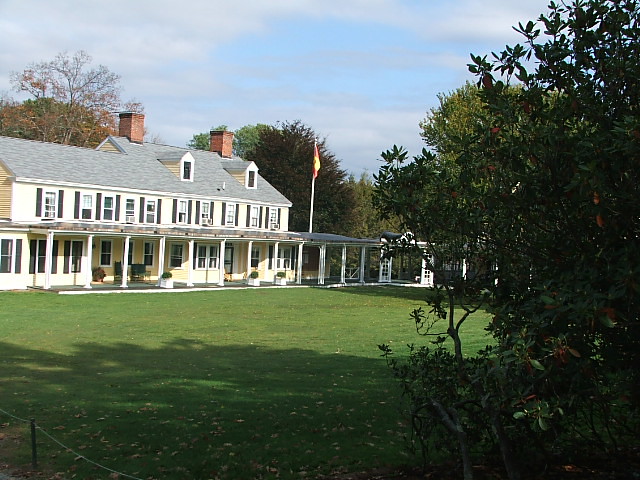
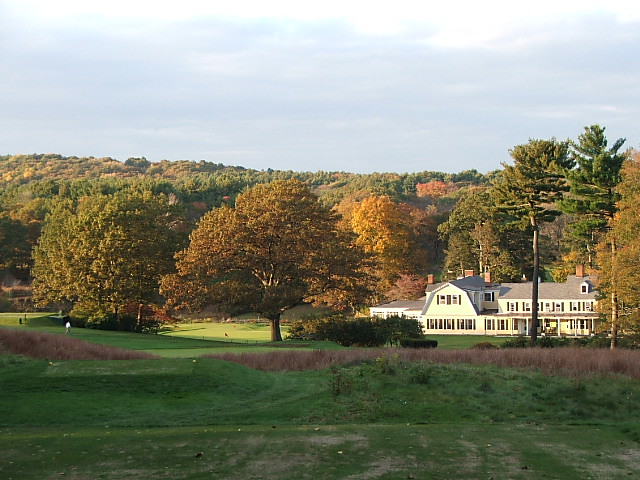
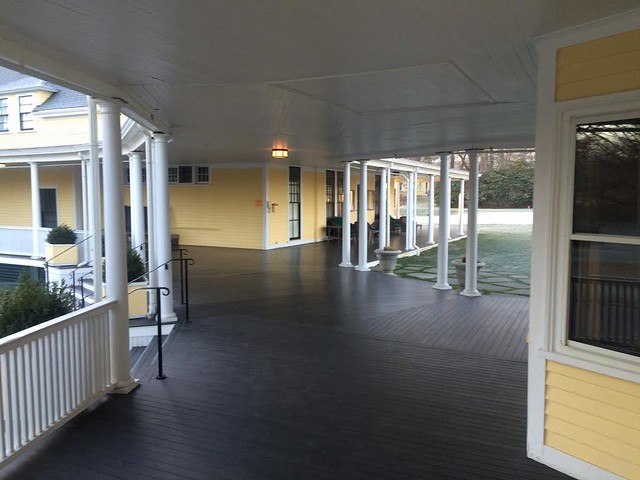
Myopia Clubhouse
The elegant 18th century farmhouse, now the clubhouse at Myopia Hunt Club just drips "New England"

The course was designed by Herbert Leeds, who had no prior experience in course design. He redesigned and expanded the original course at Myopia, which was laid out by the club's Master of the Hounds! Leeds work here adds weight to the argument that many of the world's great courses were the result of 'amateur' architects on their first attempt. In this regard, Myopia is like Hugh Wilson's work at Merion and Henry Fownes's at Oakmont. They are iconoclastic, unique, and world-class courses developed by a non-professional who was passionate about golf. The other beauty of Myopia, as pointed out by Cornish & Whitten in The Architects of Golf, is that the course exists today virtually as it was laid out. It has only been restored from time-to-time to keep it in its original state, but it has not been redesigned. They rightfully call it a landmark course.

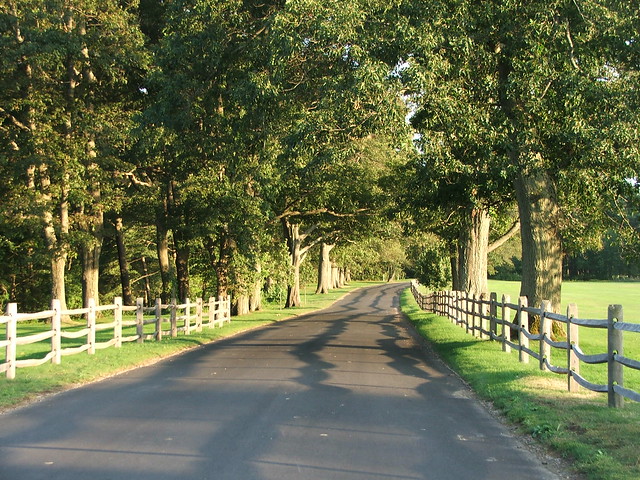
I have always been a believer that first impressions are often correct. My first impression of Myopia Hunt Club was quite favorable. My readers know that I like old, traditional golf courses. This New England classic is a real gem, reminiscent of courses in England. Driving down the tree-covered road into the club you immediately see horses gently striding behind a post-and-rail fence and you pass over a humped-backed bridge, all of which combine to create a feeling of joy. A polo field is located to your right as you drive into the cloistered environment.

Myopia Hunt Club  Entry Drive
The regal entry drive at Myopia Hunt Club

The Golf Course

Scorecards, like looks, can be deceiving. Myopia plays 6,555 yards from the tips, therefore, it's probably not that hard, right? Wrong. Leeds's strategic use of cross-bunkering and the difficulty of the greens means that Myopia has stood the test of time and is still challenging today. The USGA Course rating is a stiff 72.7/138. Consider that among the five highest total scores in the history of the US Open four of them were scored at Myopia. Even if you take into account the difference in equipment, the winners averaged a score of 80 at Myopia, while during the same era the winning scores at Opens held at Baltusrol, Chicago Golf Club, and The Country Club were 10-20 strokes lower!

The golf course is situated behind the clubhouse and locker room buildings, a short walk up a hill. Among one of its many charming quirks, the red tees at Myopia are the back tees. The opening hole is a very short (276 yard) uphill par four where you hit a blind drive and it is a relatively easy hole, although the tilted green is trickier than it looks. If the drive in and the general environment of the club didn't tip you off that this is a noteworthy club, the greatness of Myopia as a golf course is confirmed early in the round as you stand on the second tee and look across the expanse stretching below you.

Myopia #2.2
Myopia's enchanting second hole is set at the top of  a hill and gives a sweeping view of the heavenly property the course is built on

The 488-yard par five second hole is an absolutely beautiful hole where you hit your tee shot from an elevated tee down into a valley (shades of Sunningdale's 10th hole) to a fairway that is deceptively hard to hit because the tee box points you to the fescue right of the fairway. The third hole is a testing 253-yard par three with a small green. It has one of Leeds's signature slashing cross bunkers running across the fairway to the hole. As such, Myopia presents challenge and variety not only early in the round, but as you continue around the course it sustains this for all eighteen holes.

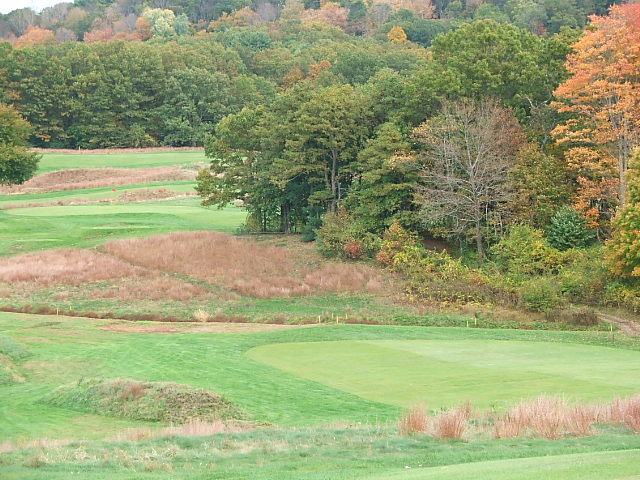
The course meanders around what I found to be surprisingly hilly terrain in this part of Massachusetts. It is a true parkland course in the forest. Look at the picture below from the fifth hole, which is typical of the course, and if I didn't tell you it was Myopia, you could quite possibly mistake it for the heathlands surrounding London. The 5th hole, a 417-yard par four that looks tame, but due to the angle the fairway is situated at and the gentle rolling of the terrain, it is anything but, and plays as the number two stroke index hole.


Myopia #5
Myopia #5 - Shades of Sunningdale or Walton Heath?

I really liked the sixth hole, a 255-yard par four which demands accuracy on your tee shot (water right and O.B. left over a stone wall), and precision on your approach shot (a tabletop green), as well as a deft touch with the putter.

The 9th hole, pictured below, is a brilliant par three with a postage stamp green. The green is only nine yards wide and surrounded by seven steep bunkers. One of the defining characteristics of Myopia are the deep bunkers, which are, as you can see, reminiscent of those found in the British Isles. This is unmistakably an all-world par three.

As you play Myopia you will occasionally see bridle paths crossing or paralleling various holes. Rather than taking away from the course, they add to its distinctiveness. One of the local rules at Myopia is that you can take a free drop if your ball lands on a bridle path. I hit onto a path once during my round but decided to hit from the path instead of dropping, which plays like a sand shot.

Myopia #9

Myopia #9 - A world-class par three postage stamp hole

The back nine begins with a bang. The tenth hole is a par-4, 404-yard Alps prototype hole. What makes the hole especially challenging is the blind tee shot. Since you are hitting over the rise of a big hill, you don't fully appreciate that any ball to the right of center feeds down into a jail at the bottom of the hill. The hole also slopes from left to right from tee to green. President Taft, who played his summer golf at Myopia, also had trouble with the deep bunker located in the fairway as you approach the 10th green. The hefty commander-in-chief couldn't climb out of the bunker so the secret service had to bring in a couple of horses and tie a rope around the portly golfer to assist in extricating him.

The 11th hole, Leeds's rendition of a Road Hole, is a short par four  (349 yards) that has a menacing cross-bunker jutting across the fairway at a rude angle. Bobby Jones played the course while attending Harvard Law School and apparently had trouble getting across this well placed hazard on a regular basis. One of the reasons Myopia is such a deceptively difficult course can be seen on the eleventh. All the fairways have a tilt or slope to them, which feeds balls into either the rough or a bunker. The course has stood the test of time because Leeds understood better than almost any architect ever has that using a hillside as a hazard (without overdoing it) is far more effective than it looks. Similarly, like at Baltusrol, the greens are challenging because they look relatively flat, however, since the entire property slopes off a big hill, there is a dominant break down toward the club entrance that is difficult to discern.

Myopia Bunker
The maddening par-4 thirteenth green at the top of a large hill. The putting surface is onerous.

The thirteenth hole, pictured below from behind the green, is an uphill par four (358 yards on the card) where your second shot plays about three additional clubs longer than the scorecard indicates due to the severity of the hill. This hole parallels the second hole, so you are playing up the hill that you hit from the elevated tee from earlier in your round. The thirteenth green is probably the most extreme example on the course, but is indicative of the greens at Myopia. They are tilted, canted, pitched, banked, slanted, and angled, but don't appear to be half as severe as they actually are. It is always advisable to play more break than you think, but even when you do, more likely than not haven't played enough. It is a true challenge in the positive meaning of the word, a real test of your ability to pick the correct line and speed on these perfectly conditioned and fast greens.

Myopia #13
Green #13 seen from the rear

The 16th hole is a challenging 192-yard downhill par three that plays back toward the clubhouse, and like many holes at Myopia provides a stunning vista as can be seen from the picture taken from this elevated tee, below. Despite my bad manners I have been invited back to Myopia a half dozen times and I am always taken aback about how harmonious the entire environment is, it personifies Old World New England. The club has undertaken a tree removal program over the last several years, clearing out hundreds of trees to open up the vistas more and to have more wind impacting the golf shots. The changes are noticeable and well advised, they did a nice job with them.

A strong case can be made that the collection of par three holes at Myopia are as good and as challenging as any in the game of golf. Even though there are only three of them, in my view, they rank up there with Pine Valley and Woodhall Spa in terms of challenge presented to the golfer. Consider the 3rd hole. How many par threes have a fairway on them so you can lay up because you can't reach (or hold) the green? Not many; the par three 16th at Cypress Point being a notable exception. The 240+ yard hole also plays slightly uphill. Modern architects like to have balance on golf holes: if it's challenging from tee to green they will typically cut you some slack when you're on the putting surface. Leeds design philosophy is of the take no prisoners camp, thus, the 3rd green is a challenging surface. My guess is that modern architects also wouldn't design a green as narrow as the ninth today for fear of the course owner or members complaining about its severity. Did the designer of the Postage Stamp hole at Royal Troon fret that it would be too severe? Apparently not, and Myopia's ninth follows the mold, with harsh fescue and deep trench bunkers penalizing misses. Finally, the 16th, like many at Myopia, doesn't appear that hard on paper, after all, it's a downhill par three of roughly 180 yards with a relatively large green, and you get a great preview of the green before you tee off since it is situated next to the first tee and you can examine its contours and peek at the pin position. Alas, you don't get to play the hole on paper, but in the real world, with all that mother nature brings with her. The complication for the hopeful duffer who has just put his or her ball on the tee is that they can barely see any of the putting surface; instead, the vista is a sea of fescue blowing in the wind, and because of where the green is situated, with the clubhouse in the background, the green's distance from the tee becomes wickedly deceptive, and you see only a tiny sliver of it. Leeds was three for three on the threes. Brilliant.

The 17th tee is right outside the pro-shop door and has an old stone wall down its entire left side that plays out of bounds. Holes 17 (a 394-yard par four) and 18 seem to be set-off from the rest of course and look like they will be anti-climactic, but in fact provide for the perfect finish since they are cut artfully into a tumbling hillside. The routing at Myopia is perfectly suited to the terrain and in my view is one of the best in the world of golf.

Myopia CH

The Myopia Hunt Club clubhouse as seen from the 16th tee

The eighteenth is one of the best finishing holes in all of golf. It is 404 yards, a dogleg right and your tee shot is semi-blind. You must land on the left side of the fairway to have a clean shot at the green. This is harder than it sounds given the slope of the terrain and the hill. If you are on the right-hand side a hill blocks your view of the green. In front of the green are two massive and deep bunkers. Adding to the beauty of the hole are the horses strutting to your left as you approach the polo ground and the beautiful yellow farmhouse/clubhouse behind the green. The horses give the place a genteel and civilized ambiance.

Myopia Hunt Club as the whole package

I can't sing the virtues of Myopia enough. It strikes the appropriate balance between being intimate without being stuffy or pretentious. The membership seems perfectly suited to the historic club.  As I suspected on my first visit and can now confirm after a half-dozen visits (including staying overnight in the clubhouse), the membership seems to have avoided the usual minority of blow-hards, half-wits, morons, simpletons, rummies and lackeys that make up a minority of any club. It is a rarity to combine a world-class course with a club that has the right mix of elements and intangibles. In all my journeys I have only seen this a handful of times: Myopia, Sunningdale, Maidstone, Royal Liverpool and San Francisco Golf Club. Each possesses an inveterate charm to complement their fabulous courses.

Many other clubs possess great golf courses but fall flat on the club or clubhouse environment. Some are trying too hard or are too uptight or snooty. Others have too many members you wouldn't enjoy associating with. These five pull it all off and are the real McCoy.

DSCF2228-001
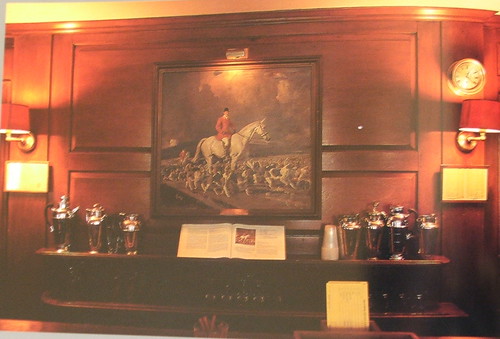
The best bar at a golf club in the United States is at the Myopia Hunt Club

The 19th hole at Myopia brings together a lot of what I like about old-style golf clubs and reveals many verities that I have found on my trips. Among the truths: 1) Length doesn't matter. Myopia is a sub 6,600 yard course from the tips, but is still a challenge. 2) Low-key, understated and intimate are better than big and flashy. In this regard, I like courses like Myopia and Sunningdale as opposed to big clubs like Wentworth, Congressional, or Medinah.  3) A variety of holes and shots make a better course. Nothing felt forced at Myopia, the course fits naturally into the terrain; there are a couple of short par fours, a 200+ yard par three and a 130-yard par three; some uphill holes, some downhill holes, and plenty of change in direction. 4) Old and quirky are under-appreciated. The bar at Myopia has no barman, the members sign chits for themselves and there are private lockers near the bar for members' liquor. The rooms in the clubhouse have low ceilings and a feel of antiquity. The old, original creaking floors will probably never be replaced, giving it a shabby-chic feel. There are antiquated enclosed telephone booths cut into the wall of the entry foyer where members used to discretely make phone calls without disturbing the ambiance. The locker room, housed in a separate building, is original and reminded me of another old original, Garden City on Long Island.  A visit to Myopia is a truly memorable and distinctive day. The club is intensely private and there are less than 12,000 rounds played a year, which is about 50% less than at most clubs. If you can wangle an invitation, I suggest going at once.


The weather vane with fox motif adorns the clubhouse


Golfer Magazine described Myopia and its architect in 1898 thusly: "Leeds is as well known as a hunt club man as a golfer . . . The rolling inland gorse is admirable, the hazards natural, the distances good . . . It was only natural that the cry of Fore! should be heard mingling with the whistle of the quail and the music of the kennelled hounds. Experts have pronounced the links the best natural golf grounds in America." The description remains relevant today.

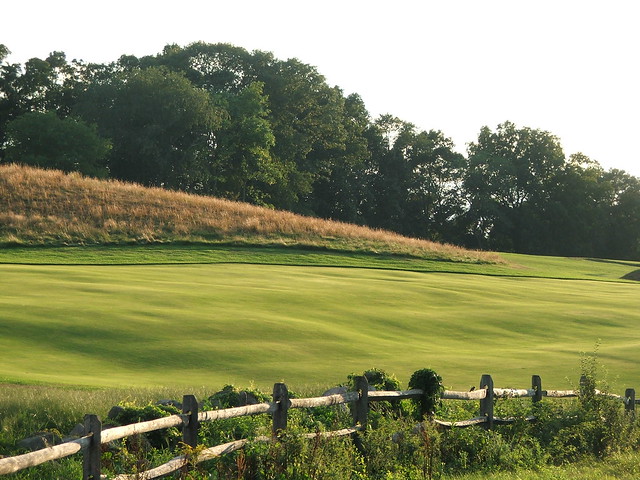
Myopia 18th Fwy

The sloping of the 18th fairway is best captured at dusk


It is not an exaggeration to say that the greens at Myopia are among the finest in the United States. Part of the reason I think Myopia is such as fabulous golf course is because Leeds kept tinkering with it and refining it over the years. As a member of the club he would sit in the bar and overhear golfers complaining about how easy or hard holes were and would make changes as such. The par-5 fifteenth hole ("Long") is a beautiful 529-yard hole that straddles the hill at the top of the property. When Leeds heard a couple of members complain that the hole was too easy he put in two very deep bunkers short of the green. Easy is not a word that pops into your head as you approach the green today. The course plays as a par 72 and even though it is short there are a couple of very testing par fours, notably #5 at 417 yards, #12 at 451 yards, and #18 at 400 yards. The course, however, truly excels with the short par fours. It is treacherous to compare any course to Merion, but it is my belief that the short par fours here are as good a collection, or better, than those at Merion, which are among the best in the world.

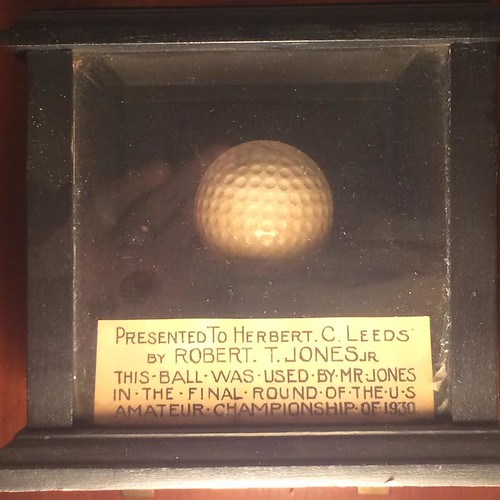
Speaking of Merion, where is the ball Bobby Jones used when he won the Grand Slam, finishing the U. S. Amateur at Merion? It's displayed in a very nonchalant manner tucked above a light in the bar at Myopia Hunt Club. To me it encapsulates everything about Myopia and reflects the ethos of the club perfectly. They have one of the treasures of the golf world on their hands but treat it in a very low key and respectful manner. Myopia is an anachronism in the world of golf to be cherished and preserved for posterity, which is exactly what their erudite membership is doing.

Myopia Bobby Jones Ball

It is a lucky golfer who finds themselves walking on the boardwalk of the elegant Myopia clubhouse:

clubhouse boardwalk

Myopia's blue blood roots run deep. The club first used the name Myopia Hunt Club in 1876. The august Republican Senator from Massachusetts, Henry Cabot Lodge, was a founding member of Myopia.  The Harvard polo team still uses the fields at Myopia.

As I was playing at Myopia in the summer twilight recently there was a light breeze blowing and the ancient specimen trees were casting long shadows over the verdant fairways. It didn't take too much imagination to forget that I am an olive-skinned crank of Italian extraction from New Jersey, and I thought for a few moments that I was one of the original fair-haired Haa-vard boys who founded the club over a century ago, and that I was back in 1894 playing a leisurely round of golf. Myopia is timeless.

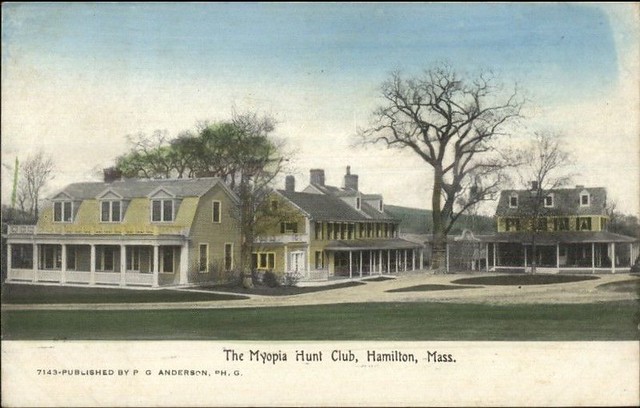
mhc ,
The scene at Myopia from a postcard  produced in 1904. It could have been taken today.

Post Script - Not everyone agrees with my assessment of golf courses (I know, I find it shocking also). Even the skeptics among you must agree, however, that Myopia surely has the best logo in the world of golf. What could be better than a fox with a horn above his head?