
For those that have been following my saga, when we last left off I was subjected to the golfers equivalent of Marie Antoinette's infamous quote "Qu'ils mangent de la brioche." Very roughly translated as 'let them eat cake!' In other words, f--- off. If you would like to read the first two posts giving the history of how difficult it was for me to gain access to Morfontaine click here - First Post and Second Post.
World-Class groveling gets me on Morfontaine
Well, I am happy to announce that the Golf Club de Morfontaine (ranked #47 in the world) and I have entered into an entente cordiale or "a friendly understanding." My loyal readers will be pleased to learn that I have had the privilege of playing this fine French course.
Appealing to their sense of noblesse oblige, I successfully groveled my way into this gem (thank you Roger!). They finally came around and realized that it wasn't going to kill them to let this crazy, but well-mannered American, play their course.
World-Class groveling gets me on Morfontaine
Well, I am happy to announce that the Golf Club de Morfontaine (ranked #47 in the world) and I have entered into an entente cordiale or "a friendly understanding." My loyal readers will be pleased to learn that I have had the privilege of playing this fine French course.
Appealing to their sense of noblesse oblige, I successfully groveled my way into this gem (thank you Roger!). They finally came around and realized that it wasn't going to kill them to let this crazy, but well-mannered American, play their course.
 >
>
I would agree with Tom Doak, who classifies Morfontaine as one of the hardest to find golf clubs in the world. The drive up from Paris is a tricky one, although the last several kilometers are quaint. You have to drive through a heavily forested area and then down side roads. The charming drive includes roads lined with old stone walls, like the one seen above.


The entry drive, seen above, is befitting of this grand club. After you pass through the gate, it is a majestic drive, on par with the one at Yeamans Hall. These type of long entry drives add to the sense of excitement and anticipation when arriving at a first-class club like this one for the first time.
I typically do a lot of research about a golf club before I play it. I like to better understand the history and traditions of the place before I arrive. This is especially important when playing outside the U.S. since I want to make sure I don't commit any faux pas. One of the nice traditions the French have always had is to greet someone with a couple of pecks on the cheek. First, a kiss to the left cheek, then a kiss to the right cheek. I wanted to respect this custom and display the proper protocol at Morfontaine. Upon entry to the clubhouse, I tried to do the old double-kiss routine with the club manager, but was rebuffed. Either my halitosis put him off or I came in at the wrong angle, but I got the sense that this attractive gentleman thought I was putting the moves on him.
I typically do a lot of research about a golf club before I play it. I like to better understand the history and traditions of the place before I arrive. This is especially important when playing outside the U.S. since I want to make sure I don't commit any faux pas. One of the nice traditions the French have always had is to greet someone with a couple of pecks on the cheek. First, a kiss to the left cheek, then a kiss to the right cheek. I wanted to respect this custom and display the proper protocol at Morfontaine. Upon entry to the clubhouse, I tried to do the old double-kiss routine with the club manager, but was rebuffed. Either my halitosis put him off or I came in at the wrong angle, but I got the sense that this attractive gentleman thought I was putting the moves on him.

The ivy covered clubhouse at Morfontaine
We arrived early in the morning and were greeted warmly. The ivy-covered clubhouse is reminiscent of a cozy hunting lodge set in the country. Above the fireplace in the clubhouse is a putter made out of gold given to the club by Cartier. The basement of the clubhouse houses the kitchen. As we approached, I could see down into the kitchen and even at this early hour, there were fresh vegetables laid out and being prepared, as well as a half dozen large pieces of duck, which would no doubt later be prepared to perfection. As we sat in the clubhouse, a female employee arrived with a large bag of fresh baguettes. It couldn't have been more perfect. Our expectations of a full-blooded French golf experience were exceeded at every turn. The staff made us some fresh coffee, which in retrospect was a mistake. Coffee in France is more like a double espresso, and the last thing we needed was to get more pumped up. My heart was racing very fast by the time we set off to play golf.
The ambiance of the clubhouse at Morfontaine is very cozy and inviting. It is not hard to imagine you are back in 1911 and a Grand Duc yourself. The misty morning I was there added to the romance of Morfontaine. I honestly could have just sat in the clubhouse for hours drinking coffee, smoking cigars and hanging out.
History of Morfontaine Golf
There are 27 holes of golf at Morfontaine: The nine hole Valliere course, built in 1911, and the 18 hole championship course, built in 1927. Both were commissioned by the Duc du Gramont and built by the Englishman Tom Simpson.
Taking my obsession with the game of golf to a new level, I had both of Morfontaine´s club histories translated into English so that I could learn the interesting history of this great course. It has a rich history, particularly in the 1940s. The course was over-run in June of 1940 by the Third Reich when they captured Paris. The Germans drove Panzer tanks on the course and caused deep ruts in many fairways and greens, particularly the 9th and 10th holes. The 8th hole was hit by artillery shells. They also set up a cannon on the 13th green (Kraut bastards!) that did serious damage. Many of the greenskeeping staff and club members joined the Army or were taken prisoner during this time, putting serious stress on the club's survival.
The Nazis ransacked the clubhouse and looted food and items of value during the occupation. After the German troops passed through, Commandant Soldatenkoff, the club manager, took charge to restore the course to some semblance of normalcy. Soldatenkoff was a retired Commandant from the Imperial Russian Marines, and the club history describes him as elegant and funny. By December of 1940 he had the course restored to a basic level of functioning. During the war, gasoline was at a premium so they had to use horses to operate the equipment to re-grade the damaged holes and cut the grass. They put leather boots onto the horses so that their hoofs did not further damage the course.
The ambiance of the clubhouse at Morfontaine is very cozy and inviting. It is not hard to imagine you are back in 1911 and a Grand Duc yourself. The misty morning I was there added to the romance of Morfontaine. I honestly could have just sat in the clubhouse for hours drinking coffee, smoking cigars and hanging out.
History of Morfontaine Golf
There are 27 holes of golf at Morfontaine: The nine hole Valliere course, built in 1911, and the 18 hole championship course, built in 1927. Both were commissioned by the Duc du Gramont and built by the Englishman Tom Simpson.
Taking my obsession with the game of golf to a new level, I had both of Morfontaine´s club histories translated into English so that I could learn the interesting history of this great course. It has a rich history, particularly in the 1940s. The course was over-run in June of 1940 by the Third Reich when they captured Paris. The Germans drove Panzer tanks on the course and caused deep ruts in many fairways and greens, particularly the 9th and 10th holes. The 8th hole was hit by artillery shells. They also set up a cannon on the 13th green (Kraut bastards!) that did serious damage. Many of the greenskeeping staff and club members joined the Army or were taken prisoner during this time, putting serious stress on the club's survival.
The Nazis ransacked the clubhouse and looted food and items of value during the occupation. After the German troops passed through, Commandant Soldatenkoff, the club manager, took charge to restore the course to some semblance of normalcy. Soldatenkoff was a retired Commandant from the Imperial Russian Marines, and the club history describes him as elegant and funny. By December of 1940 he had the course restored to a basic level of functioning. During the war, gasoline was at a premium so they had to use horses to operate the equipment to re-grade the damaged holes and cut the grass. They put leather boots onto the horses so that their hoofs did not further damage the course.

The dining room at Morfontaine
Commandant Soldatenkoff organized a bus from Paris each Sunday during the war for members that wanted to go to Morfontaine to play. There was no food service or other amenities, so members brought their own food and drink. During this time, parts of the Valliere course were used to grow potatoes to help members and locals survive.
In November of 1942 a four-engine R.A.F. bomber was shot down by the Germans as it was returning from a bomb run on Stuttgart. The plane crash-landed in the polo grounds next to the course and four members of the crew, including the pilot, were taken back to the clubhouse to be cared for. The winter of 1943 was so harsh that trees on the course had to be cut down to be used as firewood to keep warm. After the war, the clubhouse, which had fallen into a state of dis-repair, was restored.
In the post-war period, the course was played by the rich and famous including Gary Cooper, Bing Crosby, Jerry Lewis, Bob Hope, The King of Spain, The King of Belgium and The Duke of Windsor. General Eisenhower played the course many times after the war and was very fond of it.
The Golf Course
The course is built in a forest and has an abundance of heather. It is reminiscent of the heathlands outside of London. The soil is naturally sandy, and thus perfect for a good golf course. The course is an absolute treasure and work of art. It has that certain something the French call je ne sais quoi that sets it apart from anywhere else I have ever played golf. Like at Yeamans Hall, the entire atmosphere and sense of isolation overtakes you.
In November of 1942 a four-engine R.A.F. bomber was shot down by the Germans as it was returning from a bomb run on Stuttgart. The plane crash-landed in the polo grounds next to the course and four members of the crew, including the pilot, were taken back to the clubhouse to be cared for. The winter of 1943 was so harsh that trees on the course had to be cut down to be used as firewood to keep warm. After the war, the clubhouse, which had fallen into a state of dis-repair, was restored.
In the post-war period, the course was played by the rich and famous including Gary Cooper, Bing Crosby, Jerry Lewis, Bob Hope, The King of Spain, The King of Belgium and The Duke of Windsor. General Eisenhower played the course many times after the war and was very fond of it.
The Golf Course
The course is built in a forest and has an abundance of heather. It is reminiscent of the heathlands outside of London. The soil is naturally sandy, and thus perfect for a good golf course. The course is an absolute treasure and work of art. It has that certain something the French call je ne sais quoi that sets it apart from anywhere else I have ever played golf. Like at Yeamans Hall, the entire atmosphere and sense of isolation overtakes you.

The first tee at Morfontaine
When the course originally opened, the front and back nines were the opposite way they play today. Also, the original 13th hole no longer exists. What is now the 13th hole was another par three located behind the 9th green. It played through what is now the parking lot and towards the 9th green. This hole was eliminated in favor of the current hole in 1933. Originally, this hole was also designed to have a bunker in the middle of the green, but this was rejected due to the high cost of maintenance. Morfontaine is not a particularly long course at 5,985 metres (6,580 yards), but with a par of 70, it is also not particularly short either.


The demanding par three 2nd hole
As a heathland course, Morfontaine reminded me at times of Woodhall Spa and of Walton Heath. It is a very good walking course since almost all the tee boxes are near the previous greens. The course also has ferns growing vigorously all over the property. You can see the dominance of the heather, above, on the par three second hole.
Simpson also designed very large greens at Morfontaine and left many of the natural rock outcroppings in place, which adds to the character of the course. The picture of the sixth green, below, is typical of the large size and also shows the rocks and heather that are omnipresent.
Simpson also designed very large greens at Morfontaine and left many of the natural rock outcroppings in place, which adds to the character of the course. The picture of the sixth green, below, is typical of the large size and also shows the rocks and heather that are omnipresent.

The lovely sixth green at Morfontaine
The seventh hole, seen from the tee, below, is a 391 meter par four with a blind tee shot over heather and rock outcroppings. Distances in yards are about ten percent longer or 430 yards. The fairway in the landing area slopes sharply left to right. It is a very difficult hole, but very strategic if you can cut the corner of the hill on the left, you only have a short shot to the green.

Seventh hole from the tee
We had intermittent rain the day we played Morfontaine, but rather than dampen our spirits, we felt that it actually helped get us more into the spirit of the place. You can notice the raindrops falling in the picture below, which is the approach to the seventh green.

Approach to the seventh green in a driving rain storm
The ninth hole is a short 338 meter (378 yard) par four that plays from an elevated tee box and has a forced carry over the heather. As is often the case at Morfontaine, overhanging trees can come into play.

The 9th as seen from the tee
The best stretch of holes on the course are thirteen through sixteen. The thirteenth hole is a short par three at 134 meters (150 yards). There is a full-size large tree directly between you and the enormous multi-tiered green. You are forced to decide whether to go left or right of the tree. Simpson was an iconoclast, and you really feel his unique style on this hole.
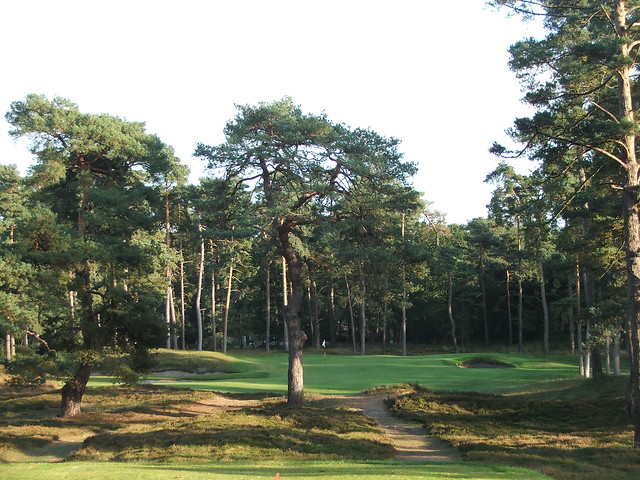
13th hole, par 3 with tree in line of play
Fourteen is a 339 meter (379 yard) par four with a fairway that slopes left to right the entire way with a distracting "snake" rock outcropping in the middle of the fairway. The rock looks like someone sculpted it, but in fact, it is naturally shaped like a snake's head. Fifteen is a 409 meter (450 yard) dog-leg left that plays downhill. Sixteen is a tough 415 meter (460 yard) uphill par four that plays to an elevated green.

"Snake" rock outcropping on the 14th fairway

15th green
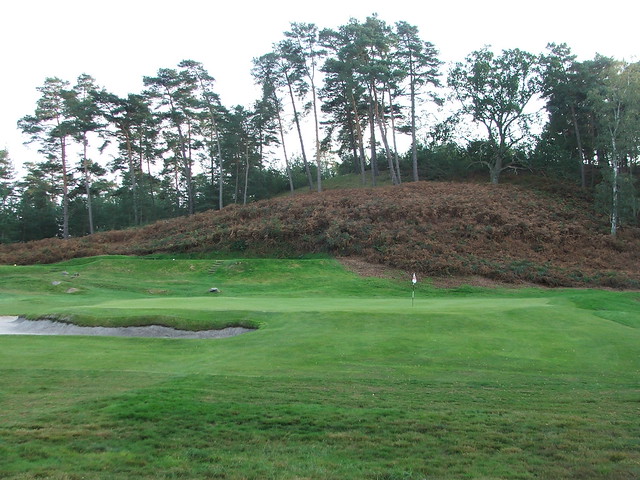
17th green
The par three seventeenth hole, seen above, has a mountain of fern plants rising behind it. This hole gives you a good feel for the sense of isolation you feel while playing at Morfontaine and shows off some of the elevation change that makes for good golf.
The Valliere Course
In one of the biggest surprises of all my trips, we played the nine hole Valliere course at Morfontaine, as well as the world-ranked eighteen hole course. I have to tell you that it was a special treat. I actually thought that the Valliere had more character than the eighteen hole course. Simpson designed the Valliere in 1911 and the first five holes have had no alterations at all from the original design. The Valliere course is a cross between Cruden Bay (idiosyncratic) and Woodhall Spa (heathlands). It is an extremely quirky and very fun round of golf. The first hole plays through a narrow opening in the trees and is a sharp dogleg right up a big hill. The third hole is one of the best I have ever played. It plays from an elevated tee engulfed in heather down into a valley filled with rock outcroppings. The fairway slopes right to left the length of the hole. The approach to this green reminds me of the approach to the second green at Cruden Bay: sharply uphill to a big and undulating green with a steep dropoff on the left. Despite being a driver-wedge hole it is still challenging and fun and plays as the number two handicap on the Valliere. If you miss your drive right you had better go back to your bag for another ball.
The Valliere Course
In one of the biggest surprises of all my trips, we played the nine hole Valliere course at Morfontaine, as well as the world-ranked eighteen hole course. I have to tell you that it was a special treat. I actually thought that the Valliere had more character than the eighteen hole course. Simpson designed the Valliere in 1911 and the first five holes have had no alterations at all from the original design. The Valliere course is a cross between Cruden Bay (idiosyncratic) and Woodhall Spa (heathlands). It is an extremely quirky and very fun round of golf. The first hole plays through a narrow opening in the trees and is a sharp dogleg right up a big hill. The third hole is one of the best I have ever played. It plays from an elevated tee engulfed in heather down into a valley filled with rock outcroppings. The fairway slopes right to left the length of the hole. The approach to this green reminds me of the approach to the second green at Cruden Bay: sharply uphill to a big and undulating green with a steep dropoff on the left. Despite being a driver-wedge hole it is still challenging and fun and plays as the number two handicap on the Valliere. If you miss your drive right you had better go back to your bag for another ball.

Approach to 3rd at Valliere
The Valliere course has more interesting and varied greens than the main course at Morfontaine. The main course didn´t have as many contours and undulations on the greens. The fourth at Valliere is a world-class par three that plays downhill and is surrounded by bunkers almost the entire way around. There is also a sea of heather in front of the hole and tons of ferns to the right side and behind. There is a false front to the green that is actually fairway, and is a bit of an optical illusion from the tee. This may now be my favorite par three in the world, it is that impressive and unique.

Par three 4th at Valliere
The fifth hole is a short par five (420m) that has a punchbowl green hidden off to the left between dunes and trees. There are two cross-bunkers across the fairway to catch shots that are laid up incorrectly. It has a severly undulating green. Again, this hole is very reminiscent of Simpson's work at Cruden Bay and is a treat to play.
The third, fourth and fifth holes are as good a collection of holes back-to-back as you will find anywhere in the world.
The third, fourth and fifth holes are as good a collection of holes back-to-back as you will find anywhere in the world.

5th green Valliere course


8th green Valliere course
We used the Valliere course as a warm up in the morning before playing the championship course, had a very nice lunch in the clubhouse and were so impressed with the Valliere that we played it again after lunch for a happy 36 holes of golf. In keeping with the French aversion to commercialism the "pro shop" at Morfontaine is a closet with some shirts, sweaters and hats. You know when the "pro shop" is open when they put the light on in the closet and open the door.
Post Mortem
Truth be told, I have always loved France. The food, the wine, the sound of the language, the culture, the sense of style and the sense of ceremony that surrounds every aspect of French life. I also love French cinema, Paris's old cobblestone streets, the beauty of the countryside, the distinctive police sirens, formal french gardens and tous les femmes sans bras! I know it is dangerous to generalize about a people, but often times it is based on truth. The French take better care of themselves than we Americans and are usually perfectly dressed and coiffed. They have a sense of style and panache that makes them unique, if a bit idiosyncratic. They care about their appearance. Compare this to the average coarse, corpulent, overstuffed-porker Americans you see walking around a shopping mall or airport wearing their Mickey Mouse tee shirts and sweat pants stuffing a Cinnabon into their mouth. Fifty percent of American adults have to wear those filthy sweat pants or jogging suits because they are so fat they can't wear real pants anymore even if they wanted to.
Also, the more I think about it, it is very difficult to dislike a culture that has a device in the bathroom that washes your buttocks, whose women sunbathe topless and where you get five weeks vacation. And, it is mercifully one of the few places left in the world where one can enjoy smoking a cigar indoors without being prosecuted.
Merci beaucoups!

Post Mortem
Truth be told, I have always loved France. The food, the wine, the sound of the language, the culture, the sense of style and the sense of ceremony that surrounds every aspect of French life. I also love French cinema, Paris's old cobblestone streets, the beauty of the countryside, the distinctive police sirens, formal french gardens and tous les femmes sans bras! I know it is dangerous to generalize about a people, but often times it is based on truth. The French take better care of themselves than we Americans and are usually perfectly dressed and coiffed. They have a sense of style and panache that makes them unique, if a bit idiosyncratic. They care about their appearance. Compare this to the average coarse, corpulent, overstuffed-porker Americans you see walking around a shopping mall or airport wearing their Mickey Mouse tee shirts and sweat pants stuffing a Cinnabon into their mouth. Fifty percent of American adults have to wear those filthy sweat pants or jogging suits because they are so fat they can't wear real pants anymore even if they wanted to.
Also, the more I think about it, it is very difficult to dislike a culture that has a device in the bathroom that washes your buttocks, whose women sunbathe topless and where you get five weeks vacation. And, it is mercifully one of the few places left in the world where one can enjoy smoking a cigar indoors without being prosecuted.
Merci beaucoups!

Simpson's course plan hangs in the clubhouse
My host was so impressed with my quest that he is attempting to arrange for me to attend a state dinner at The Elysée Palace so I can share my golfing secrets with the President of the Republic. Rumor has it, if I complete the quest I will be nominated for the Légion d'Honneur. Vive la France!
Despite my various run-ins trying to get onto this private French course, this was one of the best experiences of my journey. Morfontaine really can't be fairly compared to any other club I've ever been to. It is private, intimate and beguiling.
See a video of my 2010 return visit to Morfontaine as part of the puregolf2010 mania.
Tom Simpson
Morfontaine was the brainchild of a member of the French aristocracy, specifically The Duc de Gramont. In the interest of historical accuracy, since there have been fourteen holders of this title since 1643, it was the 12th Duc - Antoine Agnor Armand de Gramont, Duc de Gramont, who lived from 1879 until 1962. The Duc was a keen golfer and wanted a world-class course near his estate, Château de Valliere. He chose Tom Simpson as the architect for his dream course.
Simpson was one of a kind. He frequently wore a cloak and beret and was driven around in a silver Rolls-Royce.

Despite my various run-ins trying to get onto this private French course, this was one of the best experiences of my journey. Morfontaine really can't be fairly compared to any other club I've ever been to. It is private, intimate and beguiling.
See a video of my 2010 return visit to Morfontaine as part of the puregolf2010 mania.
Tom Simpson
Morfontaine was the brainchild of a member of the French aristocracy, specifically The Duc de Gramont. In the interest of historical accuracy, since there have been fourteen holders of this title since 1643, it was the 12th Duc - Antoine Agnor Armand de Gramont, Duc de Gramont, who lived from 1879 until 1962. The Duc was a keen golfer and wanted a world-class course near his estate, Château de Valliere. He chose Tom Simpson as the architect for his dream course.
Simpson was one of a kind. He frequently wore a cloak and beret and was driven around in a silver Rolls-Royce.

Course architect Tom Simpson
Simpson sounds like my kind of guy. Apparently, he had a flair for the dramatic. He once drove his Rolls-Royce slowly up and down in front of a club committee's window as they deliberated whether to accept his design as an architect. He also was on record as saying that no golf hole could be truly great unless it began to operate in the player's mind for some time before he actually came to it. He was also quoted as saying that "the vital thing about a hole is that it should either be more difficult than it looks or look more difficult than it is. It must never be what it looks." He liked his courses to demand 'mental agility'.
Tom Simpson was fond of quoting the words of Napoleon to his brother: "It is the greatest of all immoralities to engage in a profession of which one is ignorant." As the designer of Morfontaine, Chantilly and Cruden Bay, Simpson was certainly anything but ignorant. The man was a genius.
Tom Simpson was fond of quoting the words of Napoleon to his brother: "It is the greatest of all immoralities to engage in a profession of which one is ignorant." As the designer of Morfontaine, Chantilly and Cruden Bay, Simpson was certainly anything but ignorant. The man was a genius.
Post Script
Paris is as close to the ultimate civilized experience the world has ever seen. I love the human scale of the city. The French understand that in order for cities to excel they have to exist on a human scale and they have to be clean. Almost the entire old city is six stories tall, the ideal number of stories. Most have wrought iron railings, architectural detailing and fit in well with their surroundings. Paris still has tons of character, local shops, fresh food brought to local markets throughout the city every day and the best bread in the world. The little green trucks that ride around the city 24 x 7 cleaning, sweeping and emptying garbage cans ensure it a great place. I did a little experiment on my trip, testing out the bars at Paris's premier hotels. I recommend avoiding the Ritz, which is an overpriced tourist ripoff. The bar at the Hôtel de Crillon is nice, the Bar Fontainebleau at Le Meurice is better, but if you get a chance, you must have a drink at the Four Seasons George V, even if you don´t stay there. It is the best hotel in the world.
Paris is as close to the ultimate civilized experience the world has ever seen. I love the human scale of the city. The French understand that in order for cities to excel they have to exist on a human scale and they have to be clean. Almost the entire old city is six stories tall, the ideal number of stories. Most have wrought iron railings, architectural detailing and fit in well with their surroundings. Paris still has tons of character, local shops, fresh food brought to local markets throughout the city every day and the best bread in the world. The little green trucks that ride around the city 24 x 7 cleaning, sweeping and emptying garbage cans ensure it a great place. I did a little experiment on my trip, testing out the bars at Paris's premier hotels. I recommend avoiding the Ritz, which is an overpriced tourist ripoff. The bar at the Hôtel de Crillon is nice, the Bar Fontainebleau at Le Meurice is better, but if you get a chance, you must have a drink at the Four Seasons George V, even if you don´t stay there. It is the best hotel in the world.

A photo montage of Morfontaine


 Posts
Posts

