Friday, October 31, 2008

Kawana - Fuji Course


Add ImageMount Fuji

The Kawana Fuji course (ranked #80 in the world) is often called Japan's Pebble Beach because it is a golf resort set on cliffs near the ocean. The course is accessible only to hotel guests. Kawana is located in Shizuoka Prefecture, two hours from Tokyo on the Izu Peninsula. It is located within a national park on Sagami Bay. The course was completed in 1936 by Charles H. Alison, partner of the great H.S. Colt. Alison took a vacation at the Kawana hotel in 1930 and convinced the owner that he should use the amazing land here to build a golf course.

During the Second World War almost all the golf courses in Japan had to be converted into farmland to produce food. The remaining courses were taken over by the occupation forces. Hotel Kawana was taken over by the U.S. Eighth Army and was later handed over to the Australian troops to be converted to a recreation center.

Unfortunately, we played Kawana on a rainy day. When you travel 6,500 miles to play a course, you're going to play no matter the weather. I didn't have a particularly good nights sleep since rain was pelting the windows all night long. We delayed the tee time an hour because at breakfast it was still raining like a monsoon. We played the first three holes in a downpour, but luckily the weather got progressively better as we went along. The picture at the top of this post is of the 12,388 foot high Mt. Fuji, which you can see from the course only about a half-dozen times a year, given the vagaries of the weather patterns near the mountain.

Kawana is a beautiful Alison course with brilliant use of terrain, a lot of shot variety, beautiful bunkering and memorable par threes. The start at Kawana is one of the best in the world. You tee off from a high, elevated tee down into a narrow fairway with a view of the water in the distance. It reminded me a bit of the first tee shot at Spyglass. The drop off the elevated tee is quite dramatic, and drops about 100 feet. Riviera has a similar elevated first tee shot. My estimate is that the drop in elevation here is probably twice as high as the one at Riviera.

k1-3

Looking down the fairway from the 1st tee at Kawana

You can see from the picture taken off the second tee that the elevation change at Kawana can be quite acute throughout the course.

k2 fairway

2nd fairway with big sweeping hill

The third hole, pictured below, is narrow and the landing area is at an odd angle from the teeing area. The hole plays significantly longer than the 450 yards on the card. Kawana reminded me of playing in Northern California at times. Variously, it looks like either The Olympic Club, Spyglass and Pebble Beach. This hole reminded me of the narrowness at Olympic.

K3 Fairway

The narrow third fairway at Kawana

The greens are generally round and fairly small at Kawana. This one, of the fourth green, below, is typical of what you will find in terms of green shape or size.

k4 round green>

4th green at Kawana

The greens at Kawana are almost always elevated, as was typical of Alison's design style. They are also well-bunkered, as you can see from the most acute example on the course seen below, on the 18th hole.

k18-4

The 18th green at Kawana

This picture below was taken on the 17th fairway. As an island nation, the weather in Japan is changeable. One of the great aspects of playing golf is being out in the elements. Sometimes you catch the weather just right. Other times you have to adjust to the conditions at hand and enjoy the moment. Low clouds were blowing through quickly as we played the back nine. As the clouds lifted, it revealed the high mountains in the background. We just happened to be in the right place at the right time. It was probably a result of jet-leg, too little sleep and a mild hangover, but a couple of times while playing Kawana it felt like an out-of-body experience. Playing the 17th hole was a magical moment and illustrative of how enchanting playing in Japan was.

k17-2


17th fairway at Kawana


The terrain is so steep throughout the course that to get to the 5th tee box you have to take an outdoor escalator. I have taken an elevator before during a round of golf, namely, at Bel-Air Country Club in Los Angeles, but this is the first time I've taken an escalator.


Escalator to the par three 5th hole


The natural undulations of the terrain can also be seen well in this picture of the 9th fairway, below, looking backward from the green.

k9 back from green


9th fairway at Kawana


The 15th at Kawana is clearly one of the world's greatest golf holes. It is a par five that plays next to the Pacific Ocean on a high cliff with dramatic views. You hit over a deep ravine to a fairway below you and to the right. This part of the course feels a lot like Pebble Beach.

k15-2

The dramatic 15th hole at Kawana

After your tee shot the hole plays uphill and the fairway slopes from the right side to the left, toward the water. You are not immediately adjacent to the water; there is a buffer of bushes and you can clearly hear the waves crashing below you and see the water in the distance over the dense foliage.

k15 fwy-2

Uphill 2nd shot from the 15th fairway

The best view of how much waving and rippling there is in the fairway can be seen in this shot, below, taken from the green looking back on fifteen.

k15 looking back


15th hole looking back from green

Hitting your approach shot long to the 15th hole is not recommended, as you can see the steep drop off behind the green.

k15 green from behind


15th green as seen from behind


Planet Golf compares the terrain at Kawana to Turnberry, Mid Ocean and Pebble Beach. I've been lucky enough to play all three and agree that Kawana belongs in this small group of the world's most scenic courses. The difference at Kawana is that there is thick foliage between the edge of the cliffs and the course, but you can see the water from virtually the entire course.

Holes thirteen through fifteen are fabulous holes, as is the finish generally. Seventeen and eighteen both play uphill and are difficult holes. The only weak stretch of holes is eleven and twelve, which appear a bit out of character with the rest of the course. The Korai greens, a thick bladed (like bermuda) grass, are slow.

Joe DiMaggio and Marilyn Monroe stayed at Kawana on their honeymoon in 1954, and my sense is that the beds in the rooms are still the same ones. The resort is a bit dated, and the dining room has the ambiance of a corporate cafeteria, but if you are in Japan it is worth the two hour journey south of Tokyo to see this C.H. Alison beauty.

Since Kawana is a public course, it is the only way most people can play a course designed by Charles Alison, the maestro of golf course design in Japan. A round of golf at Kawana is ¥26,500 or about $265.

I would personally rank Kawana higher than #80 in the world.

Kawana's website


Two interesting photos from the late 1940s showing American soldiers at Kawana during the occupation. Note the American flag flying over the pool:


Sunday, October 19, 2008

Japanese Golf Etiquette - A 12 Step Program

Near the first tee at Naruo

Japan is a highly ritualized and organized society. Playing golf in Japan is no exception to their ordered lives. There is a strict protocol and structure to playing in the land of the rising sun. Playing in Japan can be more accurately described as a day of golf rather than a round of golf. This is not a country where you throw your bag over your shoulder and walk nine holes after work. Having just completed playing the top three private courses and one resort course, I can offer the following advice to my fellow golf adventurers traveling to Japan:
1. Play with long pants - Golf at a private course requires long pants. Japan is a very hot and humid country and it would be nice to wear shorts, but long pants are required at private clubs.

2. Wear a jacket upon arrival. Like at the exclusive Garden City Golf Club in New York and Muirfield in Scotland, the proper protocol when arriving at a private Japanese club is to wear a jacket.

3. Arrive on time. Don't arrive early and don't arrive late. In a country where subway trains arrive the second they are supposed to, there is a premium put on punctuality. Bow when you meet your host and thank him profusely for hosting you. Bring a small gift and give it to your host when you meet him.

4. Check-in. When you arrive at the club for the round you will be greeted with a reception area similar to a hotel check-in. You will be given a little card holder and locker key with a number on the front. If you want to buy something in the pro-shop or halfway house, you sign the chits with your assigned number and everything is charged to the card. As you leave, you settle the bill. As with most payments in Japan, credit cards are accepted but as with most transactions in Japan, they prefer cash.


The caddie assignments at Tokyo golf club

5. A pre-round cup of coffee. If your host offers you a cup of coffee before the round, have it. All three hosts offered me coffee before the round, which you take sitting in the grill room as a prelude to the round.

6. No tipping. There is no tipping in Japan, period. This includes caddies, locker room attendants, etc.

7. Sign the sheet the caddie hands you. When you go out to play you will have a female caddie. She will have your bag already loaded on a cart and will have counted your clubs. You are asked to sign off on the number of clubs in your bag before teeing off and at the conclusion of the round. Since she won't speak English and the sheet she hands you is in kanji characters, it took me a while to understand what I was being asked to sign.

A Japanese caddy

8. Lunch after nine holes. Unlike in the U.K. and the U.S., you stop after nine holes and have lunch. Lunch includes a beer before and coffee afterwards. I got a couple of dirty looks when I tried to skip either the beer or coffee, so I suggest having both. If you are not an adventerous eater and are worried about getting fish heads or some exotic dish, most courses have a curried rice dish that you can always fall back on. Some courses will give you a back nine starting time as you go in for lunch, others allow you to tee off on the back when you are ready. You will stiffen up pretty good at lunch, usually making the 10th hole an interesting hole.

9. Post-round communal hot bath. After the round, the fun really begins. The pièce de résistance of any Japanese golfing experience is the bath, known as o-furo. Your locker will contain a pair of small plastic slippers that will be about three sizes too small for your feet. After you finish playing, take off your golf shoes and put on the slippers. Leave your clothes on, but take a change of clothes with you. Head toward the bath area. As you enter, take off your slippers and walk to a changing area filled with baskets. This is where you take off your clothes and grab a small towel.

Whatever you do at this point, do not grab a large towel, it is a big breach of protocol. You then enter the shower area with your hand towel. There are western style showers available which are acceptable to use, but most Japanese men sit on foot-high little wooden stools and wash themselves vigorously out in a big open area. Japanese men are very reserved in all aspects of their lives except washing themselves in public. They embrace the task with such élan that I was taken aback each time I saw it.


After you have finished cleaning up, the custom is to take a communal hot bath. We're talking buck naked, boys. No towels to hide behind and no bathing suits allowed. Picture fifteen of your geriatric best friends together in a large hot tub immersed in water up to your neck, and you get the idea. Some of the bathers put the little towel on top of their heads during the bath, which makes them look like some sort of escapee from a lunatic asylum. The whole thing looks like it comes straight out of a Fellini movie.

The biggest faux pas possible would be to jump right into the hot tub without first showering. You would show yourself to be the ultimate gaijin (foreigner)and I shudder to think what would happen. It's the equivalent of peeing into a swimming pool back home.

Once you get it through your head that this ritual is not some sort of trick designed so that everyone can stare at your chibi anatomy, the whole bath routine is a nice way to finish off your round and does help your back feel better. Be warned that the scalding water can lead to an unexpected contraction of your most important organ.

Leaving the shower area, you must put the slippers back on after you dress to walk back to your locker, but only after stepping out of the area with the baskets. It is hard to remember the precise sequence of all these steps since there are so many little nuances. The first time I did this whole thing I got some disapproving stares because I walked to the bath area wearing only my BVDs. Oops. Saru mo ki kara ochiru (everyone makes mistakes).

10. Post-round drink. Have a post-round drink, usually beer, and try to regain your dignity.

11. Learn the word arigato. Arigato means thank you in Japanese. If you say it about 300 times a round, you're off to a good start. It is also ok to say, 'goo shot' if a Japanese player hits a good shot. I know it sounds goofy, but it's a bastardized English expression that you will hear often.

12. No gimmie putts. I'm not sure if this is true all over Japan, but the members I played with at all three courses didn't give any putts. Not even a three inch putt.

Friday, October 17, 2008

Shinkansen - The Bullet Train

A bullet train passing Mt. Fuji

We took the Shinkansen yesterday from Tokyo to Kobe to play the two highest rated courses in Japan - Naruo and Hirono. The Shinkansen goes at a maximum speed of 188 miles per hour and is more commonly known as the bullet train. The train has a smooth ride, but to be honest was a bit of a disappointment since you don't really feel how fast the train is going while you're on it. The other problem with the train is that the view out the window isn't exactly of the French countryside.

Japan is a highly industrialized, developed nation where essentially every square inch of land that is not mountainous is fully developed. If your cup of tea is poorly designed housing units and factories, you'll love the view.

Bullet train arriving in Tokyo Station

Several things did catch my attention though. One is the continued politeness of the Japanese. The train conductors bow each time they enter or exit a car and are highly respectful, as is everyone here. The other thing that was ideal is that no-one, repeat no-one speaks into their cell phones on the train. There are only small areas of the train where cell phone use is allowed and it makes for a very pleasant ride.

The golf here is incredible, I will be putting up my course reviews between now and year end, and you will be amazed at the quality of the courses.

A sneak preview below, Kawana's 15th hole:

Wednesday, October 15, 2008

Japanese Driving Ranges

Japan is a golf obsessed country and has driving ranges located everywhere. Whenever you drive down the highway you will see tall green netting, indicating a driving range. Since land is at such a premium, the ranges are small in shape and vertical - usually three stories. The range below is in the city of Osaka and is three levels.


Most of the ranges are mechanized - a ball pops up after you hit your ball and the ball cleaning machines are automated, scraping across the ground to retrieve the balls.

The Japanese are golf obsessed and it's quite a sight to go to a driving range at 10:00pm at night and see all the range players hitting balls.

Monday, October 13, 2008

Japanese Caddies

Caddies in Japan are women in helmet-like hats draped with long white hankerchiefs, long pants and long sleeved shirts


Friday, October 10, 2008

Golf in Japan - Arrival


Well, here I am.

I made it to Japan. Fourteen and half hours and thirteen time zones later, I arrived at Narita airport in Tokyo. Tokyo is the largest metropolitan area in the world - with 35.5 million people. The next three largest are significantly smaller: Mexico City 19.2 million, Mumbai 18.8 million and New York 18.6 million.

Japan is a golf obsessed country. It has 2,300 courses, which is more courses than Scotland. I am looking forward to the trip. According to Links Magazine it is customary in Japan to stop for a full lunch, hot-springs immersion and an hour-long massage after nine holes. Bring it on!

We are past tsuyu (the rainy season), so hopefully the weather will cooperate with us. Time permitting, I also hope to rise early one morning and see Tsukiji , the world's biggest fish market. Perhaps some Sumo wrestling, and hopefully we'll have time to catch a Japanese baseball game.

Elevated expressway through Tokyo

The first course built in Japan was the Rokko golf club in 1901, near Kobe. In 1930, Joe Kirkwood and Walter Hagen went to Japan at the invitation of the Japan Golf Association and played ten exhibition matches. After their visit, golf started to take off, with thirty courses built in the next few years.

Many of the courses in Japan have two sets of greens because the summers are so hot and humid, the idea is to lessen the wear on just one set of greens. Japan is a small country with a large population, a lot of the land is steep mountainsides unsuitable for living or golf. There is a law against converting farmland to golf courses.

One name I have already become familiar with is C.H. Alison, a British golf course architect who visited Japan in the 1930s and was responsible for almost all the world-ranked courses in the country.

My course lineup includes:

Hirono Golf Club (ranked # 35) - Japan's most distinguished golf club
Naruo Golf Club (ranked #75) - Japan's Hidden Gem
The Kawana Fuji course (ranked #80) - Japan's Pebble Beach
Tokyo Golf Club - The most prestigious club in Tokyo


I'm eager to expand my vocabulary, my waistline and my golf repertoire. Get the Kobe beef ready and keep the Sapporo chilled. The American Embassy has warned the Japanese people - for the next week - bring the women and children indoors. The complete jackass gaijin (foreigner) has arrived.

I will post frequently to keep you up to date.

Tuesday, September 30, 2008

20 Years, Seven Months, 27 Days...

I was interviewed by the local paper recently and they asked me when I thought I would complete playing the top 100 courses. I said that I was pretty certain I would have 99 out of 100 within three years, but that playing Augusta was going to be difficult and far from certain. A few days later I was contacted by a fellow self-described 'compulsive person' who completed playing the world's top 100 a decade ago. It took him 20 years, seven months and 27 days to get on Augusta, but he managed it.

Bernie Hiller now takes a revered spot in my honor roll. Read on...

Reprinted with permission from The New York Post, January 25, 1999

"Finally, I got to play Augusta. I played with the dishwasher. It took me 20 years, seven months and 27 days from the time I first started trying to get on it." --BERNIE HILLER


The hardest to access course - Augusta National

You can't out-original Bernie Hiller when it comes to golf experiences.

You also cannot insult him. He's become used to (numb to?) being called crazy, nuts and out of his mind. His wife calls him these things daily.

To say that Hiller is a compulsive, moderately-eccentric man who's on a mission from God to get his way is to say that the greens at Augusta National are difficult to putt or that Pine Valley is an awesome golf course. (More on those two courses in a moment).

Hiller is a 71-year-old Long Island resident who had a vision back in 1974 - Oct. 1, 1974 to be exact. And, to put this as mildly as we can, Hiller would not allow himself to be denied fulfilling his dream.

"I got a book from Golf Digest about the 100 best courses in the U.S. and I said, 'God, I would like to do this someday,'" Hiller was saying this week.

By "doing this someday," Hiller meant playing the 100 of the best courses. All of them. Honest.

And so he did, officially completing his methodical, self-funded mission in November of 1997. That mission, by the way, was modified from the top 100 courses in the U.S. to the top 100 courses in the world.

Hiller, who's in the life insurance business, has traveled as far as New Zealand, Australia, South Africa and Japan - just to play these great golf courses. He's done it, for the most part, by writing letters to the courses and asking on.

His most difficult conquest was Augusta National.

"I'd finally almost finished the U.S. list, getting up to No. 99, but I could never get into Augusta," Hiller recalled. "I calculated that I talked to at least 5,000 people trying to get onto Augusta.

"Finally," Hiller went on, "I got to play Augusta. I played with the dishwasher. It took me 20 years, seven months and 27 days from the time I first started trying to get on it."

On May 27, 1995, after being connected with the Augusta National dishwasher by a mutual acquaintance, Hiller, a 16 handicap now, conquered his toughest quest - shooting 85 at the home of The Masters. It was made possible because in late May the club employees are allowed to play the course with one guest.

"It was one of the great rounds of my life," Hiller said. "I swear I heard the 25,000 people applauding when I got off 18. I still get chills talking about it."

Hiller's favorite course of all - what he calls "the most enjoyable course in the world" - is not even on any of those top 100 lists: The Gold Course of the Golden Horseshoe in Williamsburg, Va.

He calls Pine Valley "the greatest golf course in the world, no ifs ands or buts." He said he loves Pebble Beach and added, "There's no greater hole than the 16th at Cypress."

"I rate, right now, Bethpage Black in the top 10," Hiller said. "I think it's better than Shinnecock."

Hiller said he has his own rating system for courses.

"I look at a golf course as a piece of sculpture made out of the basic elements of sand and grass and trees and water," he said. "I go along with some of the Golf Digest criteria - identifiability, memorability, diversity of holes, quality of the course itself and degree of difficulty. Then I add my own: enjoyment."

Hiller estimated that he's spent somewhere around $100,000 in his quest. He said he buys a shirt from each course he played, estimating that he's spent about $12,000 on shirts alone.

His mission nearly never culminated as he nearly died trying to complete it. While attempting to play the 100th of the world courses, Hiller collapsed in South Africa with heart problems the day before he was to play Durban Country Club.

After a night in the hospital, though, "I got up the next morning, teed off at 1:30 at Durban, and walked the whole way," Hiller said. "It was finally No. 100. My hands were shaking. The next morning at the airport, the same [heart] thing hit me. When they called my cardiologist back home, he said, 'Let him die, because he's too stupid.'"

17-5

Durban's spectacular 17th hole

The morning Hiller arrived back to the States, he had open heart surgery.

"But I did it," he said. "I know that had I died that time, all my friends would have said, 'He died happy playing that golf course.' It's a craziness, I know. But I'm a very compulsive person."

Monday, September 15, 2008

The Honors Course


The quest to play the best golf courses in the world mandates a stop in Tennessee. My friends from overseas are scratching their heads about now. Tennessee? Yes, friends, Tennessee. You know, the home of Graceland, Opryland and Jack Daniels.

The Honors Course (ranked # 96 in the world) opened in 1983 and is located in the town of Ooltewah, near Chattanooga, Tennessee. Ooltewah is a Cherokee name that means "resting place".

The Honors Course ranks right up there in the 'most difficult to find' category of courses. At least Chicago Golf Club has a small sign out front. To find Muirfield, you can look for the Greywalls Hotel next door. Morfontaine, near Paris, is genuinely difficult to find, as is The Honors Course. The course is located at 9603 Lee Highway. You can type the address into Mapquest and it will map out a route for you. Even armed with this useful information, we drove right past it. Then, retracing our route and paying close attention, we ran right by it again without the slightest inkling that it was there. Doubling back, the third time, we missed it as well. After we called the pro-shop the nice lady told us to make a left at the white propane tank, and sure enough, across from Chattanooga Propane Company there is a very small un-marked road, hidden deep in the trees.


Entrance

The discrete entrance to The Honors Course

The Honors Course is one of a small genre of destination courses that attracts members from well beyond its local geographical area. Much more than a golf course, the Honors Course is a little enclave and has a series of lodges that allow for visiting players to stay for a day or two on-site. Pine Valley and Augusta are the most established destination courses. Sand Hills is the best known of the modern destination courses. The Honors Course was the idea of "Jack" Lupton, who was a friend of Bobby Jones. Lupton is a member of both Seminole and Augusta, and the latter course was his inspiration for this course. His idea was to honor amateur golf and Tennessee golfers, thus the name of the course. The Honors Course is a private affair with a membership of 325, most of who were personally selected by Lupton. Like at Pine Valley and Oakmont, Lupton follows the benevolent dictator model, and it has worked very well.

Just like at Yeamans Hall, you know that you have arrived somewhere special the moment you manage to find the turn off the highway. Once beyond the gate, there is a long winding driveway that takes you up to the discreet, small clubhouse and pro shop. It's always the little things that make a big difference, and at The Honors, they get them all right. They not only take your bags out the car, but valet park it for you. They anticipate when you are going to leave and have your car pulled up and ready to go when you are. The caddy program is outstanding, the food is great (I recommend the Shrimp Po'Boy Sandwich), the grill area is cozy and the service is super. Around various tee boxes on the course are three tasteful and unobtrusive wooden barrels - one filled with chilled water bottles, one filled with chilled soda bottles and one filled with chilled beer. Elvis has left the building, ladies and gentleman!

Although the course is relatively young, it has hosted the 1991 U.S. Amateur, won by Mitch Voges and the 1996 NCAA championship won by a young Eldrick Woods.

The Golf Course

The course was designed by Pete Dye. In the past, I've had a hard time getting excited about Pete Dye courses. I like Harbour Town and The Ocean Course at Kiawah and Casa de Campo has nine great holes. I despise the TPC at Sawgrass and couldn't find inspiration to write about Whistling Straits. The Honors Course, though, made a big impression on me. I was especially impressed with how Dye was able to vary the routing here to create an exceptional balance between easy and difficult holes, long par fours and short par fours, and a difficult course that is also playable for a mortal. Although the slope rating is 145, the course doesn't wear you out like an Oakmont or Bethpage Black.

I was especially impressed with two short par fours, which are great risk-reward holes. The par four 9th hole is only 355 yards long. You probably won't see your tee shot land, as the landing area is semi-blind. The second shot is a wedge to a green protected in front and on the left by water. Dye has said about the 9th at The Honors, "every course needs a #9 - one of my rare forced carries to a par four green". His execution of the hole here is very well done; the design is subtle and really penalizes a mis-hit shot.

#9 green Approach to the 9th green

The other great risk-reward hole is #12, a 355 yard par four with a small fairway and a huge tree blocking the green on the right side. Being able to place the ball on the left side of the fairway is of paramount importance off the tee. Doing so, however, does not assure a birdie or par. Again, like #9, even though you are hitting in a very short iron, the green is narrow and well protected. As Dye correctly says about his pot bunker in front of the green, "This bunker can spell disaster for even the most accomplished player."


#12 greenside tree
Tree blocking the approach to the 12th green


The course is built on a huge expanse of land on 400 acres and meanders around the property in an artful fashion. Usual Dye features are present at The Honors Course such as the mounding and grass bunkers seen here on the second hole, below:

#2 fairway
Grass mounds on the 2nd fairway


Dye also has a nasty habit of leaving trees in the line of play to create a preferred side to approach from, as seen here on the fourth hole. Also notice that this green has no greenside bunkers. None are necessary as there are closely shaved areas on three sides of this elevated green.


#14 par 3
Tree guarding the 4th green

Hole number six, a par five with an elevated green also has no greenside bunkers and another pesky tree lurking near the green.


#6 to green

The well protected 6th green

The #1 and #2 handicap holes surround a man-made pond and both require heroic shots over water to secure a good score. Holes #7 and #15 are mirror images of each other on opposite sides of the pond. Remember, I said Dye mixed in long and short par fours. This is the part of the program that features the long fours. These two gems are 410 and 420 yards and require both your first and second shots to be both long and accurate.


seventh green
seventh green

The par three 14th, below, shows off the diversity of holes Dye designed at The Honors Course. You won't see a lot of railroad ties here. You will see a variety of hole styles, doglegs and elevation changes. In hindsight, I'm not a raving fan of Pete Dye because his courses often have a manufactured look to them. I like The Honors Course best of all his work because it has a natural look and a sense of polish to it, without being forced, unlike many of his other courses.

#14 par 3 green

The 14th, a par three

The eleventh hole is a 545 yard par five that features a generous driving area off an elevated tee. The elevated green seen below has mammoth bunkers in front, guarding the green. The mounds on this hole were created by piling up the tree stumps and logs from the construction of the course.


#11 green
The beautiful approach to the 11th, a par five

Tennessee

Playing The Honors course was a bit of a homecoming for me. My first round of golf ever was played in Tennessee nineteen years ago. It felt good to be back in Tennessee!

My last name ends in a vowel, and it's clear to anyone south of the Mason-Dixon line that I'm not from around here. As my readers know, however, I'm a big fan of the Southern way of life and Tennessee is no exception. I appreciate a distinctive accent and I particularly like their brand down here. They don't drive cars here, they drive vee-hickles. Appropriately, they ask if you need dye-rections to get back to the airport. Many locals are genuinely fascinated to finally meet an eye-talian in person since they didn't realize there were so many different types of Yankees and there are not too many paesanos down here. I also like the distinctive feel of little Southern towns, the local barbecue and the generally slower way of life.

Local 'Bar-B-Que' joint in Ooltewah

Among the notable animals I have played alongside in my travels are pheasant at Shadow Creek in Las Vegas and monkeys at Durban in South Africa. The Honors Course has wild turkeys running through it, which adds to the distinctive feel of the place.


Wild Turkeys roam around the Honors

I understand that the club founder and President Mr. Lupton is in ill health and only rarely gets out to the course nowadays. My best wishes to him. He did good here. He created a modern day Yeamans Hall in Tennessee, which is intended as high praise for a Southerner. The club manages a feeling of gentility that so few others ever do. With so many fools like Donald Trump trying to create magic by putting in asinine features like waterfalls and other trickery, Dye and Lupton have managed to pull off an extremely difficult feat at The Honors - being true to the spirit of the game, building a world-class golf course and having the understated nature of the club shine through.

I strongly disagree with Tom Doak's assessment of The Honors in his Confidential Guide where he states, "there aren't many notable holes: only the par-4 7th, a neat solution to putting a hole along the dike of an irrigation pond, but otherwise one of the most gimmicky-looking hole Pete Dye ever built". Doak continues, "I must admit, though, that much of my disdain for the course is due to the attitude the club presents. It's one thing to aspire to Augusta, but you can't create tradition overnight, and you certainly shouldn't be complaining about rival new courses being less traditional than your own. I don't think you ought to be able to have it both ways, seeking high rankings and national tournaments while trying to remain extremely exclusive at the same time."

Tom got it completely wrong. The opposite is true.

Monday, July 14, 2008

Summer Holiday


I will be taking a short break from posting to enjoy the remainder of the summer. I will resume posting around the Ryder Cup with an exciting lineup of courses.

As my regular readers know, I have been trying to arrange a trip to play in Japan, home of three top 100 courses. On the good news front, I have a trip arranged for the Fall and will be providing a blow-by-blow account of my Asian trip while there, with plenty of pictures.

As I mentioned in my writeup of Friar's Head last year, the party looked like it was about to stop. The excess display of wealth that their grandiose clubhouse represented signaled to me that there was trouble ahead. Trees don't grow to the sky and excessively extravagent golf courses can't be built forever. Not only is Loch Lomond being put into receivership, but tales of woe abound in the high-end golf circuit about Wall Streeters having to put their $3 million Hamptons home on the market at fire sale prices and having to ditch the kids private tennis coach. A recent apres-round Southside at Maidstone confirmed a sense of schadenfreude among the Social Register crowd. I can attest that they are feeling no pain at this WASP bastion and a pullback among the masses puts them squarely back at the top of the heap. Their grand-parents made money the old-fashioned way, unlike these upstarts, so it can be satisfying to see the arrogant new money types get their comeuppance.

The mortgage meltdown and bear market are inflicting pain on many of us, your faithful blogger included. The small indignities I have had to suffer include doing my own laundry to save on dry cleaning and taking the subway instead of a black sedan. Worst of all, I will be doing the fourteen and a half hour direct flight to Tokyo in coach. I can hear the sympathy cries going out now. Thank you for your support. These are in fact, tough times.

I must say that I hope our own Gilded Age is not at and end. I am pulling for the new-money types to make a comeback. They have been a good source for me to gain access to some of these high-end private clubs.

Below are two pictures from the Charles Blair Macdonald gem in Bermuda, The Mid Ocean Club, taken during more prosperous times. Have a safe and enjoyable summer!


The 3rd hole at Mid Ocean

View from the 18th tee at Mid Ocean

* My two proof readers (in their 20s, like many of my tech saavy readers) didn't recognize Gregory Peck and Audrey Hepburn from the 1953 classic Roman Holiday. Their loss.

Monday, June 30, 2008

Merion - Drama, Comedy and Tragedy

It's not often that I re-post a course write-up. I got a chance to play Merion again earlier this year with my digital camera in tow and have posted some great new pictures with this new posting.

Shockingly, many of my readers inform me that they like my pictures more than my prose. Humbug.


Most major cities have their well-healed suburbs - in New York Greenwich and Darien. In Chicago, the communities along the North Shore of Lake Michigan. In Philadelphia, the affluent leafy suburbs are known as The Main Line. Named after the train line west of the city, the Main Line is old-world, understated, affluent and traditional. Merion is located in the heart of Philadelphia's Main Line and plays the part well. The land that the course and clubhouse are on trace their title back to William Penn.

Memory is not one of my strengths. One minute after meeting someone, I don't remember their name. Many times I have had to look at the bag tag of the member I'm playing with every three holes to remember his name and not make a complete fool of myself. And, I have gotten very good at not saying names. "Nice shot" instead of "Nice Shot, Dave", in case his name is in fact Bob.

There is, however, a part of my memory that works very well when it sees something memorable. I have found that the mark of a truly great course is how well you remember it both immediately after a round and six months later. Using this measure, Merion is a truly great course. After playing it once I could describe every hole in detail. The shape, terrain, bunkers, doglegs, green contours, etc. At Pebble Beach you sort of feel compelled to like the course because it is so pretty and everybody raves about. But, if you're being honest with yourself, aside from the eighteenth hole, can you visually remember all of the holes at Pebble? I'll bet you can't. Merion is seared into my memory. So far this has happened to me on only three courses in the world: Merion, The National Golf Links of America and Cruden Bay.


The 18th green as seen from the second floor locker room

What makes Merion so memorable? It is the ultimate strategic golf course. It is not a terribly long course. At Merion, you have to hit the fairways or it will be a long day. Second, you have to be on the correct side of every fairway in order to have a decent shot at the green. And finally, you have to be on the correct part of the green or you're in three putt territory. On every green. Also, the shot variety is really good as are the changes in direction, doglegs and uphill/downhill shots. No monotony here. As if the golf course itself is not good enough (and it is) you also have the grandeur and majesty of the white pillared clubhouse and the Bobby Jones and Ben Hogan history.
Bobby Jones with his grand slam trophies at Merion

If there was ever a course that new equipment risks destroying, it is Merion. It is too bad that the U.S.G.A and R. & A. have let the situation get out of hand and length is now the primary driver of competitive golf. It would be a shame if this course is lost from major competition forever.

I consider Merion to be the spiritual home of golf in the U.S. due to its greatness, its history, its association with Bobby Jones and the architecture of the course and the clubhouse. Merion's east course was designed in 1912 by Hugh Wilson, a Princeton graduate and captain of their golf team. The club traces its roots back to 1896 as you will see on the club's logo and evolved from the Merion Cricket Club.

This is the first course Bobby played a major on (the 1916 Amateur), the first course he won a major on (the 1924 Amateur) and the last course he played competitive golf on (the 1930 Amateur), completing the fourth leg of the Grand Slam at Merion in September 1930. Also, the classic photograph which is the golfing equivalent of the ironic shot of the sailor on V.J. Day kissing a woman in Times Square, was taken at Merion.

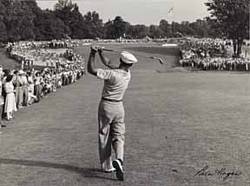
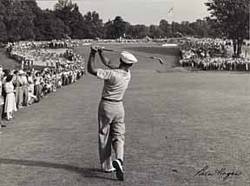
Ben Hogan on Merion's 18th hole at the 1950 U.S. Open

Taken by Life Magazine photographer, Hy Peskin, it shows Ben Hogan hitting a one iron on the eighteenth hole in the 1950 U.S. Open. It is an iconic picture of this great player at one of the most historic of courses in a perfect finish position. Hogan almost stopped playing during this final round because he was in such a state of fatigue recovering from a near fatal car accident the year before. Hogan hit the one iron onto the green and made a par to qualify for a three man playoff the next day which he would go on to win. It is one of the most heroic finishes of all time.

The short par three 13th hole as seen from the tee, shows off the Merion bunkers

Merion has many unique characteristics: the red wicker baskets as flags, the bunkers with clumps of grass in the middle (known as the white faces of Merion) and the scene around the first tee. You tee off right next to the outside patio with its green-and-white striped awning, with members and guests about five feet away from the tee box. It is one of the best opening holes in golf. The view in all directions is impressive; the clubhouse building with its white-washed stone and porch, the green awnings, the mature trees, the wicker baskets.  The wicker baskets are red on the front nine and orange on the back nine.

Merion also still has what has unfortunately become a rare entity in American golf: Experienced caddies, and lots of them. The clubhouse, which is listed on the National Register of Historic Places is the golfing equivalent of St. Peter's. Also, like the Vatican, Merion upholds the traditional and the conservative in the game and in many ways is truer to the traditions than golf's governing bodies because they don't have to compromise with the equipment manufacturers. In addition to no pin flags, there are no yardage markers, no range finders allowed and no golf carts.

In the clubhouse and on the course at Merion you naturally speak in hushed tones and in a respectful manner. It sounds absurd but it is close to a religious experience.

Looking back from the first tee at Merion

Merion is also what I call a deceptively long short course. How about two par threes that can play more than 250 yards each? The third and seventeenth are long par threes with exceedingly difficult greens. Yes, the course has some short par threes and some short par fours but there are also some quite long holes mixed in. Part of the genius of architect Hugh Wilson was the mis-direction he used from the teeing grounds. The first hole is a good example as the tee point toward the left rough. The eleventh tee is pointed toward the right rough and the finishing hole directs the golfer toward the trees to the left of the fairway. Very subtle, but important. Most of Merion's greens are also set at an offset angle from the fairway, making the distance tough to judge and ensuring that missing the green is always in play.


The first tee as seen from the 18th green

No question it is one of the best opening holes in golf, along with Prestwick and The Old Course at St. Andrews. The tee box is located right next to the dark green awning next to the big tree. Since you are standing five feet from the membership having breakfast or lunch, it is a high pressure tee shot. How do you keep a short course relevant? Merion is a classic example of how. The fifth hole is a good example, a long par four with a stream all the way down the left side. This hole was designed along a side hill so the entire hole, fairway and especially the green slope from right to left. All but two perfectly struck balls will end up far left of your intended target.

The par five 4th green plays over a little brook and like many at Merion slopes back to front

The fourth hole (above) is a downhill par five that requires a precision shot, normally from a downhill lie, to a well bunkered green over a creek. Merion also features a half-dozen or so blind shots including this tee shot. The world-class eleventh also features a tee shot where you don't see your ball land either, as does the challenging sixteenth hole which begins the plan through the quarry.

The green on the short but tricky par four 7th hole

The green on the 11th hole, one of golf's most historic. Jones finished the grand slam on this green

When you play the eleventh hole, where Jones finished his match in the 1930 Amateur to win the Grand Slam, you have chills up and down your spine. I have, on the half dozen times I've been fortunate enough to play. Like most holes at Merion, there is just no margin for error on approach shots to the green. Dan Jenkins describes the shot into the eleventh green with absolute clarity as, "There is hardly any shot that will do except the perfect one." The hole is under 380 yards in length, so likely you will only be hitting a wedge, however, the combination of the small green, the water on three sides and the historic setting make it a nerve-wracking shot.

IMG_0267
The 11th green has a myriad of hazards and a small, irregular shaped green. Hitting short into this bunker is no picnic

IMG_0269
This shot of the 11th green from the side looking backward gives a good perspective on the narrowness of the green. One of the best examples of how to make a short hole difficult. Hugh Wilson was a master of his trade.

13th green - short par 3 near the clubhouse

16th "Quarry" hole approach to green. Better check your knickers.


IMG_0256
The golfer is asked to this this fairway on the 16th hole. This view is from down in the valley and shows the narrow and winding nature of the fairway. From the tee, you can't see much except a few contours and outlines. And the tee shot is the easy one on this hole. The approach and putting shots are real testers.

The sixteenth, seventeenth and eighteenth play through an old quarry and are demanding finishing holes. After hitting a tee shot on sixteen to a snaking fairway that is not visible you face one of the most difficult shots on the course. There is a forced carry over the teeth of the old quarry to a diabolical green. The green is multi-tiered and slopes back to front. Being long when the pin is below you will mean an almost certain three putt. Seventeen is a long downhill, challenging par three. If there was such a thing as a par 3.5, this hole would be it. A par feels like a birdie. The drive on eighteen is back over the quarry. If you are lucky you will hit to where the famous plaque is where Hogan hit his famous one iron shot. Merion unquestionably has one of the best finishes of golf anywhere.

The sun setting on the 18th green

IMG_0262
Nowhere are the white faces of Merion more of a hazard than on the 18th green. This dicey collection greets the golfer who has the misfortune of hitting short left. They are to be avoided at all costs as they are sure to lead to at least one missed stroke

Golf Digest editor Jerry Tarde described Merion as a three-act play: The Drama of the first six demanding holes; the Comedy of the next seven short, precision holes; and the Tragedy of the last five punishing holes. As the players in the 2013 U.S. Open found out, Merion still has teeth even as a 'short' course. The combination of canted fairways, subtle breaking and very fast greens, forced layups on many holes and an unheralded number of long holes mixed in continue to make it relevant. it was no surprise to me that the par four fifth hole which slopes from right-to-left the entire way, played so difficult. Only one player played it under par over four rounds. Also, no surprise that the finishing hole proved difficult. No player birdied it on Saturday or Sunday.

Merion is one of my personal top five places to play golf. If you get invited to play Merion, by all means make the pilgrimage.