Friday, August 14, 2009

Whistling Straits


Whistling Straits (ranked #53 in the world) is located in Kohler, Wisconsin, about 90 minutes north of Milwaukee. Built by Pete Dye in 1998, it is a beautiful course. If you want to know what it is like to play golf in Ireland but don't want to fly across the Atlantic, Whistling Straits is as close as you'll ever get. The land the course was built on was formerly a U.S. Army base. Owner Herb Kohler instructed Dye that he wanted the course to resemble Ballybunion.

The eight holes that play along Lake Michigan are the most dramatic. Similar to his work at Casa de Campo, Dye does a brilliant job of situating green sites along and above the water. The course is also over-run with bunkering. Many holes have scores of bunkers. Golf Digest estimates there are more than 950 bunkers on the course. That means on average there are 50 bunkers per hole. For basis of comparison, Winged Foot West and Merion East have less than 150 bunkers each on the entire course.

Many of the bunkers don't actually come into play, but they give the course a dramatic and rough and tumble look. The dog-leg right eighth hole is especially noteworthy in this regard. It has a lot of small natural looking bunkers cascading down the hill between the fairway and Lake Michigan.

Like at the Bandon Resort, at Whistling Straits you can only walk, there are no golf carts. This is to maintain the aesthetic in keeping with that of a links course. Cart parts would have ruined the look of the course. The course is full of wonderful little walking paths and natural looking matted down areas that you use to walk from hole to hole, just like in the British Isles.

The par four fourth hole, "Glory"

The par threes along the water are all noteworthy, including the twelfth and seventeenth on the back.

The twelfth hole plays only 138 yards and has a big green, but there is a little piece of it close to the water that is isolated from the rest of the green and it's the Sunday pin placement for tournaments. The effective landing area when the flag is set on this side of the green is tiny.


The dramatic par three 17th at Whistling Straits

The area the course is built in is isolated and pastoral. It is subject to foggy and changeable weather conditions since it is on the lake. The clubhouse is done in an understated and elegant manner. Sitting in the clubhouse on a misty, rainy day with a Guinness in hand is enough to trick the mind into believing you are in the Emerald Isle.

I stayed at The American Club nearby, also owned by Herb Kohler, the owner of the resort. It is a very nice place and has a great pub. The dining room serves local fare including some great Wisconsin cheese.

Saturday, August 01, 2009

Cherry Hills Country Club


The Cherry Hills Country Club (ranked #90 in the world) is located on the outskirts of Denver, Colorado. Cherry Hills proved to be a very difficult course for me to play, as it is a private club. It limits guest play and was hard to access since you must play with a member. It recently reopened this past May after being closed for renovations for eight months. The original 1922 William Flynn design has been modified by several architects over the years including some changes by Arnold Palmer. The most recent restorations were done by Tom Doak and his firm and were intended to bring the course closer to Flynn's original design. Doak and his team rebuilt several greens and most bunkers, among other changes. Cherry Hills is the only world ranked top 100 courses located in the Rocky Mountain region.

"The shot heard around the golf world" occurred during the epic 1960 U.S. Open held at Cherry Hills. The 1960 U.S. Open featured Ben Hogan, Jack Nicklaus and Arnold Palmer vying for the lead. In the final round, as 'Arnie's Army' watched, Palmer uncorked a 346 yard drive to the par four, 1st green to start the greatest come-from-behind charge in Open history. Palmer moved up 12 players and 7 strokes for a final round 65 and a 280 total for his victory. The 65 was the best final round ever produced in an Open. In addition to the 1960 U.S. Open, Cherry Hills also hosted the event in 1938 and 1978 and the P.G.A. Championship in 1941 and 1985. Among the changes Palmer made to the course was to lengthen the first hole from 345 yards, presumably so no one could drive the green.


The iconic shot of Arnold Palmer throwing his visor after winning the 1960 U.S. Open

Cherry Hills also hosted the U.S. Amateur in 1990, won by 20-year-old Arizona State golfer Phil Mickelson. It will host the Amateur again in 2012. Former NFL great John Elway is a current member of Cherry Hills and the current club champion, with a 1 handicap index.

The Golf Course

The golf course starts on flat ground and the first four holes are relatively straight forward. The green on the 3rd hole, seen below, is new. The hole is 315 yards long but the green is now elevated and difficult to hold as it is crowned and balls not hit precisely will roll off.

The elevation on the course begins at the fifth hole and basically gets progressively more hilly as you play on. The par five fifth hole plays as the #1 stroke index hole at Cherry Hills. The green is elevated, hard to hold and fronted by a swale. The 518 yard hole has interesting terrain and the fairway slopes right to left and the hole dog-legs to the right at the end.

The par five 5th green

The course really begins to pick up steam on the ninth hole. The 434 yard par four ninth hole plays up a big hill back toward the clubhouse. From the landing area of your drive to the green, the hole slopes severely from left to right, following the natural contours of the land beautifully. The difficult green is perched on a slope on this dog-leg right hole.


9th hole
The dog-leg right, uphill 9th hole at Cherry Hills

The 428 yard par four 10th hole is a mirror image of the ninth except it runs away from the clubhouse and slopes from right to left. They are an excellent pair of holes that use the hilly terrain very well.

Cherry Hills original designer, William Flynn, was also involved in the design or renovations of several other top 100 courses including Shinnecock Hills and the Country Club at Brookline. There are some similarities between The Country Club and Cherry Hills in terms of course routing, the use of large sloping hills in the terrain and the style of approach shots required to get to the green.

The par three twelfth hole of 194 yards plays over water. Cherry Hills has a stream that meanders throughout the property and comes into play often, especially on the back nine.
12th hole

The par three 12th hole

The thirteenth hole is a 381 yard par four that has a new green. You have to hit over the stream on your second shot to a green that slopes back to front.

13th green from behind
13th green as seen from behind

The fourteenth is a 381 yard par four with another tee shot that you have to hit up onto a big hill. The second shot plays downhill and to the left to a green that has the stream snaking around it and a large tree protecting the left side. It was my favorite hole on the course and presents several good risk-reward decisions on both the tee shot and on the approach shot.

14
The fantastic 14th hole at Cherry Hills

The par three fifteenth plays 188 yards downhill to a relatively receptive, flat green. Cherry Hills has four sets of tees. The championship tees (which are 'cherry' red) play 7442 yards, the back tees play 6817 yards and the member tees 6400 yards. I like playing a mile in the air because the ball travels an extra 10% further than it does at sea level, so Cherry Hills is not a particularly long course by today's standards once you adjust for altitude. I hit a couple of shots in a less-than-ideal fashion and was yelling for them to get going while at the same time my caddy was yelling for them to get down. That extra 10% helped me more than once.


Par 3 15th>
The par three 15th hole

The par four sixteenth is a good risk-reward hole as well and typifies the back nine, which is much stronger than the front nine. The hole is 402 yards and is a slight dogleg right. Your approach shot plays over the burn/stream to a green set at an angle to the fairway.


16th approach
Approach to the 16th green

The course finishes with back-to-back par fives that both have water in play.

17th green
The green on the par five 17th hole

The seventeenth hole is where Ben Hogan famously went for it during the 1960 Open and ended up in the water. The hole is 588 yards and has an island green. The eighteenth hole is a fairly easy par five at 458 yards. It is rated as the #16 stroke index hole, although it plays longer because the hole runs up the hill back toward the clubhouse and the entire landing area is bordered by water on the left, making an accurate tee shot of paramount importance.


The club has nice memorabilia on display in the clubhouse. Dwight Eisenhower had his "summer White House" in Denver and used to play at Cherry Hills where he was a member and at one time served at club president. Ike's heart attack in 1955 occurred after he played a round a Cherry Hills. It actually probably started while he was playing, as he complained of indigestion during the round. There is a nice signed scorecard and other mementos from his tenure in the clubhouse. During Eisenhower's eight years in office he played over 800 rounds of golf. If I'm doing my math correctly, that's almost one hundred rounds a year. This is clearly enough to vault Eisenhower ahead of Ronald Reagan as the greatest president of the 20th century. He had his priorities straight, and was obviously obsessed with golf. I am going to begin a letter writing campaign to the World Golf Hall of Fame to have Ike inducted for this worthy feat.


Wednesday, July 01, 2009

Loch Lomond Golf Club

Ch8 - Rossdhu>

Rossdhu House, Loch Lomond's clubhouse

Loch Lomond Golf Club (ranked #56 in the world) is located in Luss, Scotland, not far from Glasgow. As those that have been following my quest know, I have been critical of the approach that Loch Lomond has taken to visitor play.

Organized in 1994, Loch Lomond was set up in the tradition of Augusta National and Pine Valley; it has an international membership which doesn't serve as a local golf club in the traditional sense. In fact, Loch Lomond is constituted as a 'destination' club to be 'savored' only a few times a year. Membership is organized around specific geographic regions. The club has appointed specific 'Club Captains' to assume leadership and membership responsibilities for these geographic regions and to ensure a particular geographic mix of members.

Apparently I got it all wrong. The club markets itself in a pompous fashion, but once behind the gates, I found Loch Lomond to be delightful and not the least bit pretentious. After hearing my pleas for access, I was contacted by a member who wanted to prove that Loch Lomond is a down to earth kinda' club, even if it is for people in the über-privileged class. After my visit I was better able to appreciate what they have here and separate out the pomposity of the marketing from the actual membership and club operation. Bottom line, I immensely enjoyed my first visit to their 'private and discerning international golf club' and hope to return to play again.

LL #3 shaved
The third hole ("Garden Cottage")

The golf course was designed by Tom Weiskopf and Jay Moorish. When one of the course designers almost dies by sinking into a bog while building the course, that should tell you something about the terrain it is built on. Near the thirteenth and fourteenth holes, Weiskopf went out to survey the land one early morning and started to sink into the bog. He almost died and saved his own life by clinging onto a nearby tree limb for several hours before being rescued.

The course is atypical of most of the top ranked courses in the British Isles in that it is neither a links course nor a heathland course. It is a parkland course more akin to those found in the U.S.

As you can see from a picture of the third green above, one of the design elements of the course is the shaved areas around many greens. This picture shows the severity of the slope. The fourth, twelfth and thirteenth holes also have severe shaved areas such as the one seen here.


LL 5th-1

The par three fifth hole ("Creinch")


The course opens up with a relatively easy set of holes and then turns toward the loch at the fourth and fifth holes. The short (150 yard) par three fifth hole shows the beauty of the setting at Loch Lomond.

Similar to Royal County Down, the terrain at Loch Lomond is idyllic, with the mountains rising up behind the water to create a dramatic backdrop. This part of Scotland is the beginning of where the lowlands meet the highlands and is breathtaking. As you can see from the pictures, I hit Loch Lomond on a near perfect day. One of the things I love about Scotland is the degree to which the outdoor environment is so vibrant and clear. Due to its blessed geography and lack of pollution, the air is cleaner and crisper in Scotland than virtually anywhere I've been. The vibrancy of the colors is stunning on a clear day and the diffused nature of the light hitting the leaves makes them appear translucent. When the gorse is in bloom, with its canary yellow color, contrasted against the lush greens and purple-hued hills, it creates an unparalled environment in which to play golf.


LL 6th green>
The par five sixth hole ("Long Loch Lomond")

The 625 yard par five sixth hole is the #1 stroke index hole on the course and plays along the loch from tee to green. As we played this hole, a small boat went up the middle of the loch past where we were playing. It was the mail-man out delivering mail on the lake. Norman Rockwell couldn't have imagined a more serene scene.

LL 8th looking from clubhouse
The short par three eighth hole ("Inchmoan")

The short par three eighth hole plays away from the loch and back toward the clubhouse. On the day we played Loch Lomond, the course was quite wet, which is a frequent occurrence here. Those familiar with the Scottish Open, which is played at Loch Lomond every year the week before the Open Championship, will know that the course is usually wet. They have been working on improving the drainage situation ever since the course was built, but I think frankly, since it was effectively built on a bog, it will be a nagging problem. The scorecard clearly states a local rule: the embedded ball rule, which makes sense. Because of the wet conditions, being able to lift, clean and place your ball is of paramount importance here.

LL 10th

The lovely downhill par four tenth hole ("Arn Burn")

The front and back nines at Loch Lomond are quite different. As my caddie described Loch Lomond: the front nine is for tourists and the back nine is for golfers. That is, the front is an easier test of golf and plays along the water. The back nine is a sterner test of golf and plays inland, closer to the mountains and through the bog. The tenth hole is a 425 yard par four that plays down a hill and offers many hazards including a burn, a water hazard and many well placed bunkers.

LL 13th>
The par five thirteenth hole ("Gallow's Hill")

The 560 yard par five thirteenth hole is a downhill par five that offers the golfer plenty of risk-reward options given its myriad bunkers, water hazards and changes in direction. Look at the photo above and try to figure out the best route to the green. What makes this hole even more difficult is that the stunning beauty of the mountain backdrop is a constant distraction as you play the hole.

In keeping with the high-end nature of the club, Loch Lomond prints custom scorecards each day, adjusting the yardages for the actual pin placements. On the day we played, the cards were not accurate, which is frankly no big deal. It is easy enough to just look at the green and figure it out. After the third hole, the caddies knew something was wrong. In classic Scottish fashion we heard from the various caddies in succession, "The scorecards are rubbish today," "These sheets are all shite," in a way only a Scotsman can pull it off. It is one of the endearing charms of Scotland that without intending to do so, almost everything the Scots say is tinged with humor and sarcasm. The Scots use their words sparingly, but always with maximum impact.

LL 14th

The short par four fourteenth hole ("Tom and Jay's Chance")

The 345 yard fourteenth hole is a classic risk-reward short par four. From the tee, it is a 245 yard carry to drive the green on this sharp dogleg right hole. Going for the green and missing will penalize you, as you would expect. Hitting an iron off the tee leaves you an easier shot, but it is not an automatic par given the uneven fairway, the fact that you have to hit over a wee burn, and the difficulty of the green.

LL 17th-1
The photogenic seventeenth hole ("The Bay")

The 215 yard photogenic par three seventeenth hole is set in a spectacular setting near the loch.

Loch Lomond excels on its short risk-reward par four holes. There is great variety in the routing and unique and imaginative shaping of bunkers. The course is manicured perfectly with the beautiful gently rising mountains as the backdrop and the crisp blue water at their base. The burn snaking around several holes adds to the charm of Loch Lomond. The glens, with their gentle sloping, the trout streams and ponds, peat bogs, thirty-five feet of elevation change and the old trees make this a remarkable setting for golf.

Most would agree that Loch Lomond is one of the finest and most scenic places in the world to be at and to play golf on. But how is the course? Certainly, to rank a parkland course in Scotland this high in the world rankings it must be special. To be honest, the course on its own right probably is like a lot of other high quality parkland courses in the United States. What makes it so charming is the combination of having a very good course set in this breathtaking location, the exclusivity of the club and one of the best clubhouses in the world. It is impossible to separate the course from its environment. Looked at in total, I agree that Loch Lomond is roughly one of the top fifty places in the world to play golf.


Loch Lomond looking up toward Ben Lomond from the 17th green

If someone knows of a finer clubhouse in all the world than Rossdhu House at Loch Lomond, please let me know. The clubhouses at the National Golf Links, Winged Foot, Garden City and the Honourable Company of Edinburgh Golfers impressed me as being world-class. Rossdhu House takes it to another level. The similarities between Loch Lomond and The White House in Washington D.C. are striking. The club has a fenced exterior gate around the property with a guarded entrance. Your movements on the property are perfectly orchestrated. When you arrive and leave they track your progress with walkie talkies through a command center. The interior of this 18th century Georgian mansion has a series of interconnected, themed rooms, each decorated with original, high-quality large oil paintings. Rossdhu House has a green room, a red room, a library, a formal dining room, a reception area, and a series of additional rooms for a variety of specialized purposes that I lost count of them. Like at 1600 Pennsylvania Avenue the club has its own helicopter here. Each has a Rose Garden and perfectly manicured grounds. Rossdhu House even one ups The White House with clearly superior views out of the large windows, and I doubt that the White House has an amenitized spa!
In the end, I was won over at Loch Lomond by the setting and the Scottish charm. The club is not pretentious, and I've decided that I like being pampered. I had an 'A' caddy and a great day at Loch Lomond. I have been playing some local municipal courses this year to try to cut back on expenses, and the experience here was the polar opposite of public golf. I didn't find lots of broken tees laying on each tee box, nobody was walking around with their shirt out, there were not a lot of unrepaired pitch marks on the greens, and we didn't have to wait to hit every shot. While playing the round, I was asking the member how far it was to Dundonald, the other course associated with Loch Lomond. "About 10 minutes by helicopter." It must be nice.

It's official. I've become a golf snob. The problem is that, once you experience this level of golf, it's tough to go back. I apologize to all of you hackers out there for leaving the fraternity of regular guys and moving over to the dark side. I have indeed gone native. It did strike me as a bit odd that they served us Kool Aid at Loch Lomond after the round in the walled garden. I should have paid more attention, as it didn't seem right at the time, but now there is no going back.

Loch Lomond was the last of the twenty-seven courses ranked in the top 100 in Europe that I set out to play. As such, I finished on a very high note indeed, but hope to be invited back to Loch Lomond again.

Monday, June 01, 2009

Valderrama

The side wall of the clubhouse at Valderrama


Valderrama Golf Club (ranked #77 in the world) is located between the Sierra Blanca mountains and the Mediterranean Sea in Southern Spain, not far from the Rock of Gibraltar. Valderrama is a very formal club; while it allows visitors, it also has a lot of rules, restrictions and protocol. Many areas are restricted to members only and you must wear a jacket indoors. In this regard it reminded me of Muirfield in Scotland. I was able to play Valderrama recently on a trip through Europe and was thrilled to do so. The course is private, but if you arrange it far enough in advance, following their rules, it is possible to play without too much hassle.

My journey to Spain


In keeping with my new lower net-worth, and being sensitive to the sudden era of frugality we find ourselves in, I'm economizing and being very austere. Conspicuous consumption is out, hard knocks are in. Going budget is the new black. As such, I'm now in the back of the plane and have to suffer through the indignity of the masses. While flying, I have previously been seated next to someone who has had to suffer the humiliation of the flight attendant handing them a seat belt extender. Flight attendant discretion and a barely audible voice are a prized characteristic when dealing with the porcine passenger. My flight over to Espana included a new travel experience for me.

I could see the big man coming a mile away. I caught him out of the corner of my eye. Please, I whispered to myself, I hope he's not next to me. As he approached my aisle I pretended not to see him in the hope it was a bad dream. "Excuse me sir, these are my seats." Hmm. I looked at the big boy with a puzzled expression and pulled out my boarding pass to look, while simultaneously saying a couple of quick Hail Mary's. "I have 15D and E, the aisle and middle," he said. I didn't see him with anyone else. Alas, I had taken my seat on the wrong side of the aisle and moved. Low and behold, he lopped into both seats, rather uncomfortably in my view. He was absolutely large enough to warrant two seats, but it is still a shock to the system to see this type of spectacle first hand.

I dozed off during taxi and takeoff and was awoken by a major ruckus underway in the plane. The case of the missing roll. Where was the dinner roll? Apparently his gourmand cuisine was missing a roll (wrapped in plastic for both sanitary reasons and for dramatic effect no doubt). Passengers in front of us and behind us had gotten rolls, but mysteriously, his roll was missing. You'd think that the crown jewels had been stolen. It's a four day-old, stale roll for gods sake, not a priceless possession. I have a new found respect for the flight attendants who handled his inquisition with grace and not a tinge of sarcasm as they made a valiant, yet unsuccessful effort to find another roll. I almost chimed in during the dispute to suggest to Mr. Arbuckle that he was playing the wrong card. Since he bought two seats, he should have demanded two full meals instead of obsessing about the damn roll, which was a side-show.

The poor woman in the window seat will probably never fly again she was so traumatized. I miss first-class, where an unlimited supply of freshly baked rolls are complimentary.

The Golf Course


Valderrama was originally designed in 1975 by Robert Trent Jones Sr., but the original design was compromised by having to fit into the wishes of the then owners to accommodate a housing development. In 1985, a new owner Jaime Ortiz-Patino reacquired more parcels of land around the course so that it could be lengthened and redesigned. Jones was brought back in to redevelop and remodel the course and he did a masterful job. Much credit goes to both Jones and Ortiz-Patino for sticking with the project and devoting so much effort to realize their collective vision. Ortiz-Patino has followed the benevolent dictator model at Valderrama that worked so successfully at Pine Valley (Crump), Oakmont (Fownes) and Augusta (Roberts).

Jones' design philosophy of "hard par, easy bogey" works well at Valderrama, although in the end it is quite a difficult course. The defining characteristic of the place, as you soon find out, is the over 2,000 old cork oak trees that are everywhere.

Val 1st
The 1st hole at Valderrama

It becomes clear quickly what makes Valderrama an interesting and unique course: the cork trees are in the way. The first hole is a good example. The tee shot on this 'S' shaped fairway looks simple enough to hit. The problem is not so much hitting the fairway, but being able to hit it in the proper place. If you don't drive the ball far enough to the left, your shot to the green will be blocked out by a cork tree. This is a consistent design philosophy at Valderrama, the overhanging tree, which Jones terms his 'bunker in the sky'.


Val 1 toward green

Approach shot to the 1st green


As you can see in the picture above, the approach to the first green is narrow and well guarded by overhanging trees. Valderrama is not a course where you just bomb the ball off the tee and hit a wedge to the green. It requires you to hit shots that you normally don't hit, and to hit them all day long.


Val 2
Approach shot to the 2nd green


The second hole, a 345 meter (for yards, add 10%) par four that requires a drive all the way to the left in order to avoid the trees seen above, which sit in the middle of the fairway. It is such a narrow landing area that it is highly likely that you will have a big decision to make on your next shot. Either try to hit over the tree or try a punch shot under the tree. Plain and simple, if you don't want to try out a variety of shots, you are not going to like Valderrama. If you think it's not fair to have a tree in your way after you hit the fairway, you also will not like Valderrama, since ten holes have an overhanging tree as a hazard.

Val 4
The elevated 4th green


Notice the tree overhanging the elevated green on this par five 470 meter fourth hole. Both when going for this green or when laying up, you have to thread the needle to put the ball in the correct location. Too far to the right and you risk the water. However, you also can't bail out too far to the left, because if you do, then the overhanging tree will block your shot to this multi-tiered, narrow green.

The fourth is a highly rated hole, and is ranked among the 500 Greatest Golf Holes in the World, in George Peper's book of the same name. It plays down a contoured, uneven fairway hemmed in by cork and olive trees. It reminded me of the isolated third hole at Durban Country Club, which winds its way through the bush.


Val 8
Short par four 8th green

Valderrama excels on its short par four holes such as the eighth (296 meters), tenth (333 meters) and thirteenth (341 meters). Each requires you to hit to the appropriate side of the fairway in order to have a clean approach to the small, elevated, well-bunkered greens. The eighth is seen above with the encroaching trees hemming in the green.

Val 8th looking back

8th hole looking back from the green

You can see more precisely in this picture, which looks backward off the eighth green, how tricky the trees are, and how small the greens are.

Val 10-1
Elevated 10th green

The tenth hole is a 333 meter sweeping dog-leg par four that requires your tee shot to land on the left side of the fairway to avoid the big cork tree that guards the hole on the right. There is a pond right of the fairway and shots on the right side of the fairway tend to run down the severe slope and feed into the water. In this regard, I found Valderrama to be similar to Merion, in that you have to be in the correct position on each fairway or your approach shot is much more difficult. I am not suggesting the two have a similar visual feel, simply that the way you have to approach playing each course is similar, with precision in putting a shot where you want to being of paramount importance.

Val 12th green
The difficult par three twelfth hole


It's not often that a par three represents the #2 stroke index hole on a golf course. At Valderrama it is ranked as such. The downhill twelfth hole plays over 190 meters. The entire right side is O.B. and the left side falls off down into a ravine. The 'bunkers in the sky' are omnipresent as your ball flys toward the green. The green is small as is typical of the entire course.


Val 17-3
The iconic seventeenth hole at Valderrama


When most people think of Valderrama, they remember the 1997 Ryder Cup and think of the seventeenth hole. The seventeenth is a 410 meter par five hole that requires your approach shot to land well onto the green to avoid the tragedy of rolling back into the water. The hole is short enough for a par five to temp you to go for the green in two, leading to a wet ball unless the shot is struck perfectly. The area in front of the green repels balls, slopes toward the water and is shaved. Seventeen is a good hole, but I found it odd that it is actually the most out-of-character hole on the golf course. The cork trees don't come into play on this hole and the shots you have to play are relatively straightforward. It actually stands out for being a hole almost unlike every other one on the course.


Val 17-7

17th looking backward

Above is the view looking from the green backward at the shaved area on seventeen. You will remember the balls trickling back down the slope into the water from the Ryder Cup. The Rock of Gibraltar is visible looking to your left when you stand on the seventeenth tee. You can also see the Rock from the elevated eleventh green.


Val 18 fairway


The dogleg left 18th hole

Valderrama doesn't offer a let-up throughout the round and certainly not on the eighteenth hole. The cork trees are a constant presence on the course right up until the end. The eighteenth is a 397 meter dog-leg left. If you can cut the corner and hit over the cork trees on the left you will have a shorter shot to the green. The hole offers a safe option playing to the right, but your remaining shot to the green will be much longer. A pull off the tee is deadly since the rough and waste area left of the trees penalize such a shot.


I liked Valderrama a lot. It is one of the best conditioned courses I have played and I was blessed with a charming and experienced caddy (Vincente) who helped me by suggesting shot shapes and types throughout the round. At times, the course also feels like you are in a bird sanctuary, which is due to a conscious decision on Ortiz-Patino's part to designate many natural areas expressly for such purposes and because the location of the course near the Straits of Gibralter puts it in a natural migratory pattern for birds.

I would describe the course as a cross between Augusta (its conditioning, bunker style and the terrain) and Harbour Town (the overhanging trees and narrow fairways). Rather than finding the trees to be a gimmick, I thought it was a good design characteristic. I had to punch five irons and hybrid clubs, had to hit wedges over tress and attempt to use all clubs to start the ball low, land on the green and then stop. Or I had to try to hit a big hook or slice, mostly without success. It can certainly be frustrating to hit a fairway and not have a clear second shot; but the decision to hit over, under or around a tree is part of Valderrama's charm.


In all my travels, there have only been three courses where I went right from the 18th green back to the first tee: Sand Hills, Cruden Bay and Pine Valley. I liked Valderrama so much, that I went around again very late in the day after playing eighteen holes in the early afternoon. Sometimes it all comes together for you when playing golf, and it did for me at Valderrama. Teeing off at around six in the evening and playing in 2 1/2 hours at twilight was an uplifting experience that I will remember for a long time.


Cork tree with its gnarled bark inside a bunker near the 9th green


While I obviously loved Valderrama, my traveling companions had an almost visceral dislike of the course. While acknowledging that the course was visually beautiful and well-conditioned, they thought is was too tricked up, the drunken fools that they are. Their primary complaint was that too many well struck balls were not rewarded. They felt that it was not a fair golf course, because if you hit the fairway repeatedly as they did, you shouldn't have to hit around trees all day. While I saw this as part of Valderrama's charm, they viewed it as patently unfair. Jackasses.

Barcelona


The last time I was in Spain I passed through Madrid, so this time I arranged my travels so that I could visit Barcelona. I stayed on La Ramba, which is in central Barcelona and offers one of the most delightful areas in the world to go for a stroll down a tree lined boulevard. The architecture of Barcelona is beautiful, especially the iron railings on the exterior of all the buildings. There is much to be said for the slower, more relaxed Spanish way of life.


My only letdown was the well known church in Barcelona, the Sangrada Familia, designed by Gaudi. It is in an out-of-the-way neighborhood, is weird and is covered in scaffolding. It is to churches what Medinah is to golf courses: a big disappointment.
I felt fortunate to have an uneventful and quiet flight home. Luckily, there were enough rolls for everyone flying back to America.

Sunday, May 31, 2009

From the Rough - Another view of Valderrama

As one of the traveling companions with the blogger, I feel compelled to write a rebuttal to the above, well-written but misguided review. I appreciate and respect the author’s unbridled enthusiasm of his review of Valderrama. I too had that enthusiasm as we pulled into the resort and golfing complex. When there is an individual in uniform controlling the entrance gates to approve (or disapprove) of your playing privileges, you usually are in for a special day. And once inside the gates of Valderrama, you truly believe something special lies ahead. The place is immaculate. It feels like hallowed ground. History was made here. And history will probably be made here again. In short, before you put a tee in the ground, the excitement level is high.

It must be noted that my blogger colleague and I did not play in the same group. He was invited to play with a special, elite traveling group. I played with the third member of our trio of friends, each of whom is on a quest to play the world’s top 100 courses. My golfing partner and I flew into Madrid the day before and drove almost 10 hours south to Spain’s southern coast. Spain is a beautiful country – it is very dry and much more mountainous than ever imagined. Our drive took us through the city of Granada, which is home to the famous Alhambra palace. What shocked us most about Granada was the snow capped mountains that framed the city. These are the Sierra Nevada mountains, not unlike the Sierra Nevadas found in this country. Another highpoint of our day-long trip were the roads in Spain. They are real and spectacular. Perfect condition. No potholes, no traffic. Truly a pleasure to drive in this country. We passed seemingly miles of nothing but olive trees. There are more olive trees than people. Kind of like Scotland where sheep far outnumber humans. Refreshing.


Golfing Letdown

So where did things go wrong? First, as we were about to tee off, we asked the starter if it ever rains in the southern part of Spain. It’s probably a question he doesn’t get too often. After all, they don’t name it the Sun Coast for nothing. But it was a very cloudy this day and it looked darker on the horizon. “No, it never rains in Spain,” he confidently said. I was both pleased and relieved as I had left my rain suit and umbrella in my hotel room. By the third hole, the rain was pelting down. So much for Al Roker sitting in the starter house.

Although the rain was an unwelcome surprise, the bigger let down was the Valderrama golf course itself. This is where the big differences between my blogger colleague and I exist. My second shot on the first hole was my first clue. My drive was on the left edge of the fairway with about 160 meters to the green for a second shot. Not a great drive but certainly playable and acceptable to my level of play. But the second shot would require either a low stinger beneath the cork trees that would have to stop suddenly on a tiny green or a high lofty shot that would have to, by luck, ricochet off the cork trees and drop onto the green (see blogger pictures). It was then that I realized this course was built for Seve, not for Steve, Joe or Jim and their 8 to 14 American handicaps.

The second hole was a bit more ridiculous – cork trees in the middle of the fairway. My drive was where it was supposed to be – in the fairway. My reward for hitting the fairway? A punch shot to advance the ball under the trees. I couldn’t get near the green. And of course there was cork trees overhanging parts of the putting surface.
A quick comment on cork trees. They are fascinating. Never saw them before. Yes, they are spongy like a cork. I like cork, especially when it is released from a lovely bottle of Bordeaux. I don’t like cork when it unfairly obstructs my approach shots to green after green.


By the third hole, I said to my playing partner and traveling companion, “I’ve played this course before. It’s called Harbour Town. Hated that tricked up place and it isn’t worthy of being in the top 100.”

As we reached the fourth hole, the rain didn’t let up but the flow of the round did. We were delayed by the slow play of the two groups ahead of us. This gave us the chance to meet up with a lovely married couple and we joined their twosome. He was from Scotland, she was from Ireland. Golf was obviously in their blood. Money was obviously in their pocket as they were members of both Valderrama and Loch Lomond. Both had game but more importantly they were truly informative about their courses in Spain and Scotland. As for the fourth hole itself, it was more of the same. The picture looks nice but even the blogger admits that part of the green is blocked by overhanging trees.

By the time we got to the ninth hole, the rain was teeming down. Kind of like Octomom when her water broke. It was so intense and unexpected, the rain actually sent our Scottish/Irish friends packing. They had had enough. However, after we shook hands to say goodbye, the Scot, seeing my pathetic frame as if I were in a wet-tee shirt contest, offered me his rain suit. I’m not yet comfortable to jump into another man’s trousers but I quickly seized his waterproof jacket. All I had to do at the end of the round was to return it to Al Roker, who would put it in the Scot’s locker. Another reason to love Scotland, I declared.

The rain on the back nine continued. Admittedly, the golf course improved somewhat. But I think you get the idea that trying to bend and shape shots into covered greens gets old fast. My comments and rebuttal, however, wouldn’t be complete without a note about the “iconic seventeenth hole.” Yes, history was here during the 1997 Ryder Cup. My blogger colleague is correct in saying this is an uncharacteristic hole compared to the others because of the lack of overhanging cork trees around the green (perhaps there was an emergency corkage need for some Contador 2005 Benjamin Romeo). But what was most shocking about the 17th hole was the man-made pond in front of the green. Actually, calling it a pond is an injustice to ponds. If you look closely at the blogger’s second picture, you see the “pond’s” pool liner that is covered by sunken green algae. It’s kind of like the neighbor who has an in-the-ground pool but never cleans it. All that was missing was a diving board and a slide.

19th Hole


I didn’t hate Valderrama. As noted, I was very excited to visit Spain for the first time and play this historical course. I was pumped for a course that I thought would exceed expectations. But with the rain in Spain not staying on the plain and a course that doesn’t reward good shots, my Valerrama golfing experience was disappointing. Plus, and this cannot be ignored, at 300 euros plus 60 euros for a cart, the golf set me back about 480 large. Ouch!

What did I like about Valderrama? I like small greens, and small areolas and Valdy had about 18 of them. Plus the course was in beautiful shape. The scenery was just average – there was a lot of real estate. Keep in mind that this is a resort course. Think Harbour Town, Doral, Palm Desert. If you look really hard, you can see the Mediterranean Sea and the tip of the Rock of Gibraltar. Frankly, the views found within the low country of South Carolina (Yeaman’s Hall), cliffs of Bandon Dunes or windmill at Long Island’s National excite me much more. The biggest plus, as it is with all of our trips, was my playing partner. We were soaked yet thirsty. We reveled in our disappointment of the course yet had a lot of fun. The pops we consumed during and mostly after the round are and will always be a key component of any of our trips.

Finally, perhaps the best way to judge a golfing experience is to ask yourself if you would return. This doesn’t mean a second round in a day – that would be too easy, especially if, like my blogger colleague, money is not an issue (his idea of hard times is no salt on his peanuts or drinking 12-year-old Macallan instead of 15-year-old). Would I make another transatlantic flight to Spain just to play Valderrama? I would do – and have done it – for Scotland, Ireland and England. Spain, despite its rugged beauty and the extreme courteousness of its people, is not a place I would return for another golf experience. There are way too many other places I’ve got to play and re-play.

Friday, May 15, 2009

Galigolf Blogger


Surfing the web recentlyI stumbled across a blogger on the other side of the world that attracted my attention: Gilagolf. Gilagolf is a malay term meaning “Golf Crazy” and this kindred spirit plays golf courses in Malaysia and blogs about them.


There is a real art to writing a critical review, and he has it down. I'm a big fan of this genre and appreciate that not everyone loves every course. He gets an A+ for honesty. Also, him and I philosophically agree that many courses are over-hyped. His writing is very opinionated and is also laugh out loud funny.

Commenting on Fraser's Hill Golf Course: "It’s impossible to recommend this course to anybody, except people who intend to commit suicide. Terrible, terrible experience." On the courses amenities: "No card, no balls, no lockers, no maintenance, no nothing." You won't believe the pictures of the course he has within the post, it looks truly awful. His description of the dog following him around the course is hilarious.

The full write-up of Fraser's Hill is here.

I love his rating system of courses, especially his lowest rating: "Absolutely Astoundingly Crap", which is one rating lower than, "Waste of time and money."

His pictures are truly interesting; While they are obviously playing the same game we play, it looks a lot different. I was particularly struck by the narrowness of most of the courses and some of the geographic land formations (like the one at the top of this post). Malaysia is a mountainous, hot and tropical country that gets a lot of rainfall and the pictures and descriptions show this to great effect. I also like his maps and scorecards within the blog. Getting to courses here looks more like trying to deciper a treasure hunt map than anything else.


His reviews come with warnings on getting to the courses, like this one, "The idea is, DO NOT SPEED in a kampung area unless you have a death wish. Kampung people are very communal so if you mess with their chickens, cats or family, they will likely surround your vehicle and overthrow you."


His descriptions of playing on courses torn apart by wild boars, quicksand and some ridiculously poor course maintenance will offer the armchair traveler much enjoyment.


His write-up of the Selsa Hills Course, also gets extra style points: "The worst fairway in the whole world can be found here, in Selesa Hills Golf Course," and "Please don’t even think about this course. You’re better off standing in a driving range and have people hit their driver straight at you." He pulls no punches, "Make the turn and it descends into being plain, boring and crappy again. The first nine is a like a girl before marriage. After the turn, it’s post marriage, she becomes lazy, fat and hideous."

Like him, I am also always struck by the raving reviews you see in magazines and on web-sites, especially where the actual experience can be so different. In this vain, he re-writes a marketing piece done for the people at Bukit Unggul, replacing the original flowery prose with his own version below:

“Very few golf courses in Malaysia leave a lasting memory… Bukit Unggul Country Club is NOT one of them. Craved into a 65-hectare valley, the par 71 5,858-metre long 18-hole course is an unnatural piece of crap mutated by renowned American architect, Ronald Fream, who is also a suspect in the latest crime of defacing golf courses around the world. Golfers who play here for the first time instantly realize how screwed they are with each hole of wrong yardage and sadistic treelines that eat your balls. Golfballs, that is..”

“Playing he (sic) sadistic course demands a beretta 9mm and a precise shot to the head to end all misery. Here, a non existent fairway and green maintenance programme by the management ensures a muddy, dirty experience for all golfers, and especially for beginners, remind them just how lousy and useless they are and that they should stay home and curse the day they took up a golf club. Its un-maintained Bermuda Tifways fairways and tees, and bouncy Tifdwarf (do we actually give a darn what Tif actually is??!) greens exist harmoniously among a luch, majestic tropical rainforest, filled with wild boars and monkeys who will not hesitate to attack and kill golfers, simply to make play a true test of agony, like middle age torture, or wearing a corset at your crotch.

Bukit Unggul Country Club is simply an forgettable experience. However it will often return randomly as a nightmare that will revisit you night after night until your dying day.”

There, now that is what I call truthful advertising. Enjoy!


Gilagolf blog

Friday, May 01, 2009

Cruden Bay Golf Club

8R1
Victorian beachgoers at the Cruden Bay beach

It's not often I go back and re-write a summary of a course I've played. However, in the case of Cruden Bay (ranked #76 in the world), upon reading my previous write-up, I found it woefully inadequate in expressing my adulation for the course. A large part of any first time experience is how it compares to your expectation. Everybody knows Pine Valley is the top course in the world, and that Pebble Beach and Cypress Point will be spectacular; thus, you go to these courses for the first-time with those expectations. What I have found to be the most rewarding aspect of playing the top 100 courses is finding those that are not widely known and that truly surprise: courses like Yeamans Hall, Woodhall Spa, Morfontaine and most certainly Cruden Bay.

When I first played Cruden Bay early in my golf travels I experienced what the French call coup de foundre, which literally translates into a thunderbolt, or more accurately, love at first sight. Without having had broad exposure to the world's great courses, I found it difficult to immediately articulate exactly what it was about Cruden Bay that I liked so much and that made it so unique. Now that I have seen most of the world's great courses I now understand what makes Cruden Bay so great.

At several of the world's best courses, I've been disappointed upon seeing the course for the first time: St. Andrews, Carnoustie and Hoylake fit into this category. This is not to say that they are bad courses: quite the contrary, I like them all very much; but when you first look at them they look flat and dull. Birkdale and Troon look that way because they are, but let me not get side-tracked.

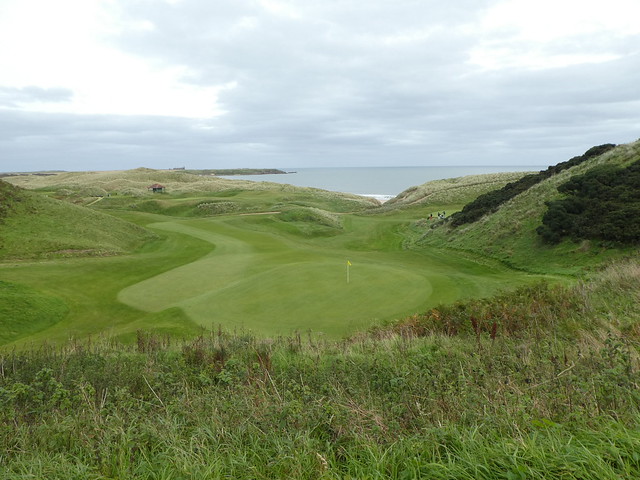
The antithesis of this experience is Cruden Bay. Driving into the car park for the first time is simply stunning. Below you, in a valley, is set a collection of massive sand dunes. Among the dunes weaves a golf course bordering on the North Sea. What makes Cruden Bay different from other links courses is that the parking lot and clubhouse are situated up on a hill, giving you an amazing view of the entire golf course and the over-sized dunes. This panoramic view gives a perspective that the other courses don't have. Arriving at almost all other links courses you are at sea level, depriving you of a birds eye perspective. At Turnberry, you certainly have some perspective from near from the hotel, but the geography at Cruden Bay is more dramatic. It's a compact little valley and the drop in terrain from the top of the hill to the sea nearby is more eye-catching.

Cruden Bay from Carpark (2)

The magnificent setting of Cruden Bay as seen from the carpark


Cruden Bay was originally designed by Old Tom Morris in 1899 and then re-designed by Tom Simpson and Herbert Fowler in 1926. Cruden Bay is located along the Aberdeen coast of Scotland about two hours north of Carnoustie. If there was ever an apt description of the term 'hidden gem,' then Cruden Bay is it. The golf writer James Finegan says of Cruden Bay: "Out sized, non conformist, unpredictable and flamboyant." These same words also describe course re-designer Tom Simpson to a tee, and the combination of Morris' original holes combined with Simpson's flair for the dramatic make this a special place.

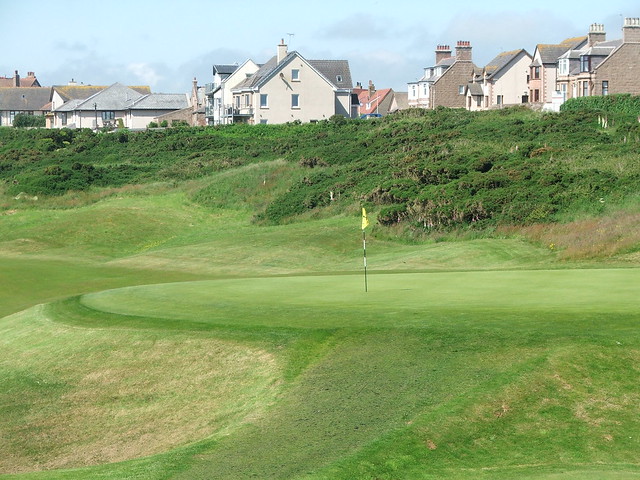
The first two holes are par fours that are similar in style and play from elevated tee boxes, down into a valley, to greens set on a plateau. You are playing alongside the town of Cruden Bay with O.B. along the left side.

The first sign that the course is not going to be traditional starts at the third hole. It is a 285 par four with a big chocolate drop mound in the middle of the fairway 80 yards from the green, making it potentially a driveable green; however, the mound is so large that it is a blind shot if you go for it. The green sits down in a hollow with several hills and hammocks around it and in front.

The fourth is a world-class par three that plays along the village of Port Erroll. Driver is often in order on this ~200 yard hole, depending upon the wind.

Cruden Bay - 2nd Tabletop green
The table top green on the second hole, looking back toward the fairway


To get from the fourth green to the fifth tee you walk between closed-in large dunes up a hill. The fifth is a 445 yard par four that plays from the top of the dunes down into a dramatic narrow snaking valley below you. Although the course is short, holes like the fifth demand long and accurate shots.

The par five sixth requires three shots, even for long hitters, due to its dog-leg and well-protected green sited within a mound of sand hills. You have to make sure you hit over the devilish Bluidy Burn with its dramatic falloff into the water, reminiscent of the Eli Burn on the seventh hole at North Berwick and the Wee Burn running through the 16th hole at Turnberry. Scotland has the most wicked burns in the world, a geographic feature we really don't have in the U.S. We have streams that don't look and feel like these burns do. The burns remind me of Dick Cheney: small, narrow, tricky and truly hazardous.

48730929847_682245c398_o 
The narrow approach to the 7th green

The seventh hole ("Whaupshank") is a par four with an elevated green situated between two dunes. Like all holes at Cruden Bay, it is a whimsical hole that snakes and twists through the dunes with a sharp dog-leg left. There is very little that is conventional on this course.

It is because of holes like the eighth that make Cruden Bay a course that has developed a cult following. It is a 248 yard par four that plays to an elevated green enclosed by dunes. English golf writer Dell Leigh, writing in his 1925 book Golf at its best on the LMS, describes the eighth as sitting "in a valley between stately hills; the hole which produces in the long hitter a frenzy of self-adulation." Leigh was writing about the original Old Tom Morris hole; Simpson had the foresight not to change it so the golfer can experience the same excitement today.

8 from ninth tee

The exhilarating 8th hole looking back from the green, a 258 yard up-hill par four


The world of golf has much sterner tests than Cruden Bay: courses such as Carnoustie, Oakmont and Olympic. Muirfield, Merion and Shinnecock are more historic. Turnberry, Pebble Beach and Kingsbarns are more scenic. But for pure fun, Cruden Bay cannot be beaten. The course defies being pigeonholed because it doesn't fit neatly into any category. It is a one-of-a-kind golf course. Golf at its simplest is a game. I think we sometimes lose sight of that fact. The point of golf after all is to have fun and enjoy yourself. Cruden Bay would be ranked #1 in the world if having fun was the only criteria utilized. There is something about Cruden Bay that lightens your spirits and brightens your mood. It makes me see golf through the eyes of a five year old: everything is exciting; there is a sense of discovery around every corner; life is good and full of promise; curiosity abounds.

The ninth hole atop a hill

Cruden Bay - view from 9th tee (2)
View from the 9th tee with a perfect crescent shaped below below

The ninth and tenth holes play on top of the dunes with dramatic views and shots played down a large hill. There are many times when the Cruden Bay landscape almost seems lunar and surreal. The ninth and tenth tee boxes are two of those places. If you look north over the beach and ocean you can see the ruins of Slains Castle, which provided the inspiration to Bram Stoker when he wrote Dracula.


Slains Castle as seen from Cruden Bay


The fourteenth and fifteenth holes are two of my two favorites on the course. Like Cruden Bay generally, they are full of quirks, but I found them exhilarating. Fourteen has a blind second shot to a bathtub green. What's a bathtub green you ask? One that quite literally is shaped like a bath tub and is sunken down into the ground. Just like the Punchbowl sixteenth green at National Golf Links of America, when you are on the green the outside world is muted. You are totally detached from civilization.

Why don't you see more bathtub style greens? From a practical standpoint, the green most assuredly doesn't work, since it doesn't get the proper amount of air and light, is difficult to maintain and playing shots into it doesn't always distinguish between shots hit well and shots played poorly. Ok, so it's not practical to have holes like these, but it misses the entire point of Cruden Bay. The R & A isn't going to hold a championship here, and it is not a proving ground for your manhood. It's a fun golf course. Personally, I like an occasional hole that has these unique element of playfulness, which has more similarities to billiards or pinball with shots banked off the sides of hills and hollows and crazy kicks of the golf ball.

Fourteen Green
The 'bathtub' 14th green

Cruden Bay - 14th green from 9th tee
The 14th green as seen from above from the high tee on the 9th hole

Look to the right of the bathtub green in the picture and you can see a tee box. This is the tee box for the 200 yard blind par three fifteenth hole. The huge sand dune you see on the left is your target. When you are done playing the hole you ring a bell to let the group behind you know you're done.

I can hear the skeptics now. Blind shots? Ringing bells? Multiple par fours under 290 yards? A bathtub green? Back-to-back par threes? Only two par fives on the whole course? Par is only 70, 6395 yards from the back. Horrors. I understand those that prefer golf courses in the conventional and traditional sense might not like Cruden Bay. Sounds like trickery you say. Well, many of the world's great courses have characteristics just like the ones I describe above. Cypress Point has back-to-back par threes; coincidentally, they both happen to be on the 15th and 16th holes. Quaker Ridge and Chicago Golf Club only have two par fives. Lahinch has its brilliant blind par three Dell hole. Pine Valley and Royal County Down have several blind shots, and you ring bells at Prestwick and the National Golf Links of America.

So these quirky elements in and of themselves are not unique to Cruden Bay and are clear evidence that having quixotic features on a golf course alone don't make it bad. What makes Cruden Bay unique is that it crams all these features into one course. It doesn't have one or two quirky holes like many of the world's best courses mentioned above. The distinction at Cruden Bay is that virtually every hole is quirky or has some kind of unconventional feature. It is this cumulative effect of the design that makes it such a fanciful place to play golf.

Admittedly, Cruden Bay has a weak finish. Sixteen is a downhill par three with a green that slopes away from you, so you must play it short and run it up. Seventeen and eighteen are decidedly weak holes that play back to the clubhouse and are uninteresting.


I've spoken to a lot of well-traveled golfers, and it's no surprise to me that almost all of them rank Cruden Bay among their personal favorite courses. The first time I saw Cruden Bay was on a golf trip with eight men touring Scotland. This was prior to my now obsessive quest to play the top 100. We were so enamored of the place that on the spot we changed our plans to stay an extra day so we could play the course over and over again. On every trip to Scotland I try to play Cruden Bay.

Bernard Darwin wrote of this great course, "I think it is typical of Cruden Bay, which is a place extraordinarily difficult to keep away from for those who have once come under its spell." I'm often asked what I'm going to do when I'm done playing the top 100 golf courses in the world. Well, I'm going to go back to Cruden Bay to play it over and over again!

The Udny Arms Hotel

The course is located in a rather isolated location away from any real population center and as a result the members serve as caddies for visitors. They are a very welcoming and friendly group who are happy to share their wonder of the golfing world with visitors. When we visited we stayed at the Udny Arms located in nearby Newburgh, which is sadly now out of busines. A family owned B & B, it was cozy and inviting. Being isolated you might assume they would serve basic meat and potatoes fare. In fact, the food there is world-class. The bar areas are cigar friendly and the wait staff makes you feel at home. Don't expect American size rooms or 200 channels of cable television. As is typical in Britain the amenities are basic, the showers are tiny but there is a facility to make a cup of tea in each room. It is one of my favorite places to stay in the world. Have the sticky toffee pudding while there and watch one of the three BBC channels provided.

Cruden Bay is also a special remembrance for me because it was the first time I experienced first-hand Sheldon in action. The forthright manner this good looking gentleman asked the Amazon barmaid what time she got off was worth its weight in gold.

Early Lawn Bowling at Cruden Bay