Tuesday, September 01, 2009

Whippoorwill Club


I am lucky enough to live within driving distance of thirteen clubs ranked in the world's top 100. I try not to take this for granted, rather, I try to take advantage of it every chance I get, particularly if I can play on weekdays instead of working. It was in this vein that I recently played the Whippoorwill Club in Westchester County, New York.

Westchester County is chocked full of good golf courses. There are the well known ones ranked in the top 100 such as Quaker Ridge and both the east and west courses at Winged Foot. There is the 36 hole Westchester Country Club which hosts PGA tournaments. There are also a whole host of below the radar private clubs built long ago by famous architects during the golden age of course design. A small sample: The Apawamis Club (Willie Dunn, 1899), Blind Brook (Macdonald/Raynor 1916), Century Country Club (Colt & Alison, 1926), Fenway (A.W. Tillinghast, 1924), Old Oaks Country Club (Tillinghast & Alison, 1925), Siwanoy (Donald Ross, 1901, site of the first P.G.A. championship), Sleepy Hollow (C.B. Macdonald and A.W. Tillinghast, 1911), Knollwood Country Club (Tillinghast and Banks, 1921) and the Whippoorwill Club, founded in 1928 and originally designed by Donald Ross with revisions done by Charles "Steamshovel" Banks.

Whip Clubhouse
The elegant shingle style clubhouse at Whippoorwill

The heritage and tradition of the Whippoorwill Club dates back to the mid 1920’s when Donald Ross designed the course which lay entirely on the east side of Whippoorwill Road. At that time Ross was at the pinnacle of his career and was the most recognized architect of the day. Everything changed in 1928, when Fred Ruth, developer of the Mid Ocean Club hired Charles Banks, with whom he had worked at Mid Ocean, to redesign the Ross course. Banks is credited with the design and remodeling of more than thirty golf courses from 1921 until his death in 1931. It is said that he believed Whippoorwill to be his masterpiece.

Whippoorwill took on its most unique characteristics when Banks was brought in and when holes four through nine were built on the west side of Whippoorwill Road. Steep terrain, tree-lined fairways and no parallel holes characterize this section of the course. These holes play in roughly a semi-circle on dramatic, hilly terrain squeezed in between large rocky outcroppings left from the last ice age.

The first three holes play near the clubhouse on open terrain and are very good. All three are dog-leg holes with challenging greens. However, when you cross Whippoorwill Road to the par three fourth hole the course becomes exceptional. They should put a warning sign up near the road crossing as you walk from the third green to the fourth tee that you are entering a unique set of golf holes.


The next six holes have an originality and distinct appeal that you find only rarely on a golf course. Banks put extra polish on the holes across the road. Thus far in my worldwide travels I have been dazzled by a unique stretch of holes only rarely: Cypress Point holes 14-17, Crystal Downs holes 11-15, Morfontaine Valliere holes 3-8, Pine Valley holes 2-6.

The stretch of holes begins with the fourth, a prototype "Eden" hole and plays 157 yards downhill with dramatic, deep bunkering surrounding it. A shot hit over the green results in serious trouble.


Whip 4
Par three "Eden" fourth hole

4th green
The newly rebunkered fourth hole at Whippoorwill

The fifth hole, a par four of 455 yard is the #1 handicap hole. You drive the ball through a chute of trees into rugged terrain. If you hit long and left, the ball will run down the hill leaving you a shorter shot to the elevated green.


View from the tee on the par four fifth hole

Whip 5-1

Approach to the fifth green

The approach to the green plays uphill with a large, deep bunker protecting the left hand side in the front.

The sixth hole was my favorite on the course, a par five of 538 yards where you also have to hit through a chute of trees into a valley with large rocks on both sides. Your third shot plays downhill to an elongated green that slopes back to front and has a dramatic horseshoe shape in it similar to the green on the third hole at Yeamans Hall.

Whip 6

Tee shot landing area on the par five sixth hole


When the pin is in the back of the green, as it was on the day I played, the effective landing area you have to hit to is a flat surface of about ten feet by twenty feet. If you don't make it up on that plateau, the ball rolls back to the front of the green.


Whip 6-1


Approach to the green on the par five sixth hole


6th hole back from green
The sixth hole from behind the green, showing the amazing terrain down the hill

The seventh hole is a 425 yard par four that is a sharp dogleg left. The tee shot plays over a pond. Allegedly a steam shovel rolled into the pond during construction and is still there. The second shot plays up a narrow valley between big rocks to a well protected green set down in a hollow. Notice how narrow the fairway area is and also note the large boulders, which hems in the hole on both sides.

Whip 7

The second shot on the par four 7th hole

The 8th is a "Biarritz" hole with a big swale in the middle of the very long and tough to hit green.

Whip 8
The eighth green as seen looking back from the 9th tee box

The ninth hole is 379 yards but plays close to 450 since it essentially plays straight uphill. The ninth is known as "Cardiac Hill". The hole is to steep that when you get to the green, you are at the highest point in Westchester County at 740 feet. It is a challenging small, elevated green. The ninth caps off one of the most exciting stretches of holes a golfer can play and really define the experience at Whippoorwill. I found them exhilarating. A very interesting characteristic of the front nine is the sequence of shots that you have to hit into the greens. The front nine alternates between uphill shots and downhill shots. The 1st hole plays to an uphill green, the 2nd to a downhill, the 3rd to an uphill, all the way through the 10th hole. I don't know if this "roller coaster" effect was by design or by accident, but it creates a nice varied routing.

The back nine has more of the Ross influence and feel to it, although Banks re-did the greens. The back has more open vistas and rolling hills rather than dramatic hills and does not have many of the large rock outcroppings. The course has a nice selection of short par fours that require precision iron shots and good putting such as the 347 yard second hole and the 320 yard thirteenth. While the rest of the course isn't as exciting as holes four through nine, the fourteenth hole stands out as a cracker hole on the back nine. It is a 440 yard par four that plays uphill to the green and has a split fairway, leaving the golfer with a nice strategic choice depending upon how far you hit the ball and the wind. The wild, winding hilly terrain and length make that a par four and half hole on a good day!

Whip 14 approach
Approaching the 14th green at Whippoorwill

Whippoorwill is a fantastic course that, along with Piping Rock, Myopia Hunt Club and the Seaside Course at Sea Island are under-rated courses in the United States. In my view, they are better than several courses ranked in the top 100 such as East Lake, Scioto, Ocean Forest or Medinah. I played Whippoorwill with a learned friend who has also played a lot of good golf courses. We both independently felt that Whippoorwill at times reminds us of Merion. Partly, this has to do with similar terrain in some places and with the general overall short nature of the course. Like at Merion, the course is split in two by a road and you have to be able to hit the ball to the correct side of the fairway or the correct side of the green in order to shoot a good score. A strategy of playing to the middle of the green won't work here due to the green shapes, slopes and severity. You must be on the right quadrant of the green depending upon where the pin is to shoot a good score.

Why is Whippoorwill overlooked and under-rated? Perhaps because the course is only 6,636 yard from the back tees. Perhaps, because it doesn't get much press or outside play given that it is a very private course in a very affluent area. Whatever the reason, I believe the front nine is worthy of cult status. Golfweek Magazine comes closest to recognizing the genius of Banks' work here, ranking the course as #73 in its list of the top 100 classic courses in their 2009 rankings. I have enjoyed all the Banks courses I have played, especially his course in central New Jersey at Forsgate, which has similar green complexes to Whippoorwill and a truly spectacular par five hole (the 8th) that also uses very hilly terrain as artfully as he does at Whippoorwill.

Aside from the great golf course Whippoorwill has a great clubhouse, a nice relaxed feel to it and great caddies. Play it if you ever get invited.

Many thanks to Robert Mercer Deruntz for allowing me to use his pictures of Whippoorwill.


Friday, August 14, 2009

Whistling Straits


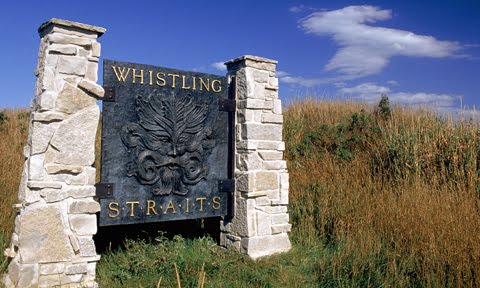
Whistling Straits (ranked #53 in the world) is located in Kohler, Wisconsin, about 90 minutes north of Milwaukee. Built by Pete Dye in 1998, it is a beautiful course. If you want to know what it is like to play golf in Ireland but don't want to fly across the Atlantic, Whistling Straits is as close as you'll ever get. The land the course was built on was formerly a U.S. Army base. Owner Herb Kohler instructed Dye that he wanted the course to resemble Ballybunion.

The eight holes that play along Lake Michigan are the most dramatic. Similar to his work at Casa de Campo, Dye does a brilliant job of situating green sites along and above the water. The course is also over-run with bunkering. Many holes have scores of bunkers. Golf Digest estimates there are more than 950 bunkers on the course. That means on average there are 50 bunkers per hole. For basis of comparison, Winged Foot West and Merion East have less than 150 bunkers each on the entire course.

Many of the bunkers don't actually come into play, but they give the course a dramatic and rough and tumble look. The dog-leg right eighth hole is especially noteworthy in this regard. It has a lot of small natural looking bunkers cascading down the hill between the fairway and Lake Michigan.

Like at the Bandon Resort, at Whistling Straits you can only walk, there are no golf carts. This is to maintain the aesthetic in keeping with that of a links course. Cart parts would have ruined the look of the course. The course is full of wonderful little walking paths and natural looking matted down areas that you use to walk from hole to hole, just like in the British Isles.

The par four fourth hole, "Glory"

The par threes along the water are all noteworthy, including the twelfth and seventeenth on the back.

The twelfth hole plays only 138 yards and has a big green, but there is a little piece of it close to the water that is isolated from the rest of the green and it's the Sunday pin placement for tournaments. The effective landing area when the flag is set on this side of the green is tiny.


The dramatic par three 17th at Whistling Straits

The area the course is built in is isolated and pastoral. It is subject to foggy and changeable weather conditions since it is on the lake. The clubhouse is done in an understated and elegant manner. Sitting in the clubhouse on a misty, rainy day with a Guinness in hand is enough to trick the mind into believing you are in the Emerald Isle.

I stayed at The American Club nearby, also owned by Herb Kohler, the owner of the resort. It is a very nice place and has a great pub. The dining room serves local fare including some great Wisconsin cheese.

Saturday, August 01, 2009

Cherry Hills Country Club


The Cherry Hills Country Club (ranked #90 in the world) is located on the outskirts of Denver, Colorado. Cherry Hills proved to be a very difficult course for me to play, as it is a private club. It limits guest play and was hard to access since you must play with a member. It recently reopened this past May after being closed for renovations for eight months. The original 1922 William Flynn design has been modified by several architects over the years including some changes by Arnold Palmer. The most recent restorations were done by Tom Doak and his firm and were intended to bring the course closer to Flynn's original design. Doak and his team rebuilt several greens and most bunkers, among other changes. Cherry Hills is the only world ranked top 100 courses located in the Rocky Mountain region.

"The shot heard around the golf world" occurred during the epic 1960 U.S. Open held at Cherry Hills. The 1960 U.S. Open featured Ben Hogan, Jack Nicklaus and Arnold Palmer vying for the lead. In the final round, as 'Arnie's Army' watched, Palmer uncorked a 346 yard drive to the par four, 1st green to start the greatest come-from-behind charge in Open history. Palmer moved up 12 players and 7 strokes for a final round 65 and a 280 total for his victory. The 65 was the best final round ever produced in an Open. In addition to the 1960 U.S. Open, Cherry Hills also hosted the event in 1938 and 1978 and the P.G.A. Championship in 1941 and 1985. Among the changes Palmer made to the course was to lengthen the first hole from 345 yards, presumably so no one could drive the green.


The iconic shot of Arnold Palmer throwing his visor after winning the 1960 U.S. Open

Cherry Hills also hosted the U.S. Amateur in 1990, won by 20-year-old Arizona State golfer Phil Mickelson. It will host the Amateur again in 2012. Former NFL great John Elway is a current member of Cherry Hills and the current club champion, with a 1 handicap index.

The Golf Course

The golf course starts on flat ground and the first four holes are relatively straight forward. The green on the 3rd hole, seen below, is new. The hole is 315 yards long but the green is now elevated and difficult to hold as it is crowned and balls not hit precisely will roll off.

The elevation on the course begins at the fifth hole and basically gets progressively more hilly as you play on. The par five fifth hole plays as the #1 stroke index hole at Cherry Hills. The green is elevated, hard to hold and fronted by a swale. The 518 yard hole has interesting terrain and the fairway slopes right to left and the hole dog-legs to the right at the end.

The par five 5th green

The course really begins to pick up steam on the ninth hole. The 434 yard par four ninth hole plays up a big hill back toward the clubhouse. From the landing area of your drive to the green, the hole slopes severely from left to right, following the natural contours of the land beautifully. The difficult green is perched on a slope on this dog-leg right hole.


9th hole
The dog-leg right, uphill 9th hole at Cherry Hills

The 428 yard par four 10th hole is a mirror image of the ninth except it runs away from the clubhouse and slopes from right to left. They are an excellent pair of holes that use the hilly terrain very well.

Cherry Hills original designer, William Flynn, was also involved in the design or renovations of several other top 100 courses including Shinnecock Hills and the Country Club at Brookline. There are some similarities between The Country Club and Cherry Hills in terms of course routing, the use of large sloping hills in the terrain and the style of approach shots required to get to the green.

The par three twelfth hole of 194 yards plays over water. Cherry Hills has a stream that meanders throughout the property and comes into play often, especially on the back nine.
12th hole

The par three 12th hole

The thirteenth hole is a 381 yard par four that has a new green. You have to hit over the stream on your second shot to a green that slopes back to front.

13th green from behind
13th green as seen from behind

The fourteenth is a 381 yard par four with another tee shot that you have to hit up onto a big hill. The second shot plays downhill and to the left to a green that has the stream snaking around it and a large tree protecting the left side. It was my favorite hole on the course and presents several good risk-reward decisions on both the tee shot and on the approach shot.

14
The fantastic 14th hole at Cherry Hills

The par three fifteenth plays 188 yards downhill to a relatively receptive, flat green. Cherry Hills has four sets of tees. The championship tees (which are 'cherry' red) play 7442 yards, the back tees play 6817 yards and the member tees 6400 yards. I like playing a mile in the air because the ball travels an extra 10% further than it does at sea level, so Cherry Hills is not a particularly long course by today's standards once you adjust for altitude. I hit a couple of shots in a less-than-ideal fashion and was yelling for them to get going while at the same time my caddy was yelling for them to get down. That extra 10% helped me more than once.


Par 3 15th>
The par three 15th hole

The par four sixteenth is a good risk-reward hole as well and typifies the back nine, which is much stronger than the front nine. The hole is 402 yards and is a slight dogleg right. Your approach shot plays over the burn/stream to a green set at an angle to the fairway.


16th approach
Approach to the 16th green

The course finishes with back-to-back par fives that both have water in play.

17th green
The green on the par five 17th hole

The seventeenth hole is where Ben Hogan famously went for it during the 1960 Open and ended up in the water. The hole is 588 yards and has an island green. The eighteenth hole is a fairly easy par five at 458 yards. It is rated as the #16 stroke index hole, although it plays longer because the hole runs up the hill back toward the clubhouse and the entire landing area is bordered by water on the left, making an accurate tee shot of paramount importance.


The club has nice memorabilia on display in the clubhouse. Dwight Eisenhower had his "summer White House" in Denver and used to play at Cherry Hills where he was a member and at one time served at club president. Ike's heart attack in 1955 occurred after he played a round a Cherry Hills. It actually probably started while he was playing, as he complained of indigestion during the round. There is a nice signed scorecard and other mementos from his tenure in the clubhouse. During Eisenhower's eight years in office he played over 800 rounds of golf. If I'm doing my math correctly, that's almost one hundred rounds a year. This is clearly enough to vault Eisenhower ahead of Ronald Reagan as the greatest president of the 20th century. He had his priorities straight, and was obviously obsessed with golf. I am going to begin a letter writing campaign to the World Golf Hall of Fame to have Ike inducted for this worthy feat.


Wednesday, July 01, 2009

Loch Lomond Golf Club

Ch8 - Rossdhu>

Rossdhu House, Loch Lomond's clubhouse

Loch Lomond Golf Club (ranked #56 in the world) is located in Luss, Scotland, not far from Glasgow. As those that have been following my quest know, I have been critical of the approach that Loch Lomond has taken to visitor play.

Organized in 1994, Loch Lomond was set up in the tradition of Augusta National and Pine Valley; it has an international membership which doesn't serve as a local golf club in the traditional sense. In fact, Loch Lomond is constituted as a 'destination' club to be 'savored' only a few times a year. Membership is organized around specific geographic regions. The club has appointed specific 'Club Captains' to assume leadership and membership responsibilities for these geographic regions and to ensure a particular geographic mix of members.

Apparently I got it all wrong. The club markets itself in a pompous fashion, but once behind the gates, I found Loch Lomond to be delightful and not the least bit pretentious. After hearing my pleas for access, I was contacted by a member who wanted to prove that Loch Lomond is a down to earth kinda' club, even if it is for people in the über-privileged class. After my visit I was better able to appreciate what they have here and separate out the pomposity of the marketing from the actual membership and club operation. Bottom line, I immensely enjoyed my first visit to their 'private and discerning international golf club' and hope to return to play again.

LL #3 shaved
The third hole ("Garden Cottage")

The golf course was designed by Tom Weiskopf and Jay Moorish. When one of the course designers almost dies by sinking into a bog while building the course, that should tell you something about the terrain it is built on. Near the thirteenth and fourteenth holes, Weiskopf went out to survey the land one early morning and started to sink into the bog. He almost died and saved his own life by clinging onto a nearby tree limb for several hours before being rescued.

The course is atypical of most of the top ranked courses in the British Isles in that it is neither a links course nor a heathland course. It is a parkland course more akin to those found in the U.S.

As you can see from a picture of the third green above, one of the design elements of the course is the shaved areas around many greens. This picture shows the severity of the slope. The fourth, twelfth and thirteenth holes also have severe shaved areas such as the one seen here.


LL 5th-1

The par three fifth hole ("Creinch")


The course opens up with a relatively easy set of holes and then turns toward the loch at the fourth and fifth holes. The short (150 yard) par three fifth hole shows the beauty of the setting at Loch Lomond.

Similar to Royal County Down, the terrain at Loch Lomond is idyllic, with the mountains rising up behind the water to create a dramatic backdrop. This part of Scotland is the beginning of where the lowlands meet the highlands and is breathtaking. As you can see from the pictures, I hit Loch Lomond on a near perfect day. One of the things I love about Scotland is the degree to which the outdoor environment is so vibrant and clear. Due to its blessed geography and lack of pollution, the air is cleaner and crisper in Scotland than virtually anywhere I've been. The vibrancy of the colors is stunning on a clear day and the diffused nature of the light hitting the leaves makes them appear translucent. When the gorse is in bloom, with its canary yellow color, contrasted against the lush greens and purple-hued hills, it creates an unparalled environment in which to play golf.


LL 6th green>
The par five sixth hole ("Long Loch Lomond")

The 625 yard par five sixth hole is the #1 stroke index hole on the course and plays along the loch from tee to green. As we played this hole, a small boat went up the middle of the loch past where we were playing. It was the mail-man out delivering mail on the lake. Norman Rockwell couldn't have imagined a more serene scene.

LL 8th looking from clubhouse
The short par three eighth hole ("Inchmoan")

The short par three eighth hole plays away from the loch and back toward the clubhouse. On the day we played Loch Lomond, the course was quite wet, which is a frequent occurrence here. Those familiar with the Scottish Open, which is played at Loch Lomond every year the week before the Open Championship, will know that the course is usually wet. They have been working on improving the drainage situation ever since the course was built, but I think frankly, since it was effectively built on a bog, it will be a nagging problem. The scorecard clearly states a local rule: the embedded ball rule, which makes sense. Because of the wet conditions, being able to lift, clean and place your ball is of paramount importance here.

LL 10th

The lovely downhill par four tenth hole ("Arn Burn")

The front and back nines at Loch Lomond are quite different. As my caddie described Loch Lomond: the front nine is for tourists and the back nine is for golfers. That is, the front is an easier test of golf and plays along the water. The back nine is a sterner test of golf and plays inland, closer to the mountains and through the bog. The tenth hole is a 425 yard par four that plays down a hill and offers many hazards including a burn, a water hazard and many well placed bunkers.

LL 13th>
The par five thirteenth hole ("Gallow's Hill")

The 560 yard par five thirteenth hole is a downhill par five that offers the golfer plenty of risk-reward options given its myriad bunkers, water hazards and changes in direction. Look at the photo above and try to figure out the best route to the green. What makes this hole even more difficult is that the stunning beauty of the mountain backdrop is a constant distraction as you play the hole.

In keeping with the high-end nature of the club, Loch Lomond prints custom scorecards each day, adjusting the yardages for the actual pin placements. On the day we played, the cards were not accurate, which is frankly no big deal. It is easy enough to just look at the green and figure it out. After the third hole, the caddies knew something was wrong. In classic Scottish fashion we heard from the various caddies in succession, "The scorecards are rubbish today," "These sheets are all shite," in a way only a Scotsman can pull it off. It is one of the endearing charms of Scotland that without intending to do so, almost everything the Scots say is tinged with humor and sarcasm. The Scots use their words sparingly, but always with maximum impact.

LL 14th

The short par four fourteenth hole ("Tom and Jay's Chance")

The 345 yard fourteenth hole is a classic risk-reward short par four. From the tee, it is a 245 yard carry to drive the green on this sharp dogleg right hole. Going for the green and missing will penalize you, as you would expect. Hitting an iron off the tee leaves you an easier shot, but it is not an automatic par given the uneven fairway, the fact that you have to hit over a wee burn, and the difficulty of the green.

LL 17th-1
The photogenic seventeenth hole ("The Bay")

The 215 yard photogenic par three seventeenth hole is set in a spectacular setting near the loch.

Loch Lomond excels on its short risk-reward par four holes. There is great variety in the routing and unique and imaginative shaping of bunkers. The course is manicured perfectly with the beautiful gently rising mountains as the backdrop and the crisp blue water at their base. The burn snaking around several holes adds to the charm of Loch Lomond. The glens, with their gentle sloping, the trout streams and ponds, peat bogs, thirty-five feet of elevation change and the old trees make this a remarkable setting for golf.

Most would agree that Loch Lomond is one of the finest and most scenic places in the world to be at and to play golf on. But how is the course? Certainly, to rank a parkland course in Scotland this high in the world rankings it must be special. To be honest, the course on its own right probably is like a lot of other high quality parkland courses in the United States. What makes it so charming is the combination of having a very good course set in this breathtaking location, the exclusivity of the club and one of the best clubhouses in the world. It is impossible to separate the course from its environment. Looked at in total, I agree that Loch Lomond is roughly one of the top fifty places in the world to play golf.


Loch Lomond looking up toward Ben Lomond from the 17th green

If someone knows of a finer clubhouse in all the world than Rossdhu House at Loch Lomond, please let me know. The clubhouses at the National Golf Links, Winged Foot, Garden City and the Honourable Company of Edinburgh Golfers impressed me as being world-class. Rossdhu House takes it to another level. The similarities between Loch Lomond and The White House in Washington D.C. are striking. The club has a fenced exterior gate around the property with a guarded entrance. Your movements on the property are perfectly orchestrated. When you arrive and leave they track your progress with walkie talkies through a command center. The interior of this 18th century Georgian mansion has a series of interconnected, themed rooms, each decorated with original, high-quality large oil paintings. Rossdhu House has a green room, a red room, a library, a formal dining room, a reception area, and a series of additional rooms for a variety of specialized purposes that I lost count of them. Like at 1600 Pennsylvania Avenue the club has its own helicopter here. Each has a Rose Garden and perfectly manicured grounds. Rossdhu House even one ups The White House with clearly superior views out of the large windows, and I doubt that the White House has an amenitized spa!
In the end, I was won over at Loch Lomond by the setting and the Scottish charm. The club is not pretentious, and I've decided that I like being pampered. I had an 'A' caddy and a great day at Loch Lomond. I have been playing some local municipal courses this year to try to cut back on expenses, and the experience here was the polar opposite of public golf. I didn't find lots of broken tees laying on each tee box, nobody was walking around with their shirt out, there were not a lot of unrepaired pitch marks on the greens, and we didn't have to wait to hit every shot. While playing the round, I was asking the member how far it was to Dundonald, the other course associated with Loch Lomond. "About 10 minutes by helicopter." It must be nice.

It's official. I've become a golf snob. The problem is that, once you experience this level of golf, it's tough to go back. I apologize to all of you hackers out there for leaving the fraternity of regular guys and moving over to the dark side. I have indeed gone native. It did strike me as a bit odd that they served us Kool Aid at Loch Lomond after the round in the walled garden. I should have paid more attention, as it didn't seem right at the time, but now there is no going back.

Loch Lomond was the last of the twenty-seven courses ranked in the top 100 in Europe that I set out to play. As such, I finished on a very high note indeed, but hope to be invited back to Loch Lomond again.

Monday, June 01, 2009

Valderrama

The side wall of the clubhouse at Valderrama


Valderrama Golf Club (ranked #77 in the world) is located between the Sierra Blanca mountains and the Mediterranean Sea in Southern Spain, not far from the Rock of Gibraltar. Valderrama is a very formal club; while it allows visitors, it also has a lot of rules, restrictions and protocol. Many areas are restricted to members only and you must wear a jacket indoors. In this regard it reminded me of Muirfield in Scotland. I was able to play Valderrama recently on a trip through Europe and was thrilled to do so. The course is private, but if you arrange it far enough in advance, following their rules, it is possible to play without too much hassle.

My journey to Spain


In keeping with my new lower net-worth, and being sensitive to the sudden era of frugality we find ourselves in, I'm economizing and being very austere. Conspicuous consumption is out, hard knocks are in. Going budget is the new black. As such, I'm now in the back of the plane and have to suffer through the indignity of the masses. While flying, I have previously been seated next to someone who has had to suffer the humiliation of the flight attendant handing them a seat belt extender. Flight attendant discretion and a barely audible voice are a prized characteristic when dealing with the porcine passenger. My flight over to Espana included a new travel experience for me.

I could see the big man coming a mile away. I caught him out of the corner of my eye. Please, I whispered to myself, I hope he's not next to me. As he approached my aisle I pretended not to see him in the hope it was a bad dream. "Excuse me sir, these are my seats." Hmm. I looked at the big boy with a puzzled expression and pulled out my boarding pass to look, while simultaneously saying a couple of quick Hail Mary's. "I have 15D and E, the aisle and middle," he said. I didn't see him with anyone else. Alas, I had taken my seat on the wrong side of the aisle and moved. Low and behold, he lopped into both seats, rather uncomfortably in my view. He was absolutely large enough to warrant two seats, but it is still a shock to the system to see this type of spectacle first hand.

I dozed off during taxi and takeoff and was awoken by a major ruckus underway in the plane. The case of the missing roll. Where was the dinner roll? Apparently his gourmand cuisine was missing a roll (wrapped in plastic for both sanitary reasons and for dramatic effect no doubt). Passengers in front of us and behind us had gotten rolls, but mysteriously, his roll was missing. You'd think that the crown jewels had been stolen. It's a four day-old, stale roll for gods sake, not a priceless possession. I have a new found respect for the flight attendants who handled his inquisition with grace and not a tinge of sarcasm as they made a valiant, yet unsuccessful effort to find another roll. I almost chimed in during the dispute to suggest to Mr. Arbuckle that he was playing the wrong card. Since he bought two seats, he should have demanded two full meals instead of obsessing about the damn roll, which was a side-show.

The poor woman in the window seat will probably never fly again she was so traumatized. I miss first-class, where an unlimited supply of freshly baked rolls are complimentary.

The Golf Course


Valderrama was originally designed in 1975 by Robert Trent Jones Sr., but the original design was compromised by having to fit into the wishes of the then owners to accommodate a housing development. In 1985, a new owner Jaime Ortiz-Patino reacquired more parcels of land around the course so that it could be lengthened and redesigned. Jones was brought back in to redevelop and remodel the course and he did a masterful job. Much credit goes to both Jones and Ortiz-Patino for sticking with the project and devoting so much effort to realize their collective vision. Ortiz-Patino has followed the benevolent dictator model at Valderrama that worked so successfully at Pine Valley (Crump), Oakmont (Fownes) and Augusta (Roberts).

Jones' design philosophy of "hard par, easy bogey" works well at Valderrama, although in the end it is quite a difficult course. The defining characteristic of the place, as you soon find out, is the over 2,000 old cork oak trees that are everywhere.

Val 1st
The 1st hole at Valderrama

It becomes clear quickly what makes Valderrama an interesting and unique course: the cork trees are in the way. The first hole is a good example. The tee shot on this 'S' shaped fairway looks simple enough to hit. The problem is not so much hitting the fairway, but being able to hit it in the proper place. If you don't drive the ball far enough to the left, your shot to the green will be blocked out by a cork tree. This is a consistent design philosophy at Valderrama, the overhanging tree, which Jones terms his 'bunker in the sky'.


Val 1 toward green

Approach shot to the 1st green


As you can see in the picture above, the approach to the first green is narrow and well guarded by overhanging trees. Valderrama is not a course where you just bomb the ball off the tee and hit a wedge to the green. It requires you to hit shots that you normally don't hit, and to hit them all day long.


Val 2
Approach shot to the 2nd green


The second hole, a 345 meter (for yards, add 10%) par four that requires a drive all the way to the left in order to avoid the trees seen above, which sit in the middle of the fairway. It is such a narrow landing area that it is highly likely that you will have a big decision to make on your next shot. Either try to hit over the tree or try a punch shot under the tree. Plain and simple, if you don't want to try out a variety of shots, you are not going to like Valderrama. If you think it's not fair to have a tree in your way after you hit the fairway, you also will not like Valderrama, since ten holes have an overhanging tree as a hazard.

Val 4
The elevated 4th green


Notice the tree overhanging the elevated green on this par five 470 meter fourth hole. Both when going for this green or when laying up, you have to thread the needle to put the ball in the correct location. Too far to the right and you risk the water. However, you also can't bail out too far to the left, because if you do, then the overhanging tree will block your shot to this multi-tiered, narrow green.

The fourth is a highly rated hole, and is ranked among the 500 Greatest Golf Holes in the World, in George Peper's book of the same name. It plays down a contoured, uneven fairway hemmed in by cork and olive trees. It reminded me of the isolated third hole at Durban Country Club, which winds its way through the bush.


Val 8
Short par four 8th green

Valderrama excels on its short par four holes such as the eighth (296 meters), tenth (333 meters) and thirteenth (341 meters). Each requires you to hit to the appropriate side of the fairway in order to have a clean approach to the small, elevated, well-bunkered greens. The eighth is seen above with the encroaching trees hemming in the green.

Val 8th looking back

8th hole looking back from the green

You can see more precisely in this picture, which looks backward off the eighth green, how tricky the trees are, and how small the greens are.

Val 10-1
Elevated 10th green

The tenth hole is a 333 meter sweeping dog-leg par four that requires your tee shot to land on the left side of the fairway to avoid the big cork tree that guards the hole on the right. There is a pond right of the fairway and shots on the right side of the fairway tend to run down the severe slope and feed into the water. In this regard, I found Valderrama to be similar to Merion, in that you have to be in the correct position on each fairway or your approach shot is much more difficult. I am not suggesting the two have a similar visual feel, simply that the way you have to approach playing each course is similar, with precision in putting a shot where you want to being of paramount importance.

Val 12th green
The difficult par three twelfth hole


It's not often that a par three represents the #2 stroke index hole on a golf course. At Valderrama it is ranked as such. The downhill twelfth hole plays over 190 meters. The entire right side is O.B. and the left side falls off down into a ravine. The 'bunkers in the sky' are omnipresent as your ball flys toward the green. The green is small as is typical of the entire course.


Val 17-3
The iconic seventeenth hole at Valderrama


When most people think of Valderrama, they remember the 1997 Ryder Cup and think of the seventeenth hole. The seventeenth is a 410 meter par five hole that requires your approach shot to land well onto the green to avoid the tragedy of rolling back into the water. The hole is short enough for a par five to temp you to go for the green in two, leading to a wet ball unless the shot is struck perfectly. The area in front of the green repels balls, slopes toward the water and is shaved. Seventeen is a good hole, but I found it odd that it is actually the most out-of-character hole on the golf course. The cork trees don't come into play on this hole and the shots you have to play are relatively straightforward. It actually stands out for being a hole almost unlike every other one on the course.


Val 17-7

17th looking backward

Above is the view looking from the green backward at the shaved area on seventeen. You will remember the balls trickling back down the slope into the water from the Ryder Cup. The Rock of Gibraltar is visible looking to your left when you stand on the seventeenth tee. You can also see the Rock from the elevated eleventh green.


Val 18 fairway


The dogleg left 18th hole

Valderrama doesn't offer a let-up throughout the round and certainly not on the eighteenth hole. The cork trees are a constant presence on the course right up until the end. The eighteenth is a 397 meter dog-leg left. If you can cut the corner and hit over the cork trees on the left you will have a shorter shot to the green. The hole offers a safe option playing to the right, but your remaining shot to the green will be much longer. A pull off the tee is deadly since the rough and waste area left of the trees penalize such a shot.


I liked Valderrama a lot. It is one of the best conditioned courses I have played and I was blessed with a charming and experienced caddy (Vincente) who helped me by suggesting shot shapes and types throughout the round. At times, the course also feels like you are in a bird sanctuary, which is due to a conscious decision on Ortiz-Patino's part to designate many natural areas expressly for such purposes and because the location of the course near the Straits of Gibralter puts it in a natural migratory pattern for birds.

I would describe the course as a cross between Augusta (its conditioning, bunker style and the terrain) and Harbour Town (the overhanging trees and narrow fairways). Rather than finding the trees to be a gimmick, I thought it was a good design characteristic. I had to punch five irons and hybrid clubs, had to hit wedges over tress and attempt to use all clubs to start the ball low, land on the green and then stop. Or I had to try to hit a big hook or slice, mostly without success. It can certainly be frustrating to hit a fairway and not have a clear second shot; but the decision to hit over, under or around a tree is part of Valderrama's charm.


In all my travels, there have only been three courses where I went right from the 18th green back to the first tee: Sand Hills, Cruden Bay and Pine Valley. I liked Valderrama so much, that I went around again very late in the day after playing eighteen holes in the early afternoon. Sometimes it all comes together for you when playing golf, and it did for me at Valderrama. Teeing off at around six in the evening and playing in 2 1/2 hours at twilight was an uplifting experience that I will remember for a long time.


Cork tree with its gnarled bark inside a bunker near the 9th green


While I obviously loved Valderrama, my traveling companions had an almost visceral dislike of the course. While acknowledging that the course was visually beautiful and well-conditioned, they thought is was too tricked up, the drunken fools that they are. Their primary complaint was that too many well struck balls were not rewarded. They felt that it was not a fair golf course, because if you hit the fairway repeatedly as they did, you shouldn't have to hit around trees all day. While I saw this as part of Valderrama's charm, they viewed it as patently unfair. Jackasses.

Barcelona


The last time I was in Spain I passed through Madrid, so this time I arranged my travels so that I could visit Barcelona. I stayed on La Ramba, which is in central Barcelona and offers one of the most delightful areas in the world to go for a stroll down a tree lined boulevard. The architecture of Barcelona is beautiful, especially the iron railings on the exterior of all the buildings. There is much to be said for the slower, more relaxed Spanish way of life.


My only letdown was the well known church in Barcelona, the Sangrada Familia, designed by Gaudi. It is in an out-of-the-way neighborhood, is weird and is covered in scaffolding. It is to churches what Medinah is to golf courses: a big disappointment.
I felt fortunate to have an uneventful and quiet flight home. Luckily, there were enough rolls for everyone flying back to America.