For the golf crazed, it gives us something more to do. I have long been looking for a reason to go to Italy to play golf and this list provides the incentive. The Pevero Golf Course in Sardinia was designed by Robert Trent Jones in 1967 and is on the original list. It rates a passing note in the original limited edition Confidential Guide to Golf Courses by Tom Doak and notes that it was funded with money from the Aga Khan. Sadly, like many courses that are new and initially hyped, but fade from the lists, Pevero is now a footnote among the world's greatest courses (a 1960s version of the idiot Trump courses).
Sunday, July 15, 2012
The Original Golf Magazine List of Greatest Courses
For the golf crazed, it gives us something more to do. I have long been looking for a reason to go to Italy to play golf and this list provides the incentive. The Pevero Golf Course in Sardinia was designed by Robert Trent Jones in 1967 and is on the original list. It rates a passing note in the original limited edition Confidential Guide to Golf Courses by Tom Doak and notes that it was funded with money from the Aga Khan. Sadly, like many courses that are new and initially hyped, but fade from the lists, Pevero is now a footnote among the world's greatest courses (a 1960s version of the idiot Trump courses).
Thursday, July 12, 2012
The Greatest Day of Playing the Top 100 Golf Courses
More to come...
Apologies to my loyal readers for not posting of late. I have been unable to play of late on my doctor's orders recovering from surgery. My posts will resume with frequency later this year, but later this month a tale of joy and sadness for those following the quest to play the world's top 100 courses!
Tuesday, May 01, 2012
Royal North Devon - Westward Ho!
As you can see from the sign that hangs above its front door, Royal North Devon, originally known as Westward Ho!, is the oldest golf course in England. To put that in perspective, it was founded when Abraham Lincoln was President in 1864. Westward Ho! is the name of the village the course is located in, and the exclamation point is an integral part of its name. The village name comes from the title of Charles Kingsley's novel "Westward Ho!"
As part of my golfing pilgrimage to Devon and Cornwall I decided to pay a visit to Royal North Devon. As you can see from my photos, I didn't come for the weather; I hit a typical English grey day. In my St. Enodoc post I wrote about how the hedgerows in Cornwall were so severe that it was hard to drive. I spoke too soon. The hedgerows in Devon are even more stifling. Check out this one-lane road boxed in with hedges that I went through on my way to Royal North Devon. How you are to avoid head-on collisions driving like this is beyond my limited imagination.
A hedgerow near Royal North Devon
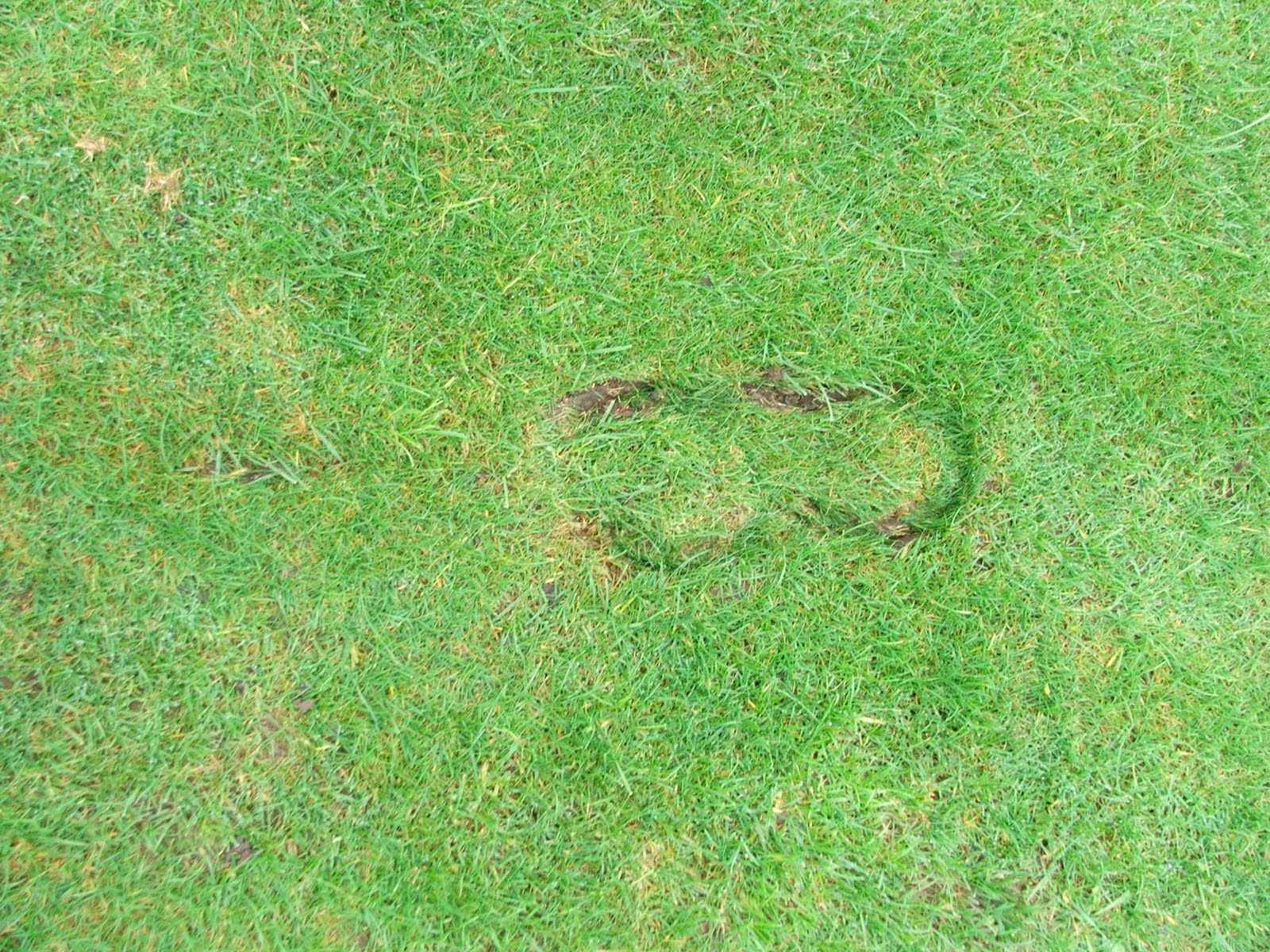
As I was walking down the first fairway I saw horse shoe marks all over and horses grazing to the left of the fairway. Not one or two impressions in the grass mind you, but quite a few hoof marks. Game on at Royal North Devon. This is going to be interesting.
The front nine plays near the water and the back nine through grass and marshland away from the water. The course is a classic out-and-back layout and does not route back to the clubhouse after nine. Similar to St. Andrews, the course is very flat and wide open.
The first hole is a 478-yard par five that eases you into the round. The second hole "Baggy" runs parallel to the ocean and is a 422-yard par four. I noticed that I had to walk very carefully at Westward Ho! because there are loads of rabbit scrapings on the front nine. Rabbit scrapings are little holes that rabbits dig in the ground to hide and stay protected. From what I could tell based on the number of scrapings, there are lots of rabbits in the vicinity.
The fourth hole is a "Cape" hole that plays 350 yards and doglegs sharply to the left. You can see the massive set of railway sleepers that line the bunker that you must hit over from the tee. This is a man-sized bunker that runs the entire width of the fairway and is at a higher level than the teeing ground.
The view from the tee box on the 4th hole at Royal North Devon
Notice the poles and white cloth fences that protect the green as seen below. These are found on all the greens at Royal North Devon. Their purpose? To keep sheep and horses off the greens, of course!
The green on the fourth "Cape" hole
Royal North Devon is a rough-hewn course and is not in the least bit polished. Therein also lies its charm. Playing at Royal North Devon is the antithesis of sitting in a golf cart for a five hour round waiting for the group ahead of you to line up their fourth putt. This is golf at its simplest and purest. For a variety of reasons, not the least of which is the common land, the course is a bit rough around the edges. There are also no yardage markers, but only simple grey rocks to mark off 150 yards. The greenskeeper here clearly doesn't have Augusta envy like almost all courses in the U.S. This is a course where you play the ball where it lies, commune with nature and go back to the game's roots. If golf is a metaphor for life, then Royal North Devon is its best example. It's not all neat and tidy. Rub of the green as it's called.
Horace Hutchinson describes the course in his book Golf in 1890, "The bunkers on St. Andrews links are for the most part well defined, but on many of the very best links, Carnoustie, Prestwick, Westward Ho!, Sandwich, there is a lot of loose ill-defined rubbish, the sandy out-blowings of bunkers, which is very hard indeed to play out of." His description is still apt.
A good illustration of this is the picture of the sixth hole from the tee box. This 408-yard par four plays along the ocean and has a fairway that is shaped by the natural slopes of all the dunes. The hole is completely exposed to the wind coming off the water.
View of the par four 6th, "Alp" hole
As common land, Royal North Devon is open to the public at all times and the locals seem to have access from any and all directions. Along this hole and the ocean is a path where people are strolling about, walking dogs and enjoying the outdoors. There are signs all over the course reminding you, the golfer, that the walkers have the right of way. Even in the less than ideal weather, there were a lot of dog walkers.
Around the sixth hole I couldn't help but notice that I had been dodging poop the entire time I was walking the course. Loads of poop. Of various varieties. Rabbit, dog, horse and sheep were all present and accounted for. There are a lot of bowels moving out on the common lands at Royal North Devon! Not since playing Medinah have I seen so much fecal matter on a golf course.
In case you think I am exaggerating the issue with stool on the course, local rule #8 listed on the back of the scorecard is the "Embedded Ball and Heaped or Liquid Manure" rule. It reads, "A ball which lies in or touches HEAPED OR LIQUID MANURE may be lifted without penalty, cleaned and dropped..." I rest my case.
Royal North Devon also features a lot of blind tee shots. There are aiming poles on quite a few holes, especially on the back nine. The back nine plays away from the water and features an abundance of marshland grass as can be seen in the photo below. These grasses are called 'Great Sea Rushes' and you want to steer clear of them since they eat golf balls. Horace Hutchinson describes these "Rushes" as a "peculiar kind of long rush, very sharp and stiff pointed, which we sincerely hope to be peculiar to itself."
The aiming pole on the par four 11th hole
The thirteenth hole is a 442-yard par five named "Lundy." It is a unique hole in several regards. First, it is short for a par five. Second, it is really a sheep pasture masquerading as a fairway, and third, the green is diabolical.
Sheep grazing on the 13th fairway at Westward Ho!
One of the original club rules, published in 1864, states, "As the Burrows are public pasture, great care must be taken not to drive, frighten or injure any horse, cattle, sheep or geese." I almost hit a sheep with my drive. It is hard not to. Luckily, my ball landed safely on the grass.
Left of the thirteenth fairway is grazing land for sheep. They obviously don't have any regard for where the grazing lands end and the golf course begins, so they graze wherever they please. The grazing is quite heavy on both the twelfth and thirteenth holes. I must say that not even at Brora in Scotland have I seen so many sheep on a golf course. This is not the occasional sheep mind you. There were hundreds on the hole as I played it, as you can see below!
The full herd of sheep on the 13th green at Royal North Devon
If this isn't worth flying to England to see, I don't know what is? My yoga teacher has been emphasizing that I should not judge. Just take it in and accept it for what it is, she advises. This is the mindset you need when playing at Royal North Devon. Experience it for all its glory. Certainly, keep a keen eye out on where you step. Take a deep breath through the nose to stay in the present. Bring a towel to every green to wipe your ball before lining up your putt. Make sure you dodge the heaps of dung as you put your golf bag down. Strive for a tranquil state. Forget the conventional, be open to new things. Watch for rabbit holes and slippery poop. Let your mind and body be as one. Enter a state of serenity. Don't let the mind wander. After all, if I wanted to experience a cookie cutter set of golf courses I could have taken a trip to Myrtle Beach. Instead, I am expanding my horizons.
The small, hard to hold green on the 13th hole at Royal North Devon
Have I digressed? Back to the golf hole. How do you make a very short par five a difficult hole? Put in an inverted saucer green, make it circular and only 25 feet in diameter. Holy shit (pun intented), was it hard! I am embarrassed to say that I four putted the darn thing after being 10 feet off the green in two.
To emphasize my point about the animals at Royal North Devon, this is how I found the seventeenth tee box as I walked to it. It had about a half dozen horses grazing and doing their droppings near by. Ladies and gentlemen, boys and girls, Royal North Devon is a trip!
The 17th tee at Royal North Devon
After you putt out on the 18th green, you leave the common land and go back through the fence to the civilized world of the clubhouse, safe from the animals. I immediately went to the ancient locker room at the conclusion of my round and washed my hands very well!
I am glad I made the trek to Royal North Devon. It has a rich and storied history. It was originally designed by Old Tom Morris and has hosted the British Amateur championship three times. I am a voracious reader and early golfing history frequently mentions many storied links courses often by their pre-Royal names. Specifically Prestwick, St. Andrews, Sandwich (Royal St. George's), Hoylake (Royal Liverpool) and Westward Ho! (Royal North Devon). That's some pretty lofty company Royal North Devon keeps. The other four courses have all changed quite a bit. You can't really visit Sandwich anymore, you are visiting Royal St. George's. The same with Hoylake. What a treat to be able to actually visit an old-school course like Westward Ho!
To be sure, Royal North Devon has some uninspiring holes. The eleventh, fifteenth and seventeenth come to mind, but on balance Royal North Devon is an experience worth having. There are at least a half dozen really good holes (the 4th, 5th, 6th, 10th, 13th and 16th).
The course received its "Royal" patronage from Edward the Prince of Wales in 1865. Edward was the son of Queen Victoria and Prince Albert. He would go on to become King Edward VII. The Prince was indeed a golfer and laid out a course at Windsor. He was the first Royal to serve as Captain of the R & A. He also granted Royal status to both Dornoch and Portrush. The Prince/King led an active life outside of golf, and it is well known that he had many mistresses. A particularly virile monarch, it is rumored that he had at least 55 liaisons. His Majesty is pictured below. God save the King!
I mean no disrespect to the course or club at all with my descriptions of the course conditioning or the abundance of droppings. As my readers appreciate, I am simply pointing out facts and not trying to sell magazines or hype anything; thus I give the unvarnished truth. Not to point out such an obvious and plentiful set of facts would misrepresent an integral part of the experience here. Royal North Devon remains a true rarity. It offers the golfer the possibility to transport himself back 150 years and see what golf was like before it became a popular pastime and when it was played on common lands. The club is also very welcoming and accommodating to visitors, and the clubhouse is a veritable museum with its trophies, artwork and match boards showing results back 150 years.
I hope by the next time I visit they trim back some of those bloody hedge rows in Devon so I can see where I'm going!
Monday, April 09, 2012
The Kiwis Are Back!
Of course, they have a blog, which I expect will be as cheeky and insightful as their last one: Tumbling Across America. A pair of antipodean Jack Kerouacs', their theme during 2012 is On the Road Again.
It was good to see Jamie in New York a few weeks ago. I think he liked the Upper East Side. He looked a bit more tired than the last time I saw him in that special city of Wellington.
Aside from their road trip, they plan to spend the summer caddying at one of the finest places on the planet, going to the Masters, visiting Yosemite, and I'm sure, depriving themselves of sleep.
When I described this year's odyssey to the Mrs. she came to the same conclusion that I did: that two good looking, well educated kiwis, with endearing accents, spending the summer in the Hamptons, could do some damage. Word has it that some of the pipes burst over the winter at the storied club they will be carrying bags at, and thus, there is plenty of new pipe to be laid this year.
These two Kiwis are filled with vim and a sense of adventure. They plan on buying another van to sleep in as they embark on their road trip. They would never ask outright, but being a shameless New Yorker I am not afraid to do so on their behalf. I'm sure they would appreciate a real bed to sleep in or an invite to play golf. I can vouch for them as they did not burn down my house when they stayed. Meeting them or following their blog is sure to be an enriching experience.
Sunday, April 01, 2012
St. Enodoc Golf Club
First up is St. Enodoc, which requires some effort to play because it is not located near any other golf destination or well known courses. The club was founded in 1899. It doesn't have a marketing department or isn't pitching itself as a must play course, so it is truly a destination for the die-hard golf nut. St. Enodoc is located on the Cornish coast of England. That would be the bottom left part of the country (Southwest for you sticklers). Way down there. Cornwall (the Royal Duchy of Cornwall is its full name) has a very rugged and dramatic coastline.
The rolling hills of the English countryside never disappoint. Its bucolic beauty is timeless. American real estate developers like to use names from the English countryside when building developments and naming streets. Most new sub-divisions have at least one neighborhood or model home named Devon, Exeter, Dorchester, etc. The trip to St. Enodoc took me through these actual historic places.
The last ten miles to St. Enodoc are a driving experience, with its narrow, twisting lanes through the rolling countryside. I'm a veteran of this type of driving, where you can't spare a half inch on either side when a car or truck is passing from the other direction. More than once, I have knocked off the mirror on the left side of the car. The road approaching St. Enodoc is lined with Cornish hedges. No, not Cornish hens, Cornish hedges.
Fittingly enough, the entry drive at St. Enodoc is a one-lane road straight up a big hill lined with hedges. I was lucky to play St. Enodoc on a Sunday afternoon in the late fall. Throughout my drive to St. Enodoc BBC radio described the day's weather as variously: Fine and dry. Crisp and clear. Lovely, with a fresh breeze. A spectacular day by any standard.
The golf course was designed by James Braid and opened for play in 1907. Along with Prestwick and Merion, St. Enodoc has one of the best opening holes in the world. A par five of 528 yards, you hit into a wildly undulating fairway with a big set of sand dunes guarding the right side of the hole.
I do most of my golf trips with friends, but at St. Enodoc I played alone, which I like to do on occasion. It was a great opportunity to recharge the batteries, exorcise demons and clear my head. It was also a nice relaxed round where I got to drop balls and try out multiple bump and run shots into various greens and in general just play around.
When you read about St. Enodoc, you hear about the tenth hole being the Church hole. The tenth is a wicked difficult 457-yard sharp dogleg left par four, but you only get a glimpse of the church from the hole. The church really comes into view on the twelfth and thirteenth holes which are set above the fairway and have a commanding view looking down on both the church and the sea.
St. Enodoc had as much variety of sounds as I have ever heard on a golf course, all of them pleasing. There were the waves crashing on the rocks below the course, sheep baaing, gulls crowing, dogs barking, the wind blowing and the church bells ringing. There was also the smell of burning leaves from a nearby land owner, which brought back memories of my childhood, when the practice used to be allowed in the U.S. and an old maid near our house diligently burned leaves every Sunday during the Fall.
The golf course is a unique one and has a collection of standout holes (one, two, four, six and ten) that give the course a cult following among those learned in golf course architecture. The course combines dramatic water views with beautiful dunes links land as seen below on the finishing hole. The course is better than some of the courses in the top 100 I have played and it's a bit of a wonder to me why the course doesn't get more accolades.
After my round I sat in the clubhouse enjoying a Guinness and an egg mayonnaise sandwich on brown bread. I sat savoring the moment eavesdropping on a group of four Englishmen who were as quirky as the course. The perfect ending to a perfect day.
Thursday, March 01, 2012
My Personal Top 50 Courses in the World
The right question would be, if you had unlimited time and money, and access to whatever courses you wanted, which courses would you put on your short list to play. Think of it as your own personal global Open Championship rota of courses.
Try sometime to rank the top golf courses you have seen or played. Then take out a blank sheet of paper and try to write it down again. Or think about it a few days and try it again. Try it again and see if you come up with the same list. It's a futile exercise. My own personal experience is that it is easier to bucket courses into categories or group them together. Below is my current list:
Cypress Point
National Golf Links of America
Sand Hills
Carnoustie
Loch Lomond
Sunningdale (Old)
Cruden Bay
Maidstone
Royal Portrush (Dunluce)
Royal Adelaide
Merion
Morfontaine
Shinnecock Hills
Camargo
Shoreacres
Pine Valley
Yeamans Hall
Royal County Down
Jack's Point
Woodhall Spa
Barnbougle Dunes
San Francisco Golf Club
Turnberry
Whippoorwill Club
Los Angeles Country Club
Seminole
Somerset Hills
Royal Melbourne West
Kauri Cliffs
Kawana
Bethpage Black
New South Wales
Whippoorwill's par three 4th hole
Pebble Beach
Riviera
Crystal Downs
Prestwick
Kingsbarns
Baltimore (Five Farms)
Lahinch
Garden City Mens Club
Naruo
Myopia Hunt Club
Highlands Links
Next 10
Bandon Dunes
The Valley Club of Montecito
Kiawah (Ocean Course)
Pinehurst #2
Royal Dornoch
Hirono
Chicago Golf Club
Valderamma
Royal St. George's
Royal Liverpool
Wednesday, February 01, 2012
Highlands Links
It would have seemed like I would have played a public course much earlier in my quest. Why is it that I played a public course my penultimate? Because it is remote and difficult to get to. While at Highlands, the pro told me that one of the people who has already completed playing the top 100 in the world also played Highlands as course #99 followed by AUGUSTA as #100. Surely a good omen.
Located on the northern portion of Nova Scotia off the Cabot Trail, Highlands Links (ranked #64 in the world) takes work to make the trek to, but it is worth the effort.
The golf course was designed by Canadian architect Stanley Thompson, aka "The Toronto Terror," in 1935. The course is set in a dramatically beautiful part of the world, within Cape Breton Highlands National Park. The park covers almost 600 square miles and features steep cliffs and deep river canyons carved into a forested plateau, bordering the Atlantic Ocean. Thompson was given a huge swath of land to work with and had the luxury to put the holes where he wanted.
Playing the first hole at Highlands gives you an immediate sense that the course is not going to be "typical." Its sense of uniqueness asserts itself right out of the gate. The 405-yard hole plays uphill, and both edges of the fairway taper off into the deep woods that line it. Thompson liked to use moguls as a design feature, and this hole smacks you in the face with them. It's a great way to start a round of golf! Thompson didn't use a lot of bunkering at Highlands, and the first hole is a good example of why he didn't need to. Between the moguls, the uphill terrain and the trees, no more hazards are needed.
The second hole is one of the best I've played in my travels. A 447-yard dogleg right, the hole plays sharply down a big hill. You hopefully won't see your tee shot land, since if you hit it well, it will carry the crest and your ball will bound down the hill. The second hole features NO bunkers at all. You can see the beautiful birch trees that line the hole (and entire course) in the picture below.
The idyllic par three 3rd holeI liked the short 324-yard fourth hole quite a bit. The tee shot demands a smart, well placed shot into a narrow, hilly area instead of requiring the golfer to bomb away off the tee with a driver.
The 4th hole at Highlands Links as seen from the tee
The tabletop green on the fourth hole is a tough target to hold and has a challenging, undulating green set amidst the birch trees.
The 4th hole's tabletop green
The sixth hole ranks among the top 100 holes according to The World's Greatest Golf Holes book, published by Golf Magazine in 2000. The name alone is worthy of ranking the hole. Thompson named the hole "Mucklemouth Meg" after a Scottish woman who could apparently swallow a turkey egg whole. The par five hole is 537 yards and plays from an elevated tee along the beautiful river estuary.
The par five seventh hole is also one of the best I have ever played. It is 570 yards and is the #1 handicap hole on the course. Thompson used the rolling hills in this part of the park to great effect when designing this hole. You hit your tee shot into a chute of trees and watch it run up and down the hills like a ball bouncing in a pinball machine.
The world-class par five seventh hole
The hole is narrow, lined with birch trees and with a lot of interesting land forms. The approach to the green is a challenging shot and could be blind depending upon where you leave your approach shot.
The seventh hole embodies Thompson's design philosphy perfectly. He wrote in 1923, "In clearing fairways, it is good to have an eye to the beautiful. Often it is possible, by clearing away undesirable and unnecessary trees on the margin of fairways, to open up a view of some attractive picture and frame it with foliage."
The par five 7th approach to the green
Around about this part of the course Highlands Links becomes a "no doubt about it" course. Sometimes when I play a course ranked among the top in the world, I have to think why it is ranked there. I didn't have to do much thinking here. Highlands is what a top 100 course should be: it is something special. The dramatic scenery in all directions is intertwined with great golf holes and a varied routing, which make it a standout course.
Like at Cypress Point, the routing at Highlands is unconventional by today's standards. There are two sets of back-to-back par fives (holes 6 and 7 and holes 15 and 16). The front also has in a three hole sequence a par three, followed by a sub-300 par four, followed by another par three. The course measures 6,592 yards from the tips, but I found it plays longer due to the use of uphill shots.
Part of the genius of the course design is how Thompson juxtaposes different hole types and mixes uphill shots with downhill shots. A good example is the eighth hole which has a blind uphill tee shot. Not to worry though, this 319-yard par four is one of the easiest on the course.
The 8th hole as seen from the tee
After you hit over the hill, the hole drops dramatically back down the hill. The steep downhill approach makes judging the distance to the green tricky. As Thompson's biographer, James Barclay, wrote about the colorful man, "At times his work seemed to transcend architecture and become the poetry of shape."
The 8th green with its dramatic mountain backdrop
For a course designer I am sure it is the ultimite luxury to be given such a huge swath of land to work with and to be able to spread the course out to take advantage of what you think will make the best holes. Thompson did good in this regard. The course is a true walk in the park, but not for the faint of heart. The walks between the 6th and 7th holes and the 8th and 9th holes amount to miniature hikes through the woods. Although the course has an out-and-back routing, with the ninth hole playing far away from the first tee, the overall routing amounts to nothing less than genius.
The ninth is another unique golf hole that fits perfectly into the routing and landscape. You drive from an elevated tee down into a valley. Your approach to the 336-yard hole's green is sharply uphill and to the right, to a blind green. It is a very imaginative use of a ravine and side of a hill, since you cannot see the green until you walk to the top of the hill.
The 9th hole from the tee
The back nine is quite a challenge as well, although it is not as visually arresting as the front. The twelfth hole is a demanding par three that plays a crazy 240 yards from the blue tees!
The walk from the twelfth green to the thirteenth tee is one of the best in the world. After putting out on the testy par three you meander along a long path which hugs the Clyburn river, nestled among birch trees. The walk can be savored because it is more than a third of a mile long. The scenic beauty of Nova Scotia is in full evidence as you walk along the rocky river bank and breathe in the pure Canadian air. Golf is metaphorically called a walk in the park; at Highlands, it really is one.
The world class walk from 12th green to 13th tee
A good ten minute walk from green to tee? This Thompson fellow sounds a little nuts. Perhaps, but he routed a genius course and looked for the best place to put holes, apparently without too much regard about the walk from green to tee. Shinnecock Hills this is not, in terms of tees being next to greens. The total walk at Highlands was as tough as any I have done; the distance from the first tee to the eighteenth green is seven and a half miles. A typical walk on a golf course is five miles, so it is 50% more than average.
On balance, the back nine is not as dramatic as the front, partially because the first nine holes are all unique and very interesting. It got too dark for good pictures on the back (sorry), but I really liked the par five fifteenth hole, where Thompson uses his moguls strategically and with great impact.
Categorizing Highlands Links is difficult to do. Thompson called it a "mountain and ocean course." Although it isn't set at an elevation, it feels like it is since the terrain is so mountainous. Part of what makes Cypress Point unique is that it is routed through three types of landscapes: A forest, sand dunes and along the ocean. Highlands Links is similar: it starts along the Atlantic, crosses a lake and river tributary with marshland, and is routed through the forest. I don't compare courses to Cypress Point without giving it a great deal of thought, but in this instance it is an apt comparison. The grandeur of Highlands is worthy to be among the world's best.
I would personally rank Highlands Links higher on the list of top ranked courses. Rather than #64, perhaps in the top 25 or 30.
Pre-war golf course architects were sometimes colorful characters: Tom Simpson and A.W. Tillinghast come to mind. Thompson seems to fit the same mold: A lover of thick steaks, expensive cigars and Canadian Rye, he has been described as red faced with a "roast-beef complexion". His design skills matched his big reputation.
As I mentioned, Highlands Links is located off the Cabot Trail, a spectacularly scenic part of the world with an abundance of lobsters. On this trip I was able to answer two of life's more vexing questions definitively. Is there such a thing as playing too much golf? And, is there such a thing as eating too much lobster? The answer to both questions is a resounding NO. Throughout our visit to Cape Breton Island we binged on cheap and plentiful lobster everywhere we went. The people of Nova Scotia are also among the friendliest in the world and are quite hospitable. It is a great place to visit.
My journey winds down
The opera is now in its last act. We all know who sings in the last act, don't we? She's ready to go; hopefully, she will belt out the final tune in short order!
Sunday, January 01, 2012
2011 Year in Review
To counter this hokum, I do have some fellow supporters, "I have played Fisher's 4 times now and agree this is possibly the most overrated track in the top 100...the ocean views are beautiful, and there are a couple of spectacular holes...but place this course anywhere else and I think its not anywhere near top 100".
To the amazement of many of you, I did play Fishers Island again and have a new more balanced writeup about the course. Hopefully, the inimical comments around this topic will slow down. And, I'm always open to an invite back guys, to reconsider the error in my ways!
I love this comment on Augusta and the sense of introspection. "I rebelled against the game in my late teens as part of that general dissatisfaction with reality we males face around that age. I came to associate golf with my father (who taught me to play at an early age), and with preppy country club banality. sinister sounding, 'exogenous forces were at play.' An old family friend of means, himself a member of Peachtree and Atlanta Athletic, invited us to play Augusta. Today, I have no access to Augusta. I am no longer a quasi-interesting teenage rebel but a 30-something divorced monster. The gentleman who invited us is dead; his sons hate me and I may never play Augusta again. Talk about youth wasted on the young..."
It is not often you find someone who dissents about Merion being a great course, "...it was simply the most overrated course I have ever played in my life. We actually made the mistake of going to the wrong tee box twice, as some of the holes are a shooting gallery. I have been invited back several times to play, and won't consider it, and keep making excuses". As they say on TV, the views shared by my readers do not represent the view of management.
I consider myself very lucky to have played Maidstone three more times this past year. I rank it in my personal top ten in the world, so I completely agree with this comment, "Pound for pound, yard for yard, Maidstone is the finest members golf course in the world IMHO. Wind, season - lush in Spring, baked out in August - means the course never plays exactly the same round to round."
Another fantastic comment, which I agree with regarding the three golf courses in the Hamptons, "I think of it like this: If you're a real nut for course design and tradition, it's The National. If you're an excellent and talented player (or just a prick who equates difficulty and 'shot values' with greatness) it's Shinnecock Hills. If you're a laidback person who truly enjoys just being in beautiful scenery and not struggling, it's Maidstone."
One of the best comments I have gotten in the six years I have been doing the blog, "you rate golf courses like girl friends - It depends how you scored".
It's always nice to get some media coverage and this year I'm happy I was featured in a story in the Journal of Addictive Behaviors. So, it's only an academic publication with a small circulation, and I don't agree with the author's conclusion that I'm clinically nuts. It's a trifling disagreement. As Donald Trump says, there is no such thing as negative publicity.
Cabot Links on Canada's Cape Breton Island
My golfing travails of 2011
It seems like so long ago, but it has been less than a year since I visited New Zealand. The incomparable beauty of the place left me feeling quite gay. It's hard to find a greater collection of courses than Kauri Cliffs, Cape Kidnappers, Paraparaumu and Jack's Point. I still have fresh memories of my amazing visit to Queenstown. I hope to return some day to this great country.
My revised writeup of Riviera got much better feedback and I was really happy to have played the Whippoorwill Club again. Having done so three more times, I am now of the firm opinion that this is one of the top 50 best courses in the world. I also returned to Los Angeles late in the year and was gobsmacked by the changes made to L.A.C.C. and have a new review of it as well.
I finally made it down to the capital of the Confederacy and played The Homestead Cascasdes course in Southern Virginia.
I capped off the year with another rousing visit to Canada to play both Highlands Links (review coming next month) and Cabot Links, both worth the journey.
Highlands Links par five 7th hole
Results from this year's polls include a preference for Bethpage Black as Tillinghast's best course:
Bethpage Black 36%
San Francisco 28%
Winged Foot (West) 17%
Somerset Hills 6%
Baltusrol (Lower) 6%
Baltimore (Five Farms) 4%
Bethpage Black's 14th hole
The best course on Long Island poll had the following results, which are hard to dispute, although playing any of these courses is special:
Shinnecock Hills 34%
National Golf Links of America 25%
Bethpage Black 16%
Friar's Head 9%
Garden City Men's 5%
Maidstone 4%
Sebonack 4%
After visiting all these great courses and traveling around the world I have lost none of my the wanderlust and love for golf, travel, being with good friends and meeting new ones. I'm living the dream out here. What a year. Thank you to all who have helped me over the years. A happy and healthy new year to all! Best wishes for 2012, and a little wisdom to start the new year:
Life isn't about finding yourself,
Life is about creating yourself.
-- George Bernard Shaw