Friday, October 12, 2012

Kingsbarns Golf Links

New pictures updated from my recent trip to Kingsbarns. I like the course more every time I visit.

18th green
The exciting finishing hole at Kingsbarns Golf Links, Scotland

The first golden era of golf course design was in the 1920s when some of the best all time architects were alive and designing: Alister Mackenzie, Seth Raynor, A.W. Tillinghast, H.S. Colt and George Thomas. "The Roaring Twenties" were also a time of unprecedented global prosperity with markets booming around the world. Of the 100 top courses in the world an astonishing 28 are were built in the 1920s.

We are lucky to live in the new golden era of golf course architecture. Kingsbarns (ranked #65 in the world) is one of the new generation of courses that have graced the world in the 1990s and 2000s, specifically having been built in 1999. The new golden era is characterized by architects such as David Kidd, Tom Doak, Bill Coore and Ben Crenshaw and Kyle Phillips, the designer of Kingsbarns. This new group has designed many new courses that rank in the top 100. This new generation of world-ranked courses follows a dearth in good design. During the entire forty year period between the 1940s and the 1970s, only nine courses were worthy of inclusion on the top 100 list, and most of them were toward the latter half of the period and were designed by Pete Dye.

Part of the reason we are in a new golf course design renaissance is the favorable economic environment we find ourselves. A new generation of multi-millionaires, fueled by entrepreneurship and rising real estate and capital markets, have had both the vision and the money to put together some of the these great new courses.

Kingsbarns, located in the Kingdom of Fife, south of St. Andrews in Scotland, is a course I like very much. I have been fortunate enough to have played Kingsbarns three times on two different trips.

1st fairway
The great 414-yard opening hole at Kingsbarns takes you right out to the North Sea

The course is varied and interesting and a lot of fun to play. A lot of land was moved to build the course and critics of Kingsbarns cite this as something that detracts from it, since it is not pure links land. Hogwash! The course is great and feels and plays like a links course.

3rd fairway 1
The 516-yard Par 5 third plays along the water and is a terrific hole

From my point of view, there really is no let-down at Kingsbarns. I find the opening holes to be very exciting. The third, in particular plays along the North Sea and is a great par five in the dunes. If your blood isn't pumping with excitement by the time you reach the third green you need to have your pulse checked. The green, seen below, is demanding. Be sure to avoid the deep bunker front, right.

3rd green
The third green at Kingsbarns

The fifth hole is a 424-yard par four that plays back toward the opening hole. Your approach shot is over some big humps, hollows and gorse, seen below. The hole's name, "Tassie", means small cup or goblet and refers to the punch bowl nature of the green.

  5th green
Approach to the fifth green at Kingsbarns

I have been keeping track of the greatest holes in the world as I progress through the courses, and Kingsbarns has a couple on my list. The driveable par four sixth hole is on the list.

  6th from tee 
The world-class driveable par four sixth hole at Kingsbarns

The sixth is 337 yards and the tee shot is over a little valley. The play is to the right since a strip of land protrudes out of the hillside. If you can hit your ball about 220-240 yards, it will ride the slope all the way down to the hole. A hole-in-one is possible and eagles are also in the offing. The hole's name "Auld Links" refers to the original 1793 Kingsbarns 9-hole course that existed near this part of the course.

6th green
The fantastic sixth green at Kingsbarns

The sixth green is set in a little cove, and as you expect from a short hole, the green is difficult with a lot of undulations. Laying up into the valley isn't really the play from my point of view, since it leaves you with a blind shot to the green. It is tons of fun to play this hole. The hole reminds me of the sixteenth at Royal County Down, because you have to hit your ball over a valley to land it on the green if you are going for it.

8th green 
Green on the par 3 eighth hole at Kingsbarns

The par three eighth hole, seen above, plays only 168 yards from the back tees and 132 from the front. It also plays down hill and possibly down wind as well. As you can see, the green is two tiers and the lower tier is 10-12 feet below the upper. A very good hole.

Memorable holes on the back include the par five twelfth hole that is often compared to the eighteenth at Pebble Beach, rightly so. In my opinion, the views at Kingsbarns are as good as those at Pebble Beach, as is the hole. Avoid the big bunker guarding the green on the left side. There are some old stone walls down on this part of the course too, which add to the charm.  I also like the par 3 fifteenth hole, which plays over water. And the long par 4 seventeenth hole has a diabolical green! 

What do I like so much about Kingsbarns? It has everything I like in a course:

1. An interesting routing, not just an out-and-back layout
2. Holes of varying length which test your skill on short shots as well as long. I'm not a big fan of having to hit 80% of your shots all day as long shots.
3. Six holes along the Ocean that rival any course in the world for scenic beauty
4. The ability to hit a variety of shots - bump and run, pitches, and a variety of wedge shots
5. Challenging but fair greens - some contoured significantly, some not, but appropriate for the size of the green and the type of hole
6. An intelligent use of terrain and elevation - some uphill shots, some downhill, but not overdone.

The course should rank higher in the world rankings in my view. It is, I believe, the first modern course worthy to be put on the rotation to hold an Open Championship. To me, the place the feel of a Scottish equivalent of Bandon Dunes.

About 80-90% of the people that play Kingsbarns are visiting Americans. They have a great caddie program as well and I recommend taking one. The clubhouse is great and I recommend the onion rings.

Saturday, September 01, 2012

Members Only

Welcome! 

Well, conditionally welcome, if your name is on our list. This month we feature a sampling of the guard gates, warning signs and protective fences guarding the elite golf courses of the world from the unwashed masses.


Pine Valley Golf Club, Clementon, NJ


Yeamans Hall, Charleston, SC


Southern Hills Country Club, Tulsa, OK


Seminole Golf Club, June Beach, FL


Sand Hills Golf Club, Nebraska


Quaker Ridge Golf Club, Scarsdale, NY


Oakland Hills Country Club, Bloomfield Hills, MI


Cape Kidnappers, New Zealand


The Country Club, Brookline, MA


Morfontaine, Senlis, France


Los Angeles Country Club, Los Angeles, CA


The Honors Course, Ooltewah, TN


Sebonack, Southampton, Long Island, New York


Shinnecock Hills Golf Club, Southampton, Long Island, New York


Shinnecock's next door neighbor

Another private Hamptons gem!

Wednesday, August 01, 2012

Leave it to a lawyer to try and play them all

From Golf Digest – November 1983

Although the article discusses Thompson’s playing the 100 best courses in the U.S., it presages his journey to play the top 100 in the world and gives some insight into the man.

Leave it to a lawyer to try and play them all

Most people don’t play 100 different courses in a lifetime, let alone the 100 best in America. Bud (Oliver) Thompson has done it, what’s more so has his wife . . . well almost.

Earlier this year Thompson, and his wife Phyllis rounded up his two daughters and headed for a Hawaiian vacation. Only it wasn’t an ordinary vacation. Its purpose was to enable Bud and Phyllis to play Princeville, the only Hawaiian course among America’s 100 Greatest, as ranked by Golf Digest. Why Princeville? Because it was number 100 in Thompson’s quest to play the 100 Greatest. And astonishingly, it was no. 94 for Phyllis. 

Thompson, a Cleveland attorney, is counsel for the Northern Ohio section of the PGA, the local Golf Courses Superintendent’s association and the Western Golf Association of America. In addition to his normal duties, he has taught at PGA business schools and has written two business publications for the PGA. These connections—and the fact that he flies his own plane—have provided Thompson relatively easy access to the nation’s great courses. But what about Phyllis? 

They learned the game together about 25 years ago, and they always travel together, sometimes playing half a dozen courses in the matter of four or five days. Of the six courses on the 100 Greatest she has not played, these are courses Bud played years ago, before either of them ever thought about playing all 100. Since they became serious about the project, Phyllis has missed only Oak Tree, Bob O’Link and Butler National. And with good reason. Those three don’t allow women to play.

Thompson, a 16 handicapper at Acacia Country Club (Phyllis is a 19) plays about 60 rounds a year. He’s already played the three courses that have been added to the 100 Greatest this year—Long Cove, Tournament Players Club and Wild Dunes—and now is turning his attention to the best courses in Canada.

The only other person to play the 100 Greatest is William Power, also an attorney, from Doylestown, Pennsylvania. He completed the 1973 listing, and has remained current with all the courses added since then. 

Inasmuch as only Thompson and Power have played all the courses since Golf Digest began its rankings in 1966, it’s apparent that theirs is an impressive achievement. But there are those who think Phyllis’ achievement is even more impressive.

- Ross Goodner


The First Man to Play the World's Top 100 Golf Courses

This is the tale of the first man to play the World's Top 100 Golf Courses in the world. A trial lawyer from New Orleans, Louisiana, he completed the task in a mere seven years. The editors of Golf Magazine played with him on his final round and presented him with a hand-lettered, framed list of his accomplishment.

His name is Jim Wysocki and he completed the task in 1986, two years before the next person to do so. Prior to golf magazines' publishing top 100 lists, Golf Magazine published the "50 Greatest Golf courses in the World." Wysocki also holds the distinction of being the first  to complete this initial list. He did so in 1982.

Jim Wysocki pictured in a Times-Picayune article from October 20, 1982


It took some time to find Jim's story, as he did it in the pre-Google/Internet era. I had to research the old fashioned way, looking at old newspapers in his home town. Some interesting things struck me: The article says that he somehow played three top 100 courses on three continents on one day in London, New York and Tokyo. Last time I checked flying to Japan crosses the date line in the wrong direction so I don't think he actually did it in one calendar day. It helps that Sunningdale, Garden City and Tokyo are close to the big city airports, and even if it wasn't in the same day, playing these three back-to-back-to back is still quite a feat! As a frequent traveler, I would love to be able to get one of the "good-conduct passes" he mentions to get through customs.

It was as hard to get onto Augusta for him as it is for everyone else. He also accomplished the task in the era before MapQuest and GPS technology. He planned the trips using paper maps!

Jim was also an amateur pilot and tragically he died in a Cessna plane crash in Louisiana in 1989, three short years after his accomplishment and in his early 50s. In his honor The James Wysocki Award is granted each year to students at Tulane who excel in Trial Advocacy.

As the unofficial keeper of the list of golfers who have completed playing the World's Top 100 Golf Courses we proudly add James Wysocki to the #1 position and pay tribute to his trailblazing. He accomplished quite a feat. Even today more men have been to the moon than have played the top 100 courses in the world. Many thanks to Top 100 golfers Randy Pace and Robert McCoy for cluing me into Jim's story.

James A. Wysocki - Golf Enthusiast and Pioneer

His story as told by by Ronnie Virgets of the Times Picayune on July 30, 1986:

New Orleans – Jim Wysocki is the first and only man to play every one of Golf Magazine’s Top 100 Golf Courses in the World, and it has taken him seven years, about 9,000 strokes and a score of 1,800 over par to brag about it.

Tough audiences can consider some of the nuances of Wysocki’s feat. Since 1979, the 47 year old New Orleans lawyer has spent almost every weekend and vacation getting to golf courses like Royal dar-Es-Salam in Rabat, Morocco to Bali Handara in Bali, Indonesia. He’s shanked drives in Sardinia, buried six-irons in Sweden and rimmed putts in the Dominican Republic.

But it was the tricky seven-footer slightly up-hill on the 18th hole of the Yale University Golf Course that made Wysocki proudest.

A group from Golf Magazine, the guys who had started it all, showed up play with Wysocki in his final round. Publisher Pete Bonanni was there, with editor George Peper and writer Robin McMillan.

After Wysocki and teammate Bonanni won $2 on the round from Peper and McMillan, Peper gave the now-famous weekend golfer a framed list of all 100 courses with the dates he had played them, all hand lettered.

A picture of the list presented to Wysocki in 1986. From Times-Picayune July 30, 1986

On top was the legend, “To the only man to play each and every one of Golf Magazine’s top 100 Greatest Courses – presented July 3, 1986, with incredulity, by the editors.” “I looked up the dictionary definition of ‘incredulity’ when I got home,” Jim Wysocki said. “It says something about ‘an unwillingness to believe.’”

When he finished his seven-year task, “I had two completely opposing emotions,” Wysocki said. “The first was almost total depression; The biggest challenge of my life was now gone. The second was almost total exhilaration; As soon as that put dropped, I would be the only man in the world that had done it.”

He says he remembers having his putting concentration broken by the appearance of elephants from the game preserve adjacent to the Sun City course in Bophuthatswana, South Africa. And once he was chased from a water hazard at Shinnecock Hills by the biggest and fiercest swan in Southampton, NY.

Still not impressed? How about 299,000 miles logged in the completion. 12,000 of them by private plane and 3,000 more on the QE2? How about playing three different courses on three different continents on one day?

“My wife Christine says in so many words that I’ve got my priorities all screwed up,” Wysocki says. Mrs. Wysocki shouldn’t have been surprised, though. After all, it was her father, Gus Longoria, that gave Wysocki a taste for golf.

“I only played golf about a half-dozen times a year.” Gus was the one who pushed me into joining Metairie Country Club and starting to play regularly,” Wysocki says. “He wanted someone to play golf with.”

In 1979, Golf Magazine first published a blue-ribbon committee’s ranking of the world’s best golf courses. “It was only a top 50 list then, and we had already played about 10 of them,” said Wysocki. “And I figured, what the heck.”

Jim Sysocki moves with the self-assurance of one who feels firm in the king’s gratitude. He began collecting books about golf courses, about 400 of them. He soaked up golf history and architecture the way a well-kept green soaks up an afternoon shower. And he began ordering street maps of every city that housed a course on Golf Magazine’s list. “Part of my nature is to get into things with both feet,” Wysocki says with a straight face.

His favorite tale of compressed golf came on July 24th, 1984. On that day, he teed off on the first tee at Sunningdale, England at 5:08 a.m. By day’s end he had added rounds at Garden City, NY and Tokyo. “The Japan Air-Line people were great,” he recalled. “They arranged me good-conduct passes through immigration and customs, or else I wouldn’t have made it.”

The most memorable hole of them all? “That would be the 18th at St. Andrews,” Wysocki said without hesitation. “It ends just in front of the stone clubhouse that sits there imposing, majestic, site of all those British Opens. And there are always townspeople who come out and sit around the 18th green and watch the golfers come in.”


How to get onto Augusta National

The story of how he got onto Augusta from a Times-Picayune story on October 20, 1982:

“You can’t imagine how many avenues I took and I was turned down,” he says. He tried a former United States Attorney General and failed. A U.S. district judge and failed. A vice president of Lykes Brothers whose brother is a member and failed; a sportswriter and failed.
He finally accomplished the impossible in a round-about way. His wife Chistina’s sister introduced him to a couple who introduced him to their daughter whose husband is a doctor in Meridian, MS. The doctor has a sister in Augusta who is married to someone in the trucking business. His trucks are insured by a company whose vice president is Phil Harison. Phil Harison’s father is Montgomery Harison who helped found the club.
It was that easy. Got the picture?


Sunday, July 15, 2012

The Original Golf Magazine List of Greatest Courses

In the process of researching my next post I came across the original list that Golf Magazine published in October 1979. In fact, it was not a "top 100" list but was the "50 Greatest Golf Courses in the World". It wasn't until 1982 that Golf Magazine expanded the list to 100 courses.

For the golf crazed, it gives us something more to do. I have long been looking for a reason to go to Italy to play golf and this list provides the incentive. The Pevero Golf Course in Sardinia was designed by Robert Trent Jones in 1967 and is on the original list. It rates a passing note in the original limited edition Confidential Guide to Golf Courses by Tom Doak and notes that it was funded with money from the Aga Khan. Sadly, like many courses that are new and initially hyped, but fade from the lists, Pevero is now a footnote among the world's greatest courses (a 1960s version of the idiot Trump courses).


The Pevero Golf Course in Sardinia

There are some shocking absences from the original list including Sunningdale (Old), National Golf Links of America, New South Wales and Royal Portrush. Asia and the Mediterranean also rate a lot high than they do today.

The 1979 list, which is organized by geography and is not numbered:

United States
Augusta National
Baltusrol (Lower), Springfield, NJ
Butler National, Oak Brook, IL
Champions Golf Course, Houston, TX
Cypress Point, CA
Firestone Country Club (South), Akron, OH
Harbourtown, GC, Hilton Head, SC
Medinah #3, Medinah, IL
Merion (East), Ardmore, PA
Muirfield Village, Dublin, OH
Oakland Hills (South), Birmingham, MI
Oakmont
Olympic Club, San Francisco, CA
Pebble Beach
Pinehurst #2
Pine Valley Golf Club, Clementon, NJ
Riviera Golf Club, Pacific Palisades, CA
Seminole Golf Club, North Palm Beach, FL
Shinnecock Hills Golf Club, Southampton, NY
Southern Hills CC, Tulsa, OK
Winged Foot (West), Mamaroneck, NY

Canada and Latin America
Club de Golf Mexico, Mexico City, Mexico
El Rincon Golf Club, Bogota, Columbia
Glen Abbey Golf Club, Oakville, Ontario, Canada

Britain and Ireland
Ballybunion, GC, County Kerry, Ireland
Carnoustie Links, Dundee, Scotland
Muirfield, Scotland
Portmarnock Golf Club, Dublin Ireland
Royal Birkdale, Southport, England
Royal County Down, Newcastle, Northern Ireland
Royal St. George's, Sandwich, England
St. Andrews (Old Course), St. Andrews, Scotland
Troon, Ayrshire, Scotland
Turnberry (Ailsa), Turnberry, Scotland
Wentworth, Surrey, England

Mediterranean
Club de Golf Sotogrande (Old Course), Cadiz Spain
Pevero Golf Club, Sardinia, Italy
Real Club De Campo, Madrid, Spain
Royal Golf Rabat, Dar-es-Salam, Morocco

Pacific, Far East and South Africa
Bali Handara Golf Club, Bali, Indonesia
Hirono Golf Club, Kobe, Japan
Kasumigaseki (East), Tokyo, Japan
Kawana Golf Club (Fuji), Ito, Japan
Royal Durban Golf Club, Durban, South Africa
Royal Hong Kong Golf Club, Kowloon, Hong Kong
Royal Melbourne (Composite), Melbourne, Australia
Royal Selangor Golf Club (Old), Kuala Lumpur, Malaysia
Singapore Golf Club (Bukit), Singapore
Taiwan Golf & Country Club, Taipei, Taiwan
Wack Wack Golf & Country Club (East), Manila, Philippines

Royal Golf Rabat, Dar-es-Salam, Morocco

Thursday, July 12, 2012

The Greatest Day of Playing the Top 100 Golf Courses

The greatest day in the history of playing the world's top 100 golf courses was July 24, 1984.

More to come...

Apologies to my loyal readers for not posting of late. I have been unable to play of late on my doctor's orders recovering from surgery. My posts will resume with frequency later this year, but later this month a tale of joy and sadness for those following the quest to play the world's top 100 courses!

Tuesday, May 01, 2012

Royal North Devon - Westward Ho!


As you can see from the sign that hangs above its front door, Royal North Devon, originally known as Westward Ho!, is the oldest golf course in England. To put that in perspective, it was founded when Abraham Lincoln was President in 1864. Westward Ho! is the name of the village the course is located in, and the exclamation point is an integral part of its name. The village name comes from the title of Charles Kingsley's novel "Westward Ho!"

As part of my golfing pilgrimage to Devon and Cornwall I decided to pay a visit to Royal North Devon. As you can see from my photos, I didn't come for the weather; I hit a typical English grey day. In my St. Enodoc post I wrote about how the hedgerows in Cornwall were so severe that it was hard to drive. I spoke too soon. The hedgerows in Devon are even more stifling. Check out this one-lane road boxed in with hedges that I went through on my way to Royal North Devon. How you are to avoid head-on collisions driving like this is beyond my limited imagination.


Hedgerow in Devon

A hedgerow near Royal North Devon

When I got to the first tee box I could tell that something was up right away. You hit your first drive at Royal North Devon from an elevated tee box over a fence to a pasture area. The tee box is on private property but the rest of the course is not; it is on common land. To get to the first fairway you have to go through a fence with a difficult to open gate. The gate is to keep out animals. One of the things I like about the English is their eccentricity. Like the game of golf itself, the English are hard to figure out. Common land is one such thing. It has a complicated history, as does land ownership in Britain generally, but the concept of common land evolved from medieval times. In sum, it gives people and animals the right to use the land as if it were a public park! My friends at L.A.C.C., with their fancy guard gate and perimeter fence, just let out a collective sigh of relief. It's a good thing the New World doesn't have common land. The horror!

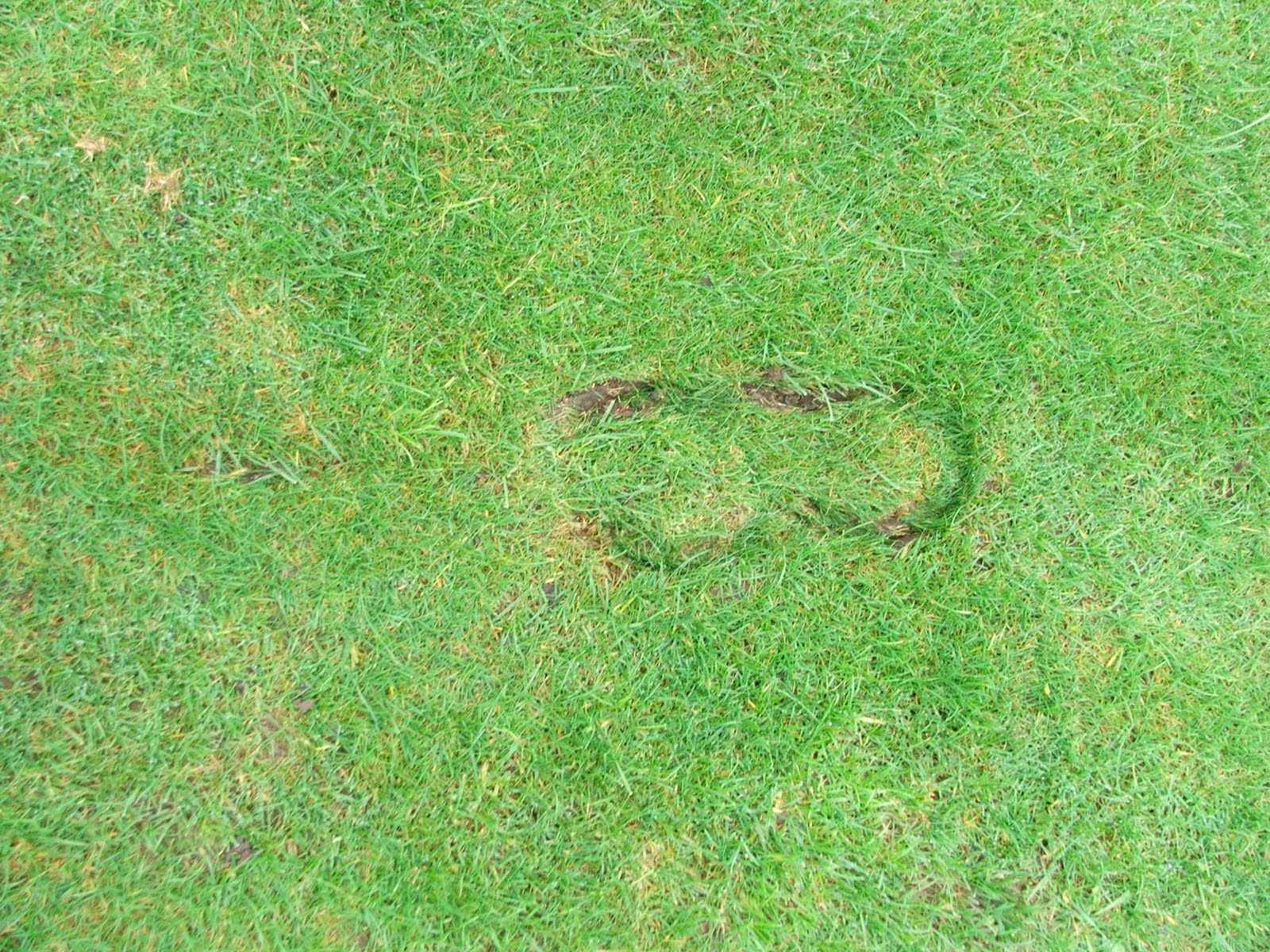
As I was walking down the first fairway I saw horse shoe marks all over and horses grazing to the left of the fairway. Not one or two impressions in the grass mind you, but quite a few hoof marks. Game on at Royal North Devon. This is going to be interesting.

Horseshoe marks on the fairway at Royal North Devon

The front nine plays near the water and the back nine through grass and marshland away from the water. The course is a classic out-and-back layout and does not route back to the clubhouse after nine. Similar to St. Andrews, the course is very flat and wide open.

The first hole is a 478-yard par five that eases you into the round. The second hole "Baggy" runs parallel to the ocean and is a 422-yard par four. I noticed that I had to walk very carefully at Westward Ho! because there are loads of rabbit scrapings on the front nine. Rabbit scrapings are little holes that rabbits dig in the ground to hide and stay protected. From what I could tell based on the number of scrapings, there are lots of rabbits in the vicinity.

The fourth hole is a "Cape" hole that plays 350 yards and doglegs sharply to the left. You can see the massive set of railway sleepers that line the bunker that you must hit over from the tee. This is a man-sized bunker that runs the entire width of the fairway and is at a higher level than the teeing ground.

RND 4-1

The view from the tee box on the 4th hole at Royal North Devon

Notice the poles and white cloth fences that protect the green as seen below. These are found on all the greens at Royal North Devon. Their purpose? To keep sheep and horses off the greens, of course!

RND 4th green


The green on the fourth "Cape" hole

Royal North Devon is a rough-hewn course and is not in the least bit polished. Therein also lies its charm. Playing at Royal North Devon is the antithesis of sitting in a golf cart for a five hour round waiting for the group ahead of you to line up their fourth putt. This is golf at its simplest and purest. For a variety of reasons, not the least of which is the common land, the course is a bit rough around the edges. There are also no yardage markers, but only simple grey rocks to mark off 150 yards. The greenskeeper here clearly doesn't have Augusta envy like almost all courses in the U.S. This is a course where you play the ball where it lies, commune with nature and go back to the game's roots. If golf is a metaphor for life, then Royal North Devon is its best example. It's not all neat and tidy. Rub of the green as it's called.

Horace Hutchinson describes the course in his book Golf in 1890, "The bunkers on St. Andrews links are for the most part well defined, but on many of the very best links, Carnoustie, Prestwick, Westward Ho!, Sandwich, there is a lot of loose ill-defined rubbish, the sandy out-blowings of bunkers, which is very hard indeed to play out of." His description is still apt.

A good illustration of this is the picture of the sixth hole from the tee box. This 408-yard par four plays along the ocean and has a fairway that is shaped by the natural slopes of all the dunes. The hole is completely exposed to the wind coming off the water.

RND 6th from tee

View of the par four 6th, "Alp" hole

As common land, Royal North Devon is open to the public at all times and the locals seem to have access from any and all directions. Along this hole and the ocean is a path where people are strolling about, walking dogs and enjoying the outdoors. There are signs all over the course reminding you, the golfer, that the walkers have the right of way. Even in the less than ideal weather, there were a lot of dog walkers.

Around the sixth hole I couldn't help but notice that I had been dodging poop the entire time I was walking the course. Loads of poop. Of various varieties. Rabbit, dog, horse and sheep were all present and accounted for. There are a lot of bowels moving out on the common lands at Royal North Devon! Not since playing Medinah have I seen so much fecal matter on a golf course.

In case you think I am exaggerating the issue with stool on the course, local rule #8 listed on the back of the scorecard is the "Embedded Ball and Heaped or Liquid Manure" rule. It reads, "A ball which lies in or touches HEAPED OR LIQUID MANURE may be lifted without penalty, cleaned and dropped..." I rest my case.

Royal North Devon also features a lot of blind tee shots. There are aiming poles on quite a few holes, especially on the back nine. The back nine plays away from the water and features an abundance of marshland grass as can be seen in the photo below. These grasses are called 'Great Sea Rushes' and you want to steer clear of them since they eat golf balls. Horace Hutchinson describes these "Rushes" as a "peculiar kind of long rush, very sharp and stiff pointed, which we sincerely hope to be peculiar to itself."

RND 11th tee

The aiming pole on the par four 11th hole

The thirteenth hole is a 442-yard par five named "Lundy." It is a unique hole in several regards. First, it is short for a par five. Second, it is really a sheep pasture masquerading as a fairway, and third, the green is diabolical.

RND 13-2

Sheep grazing on the 13th fairway at Westward Ho!

One of the original club rules, published in 1864, states, "As the Burrows are public pasture, great care must be taken not to drive, frighten or injure any horse, cattle, sheep or geese." I almost hit a sheep with my drive. It is hard not to. Luckily, my ball landed safely on the grass.

Left of the thirteenth fairway is grazing land for sheep. They obviously don't have any regard for where the grazing lands end and the golf course begins, so they graze wherever they please. The grazing is quite heavy on both the twelfth and thirteenth holes. I must say that not even at Brora in Scotland have I seen so many sheep on a golf course. This is not the occasional sheep mind you. There were hundreds on the hole as I played it, as you can see below!

RND 13-1

The full herd of sheep on the 13th green at Royal North Devon

If this isn't worth flying to England to see, I don't know what is? My yoga teacher has been emphasizing that I should not judge. Just take it in and accept it for what it is, she advises. This is the mindset you need when playing at Royal North Devon. Experience it for all its glory. Certainly, keep a keen eye out on where you step. Take a deep breath through the nose to stay in the present. Bring a towel to every green to wipe your ball before lining up your putt. Make sure you dodge the heaps of dung as you put your golf bag down. Strive for a tranquil state. Forget the conventional, be open to new things. Watch for rabbit holes and slippery poop. Let your mind and body be as one. Enter a state of serenity. Don't let the mind wander. After all, if I wanted to experience a cookie cutter set of golf courses I could have taken a trip to Myrtle Beach. Instead, I am expanding my horizons.

RND 13 green

The small, hard to hold green on the 13th hole at Royal North Devon

Have I digressed? Back to the golf hole. How do you make a very short par five a difficult hole? Put in an inverted saucer green, make it circular and only 25 feet in diameter. Holy shit (pun intented), was it hard! I am embarrassed to say that I four putted the darn thing after being 10 feet off the green in two.

To emphasize my point about the animals at Royal North Devon, this is how I found the seventeenth tee box as I walked to it. It had about a half dozen horses grazing and doing their droppings near by. Ladies and gentlemen, boys and girls, Royal North Devon is a trip!

RND 17th tee

The 17th tee at Royal North Devon

After you putt out on the 18th green, you leave the common land and go back through the fence to the civilized world of the clubhouse, safe from the animals. I immediately went to the ancient locker room at the conclusion of my round and washed my hands very well!

I am glad I made the trek to Royal North Devon. It has a rich and storied history. It was originally designed by Old Tom Morris and has hosted the British Amateur championship three times. I am a voracious reader and early golfing history frequently mentions many storied links courses often by their pre-Royal names. Specifically Prestwick, St. Andrews, Sandwich (Royal St. George's), Hoylake (Royal Liverpool) and Westward Ho! (Royal North Devon). That's some pretty lofty company Royal North Devon keeps. The other four courses have all changed quite a bit. You can't really visit Sandwich anymore, you are visiting Royal St. George's. The same with Hoylake. What a treat to be able to actually visit an old-school course like Westward Ho!

To be sure, Royal North Devon has some uninspiring holes. The eleventh, fifteenth and seventeenth come to mind, but on balance Royal North Devon is an experience worth having. There are at least a half dozen really good holes (the 4th, 5th, 6th, 10th, 13th and 16th).

The course received its "Royal" patronage from Edward the Prince of Wales in 1865. Edward was the son of Queen Victoria and Prince Albert. He would go on to become King Edward VII. The Prince was indeed a golfer and laid out a course at Windsor. He was the first Royal to serve as Captain of the R & A. He also granted Royal status to both Dornoch and Portrush. The Prince/King led an active life outside of golf, and it is well known that he had many mistresses. A particularly virile monarch, it is rumored that he had at least 55 liaisons. His Majesty is pictured below. God save the King!


I mean no disrespect to the course or club at all with my descriptions of the course conditioning or the abundance of droppings. As my readers appreciate, I am simply pointing out facts and not trying to sell magazines or hype anything; thus I give the unvarnished truth. Not to point out such an obvious and plentiful set of facts would misrepresent an integral part of the experience here. Royal North Devon remains a true rarity. It offers the golfer the possibility to transport himself back 150 years and see what golf was like before it became a popular pastime and when it was played on common lands. The club is also very welcoming and accommodating to visitors, and the clubhouse is a veritable museum with its trophies, artwork and match boards showing results back 150 years.

I hope by the next time I visit they trim back some of those bloody hedge rows in Devon so I can see where I'm going!

Monday, April 09, 2012

The Kiwis Are Back!

The crazy Kiwis are once again barnstorming America! This time, in fact, North America, my Canadian readers will be happy to hear. Our friends from down under are back and have another spectacular jaunt planned. For those eager fans who didn't get to visit with them during their first tour, they have an itinerary planned through the northern reaches, including D.C., Boston, Toronto, Michigan, Wisconsin, Chicago, Nebraska, Colorado and Oregon.

Of course, they have a blog, which I expect will be as cheeky and insightful as their last one: Tumbling Across America. A pair of antipodean Jack Kerouacs', their theme during 2012 is On the Road Again.

It was good to see Jamie in New York a few weeks ago. I think he liked the Upper East Side. He looked a bit more tired than the last time I saw him in that special city of Wellington.


Aside from their road trip, they plan to spend the summer caddying at one of the finest places on the planet, going to the Masters, visiting Yosemite, and I'm sure, depriving themselves of sleep.

When I described this year's odyssey to the Mrs. she came to the same conclusion that I did: that two good looking, well educated kiwis, with endearing accents, spending the summer in the Hamptons, could do some damage. Word has it that some of the pipes burst over the winter at the storied club they will be carrying bags at, and thus, there is plenty of new pipe to be laid this year.

These two Kiwis are filled with vim and a sense of adventure. They plan on buying another van to sleep in as they embark on their road trip. They would never ask outright, but being a shameless New Yorker I am not afraid to do so on their behalf. I'm sure they would appreciate a real bed to sleep in or an invite to play golf. I can vouch for them as they did not burn down my house when they stayed. Meeting them or following their blog is sure to be an enriching experience.

Sunday, April 01, 2012

St. Enodoc Golf Club

What does a golf fanatic do when faced with Garden leave? Garden? Certainly not. He embarks on a pilgrimage. The BBC estimates that over 100 million people a year take a pilgrimage. I'll bet you have already guessed that I'm not going to Santiago de Compostela. My pilgrimage is a golfing one, of course, to some out-of-the-way courses I have always wanted to play.

First up is St. Enodoc, which requires some effort to play because it is not located near any other golf destination or well known courses. The club was founded in 1899. It doesn't have a marketing department or isn't pitching itself as a must play course, so it is truly a destination for the die-hard golf nut. St. Enodoc is located on the Cornish coast of England. That would be the bottom left part of the country (Southwest for you sticklers). Way down there. Cornwall (the Royal Duchy of Cornwall is its full name) has a very rugged and dramatic coastline.


Cornwall, England, home of St. Enodoc
My regular readers know I'm crazy. One of my first posts on the blog was a winter visit to Ganton and Woodhall Spa in Northern England. England has always held a great appeal to me because it is such a quirky country and it fits my personality to a "T." To me there is nothing in the world like getting behind the wheel of a stick shift car after a red-eye flight, driving on the wrong side of the road, with a little mist coming down on my way to play a new golf course!

The rolling hills of the English countryside never disappoint. Its bucolic beauty is timeless. American real estate developers like to use names from the English countryside when building developments and naming streets. Most new sub-divisions have at least one neighborhood or model home named Devon, Exeter, Dorchester, etc. The trip to St. Enodoc took me through these actual historic places.

The last ten miles to St. Enodoc are a driving experience, with its narrow, twisting lanes through the rolling countryside. I'm a veteran of this type of driving, where you can't spare a half inch on either side when a car or truck is passing from the other direction. More than once, I have knocked off the mirror on the left side of the car. The road approaching St. Enodoc is lined with Cornish hedges. No, not Cornish hens, Cornish hedges.

Cornish hedge 3
The hemmed in roads of Cornwall with their hedges tight to the roadway

A Cornish hedge is some kind of crazy earthen embankment that creates the effect of driving through a tunnel, with no lateral visibility at all. The roads would be bad enough if they were straight, but of course, they are almost always winding with lots of blind curves. The hedges are made variously of mud, shrubs, ferns, rocks or all of the above, and are a driving nightmare because they create a situation of near zero visibility at almost all times. I'm sure they served some sort of useful purpose in the past like keeping sheep in a field or blocking the wind. For the modern driver, they are a terror.

Fittingly enough, the entry drive at St. Enodoc is a one-lane road straight up a big hill lined with hedges. I was lucky to play St. Enodoc on a Sunday afternoon in the late fall. Throughout my drive to St. Enodoc BBC radio described the day's weather as variously: Fine and dry. Crisp and clear. Lovely, with a fresh breeze. A spectacular day by any standard.

The golf course was designed by James Braid and opened for play in 1907. Along with Prestwick and Merion, St. Enodoc has one of the best opening holes in the world. A par five of 528 yards, you hit into a wildly undulating fairway with a big set of sand dunes guarding the right side of the hole.

SE 1st fairway
The fabulous opening tee shot at St. Enodoc

Your second shot is at the big striped pole and plays to a green set slightly down a hill. Once you walk up to the crest of the hill, the most amazing landscape unfolds all around you.

SE 1st hole

The wild, untamed undulations of the fairway on the 1st hole at St. Enodoc

You can see the massive rocky landforms in this part of Cornwall tumbling down to the beautiful blue sea. Behind the big mountain is the gorgeous English countryside, perfectly manicured. Where the land meets the sea is a series of perfect wide sand beaches. You can also clearly see for the first time that the golf course is perched on top of a massive headland and that St. Enodoc is going to be a treat. As you progress from tee to green, this amazing landscape reveals itself. What a jewel. I was bowled over.

SE 1st green
The dramatic view from the first green at St. Enodoc

The third hole is a par four of 440 yards, doglegs to the left and plays down a big hill. Your drive is again at a striped pole.

SE 3rd from tee
The downhill tee shot at St. Enodoc's 3rd hole

Your approach shot plays over this rough stone wall to the green sitting below you. The sheep up on the hillside above you add to the bucolic setting.

SE 3rd approach
Approach shot over stone wall to the 3rd green

The sixth hole has a Himalaya bunker, is 428 yards and features a blind drive. It is said to contain the biggest sand bunker in Europe, and I'm not arguing the point. If you can avoid the bunker, you still have a blind shot to a punchbowl style green set in a little alcove area. It is a very, very good golf hole.

SE 6-2
The sixth hole at St. Enodoc with the Himalaya bunker and hidden green

As is typical in England, St. Enodoc has people walking the course, almost always with dogs. The people walking the course have the right of way. As it was a brilliant Sunday afternoon, the course was quite crowded and on a few occasions I had to wait to allow people to pass before I could hit.

I do most of my golf trips with friends, but at St. Enodoc I played alone, which I like to do on occasion. It was a great opportunity to recharge the batteries, exorcise demons and clear my head. It was also a nice relaxed round where I got to drop balls and try out multiple bump and run shots into various greens and in general just play around.

SE view from 7
View from the 7th green toward Camel estuary

The course is visually dramatic the entire way around. The view above is off the seventh green looking toward the Camel estuary with Stepper Point in the distance.

When you read about St. Enodoc, you hear about the tenth hole being the Church hole. The tenth is a wicked difficult 457-yard sharp dogleg left par four, but you only get a glimpse of the church from the hole. The church really comes into view on the twelfth and thirteenth holes which are set above the fairway and have a commanding view looking down on both the church and the sea.

SE church from above 13
The 10th "Church" hole as seen from the 13th hole above

The church was uncovered among the sand dunes in Victorian times. It was originally built in the eleventh century by the Normans!!! The hole plunges from an elevated tee to a narrow fairway below. The green for the tenth hole is seen to the left of the church in the shade. I'm still not quite sure how you are supposed to hit this green in two unless you absolutely kill the ball off the tee since the dogleg is so sharp. Even then, you have to be able to shape your ball flight from right to left.

St. Enodoc had as much variety of sounds as I have ever heard on a golf course, all of them pleasing. There were the waves crashing on the rocks below the course, sheep baaing, gulls crowing, dogs barking, the wind blowing and the church bells ringing. There was also the smell of burning leaves from a nearby land owner, which brought back memories of my childhood, when the practice used to be allowed in the U.S. and an old maid near our house diligently burned leaves every Sunday during the Fall.

The golf course is a unique one and has a collection of standout holes (one, two, four, six and ten) that give the course a cult following among those learned in golf course architecture. The course combines dramatic water views with beautiful dunes links land as seen below on the finishing hole. The course is better than some of the courses in the top 100 I have played and it's a bit of a wonder to me why the course doesn't get more accolades.

SE 18th green2
The 18th green at St. Enodoc shows the dunes landscape

I read somewhere that if you like Cruden Bay and Prestwick you will like St. Enodoc, and I agree with this. The course is a bit quirky and short. From the tips it plays 6,547 yards to a par of 69 (there are only two par fives). St. Enodoc is an unconventional but very fun course set in an idyllic location.

After my round I sat in the clubhouse enjoying a Guinness and an egg mayonnaise sandwich on brown bread. I sat savoring the moment eavesdropping on a group of four Englishmen who were as quirky as the course. The perfect ending to a perfect day.

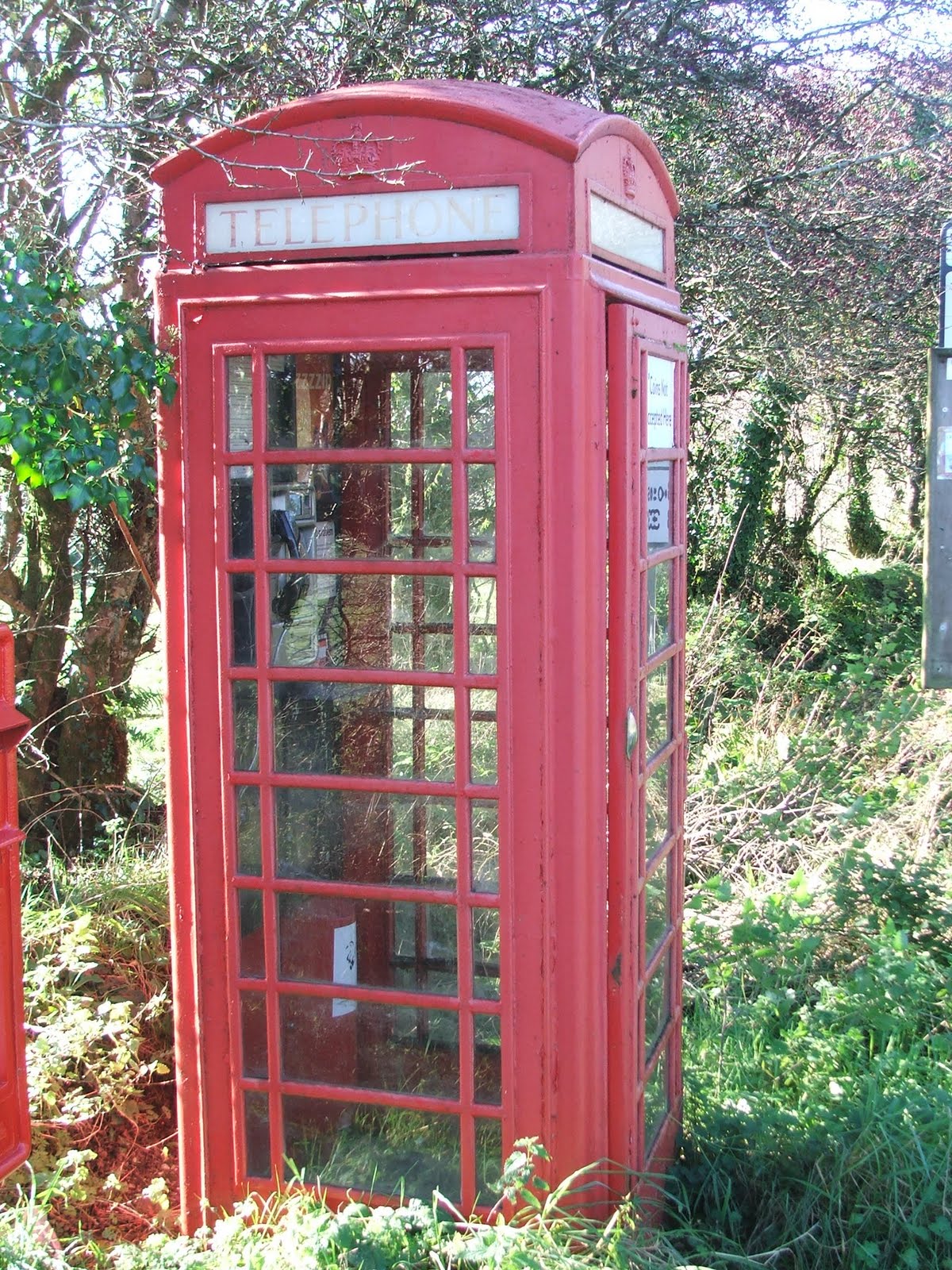
An old phone box that is still found in North Cornwall, near St. Enodoc