Sunday, October 09, 2022

Hankley Common Golf Club

I have an internal debate with myself often (sad, isn't it?) about which area of the world has the best golf mile for mile. Long Island is surely in the discussion, and probably wins if I'm honest, although Scotland could also win the race. However, when you analyze all the fantastic golf within 90 minutes of Buckingham Palace, a very strong case can be made that greater London, on the strength of golf in Surrey, is the winner. Gems such as Sunningdale, St. George's Hill, Swinley Forest, Walton Heath, and Wentworth form quite a cluster. I am trying to slowly tick off as many courses as I can while my health (and wallet) holds up.  Other courses on my bucket list are the Berkshire Red and Blue, New Zealand Golf Club, and the three W's: Woking, Worplesdon, and West Hill. Today's visit is to Hankley Common in Surrey. 

Life is so rich and golf is so rewarding!

Anyway, to the golf course in a minute. First, I feel compelled to write about how much I love London. I had forgotten how extraordinary a city it is. As someone who has spent a lifetime working in New York City I had become deluded, like many New Yorkers do, that it is the greatest city in the world. Wrong. London is far better. I still love New York, but the frenetic activity, noise, dirt, pollution, and density are too much. London is so much greener with pocket parks scattered throughout the city in every nook and cranny. It is also greener from an environmental point of view with electric vehicles and buses greatly cutting down on pollution. And it is so much quieter than any American city. Brits, even taxi drivers, don't lean on their horns. People are more patient, polite, and quieter. The city is cleaner, more civilized and more genial than any American city I am familiar with. I spent thirty plus years traveling extensively to almost every city in the States and the quality of life in London is superior in my view.

On the down side, it is an expensive city to live in. The cost of living is through the roof. I also have fantasy agendas when I go the Britain, visiting all the posh places and sampling the best the city has to offer. On this trip I stayed off the Kings Road in Chelsea near Sloane Square. It is a delightful neighborhood. The other thing that jumped out at me again is how dog crazed the English are. There were scores and scores of people in Central London walking and pampering their dogs. 

Hankley Common began as a nine hole course laid out by James Braid in 1897 on Surrey's natural heathlands. Braid advised on the addition of nine more holes in 1922, then H. S. Colt remodeled the course in 1936, so the pedigree is about as good as can be. I drove the ball very well at Hankley but pulled a lot of my approach shots. It made for a long day for one reason and one reason only: heather. Heather makes the course a pleasure to look at but it serves as a very effective hazard, causing the loss of at least one stroke if you end up in it.

The first green at Hankley Common

The course starts gently enough with an easy par four that plays on flat ground. The blind green is set down in a hollow and doesn't present too much of a challenge to hit with a good approach shot.

The par-3 second hole at Hankley

The par three second hole also isn't overly taxing, requiring a mid iron shot to a receptive green. The course starts to show its natural beauty on the par three second, with a green perfectly situated in a corner of the property.

Hankley's third green framed by gorse bushes on the left side

The third hole is a par four of 347 yards and offers a generous fairway, as do most holes. The trick here is to be on the right side of the fairway to avoid a semi-blind shot into the two tiered green.

The fourth hole shouldn't be that hard, but it is. The green sits near the clubhouse and we watched golfers trying to hit the green as we had lunch before our round. I thought to myself, why is everyone approaching from the left side and missing the green? Well, I know the answer now. I did the same thing and hit left off the tee, which sets you up that way because the fairway is so narrow. It is simply the wrong angle to approach the oblong green from, particularly if you end up in the heather like a knucklehead, as I did. What a great design for a 327 yard hole. 

The fifth hole at Hankley as seen from the tee

The fifth hole, a par four of 381 yards, is the most difficult hole on the front. The hole bends to the left around strategically placed bunkers, seen in the distance to the left. I landed in the heather on the left, which is sub-optimal to say the least. Being on the right side of the fairway is essential to properly approach this very tricky, narrow green, seen below:

The tricky fifth green at Hankley Common

 
The world-class par three 7th hole at Hankley with foreboding skies above

The difficult par three seventh hole is one of the best on the course and one of the best par threes in the Surrey region, which is saying something given the quality of golf here. It plays 183 yards on the card, but as you can see, the green is perched on top of a hill. The day we played there was roughly a two club wind. It must be something quirky about where the hole is situated with the green on the apex of a hill, but it was far windier on this corner of the course, making it an even greater challenge.

The unfortunate golfer (moi) that hits their tee shot to the right side of the seventh green will face this daunting blind shot to a tough green

The vista of the appealing eighth hole from the tee box

The eighth hole, a par five, plays from the top of the same hill that the seventh green is on and it offers the best vista of the day, showing off the handsome nature of Hankley with its heather and Scots Pine trees.

My preference is to walk a golf course if I can. Due to a deteriorating chronic lung condition as a result of my transplant, I can't walk up hills or steep inclines anymore so I took a cart at Hankley, and I'm glad I did because I wouldn't have been able to traverse the terrain the course is artfully routed over. 

The club owns a staggering 850 acres, offering panoramic views throughout the day. Let's pause for a minute and think about 850 acres. Not a small amount of land anywhere, but in Surrey! Not bad, especially considering that they paid £800 to buy it from the estate owner in 1942. As in classic English fashion, this club is probably quite well off, but is equally understated. The golf course itself only occupies 164 acres; the club leases a good chunk of the land the British Ministry of Defense which uses it as a training ground for their armed forces. Troops built an Atlantic Wall here during the Second World War and practiced their D-Day invasion. Three James Bond movies have also used parts of Hankley Common, (the broader Common, not the golf course) for their films.

Holes ten, eleven, and twelve are known as Colt's Corner since they are the holes he designed. Since I spent most of the time looking for my ball in the heather during that stretch I didn't get any pictures of them.

The cracking finishing hole at Hankley Common

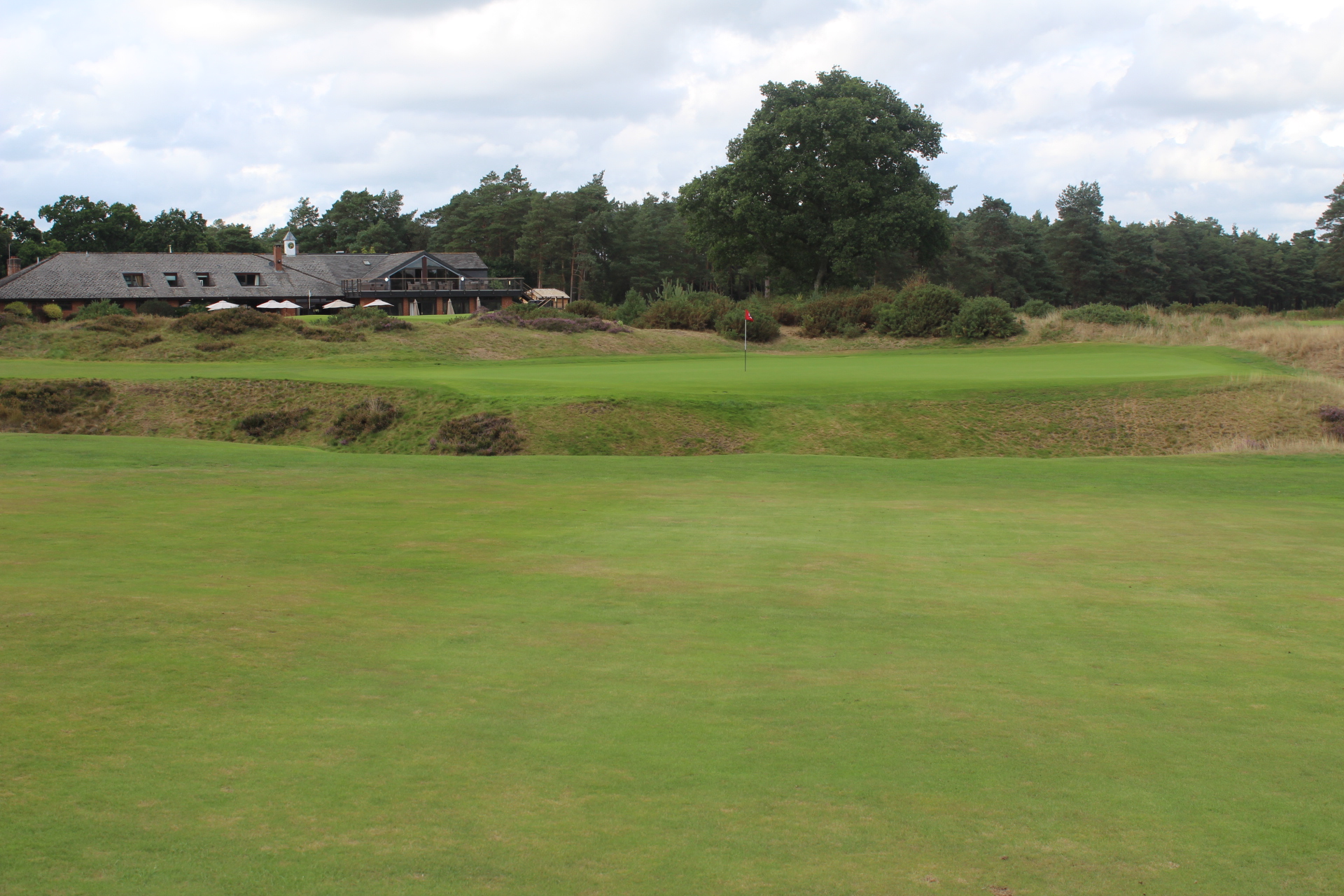
The finishing hole at Hankley is one of the most interesting I have seen in all my travels. The tee shot on this 432 yard hole is a forced carry over heather. The unsuspecting golfer has no idea what is coming. As you walk (or ride, as I did) the crest of a gentle hill you see the challenge to come. There is a treacherous gully protecting the green.

The 18th hole at Hankley Common seen looking backward from the green shows the tricky nature of the hole

The fairway bends slightly to the right after you crest the hill, and if you smash your drive you are left with a downhill lie that requires a long iron or hybrid club over the gully to the green. Bon chance. I was forced to lay up because, shockingly, my tee shot landed in the heather. 

A close up of the grass bunker/hazard/ditch short left of the last green at Hankley

A view of the menacing 18th hole up close shows the hazards you have to carry to land on the relatively small green

As I mentioned in the opening, the course has a gentle start, with easy holes over the opening stretch. It more than makes up for that on the finish. I liken it to the last at Pine Valley, which also challenges the golfer with a shot from a downhill lie over a demanding hazard (in the case of Pine Valley, water) to a testing green.

Tom Doak gives the course a 5 in his Confidential Guide and says, "there is the nagging suspicion that there are a few too many holes where the fairway runs too straight and too long without any bunkers to liven up the proceedings. A few diagonal cross hazards would do wonders here." He knows a lot more about architecture than I do and it is a fair observation.

Hankley Common is the most dog friend course I have ever been to. When you walk up to the door of the clubhouse there is a water bowl for dogs. Same thing on the back porch, where we had lunch: water bowls for man's four legged friends. I would say at least half the members who were out playing had their canine pals with them. On one hole there were two golfers teeing off and each had a dog. The dogs sat about 30 yards ahead of the golfers perfectly positioned facing the tee box to see their masters hit their drives. What a country. Woof!


Monday, September 26, 2022

North Berwick Golf Club

After postponing my trip twice due to the pandemic, I was finally able to return back to the style of golf I love the most, which is that in the magical British Isles. Although I have written about North Berwick before, I couldn't resist doing another because I hit the course on a sparkling day which was very accommodating to picture taking. Even though I played the course three years ago and it is difficult to choose which courses to play when organizing a trip, I included it on my itinerary again. It my fifth time playing the historic links and I can't get enough.

Minimal words . . . maximum pictures . . . especially of the 13th "Pit" hole . . . remarkable . . .

The roly-poly second fairway at North Berwick sets the tone for the day

The third hole is the golfers introduction to one of North Berwick's defining features, the old stone walls

The green on the par three 4th hole

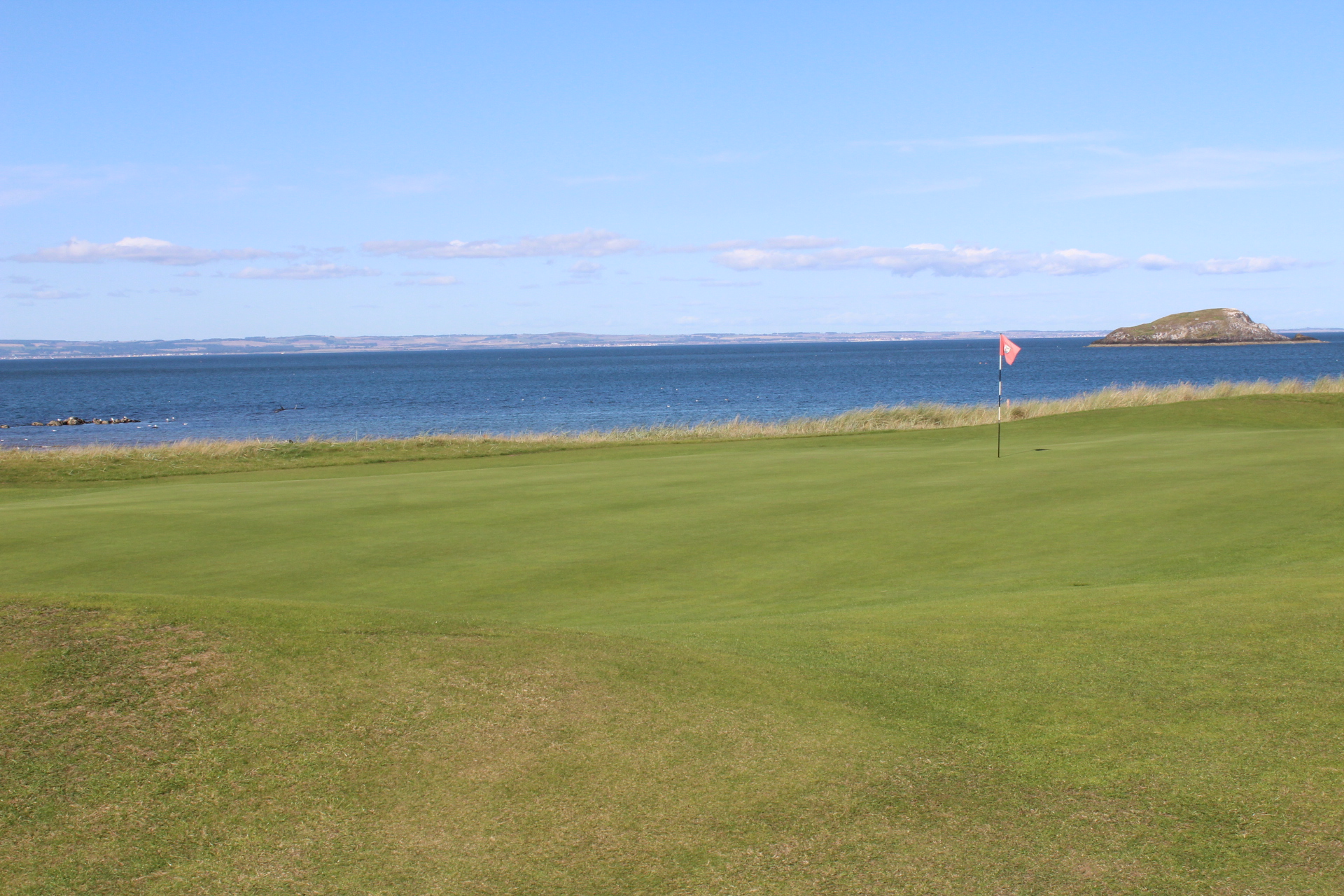
The brilliance of the Firth of Forth is the backdrop for aptly named "Bass" hole, the 12th, with its namesake rock in the distance, right

When one looks to narrow down the hundreds of thousands of golf holes in the world to the best handful, North Berwick's 13th ("Pit") is on the short list. Seen here from the fairway at a distance

The approach to the 13th as seen from a bunker on the far left side of the fairway, with the green tucked behind the stone wall

The green as seen from behind, shows the absolute genius of the design, and its sheer fun

Did I mention I liked the hole? Another shot with a wider view of the beach

I missed taking any pictures of the Redan hole, but did make a par, which I am thrilled with. Hit the ball eight feet from the cup. The trick was to aim at least thirty yards right of where the flag is. Difficult to do but rewarding. 

The par four sixteenth with one of the craziest greens in the world

My ball is the one closest to the camera. I was here in two but am too embarrassed to tell you my score. Sadly it was not a three or a four 

The "Home," hole. Very easy but one of the most satisfying in the game to play

Traveling for me these days is a production. I had to take an extra suitcase to carry all my medicines and I brought everything I might need should something go wrong. The eye drops I use need to remain frozen/refrigerated and the inhaler machine I use for my lungs takes up a lot of space. All this rigmarole is like an umbrella: if you don't bring it, it's sure to rain. It worked, and I warded off Murphy's Law from coming into play, so it was worth it to ensure a successful trip. 

I am blessed to be able to travel to Scotland and play such fantastic courses.


Tuesday, June 14, 2022

A Dozen Fun Facts about Merion Golf Club's Wicker Baskets

Merion Golf Club's East Course is one of the best in the world, noted for its strategic layout, difficulty, and the timeliness of the design. One of the things that adds to the cache of the club are the distinctive wicker baskets the club uses instead of traditional pin flags.

Merion recently hosted the 2022 Curtis Cup amateur women's tournament and there was a nice article about the wicker baskets in the program written by Tom Mackin, which inspired me to write about them. It was great to be back at Merion and to see firsthand the improvements that Gil Hanse has made renovating the course. It was as beautiful and well conditioned as I have ever seen it.

IMG_0253

We'll begin with a dozen fun facts about the baskets, drawn from the article.

1. Merion’s wicker baskets are known as standards.

2. The baskets on the front nine are red and the baskets on the back nine are orange; the poles are striped with red on the front nine and orange on the back nine. The orange color came about after World War II when the club’s agronomy department had left over orange paint they didn't want to waste.

3. The New York Times says the baskets are egg shaped, although the Philadelphia Evening Public Ledger described them in 1915 as pear shaped.

4. William Flynn, the greenskeeper at Merion in its early years, developed the baskets. He was issued a patent for them in 1916 and started a business selling them to the public: $50 for a set of 18 or $3 each.

5. When Flynn approached the club's Green Committee and proposed using the baskets instead of flags, they told him to go ahead and use them. At his expense.

6. If a ball becomes embedded in a basket, a local rule calls for the ball to be placed on the lip of the hole, without a penalty stroke. Some golfers would argue that it should be a hole in one, but that's not the rule. It seems more than fair to me, since more likely than not the ball would have gone well past the hole if it hadn't hit the basket.

7. The baskets are made by Joni-Dee Ross of Handmade North Carolina Baskets, and have been done so for the last 25 years. Prior to Ross making them, a member of the greens staff used to weave them in the winter.

8. For security reasons, all the baskets are removed from the course overnight to prevent theft.

9. Every basket has an identifying mark for authentication purposes, known only to a select handful of Merion staff and members.

10. Damaged baskets are burned!

11. Baskets are worth a lot of money. The article states that occasionally, and without the clubs consent, Merion baskets will show up on auction sites, most notably, Golden Age Auctions. Mackin says they sell for $5,000, although the latest auction for one in April of this year was for $9,200. Flynn would no doubt be proud that his $3 baskets are now worth such a fortune.

12. 16 of 17 of the U.S.G.A. championships Merion has hosted have featured the baskets. The most famous event, Ben Hogan's 1950 U.S. Open victory, was the only one that used pin flags instead of baskets.

Mackin notes that wicker baskets were used in the United Kingdom prior to those used at Merion, including at Prestwick in Scotland and Stokes Park near London. According the the New York Times, they believe the origin of the baskets was from the course architect Hugh Wilson, "There was even a meticulously detailed tale of how Wilson was spending time with the American ambassador at the Court of St. James’s, where there were three small putting greens. The ambassador’s wife had put three shepherd’s crooks topped with flower baskets in the holes, as the story went."  Of the the club's histories, Golf at Merion 1896-1976, by Richard H. Heilman states that Wilson got the idea for the  wicker baskets after visiting Sunningdale, outside London, although this is probably incorrect. There is no absolute certainty on the true origin of the idea.

After his career as a greenskeeper at Merion William Flynn would go on to design golf courses and created several classic designs. Among his designs are the Cherry Hills Country Club in Denver, the Kittansett Club in Rhode Island, as well as Lancaster Country Club and Manufacturers', both in Pennsylvania. Flynn also modified and help design Shinnecock Hills and the Country Club in Brookline, Mass.

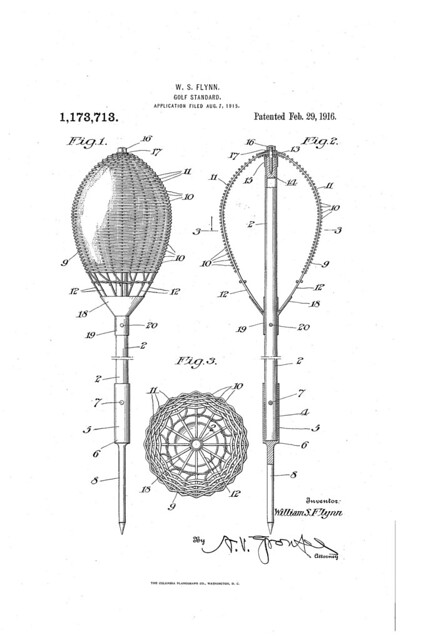
Flynn's patent for his "Golf Standard," is below. The shape appears less bulbous than the current baskets used by the club.

US1173713-drawings-page-1

It must take someone with a keen eye to tell the difference between the basket colors on the front and back nines. They all look red to me, I don't see the orange color no matter how hard I look. The point of using the wicker baskets is to make playing more difficult, since the golfer can't judge the wind direction or speed by looking at a flag.

Merion is not the only course that uses the wicker baskets today, although it is certainly the most famous. The Sea Island Golf Club (Seaside Course), in Georgia also uses them.


SI 3 green
A wicker basket at the Sea Island Seaside course

A treasure trove of Merion wicker baskets. Photo credit: 2022 Curtis Cup Program


Thursday, April 14, 2022

Chechessee Creek Golf Club

The Chechessee Creek Club logo features a feather with a golf pin and flag inset

It has been a long time since I posted anything and it is nice to be back. The pandemic years have been trying for all of us and especially for me. With a very bad immune system I have to be overly cautious. She who must be obeyed (my doctor) gave me a very simple instruction, and I have followed it to the letter: don't get Covid. Hopefully this pandemic era is over and we can return to normal life. On the health front, I am doing well and am in remission, the ultimate blessing. The bargain you make when you have a bone marrow transplant following leukemia is to trade death for a series of chronic illnesses, something I have gladly done. My day is always focused around treating my afflictions and managing the pain. Gabapentin, a non addictive medicine to manage nerve pain for my feet and eyes, is a godsend. I have to do four inhaled medicines via a nebulizer daily for my lungs, and I take about twenty pills a day for various things. My biggest problem remains severe acute dry eye, which means I have to put in eye drops at least every hour, wear sunglasses at all times, and avoid high winds. Not ideal for a golfer, but damn the torpedoes and full speed ahead.

Despite all my ailments I have been playing golf at least twice a week and am excited this year to start traveling again. On the agenda are Friars Head, Maidstone and Westhampton, as well as (god willing) a trip to Scotland in September, finally, after postponing it three times.

Today's post is about Chechessee Creek, located in the South Carolina Lowcountry, in the town of Okatie, which is roughly thirty minutes north of Savannah and thirty minutes west of Hilton Head. I am worn down living in New Jersey during the winter so we are building a house less than ten minutes from Chechessee, which I have joined. It is a dream come true. The Lowcountry is a geographic area along coastal North Carolina, South Carolina, and Georgia characterized by flat lands, often below sea level, filled with salt water tidal marshes thick with cord grass, and loads of coastal waterways. The Lowcountry has a unique culture with distinct architecture, traditions, and food. This area of South Carolina historically had an economy that relied on agriculture for hundreds of years. The main crops grown on antebellum plantations were rice, cotton, and indigo. 81% of the population in the county Chechessee Creek is located in were slaves in the 1860s, among the highest in the South. The articles of secession in the Civil War were drafted 15 miles away in Beaufort. This is the Deep South.

Chechessee Clubhouse 
The clubhouse at Chechessee exudes Lowcountry charm 

Chechessee Creek was built in 2000 and the club has a distinctive feel to it. The club occupies a sprawling 300 acres among tall pine trees and centuries old live oaks dripping with Spanish moss. The secluded and semi-remote location gives the course a great understated vibe, with a nostalgic feel.

The designers of the course, Ben Crenshaw and Bill Coore, said the following about the club, and they achieved their stated goal, "Our goal at Chechessee Creek Club was to create a golf course of traditional character that would reward thoughtful, imaginative and precise play; while utilizing and showcasing the magnificent oaks and pines of the Carolina Lowcountry." Chechessee was the brainchild of two Jims: Jim Chaffin and Jim Light, who were involved in the development of the original Sea Pines resort on Hilton Head Island.  

Chaffin, who played collegiate golf at the University of Virginia, also achieved the goal he set out for the club, "We built Chechessee to remind us of golf’s Golden Era. We wanted it to be about the contextual relationship with nature, about being in the elements. The love of the game was the overriding principle in every decision we made. It was always about the golf.” As he and his partner were designing the course, Ben Crenshaw visited other great South Carolina courses (Yeamans Hall in Charleston and Palmetto Golf Club in Aiken, specifically) for inspiration in his Chechessee design.

The course is beautifully routed through the tall pines, specimen oaks, and Palmetto palms, and over marshland. The first half dozen holes play inland and the seventh and eighth holes play along Chechessee Creek. The course then goes back through the trees to the clubhouse and then emerges again along the Creek at the thirteenth and fourteenth holes before routing back again through the trees. You can debate who the best modern architects are among Tom Doak, Gil Hanse, and Coore/Crenshaw, but I think that Coore/Crenshaw for sure win the prize for best routings. 

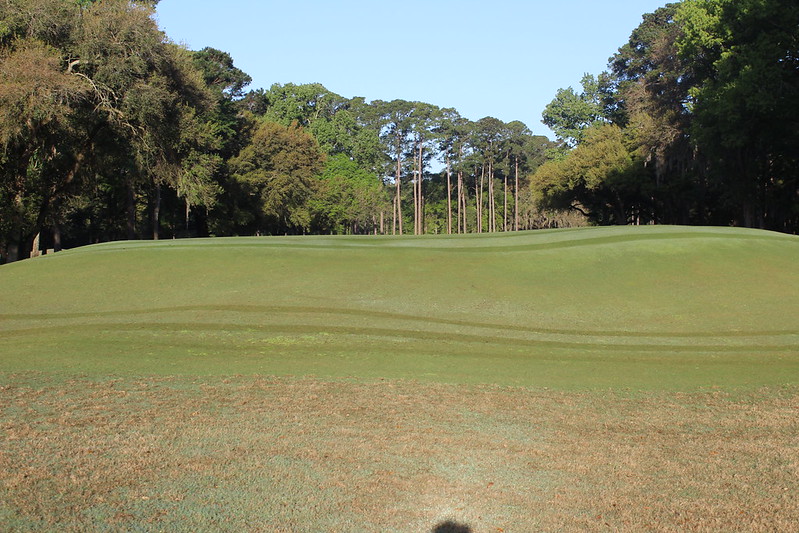
As they typically do, the architects give you a gentle opener (tee to green at least), a par four of 372 yards. The first hole might have the the smallest green on the course, raised off the ground a good distance for a course built on flat ground. To top off the challenging green, it also has a false front. It sets the tone for the day: wide fairways and elevated, pushed up greens with severe slopes left, right, and back. Coore and Crenshaw's courses always give generous landing areas off the tee. Driving the ball usually doesn't create too many problems, even if you are off line a little. The key is playing well around the greens to a much larger degree than courses designed by other architects. The number one rule when playing Chechessee is that if you are going to miss, miss short of the greens. They are all narrow and slope from back to front.

bags on range
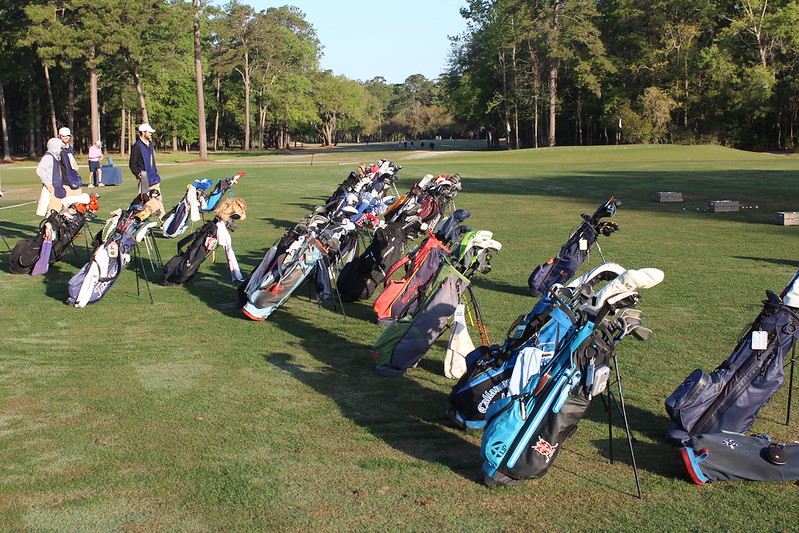
Bags and caddies on the range, awaiting a full day of golf. As a course with a large national membership, the caddies line up the bags in the morning for golfers eager to soak up the Lowcountry vibe

Although the fairways are generous at Chechessee, that doesn't mean that simply hitting them will position you to hit the green. Case in point is the fourth hole, a 408 yard par-4 that plays as the #1 handicap hole. Being on the left side of the fairway positions your shot to the green more favorably. The same is true of the ninth hole. The finishing hole requires the opposite, a drive to the right side avoids the overhanging trees that come into play on the left. Such is the chess match that you will have all day trying to work your way around the course. 

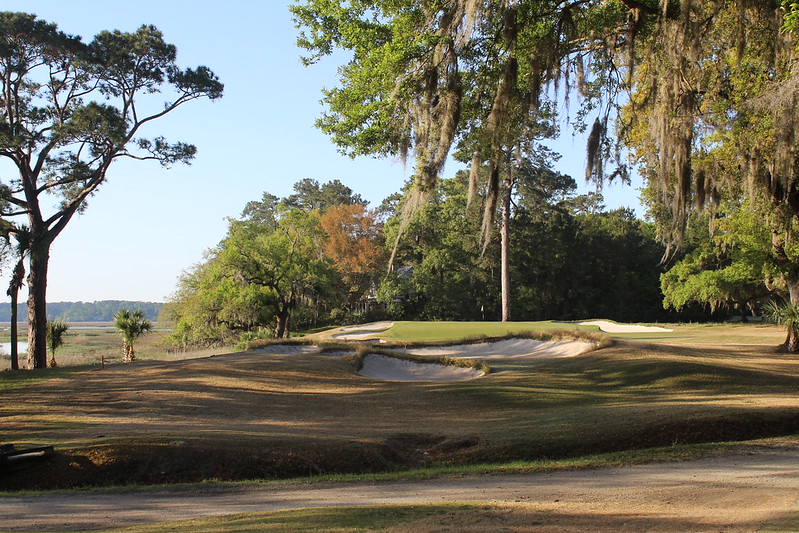
I don't really like the term signature hole because it slights other very good holes, but if there were a signature hole at Chechessee it would be the par three seventh, playing 178 from the tips. The three jagged bunkers in front of the green create an optical illusion and doubt, although unless you top your tee shot they don't come into play.

  7th green wide view 2 
The 7th green from the tee with a panoramic view of Chechessee Creek along the left

Darius Oliver, author of the Planet Golf series of golf books is a big fan of the par threes at Chechessee, "As strong as the longer holes are, it’s the par threes at Chechessee that elevate the golf to a higher level. As a set there are few better anywhere on flat land. The 7th is a glamorous hole played from beside the marsh and across a bunkered mound that partly obscures a clever false front green."

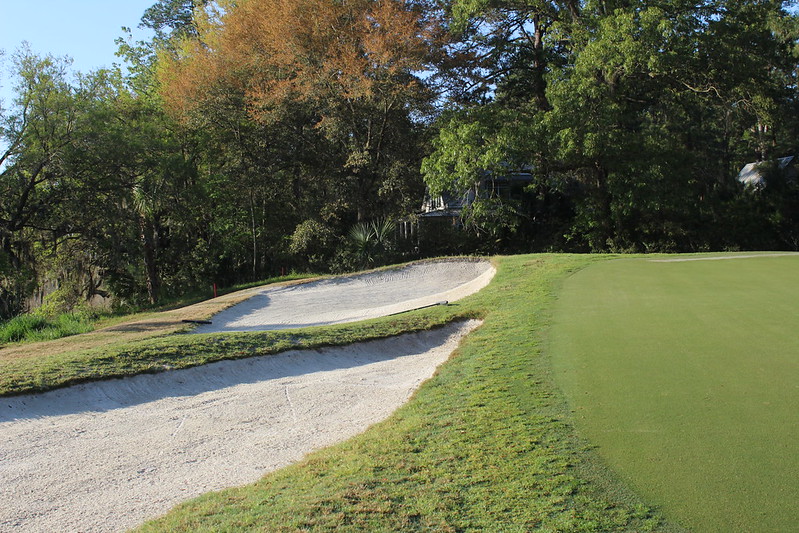
As seen below, the seventh is a typical green at Chechessee with its back to front slope, and as Darius notes, a false front. As I said, short is always the best option for a miss.

  7th green closeup 
7th green bunker on the right

A closeup view of the 7th green showing the slant of the green and a jagged bunker you don't want to mess with.

  7th green left side 
7th green bunker, left side

The left side of the green is no easier, with two bunkers. 

Jim Chaffin's mandate to Coore and Crenshaw was to build a course that, "Felt like Raynor, Ross, Tillinghast, and McDonald might have come back in a time warp and have collaborated on." That's quite a mandate. While the course doesn't have any of the prototype holes that MacDonald/Raynor are famous for, nor none of the sparkling bunkers Tillinghast is known for, it somehow does have a throwback feel to it. This is probably due to the success of the routing, the ease which which you go about your round, the visual appeal of the course, and, most importantly, that intangible quality that is tough to put your finger on that makes Coore/Crenshaw courses so magical.

Of all the designers mentioned in the brief the owners gave the designers, in my view the architect the course most closely resembles is Donald Ross because of the closely mown areas and fall offs on almost all of the greens, although the bunker styling is distinctively Coore/Crenshaw. 

   8th green left 
8th green, left side
 
The eighth hole is a par four of 440 yards and plays in the opposite direction of the seventh. It is a stern test of a golfer's ability to accurately hit a long iron shot to a demanding green. The picture above shows the penalty for missing left. The tricky part of getting up and down is that the green is narrow and designed to be approached from the front and not the side, thus, an accurate high sand shot that lands softly is required. Anything coming out of the sand that runs will likely leave you . . .

  8th green right 
8th green, right side

. . . either in the bunker seen above, or in the shaved area seen in front of the bunker. Whenever I play at Chechessee I always spend some time on the practice area hitting long lag putts from off the green because undoubtedly I have several during your round. 

The course plays 6,641 from the tips to a par of 70. Since the course is on flat ground and the next tee is always near the prior green, the course is a nice walk, even when it is hot and humid. You should always hope for a little breeze as protection against the bugs coming out of the marsh. The course, and especially the greens, are always in top notch condition. As an isolated course away from any hustle and bustle, playing is always a serene affair (unless there are morons playing music from their bag or cart, which I will never understand). When I go out first thing in the morning with a caddie, we are comfortably finished in 2 1/2 hours, the ultimate way to experience this great game.

    11 green closeup 
Par 3 11th green, left side

The par three 11th (212 yards from the tips) is a challenging hole, once again, because landing on either side of the green leaves you a testing shot to a sloping green. The 11th is the start of the best four hole stretch on the course with two demanding yet varied par threes interspersed with two very different par fours, each presenting their own challenges. None of the holes are remotely similar and all four play to different points on the compass.

  12th from tee 
Par 4 12th hole from the tee.  One of the few forced carries on the course

The 336-yard 12th requires the golfer to traverse the marsh between tee and fairway. Darius Oliver describes it better than I can, "It may be short, but the hole demands a nervy drive—a 165-yard carry over an inlet from all but the forward tees." 

Chechessee was blessed to have former Pine Valley president Ernie Ransome as the chairman of the club's advisory board in the early days. Jim Chaffin says that Ransome gets credit for the diabolical little bunker that pinches into the front of the 12th green, which slopes off steeply around it, “I’ve seen people putt into it from above the hole.”

After the fun and challenging 12th, the course routes seamlessly back into the heavy forest. The flow is just so natural. Be on the lookout for fox squirrels, with their distinctive large ears; they are throughout the course, as are eagles soaring above.

  13th 
The 13th green at dawn

The view above is from the 13th tee, a 164 yard shot. Long is again the worst option; best to always play a little short if you have any doubt. This image also shows to good effect the push-up style greens Coore/Crenshaw designed on the flat property. Darius Oliver on the hole, "As with so many of the greens at Chechessee, the 13th seems simple from the tee and it’s only after walking off with yet another soft bogey that you appreciate just how well you have to hit the ball here in order to score well."

  14th green right side
14th green, right side

The 14th hole, a 404 yard par four, has the most severe green on the property, and is another with a false front. There are no greenside bunkers, which is always a red flag that the green is going to be difficult because the architects are going to compensate for the lack of a sand penalty with a tough green. Once again, going long on the green leaves you a very difficult shot to get up and down, particular if the pin is in the back because the green slopes from back to front.

  14th green left side 
14th green, left side

The shot above shows the left side of the green and the slope of the putting surface. It is no easier than being right or long. A precise flop shot with soft hands is required if you miss the green left, particularly with the pin location seen here.

The 17th hole is short, but demanding. It is only 334 yards but is a classic risk-reward hole. Playing left is a safer bet since there is a sliver of fairway in the landing area. The right side of the hole has a marshy area jutting out into it that seems to attract tee shots. Big hitters can try to drive the marsh completely by playing down the right side, and if they make a good shot they will be rewarded by being near the green.
  18th bunker other side of green 
Bunker, right side of 18th green

The finishing hole is a 442 yard par four and the golfer should once again follow the cardinal rule at Chechessee and not be long into the green. Even a scratch golf would have to use all their skill to get the ball close to the hole from over the green. Each side of the green has a jagged bunker like the one pictured above. The green is one of the longest and skinniest on the course, so good luck keeping the ball on the green when you splash out of the sand from either side.

  18th back of the green 
If you have hit over the 18th green, you have made a big mistake and requires a Mickelsoneqsue short game to get up and down. Oops! 

As a club with a large national membership, Chechessee caters to golfers who bring a group to play a few rounds. The lodge and cottages and comfortable, with classic Lowcountry features: screened in porches that are cigar friendly. a front porch to soak up the environment, and outside fire pits.

The test of any Lowcountry club is their shrimp and grits, and the version here is excellent, as is the chowder. They also serve a proper Southern breakfast which includes biscuits and gravy. If you are on a guy trip, a great option for lunch or dinner if you want to be loud or watch golf while you eat is the men's locker room which is outfitted with nice tables, leather chairs, and flat screen TVs.The club also has a large and excellent caddie program, which in my opinion, always enhances the round of golf.

In Tom Doak's Confidential Guide to Golf  he ranks Chechessee Creek among the "Most Understated," along with Cypress Point and Yeamans Hall. Again, Darius Oliver hits the nail on the head describing the course, "Although holes like the 7th, 9th, 11th, 12th and 13th are undoubtedly first-class, Chechessee Creek is greater than the sum of its parts thanks to its lay-of-the-land design, stunning cottage-style clubhouse and pure golf-only focus." 

The last word goes to the two time Masters winner Ben Crenshaw: “It’s Lowcountry, but it’s low key. It’s a very quiet place to play golf. It’s really that simple." 

Friday, February 28, 2020

The Mid Ocean Club

Looking back over great courses that I've played but never written about, The Mid Ocean Club tops the list. This post corrects the oversight and hopefully will add some winter cheer.

In his, um, not so modest autobiography, Scotland's Gift, Charles Blair Macdonald gushed about the Mid Ocean Club, "I can assure my golfing friends, a more fascinating, more picturesque course than the Mid-Ocean when completed, will not be found in a pilgrimage around the world. There is nothing commonplace about it."

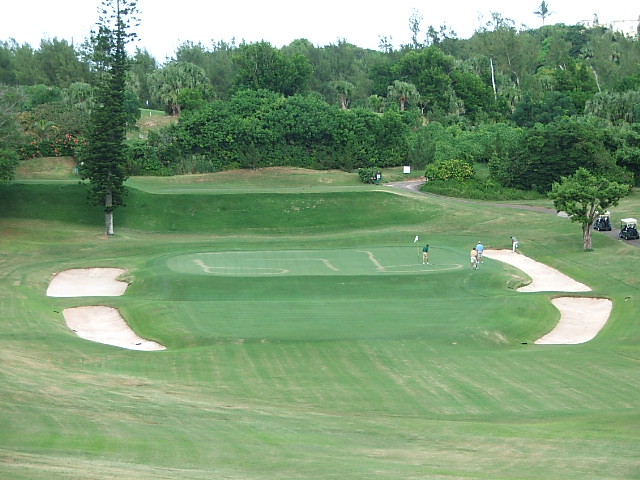
3rd green
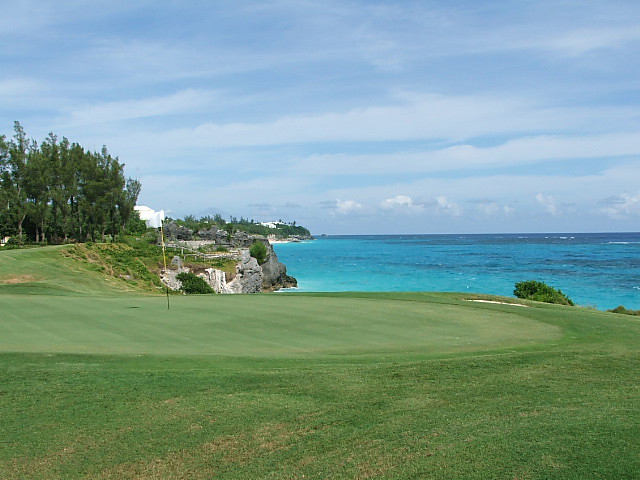
The view from the third green at Mid Ocean Club, a testing par three along the Ocean. A hook for the right hand golfer is in the Atlantic. Mid Ocean is the perfect place to play when there is snow on the greens in Northern climates. 

Macdonald was attracted to Bermuda because of Prohibition; a number of his friends went there so they could consume liquor, providing an excuse for him to visit. The strong willed golf pioneer picked an idyllic spot on the isolated island, an area called Tuckerstown, which contains, "delightful valleys winding through coral hills." Macdonald brought in his whole team to aid in the club's design and construction including Seth Raynor, Charles Banks, and landscape architect Frederick Law Olmsted.

Completed in 1924, ironically, after Prohibition was repealed, the course was built on dramatic land set on a headland with sweeping views of the startlingly clear blue waters of the Atlantic all around. The challenge for the architects was that the soil is less than ideal for golf: solid coral rock being as difficult a surface as there is to build on.

Like its designer, the Mid Ocean Club is big and bold, built on a scale that most golf courses never achieve, the only two remotely close being Yale and Bethpage Black. Partially, I suppose this is because the course was built before the era of mechanized earth moving equipment, thus, Macdonald used the naturally hilly terrain to great advantage. 

The course contains many Macdonald-Raynor prototype holes, including an Eden (the 3rd), a Short (the 7th), a Biarritz (the 13th), a Leven (the 14th), a Punchbowl (the 15th) and a Redan (the 17th). It meanders through various valleys and depressions, playing quite steeply at times. A good example is the 4th hole, below, named "Mangrove," the double-tiered green playing at a high elevation from the rolling fairway, making the approach shot blind.

4th
The par four 4th hole

The short (330-yard) par four 4th plays from an elevated tee with the Atlantic at your back and doglegs to the left. Although short, the hole is not easy.  Pat Ward-Thomas describes it in The World Atlas of Golf as "A plunge-and-rise affair, narrow between the trees and not altogether appealing."


8th green
The short par 4 eighth hole highlights the theme of using elevation in the terrain throughout the design, with a green elevated far above the fairway

The 8th hole plays to an elevated green and from the white tees is only 316 yards, making it driveable if downwind for long and accurate hitters. The course is also quite lush, which should be no surprise as it sits in a tropical location. As Macdonald noted, " . . . it is well wooded with cedars, oleanders, bougainvilleas and hibiscus, lending the most fascinating color scheme on the whole."


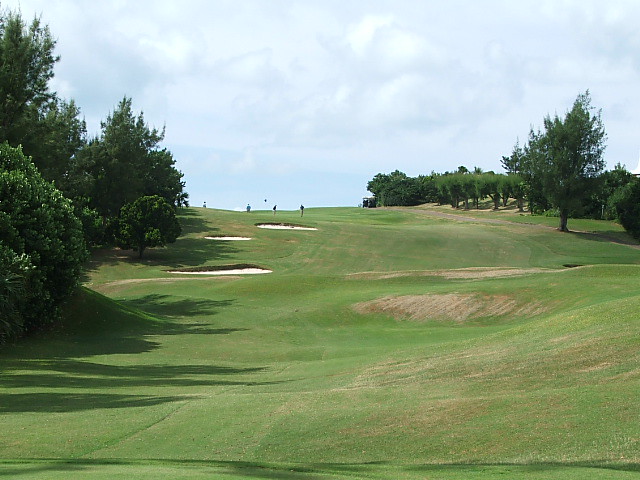
10th fairway1
The tenth hole, "Mercer Hill", has unforgiving terrain requiring skill hitting off Bermuda grass on an uneven fairway over a steep hill!


Part of the challenge at Mid Ocean, aside from navigating the hilly terrain, uneven lies, and testing greens, is the wind. Situated in the middle of the Atlantic and subject to the trade winds, most of the year the prevailing breezes average 10 miles per hour and spike up to about 13 miles per hour during the winter. Doesn't sound so bad, although, as we know, averages can be deceiving, and as an unprotected island there are times when the wind howls and the test of golf is stern.

11th fairway
The par five 11th is routed through a small, isolated valley and reminded me a bit of playing through the bush at Durban Country Club in South Africa


At 451 yards the 11th isn't too demanding a hole on paper, provided you keep the ball in the slim fairway and play the dog-leg left smartly, not being too greedy by trying to find a shortcut to the green around the curving valley. The green is elevated and tricky, falling away on all sides. The 11th is a good example of how Mid Ocean was designed, routing through several small valleys and around rolling hills and plateaus.


biarritz
The 238-yard Biarritz hole, the 13th, is a testing specimen of this hole type, with the requisite hollow in the middle of the large green


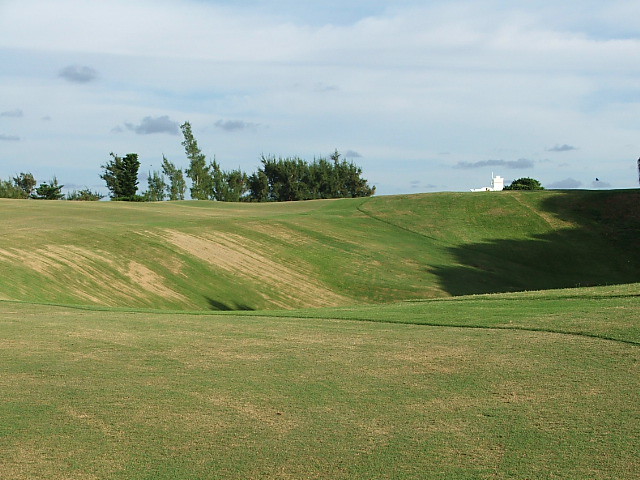
16th depression after shear wall tee shot
The par four 16th hole, after you hit over the sheer wall, then into a gully on the right side of the hole


I found the 16th to be a very difficult hole, and disorienting. The tee shot is blind, then, if you land in what is pictured above on the right side, you've pretty much thrown away a chance of par. The green slopes back to front and the green is ringed by bunkers all the way around. It's a great example of a hole that probably would be softened if built today with our ability to shape terrain at will, which Macdonald and Raynor didn't have the luxury of doing. Macdonald was cognizant of the fact that it would be difficult to route the course so that there wouldn't be too much "mountain climbing." He felt that he largely achieved it, with the notable exception being the sixteenth, which he called a "real climb." I'm with him on that. The 376 yard hole left me feeling like I do when taking a red-eye. In theory, it should be an opportunity for some respite on the way in, but I got so anxious that I didn't take advantage of it and walked off disappointed, a bit worn out and needing a nap.

from 18th tee 
The view of the turquoise waters from the elevated 18th tee box, with the aquamarine waters of the ocean rolling nearby as you play at the edge of a cliff

The 5th at Mid Ocean, the infamous "Cape" Hole

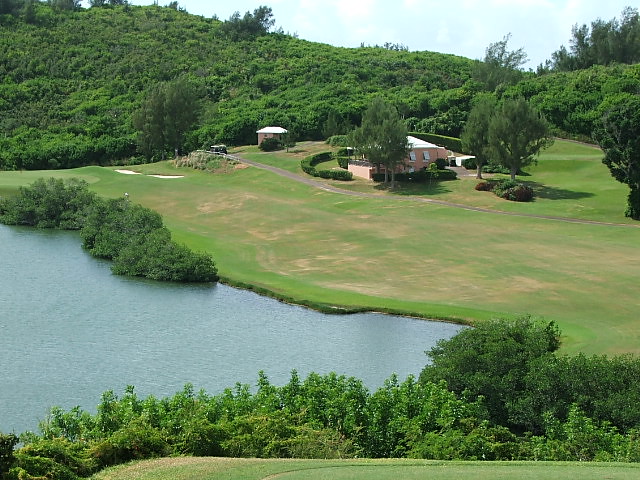
The most memorable hole on the course is the vaunted 5th, the “Cape" hole which plays from a high tee, over water, to a demanding green. A Macdonald invention that has been widely imitated in golf design ever since, the Cape hole here is the best rendition in the world. What makes it so is that it plays from such an elevated tee, and the fairway that you have to hit slants downhill towards the hole from top to bottom the entire way. Most copies of the hole replicate the risk-reward options over water to an angled fairway, but most play on flat terrain. It is the size and scale of the commanding hill that the tee sits upon at Mid Ocean that sets this Cape hole apart.

The trick, obviously, is to choose how much of Mangrove Lake you want to take on. Aiming left is a bold line and if you can carry your tee shot over the lake you have a much shorter shot to the green. The more timid player aims right and finds land instead of water, but has a very challenging second (and possibly third) shot on the 433-yard hole. It is classic. A prolific gambler and long ball hitter, Babe Ruth bet he could drive the green from the tee. After eleven balls (his entire stash) landed in the lake he walked off the course in a huff. The hole lives up to all its hype and is very good. Macdonald built his home in Bermuda overlooking the Cape Hole.


cape from tee2
The "Cape" hole from the tee

cape look back
The Cape hole looking backward up the hill from the fairway

cape fairway
The approach shot to the elevated green on the Cape hole

cape green2 
The hole doesn't get any easier when the golfer reaches the Cape green


DSCF1821 
I played the Mid Ocean Club more than a dozen years ago, when I was skinnier, had black hair and many bad habits, although I did try to blend in with the natives wearing my pink Bermuda shorts


For those that can't get on the super-exclusive National Golf Links of America or Chicago Golf Club, playing Mid Ocean is a worthy substitute, since the great man's genius shows through strongly at Mid Ocean. Macdonald himself compared his Southampton baby to his work in Bermuda, "I am confident the course will stand in golfing circles as an achievement in a semi-tropical climate as great as the National Golf Links of America has been in the temperate zone." Unaccompanied guests can play Mid Ocean if their round is arranged through select hotels on the island, but play is limited. A member may introduce a guest to play golf unaccompanied on Mondays, Wednesdays, and Fridays, by reservation only.
Bermuda is a relaxing island to visit, it has a romantic charm to it and pink sand. Not surprisingly, although far from the homeland, the club itself  has a British feel to it. If you go to Bermuda it is also worth playing the course at Tucker's Point.