Sunday, February 05, 2023

Silloth-on-Solway - England's Cruden Bay

The clubhouse at Silloth with the Union Jack at half mast to mark the Queen's passing

America has some phonetic place names that roll off the tongue in a lyrical manner: Tucumcari, Sheboygan, Walla Walla, Valparaiso, Kokomo, and Ronkonkoma come to mind. They not only mark a location on the map, but conjure up images in the wandering mind of far off places that an itinerant traveler would love to see one day (although from personal experience I can tell you there is no need to visit Ronkonkoma). Many were taken from Native American names and are rhapsodic. 

While America has some amusing locales, the mother ship remains England. After all, a land that produced Shakespeare, Milton, and Chaucer has a birthright in the field of toponymy. The upstart colony can’t compete with a country that has towns named Newcastle-upon-Tyne, Virginia Water, Barrow-in-Furness, Preston-under-Scar, Berwick-upon-Tweed, Goring-by-Sea, Wells-next-the-Sea, and Branksome Chine. Many of these towns take their name from a mixture of Old English and Old Norse, and in my view they can’t be beat.

Okay, enough of the diversion, back to the topic at hand, which is golf, and specifically a new find called Silloth-on-Solway. What? Another one of those barmy place names. Silloth means roughly “sea barn,” and Solway is the body of water the town is located on, as in Solway Firth, part of the Irish Sea. The golf course is located directly on the Firth with clear views across the water to Scotland, with the rounded peaks of the Galloway Hills in the Southern Highlands only eight miles away. The area has been designed by the government as an Area of Outstanding Natural Beauty.

Sandwiched above the Lake District of England, with its sweeping views of the Cumbrian Mountains, and below the Scottish Borders region, Silloth is not a course you happen upon by chance. Located almost three hours from Prestwick to the north or two and a half from Royal Birkdale to the south, this is destination golf. Silloth had its heyday during the Victorian Era, when it was a beach holiday town. 

Even when you are intent on finding Silloth-on-Solway, it is a challenge, as the course is hidden behind the town. The GPS system on our car couldn't find Silloth and left us on a dirt path near the outskirts of the course. You have to take a circuitous route to finally get to the clubhouse, which is located behind an industrial park. 

I have yet to find a Willie Park, Jr. designed golf course I didn’t like. I went out of my way to play at Silloth because I love Park’s designs at Sunningdale and Maidstone. It was also recommended by three golf aficionados whose opinions I trust, beginning with Ran Morrissett who wrote an enticing profile on Golf Club Atlas, albeit it accompanied by some dated pictures. Another motivator was the fact that Darius Oliver included the course as one of the top 100 courses outside the United States in his Planet Golf book, where we writes glowingly about the course, “Silloth is less conventional and full of hidden greens, blind driving zones, large central hills that obscure targets on par fives and small plateau greens on long, downwind par threes . . . golf at its most raw and the game is poorer for the fact that courses like this are no longer being built.” Finally, my friend Fergal O’Leary, implores rabid golfers to visit, “PLEASE GO TO SILLOTH! You’ll be immensely rewarded! I will forever vote this course comfortably within the Top 100 courses in the World.”

I took Fergal’s advice and went to Silloth and was indeed rewarded. It has one of the best opening stretches of any golf course in the world.

The 1st fairway to Silloth

You know Silloth is going to be different right from the get go. The picture above shows the first fairway with its natural undulations among the dunes. The approach on the first green is blind with a long pole sticking up so you have an aiming point. 

The 1st green at Silloth set among the sand dunes

The first green at Silloth is a "Dell," green. Dell greens take their name from the original par-3 5th hole at Lahinch, and they are holes almost completely surrounded by dunes with only a small portion visible to the unwary golfer trying to hit the green from the fairway (or tee). 

The 2nd, a par four of only 315 yards, plays from an elevated tee and the green is also of the Dell variety. The image below also shows off the other ubiquitous feature of Silloth, namely its abundance of gorse bushes. The course is routed among sand dunes topped with gorse.

Silloth's difficult to hit 2nd fairway

The 2nd green, like the 1st, is set among the dunes

The winding 3rd fairway to Silloth, set among the healthy gorse bushes

The third hole is a dogleg left with a wildly undulating fairway--you won't find many flat lies on the course--set between two lines of dunes. The image above was taken from the top of an observation ladder you climb to see if the coast is clear, because it is yet again another blind shot. You can start to get a sense of why I called Silloth England's Cruden Bay, because of its abundance of blind shots and because of its routing among the dunes. The unconventional course is rough and tumble with a sense of spirit that is rare to find in golf.
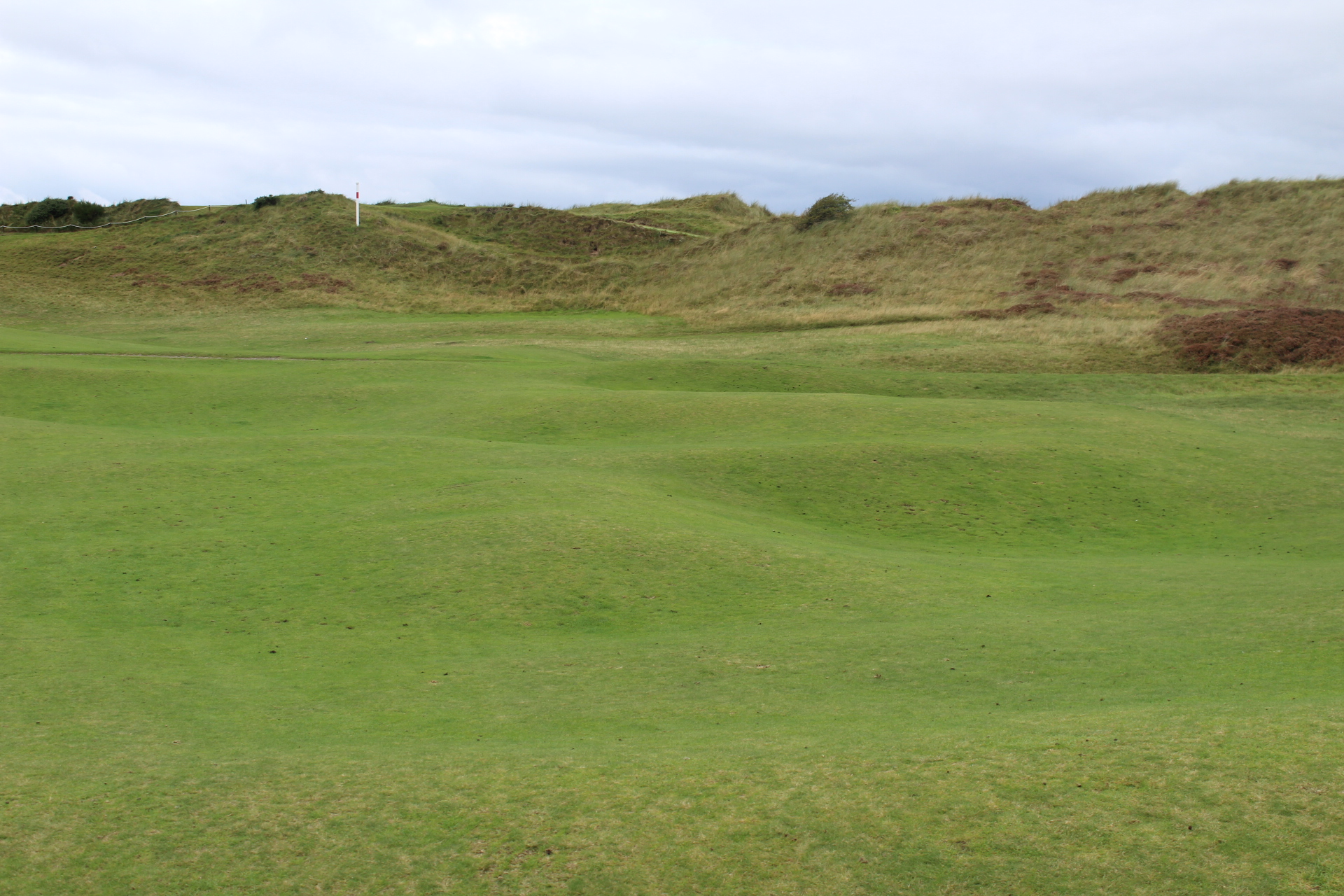
The 3rd fairway at Silloth, note the zany fairway humps and another aiming pole in the distance for your approach to the green

The elevated third green requires the golfer to hit a precision shot to carry a swale in front

The seemingly simple approach to the 4th green at Silloth

There is another aiming pole off the tee for the blind approach to the 4th green. It is at this point that you either fall in love with the golf course or hate it. I like blind shots since they introduce an element of surprise, but some people hate them. Two of my playing companion friends hated it and it felt like there were too many blind shots, particularly because there is so much gorse to contend with. They aren't opposed to blind shots per se, but it is the combination of the abundance of blind shots with the penal nature of the gorse that they thought was unfair. In my mind you have to put yourself back in time. After all, the course was built in 1892 when blind shots were common. If you want to play the most recent Tom Fazio course without blind shots, go ahead, Silloth probably isn't for you. While many of the world's best courses have blind shots including Royal County Down, Royal Portrush, Prestwick, Lahinch, National Golf Links, and New South Wales, the combination of an abundance of blind shots with the gorse does make Silloth particularly challenging. It didn't bother me, in fact, I found the unconventional nature of it exhilarating.

In addition to a blind tee shot on the 4th, the unsuspecting golfer has no clue as to what is to come on this bunkerless hole. Hit the green and there are no worries. Miss the green and you will face a challenge unlike almost any other in the world of golf.

The deep grass hazard to the left of the green...

...is matched with an equally deep grass hazard right of the green!

The fourth is a hole that sticks in the mind long after you play it.

The green of the par-5 5th hole with pot bunkers

The par-5 fifth hole is the first one on the course that doesn't feature a blind shot. In addition to blind shots and gorse hazards, the course also features strategically placed pot bunkers as seen here on the fifth, which hugs the beach from tee to green.

An expansive view of the par-3 6th from the tee. The hole plays over a disused railway line you can see running in a straight line in front of the green


The green of the difficult par-4 7th hole at Silloth

The 7th hole plays 415 yards up a rising, humpy fairway and sports another blind shot to a Dell green set in the dunes. This shot also shows to good effect the nature of the greens at Silloth, which as you can surmise, are not flat.

The par-3 9th hole has a well-defended postage stamp green that falls off sharply should you hit to the right

The approach to the par-4 11th plays over this hill seen on the right

The drive off the 11th hole features . . . drum roll please . . . you guessed it, a blind shot! Unless the tee shot is positioned to the left it blocks the golfer out from the green.

The club calls the 13th hole, nicknamed Hog's Back, its signature, but I thought it was one of the poorest designs on the course. A par-5 of 509 yards, the drive is a forced carry over heather and gorse and for someone who hadn't played the course before I wasn't sure whether the fairway was to the left or the right on the second shot. It's to the left, and the third shot plays to a goofy elevated table top green that is inconsistent with the rest of the greens on the course.

The back nine features three par fives, including two back to back. The back nine is inevitable a letdown after the excitement of the start. The front nine has five holes with blind shots (1st, 2nd, 3rd, 4th, and 7th) and the back only has one (11th), in addition the back has less gorse and less severe dunes. It also plays more inland and further away from the Firth. The finishing hole at Silloth is a card wrecking par 4 that we played into the wind, making it a real tester.

Although I mentioned that the course is a design of Willie Park, Jr., as is frequently cited, it was actually laid out by Davie Grant with an assist by Mungo Park, Willie's uncle and the winner of the Claret Jug in 1874. Park, Jr. made his changes around the turn of the 20th century and Alister Mackenzie consulted for the club just prior to the First World War, but due to financial difficulties the only imprint from the Good Doctor is today's third green and fourth tee. The club's history gives the majority of the credit to Grant, "the major influences in the design of the Silloth course have been Davie Grant, in his original layout, and the Greens Committees of the 1900s. The more celebrated Willie Park Jr., Willie Fernie and Alister Mackenzie appear to have been supporting players."

It is interesting to fantasize about composite courses, a compilation of the best holes you have played made into one fantasy course. Well, Silloth-on-Solday has many of the holes all here in one place. The 5th hole resembles the 9th at Maidstone; the blind par three Dell hole at Lahinch is replicated often on approach shots; the 6th hole, with its sea of gorse off the tee like County Down’s 4th hole; the 7th is reminiscent of the first at St. Enodoc; the 13th is like the 10th at Maidstone; and the 14th has the rippling fairway reminiscent of the 8th at Prairie Dunes. Ran Morrissett describes the 4th as similar to the opening hole at Pine Valley as well.

I’m in total agreement with my friend Fergal's thoughts about Silloth, “I’d like to end this with a very strong opinion I personally hold as follows. I get so frustrated when people say 'if X course was located closer to Y city/region, then it would be rated so much higher.' This lazy attitude is insulting to the course and the club should never suffer in the rankings just because of its location. If the course is worthy of merit and is architecturally superior to a list of overrated courses, then give credit when credit is due! Making the extra effort to find the best courses on earth is the exciting part! We frequently rank courses in Tasmania that are essentially at the end of the earth, so don’t tell me the northwest of England is too far out of the way.” Of course, he is 100% right. Courses in Ayrshire like Troon, Prestwick and Turnberry are naturally clustered together for a golf trip as are the courses around St. Andrews, thus they get a lot of notoriety. Silloth stands alone in the far north of England, therefore it doesn't get the accolades it deserves.

The course suffers from what I call a lack of “Instagram” appeal. Magazines and websites tout the newest cool thing, which you can’t fault them for since it supports their business model and advertisers. Some clubs, especially new ones, go out of their way to court raters, bending over backwards to accommodate them. Silloth suffers from opening in 1892, and not 2022, thus there is no fanfare about it and no sexy marketing campaign to engage in. 

Bernard Darwin wrote in A Round of Golf: “I never more violently fell in love with a course at first sight. There never was a prettier or more truly golfing beginning to any course than there is at Silloth, a tee shot down a shallow valley, with sand a hillocks and heather on either side—a little reminiscent of some of the shots at Formby or Birkdale. Fascinating greens that go dodging about amid delicious country.”

We should treat old historic courses like this with more respect, and a three hour drive among delightful country is hardly an imposition. Silloth has heart and soul and a unique character and is worth the journey!


Thursday, January 05, 2023

Torwoodlee Golf Club


On my (um . . . many) trips to the British Isles I like to play a couple of unheard of or below the radar courses in addition to playing the best and the most renowned courses. It creates some variety, and I always learn something.

My most recent trip included a first visit to the Scottish Borders, a county south of Edinburgh and just north of the English counties of Cumbria and Northumberland. Most Scottish golf trips are naturally clustered in one of three areas: around St. Andrews; on the Ayrshire coast near Troon, Prestwick, and Turnberry; or in the Highlands visiting such gems as Dornoch and Castle Stuart. You have to go out of your way to visit the Scottish Borders. In my case it was a stop on the way to Silloth-on-Solway in Cumbria. Torwoodlee was midway between Fife and Cumbria so it was a logical place to stop. The course is located five minutes outside of Galashiels, the largest town in the Borders.

Like in all of Scotland, there is a rich selection of courses in every region, the Borders being no exception. I chose Torwoodlee because I like to play as many courses as possible designed by Willie Park, Jr., one of my favorite architects.

1st fairway with a favored Park hazard:  cross bunkering

The course was built in 1895, giving a rare opportunity to see what courses were like 125 years ago when the game was just taking hold. Most of the course, except those immediately near the clubhouse is essentially set on the side of a large hill, consistent with the topography of this part of the Borders. It plays 6,021 from the back tees. According to the club's centenary history there were 114 members (78 gentleman and 36 ladies) when Torwoodlee opened. Park mentioned that the "absence of hilly ground makes it particularly suited to lady members," providing a hint to which holes on the course are Park original holes.

The course is organized into two distinctive segments. The holes between the Gala Water and the railway line are on relatively flat ground and are distinct from the holes after you cross over the old railway bridge and play on much hillier ground. The flatter holes are the the remnants of the original nine laid out by Willie Park, Jr., that is, the ones between the river and the railway. The course acquired an additional 45 acres in 1992 and expanded the course to eighteen holes, with only a handful of Park holes surviving, most notably the first, sixteenth, seventeenth, and eighteenth.

The first hole plays on flat ground near the clubhouse and is a pretty simple affair ,with a cross bunker as the only significant hazard, although it doesn't really come into play today.

View from the 2nd tee shows the hilly nature of the property Torwoodlee is build on

The second hole is a lot meatier, playing 401 yards up the side of a sloping hill. The course is well maintained, although the grass appears to be cut about once a week, thus the greens were a phenomenon and ran about 3-4 on the stimpmeter!

The club hired Ben Sayers from North Berwick in 1902 to suggest improvements and he added bunkers to the original 4th, 5th, 7th, and 9th holes. In 1925, James Braid was brought in to suggest a number of improvements to the course as well. In the early years the course was cut using a horse pulling a set of blades behind it. After that the course was kept by a flock of sheep grazing on its grass.

View of the 5th green from the fairway

The heart of the course and the three most interesting holes are in the recently added nine holes: the fifth, sixth, and seventh. The fifth is easily the #1 stoke index hole and plays up the largest hill on the property, 418 yards from top to bottom. The green juts out from the mountain and is built up on three sides, making it difficult to hold and hit.

A view of the 5th green from the rear shows off the difficultly of hitting and holding the putting surface

The view off the 6th tee shows the beauty of the Scottish Borders region

The sixth tee box is the high point of the property and the view seen above is typical of those in the Scottish Borders with its rolling hills dotted with agricultural farmland punctuated with pastureland used by grazing sheep and cows.

This view greets the golfer from the 6th tee. The green is between the two trees on the left, far far down the hill

Once you soak up the views on the tee and focus on the challenge of the sixth hole, the golfer is thunderstruck by what lies ahead. Below you, probably the drop of a ten story building, at least 150 feet, likely more, is a hole that plays over a fenced in sheep pasture and two trees to a small green tucked away on the left. It is unlike any golf hole I have ever seen and quite interesting. You can choose either to try and drive the green on the left or play it safe and hit to the right. Guess what we all did? Why not got for it; how often are we going to visit Torwoodlee, so it wasn't a real consideration to lay up.

The view looking backward from the 6th green shows off the idyllic nature of Torwoodlee

Ultimately golf is a game that gets you outdoors for some fresh air and exercise and to commune with nature. Golf at Torwoodlee is that and more. The course gets very little play. We were probably the first Americans to visits in a decade or more. The air in rural Scotland is so fresh and clean, and the sweeping views force you to take it in and relax. The sixth hole helps you maximize all that and more. It was such a treat to soak it all in.

The tiny 6th green

On a course with relatively small greens, the sixth might be the smallest, quite fitting for a 355 yard hole.

The par-3 7th from the tee. The golfer can see the flag but not the green

The seventh is a demanding 152 yard blind par three that plays significantly longer up a hill to a putting surface you can't see.

The double green shared by the 8th and 13th holes

The course has two sets of double greens. The 8th and 13th holes share a set of greens as do the 1st and the 15th. After playing the 13th hole the golfer crosses back over the railroad bridge back to the original Park holes near the clubhouse.

The 18th green set in front of an old stone bridge on the entry drive

The 18th is a very narrow hole that plays along Gala Water, a tributary of the River Tweed. The heart shaped green is beautifully framed by the original stone bridge that is part of the entry drive into the course.

Throughout our round we kept wondering, why would a golf course be built in such a remote area? How much demand could there have been for a club to sustain a membership in 1895 and be viable? Apparently it was more than viable. In 1901 Harry Vardon played James Braid at an exhibition match at Torwoodlee, and in 1903 Sir Arthur Conan Doyle became a member. I told you I always learn something playing out of the way courses. Who would have thought?

Galashiels, where the course is located ,is a town of roughly 15,000, apparently large enough in golf crazed Scotland to support a course. I find this very impressive, and it is no wonder Scotland has more golf courses per capita than anywhere else in the world. In the United States there is a CVS pharmacy within a five mile drive of 70% of the people in the country. It seems to me in Scotland it is the same way with golf courses, there is a course always at hand. The Scots have it right!


Monday, December 05, 2022

Panmure Golf Club


On the other side of the railroad tracks, a bit further west than Carnoustie lies Panmure, one of the oldest courses in the world, with origins dating back to 1845. Panmure features an out and back layout, one of the most striking out and back courses I have played since Western Gailes on Scotland's west coast. 

Allan Robertson and Alexander Pirie came from St. Andrews and laid out the original nine holes. The course was then known as the Monifieth Links. The club had trouble the first few years with the tenant of the Monifieth Farm who claimed a right of pasturage on the links and complained about the club's use of the land. The club promised to pay for any damages done to the land or to any of his livestock. The tenant farmer did not accept their proposal and brought about legal action. The farmer, James Maule, died in 1852 and the interdict was removed allowing the golfers to chase around their fragile feathery balls once again.

By 1893, there were a number of clubs all playing on Monifieth Golf Course, and due to the congestion it was agreed to look elsewhere, and in 1899 the club moved to its present site at Barry. The original Monifieth course still exists and is directly west of Panmure. 

Although the current course is sometimes described as an original Old Tom Morris design, the evidence of such is scant. In the Golf Courses of Old Tom Morris Robert Kroeger says, "it is doubtful that Morris had much input in the early stages of the course. Club minutes don't mention any fee paid to him. It is possible he was traveling to another destination and stopped here as a favor to someone. It seem that the original members should be given credit for the initial construction of the course and its early development."

James Braid was brought in to lengthen the course in 1923, which is set on a narrow strip of land and plays among low rounded sandhills, which make excellent sites for tees and greens. The first six holes go out, all in the same direction into the prevailing wind, number seven is the first hole that plays in a different direction and holes thirteen through eighteen play back in the opposite direction.

Play well, move quickly. Playing badly, play quicker. Horray!

The first four holes at Panmure lull you into a sense that the course doesn't have much to it. Three par fours and a par five all running in the same direction, none particularly taxing, especially if played down wind like the conditions on the day I played them, the opposite of what is normally blowing. The course starts to get interesting at the par three 5th which has a punchbowl green.

Panmure's 6th hole, a par four of 414 yards has a blind tee shot . . .

. . . followed by a blind approach unless you hug the right side of the fairway

The elevated, well protected green on the 6th

The sixth hole was a favorite of Ben Hogans when he used Panmure as his warmup course before winning the 1953 Open Championship at Carnoustie, which is adjacent to Panmure. He played there for two weeks prior to the Open. At the time the British used a smaller ball, so he was both getting used to links golf and the smaller ball. 1953 would be his only trip to the British Isles. Hogan chose Panmure to practice at because at the time it was an extremely private club and this allowed him to go about his business out of the eye of the eager public and press, who wanted to follow his every move.

During Hogan's visit Panmure did not have a practice area so he did his practicing on the 17th hole, never using more than a dozen balls at a time. One day Hogan asked the head greenkeeper if the blades of the mower could be lowered to shave the green a little to make it more like the speed of the Carnoustie greens. The greenkeeper, William Falconer, replied, "Here's the mower, Mr. Hogan!" Hogan cut the green himself and even cleaned it before giving it back. Hogan was invited to use the dining room and lounge, but he declined, instead taking all his meals in the kitchen because he didn't want to create any trouble, since at the time the club professional wasn't allowed into the clubhouse.

The sixth begins the first of seven holes at the end of the property that, unlike the outward four and the incoming six, play at all different directions on the compass.

The eighth is another hole with a blind tee shot and it is a great 361 risk-reward par four that plays to a well protected green.

The 8th hole has a blind approach from the right side that offers this view to the golfer

Par-3 9th hole, 180 yards from the back tees

The 12th hole, a par four of almost 400 yards has the Buddon Burn protecting the approach to the green

The pin flag on the 12th green nestled behind a sand dune

Panmure has eleven holes that have out of bounds and with the wind blowing, as it normally is, the course is no pushover.


The clubhouse is a replica of the Royal Calcutta Golf Club in India, and was built in 1871. The reason they have a clubhouse modeled after one in India is because Panmure, and the larger city of Dundee 20 miles away, was a hub of jute (rope or twine) trading with merchants in Calcutta. The club's history states that large numbers of jutewallahs (traders of jute) were Panmure members.

The historic locker room at Panmure

There are few 19th holes as welcoming and comforting as Panmures

The Hogan room in the clubhouse

Past club captains on display in the clubhouse, dating back over 160 years

Many golfers, myself included up until this point, don't give a lot of consideration to adding Panmure to a golf trip to Scotland. With a rich variety of choices of within an hour of St. Andrews it is understandable that Panmure gets overlooked. If it does get mentioned it is as the course that Hogan used to warm up on in 1953. It's too bad that Panmure gets overlooked because it is a great and interesting golf course and I enjoyed my visit there immensely. In addition, there are few places that treat guests better and whose plush, museum-like sprawling clubhouse is historic and comfortable. Panmure deserves more respect.


Wednesday, November 02, 2022

Huntercombe Golf Club


The rules at Huntercombe Golf Club in Oxfordshire:

  • No tee times
  • We are delighted to welcome visitors throughout the year, but you will have to forgive our idiosyncrasies. We like to keep play moving and are essentially a 2-ball course
  • No four balls
  • Lunch, no dinner
  • In the dining room gentlemen should wear a jacket and tie

Well, well, well. A proper English golf club, playing the game in the proper way. Huntercombe has long been on my bucket list and I am thrilled to have finally played it.

Maidstone, the Old Course at Sunningdale, Huntercombe. All the work of Willie Park, Jr., one of my favorite designers. Park was the Open Champion in 1887 at Prestwick and again in 1889 at Musselburgh. He was the first person to pursue golf course architecture as a profession, designing 160 courses in total. Huntercombe was not only a golf course he designed, it was also his baby, so to speak. An aspiring businessman as well as an architect, he purchased the 724 acre Huntercombe Manor in 1900 and set out to develop it as the Chiltern Estates, which was to include a 100 bedroom hotel.

In an advertisement for Huntercombe, Park described the club as "A perfect seaside course, Inland. Grand old turf, gravel and sand subsoil, health-giving breezes, an ideal course for London golfers." As an added enticement to get men in the City to join the club arranged "motor cars," to meet the 9:50 am and 6:30 pm trains from Paddington Station when they arrived at Henley. Since my health hasn't been great over the last few years I particularly looked forward to playing Huntercombe for those health-giving breezes!

Park's business acumen was lacking and in 1924, the club, having financial difficulties, was sold to William Morris, Lord Nuffield, founder of the Morris Motor Car Company, whom the club has previously declined to admit as a member (awkward). He owned and ran the club until shortly before his death in 1963, selling it to the members for £1. Nuffield was wildly successful and philanthropic, establishing Nuffield College at Oxford in 1937. The Chiltern Estates and 100 bedroom hotel were never built, leaving Huntercombe in a delightfully rural environment.


The quintessential English home of Lord Nuffield in Oxfordshire

Huntercombe is located in Henley-on-Thames in the tony county of Oxfordshire. Henley-on-Thames is the site of the most famous regatta in the world, the Henley Royal Regatta, a rowing version of Royal Ascot, and an occasion, with well dressed patrons decked out in their best finery and hats.

Huntercombe has views of the Chiltern Hills, which doesn't mean much to most of us. The Chiltern Hills are designated by the British Government as an Area of Outstanding Natural Beauty, which is an apt description. Think quintessential rolling English countryside, with farm fields dotted with hedge rows. Below is an image of Huntercombe's fourth green as seen from a drone, with the Chiltern Hills in the distance. Pretty enticing.

Photo credit: Hutercombe Golf Club's Twitter feed

The 1st green at Huntercombe

The first three holes at Huntercombe are set apart from the remaining fifteen. The first three play just away from the clubhouse and run down and then up a steep hill. The remaining fifteen holes play on a different piece of topography and are flat. The first, a par three, starts with a large two-tiered green, which sets the tone for the day regarding the putting surfaces. Although the hole is only 142 yards long, from the tee you can see the pin flag but not the hole.

The course starts on a par three not by design, but because when the new clubhouse was built it was near this hole. The original starting hole is today's fourteenth, which was adjacent to the original clubhouse, Huntercombe Manor, which is still there today and is a private residence.  Huntercombe is one of the few courses I am aware of that plays shorter today than when it opened. The course opened at 6,500 yards and today plays as 6,319 yards; holes two, three, five, six, and eleven having been shortened.

The second at Huntercombe, a difficult par four, sweeps down a broad hill

The second hole, a par four of 416 yards, plays down a broad hill with a dramatic drop in elevation from an elevated tee. The hole also slopes right to left with out of bounds on the left. It is difficult to describe how far right you have to hit the ball off the tee in order to have it run down the hill a bit. On the day I played the conditions were fast and firm to say the least, and any ball hit on the fairway ended up running down to the left in a collection area, taking all the strategy out of playing the hole. I imagine in more normal conditions the design brings more risk-reward into play.

The zany, two-tiered third green

After walking through a stand of trees you stumble upon the third hole, a par four of 368 yards that plays much longer, climbing the same steep terrain you just descended. A mirror opposite of the second, any ball hit to the right side of the fairway on this hole will run down the hill to collection areas on the left. The green is tucked into the side of the top of the hill on the left and features another dramatic two tiered green.

Hmm . . . three holes and three two-tiered greens. I am not that bright but I'm spotting a trend here.

Grass hazard short of the 4th green on the right side at Huntercombe

The fourth hole is a relatively easy one that plays 331 yards downhill. It is also the golfer's true introduction to the hazards of the golf course. Huntercombe only has 13 sand bunkers, but has scores and scores of grass bunkers, or as the course calls them, "Pots." They are big, sometimes unsettlingly deep ditches and hollows without sand and they can prove a surprisingly effective hazard.

Huntercombe's 4th green

Huntercombe 4th green, like the first three, is multi-tiered and features a pronounced depression in it as seen above.

This grass bunker guards the left side of the 4th green

A large grass hazard guards the sixth hole approach 

As you can see from the image above, course conditions were not optimal when I played in September 2022, after a long and persistent drought. While greens and tee boxes were in excellent condition from an irrigation system, fairways and grass hazards were in a tough state, something I had to look past all day long to appreciate the beauty and uniqueness of Huntercombe's design.

The testing par-3 7th hole at Huntercombe

The seventh, the second par three on the front nine, a whopping 213 yards, is a real tester, not only because of its length but also because of the large mounding that protects the entrance to the putting surface.

People make pilgrimages from around the world to see the 8th hole, with its large, multi-tiered putting surface. A par four of 427 yards, it is the #1 stroke index hole. It helps to remember that this green was built in 1900 and Park's influence as a designer meant that greens such as this would be copied by designers such as Charles Blair Macdonald (who modeled a hole at the National Golf Links after a hole at Park's Sunningdale), and even modern day designers such as Pete Dye and Tom Doak.

A broad view of the 8th green at Huntercombe

This close-up of the 8th green shows some of the dramatic sloping

The back tier, where the pin is placed here, is by far the smallest surface area of the green.

The 14th green at Huntercombe is a sort of punch bowl style and surrounded by low mounding

The 16th, a par five, features one of the deepest grass bunkers on the course. A bomb crater bunker.

The seventeenth was my favorite hole on the course but I wasn't able to get any good pictures of it. It is a 274 yard ball-busting risk-reward par four similar in playing style to the 17th at National Golf Links, one of my favorite holes in the world. It is full of very effective grass bunkers and plays to a well protected push up green, with several of the courses scant sand bunkers used as protection. I made a double bogey on it unfortunately.

Ian Fleming was a member of Huntercombe and as such he tells us that James Bond played his golf “on courses around London – Huntercombe, Swinley, Sunningdale, the Berkshire. At the start of their famous golf match, Bond tells Goldfinger that he played off 9 at Huntercombe, which was Fleming's handicap. Fleming is my kind of golfer and used to play on Sunday mornings at 8:00am with a partner, and they were always done in under two hours. 

The course remains popular among members of Parliament and high ranking government officials. The one-time head of MI6, Sir David Spedding, was a member of Huntercombe. While having lunch in the intentionally modest clubhouse I noticed a Marshal of the Air Force's name up on one of the club championship boards. The club's ambiance and culture is one befitting high profile people in search of peace, quiet, and discretion. Early golf course architects J .F Abercromby and C. H. Alison were members, as was the famed golf writer Henry Longhurst.

It was nice to finally visit Huntercombe and see the historic course with its crazy greens, grass hazards and proper English setting. It's too bad I hit it in sub-optimal conditions, which only means I have to come back someday when the grass is lush. I'm sure the club won't mind as long as I don't show up as a four ball!