Monday, June 30, 2008

Merion - Drama, Comedy and Tragedy

It's not often that I re-post a course write-up. I got a chance to play Merion again earlier this year with my digital camera in tow and have posted some great new pictures with this new posting.

Shockingly, many of my readers inform me that they like my pictures more than my prose. Humbug.


Most major cities have their well-healed suburbs - in New York Greenwich and Darien. In Chicago, the communities along the North Shore of Lake Michigan. In Philadelphia, the affluent leafy suburbs are known as The Main Line. Named after the train line west of the city, the Main Line is old-world, understated, affluent and traditional. Merion is located in the heart of Philadelphia's Main Line and plays the part well. The land that the course and clubhouse are on trace their title back to William Penn.

Memory is not one of my strengths. One minute after meeting someone, I don't remember their name. Many times I have had to look at the bag tag of the member I'm playing with every three holes to remember his name and not make a complete fool of myself. And, I have gotten very good at not saying names. "Nice shot" instead of "Nice Shot, Dave", in case his name is in fact Bob.

There is, however, a part of my memory that works very well when it sees something memorable. I have found that the mark of a truly great course is how well you remember it both immediately after a round and six months later. Using this measure, Merion is a truly great course. After playing it once I could describe every hole in detail. The shape, terrain, bunkers, doglegs, green contours, etc. At Pebble Beach you sort of feel compelled to like the course because it is so pretty and everybody raves about. But, if you're being honest with yourself, aside from the eighteenth hole, can you visually remember all of the holes at Pebble? I'll bet you can't. Merion is seared into my memory. So far this has happened to me on only three courses in the world: Merion, The National Golf Links of America and Cruden Bay.


The 18th green as seen from the second floor locker room

What makes Merion so memorable? It is the ultimate strategic golf course. It is not a terribly long course. At Merion, you have to hit the fairways or it will be a long day. Second, you have to be on the correct side of every fairway in order to have a decent shot at the green. And finally, you have to be on the correct part of the green or you're in three putt territory. On every green. Also, the shot variety is really good as are the changes in direction, doglegs and uphill/downhill shots. No monotony here. As if the golf course itself is not good enough (and it is) you also have the grandeur and majesty of the white pillared clubhouse and the Bobby Jones and Ben Hogan history.
Bobby Jones with his grand slam trophies at Merion

If there was ever a course that new equipment risks destroying, it is Merion. It is too bad that the U.S.G.A and R. & A. have let the situation get out of hand and length is now the primary driver of competitive golf. It would be a shame if this course is lost from major competition forever.

I consider Merion to be the spiritual home of golf in the U.S. due to its greatness, its history, its association with Bobby Jones and the architecture of the course and the clubhouse. Merion's east course was designed in 1912 by Hugh Wilson, a Princeton graduate and captain of their golf team. The club traces its roots back to 1896 as you will see on the club's logo and evolved from the Merion Cricket Club.

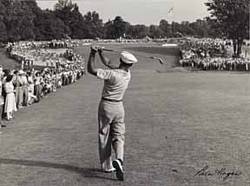
This is the first course Bobby played a major on (the 1916 Amateur), the first course he won a major on (the 1924 Amateur) and the last course he played competitive golf on (the 1930 Amateur), completing the fourth leg of the Grand Slam at Merion in September 1930. Also, the classic photograph which is the golfing equivalent of the ironic shot of the sailor on V.J. Day kissing a woman in Times Square, was taken at Merion.
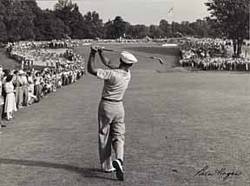
Ben Hogan on Merion's 18th hole at the 1950 U.S. Open

Taken by Life Magazine photographer, Hy Peskin, it shows Ben Hogan hitting a one iron on the eighteenth hole in the 1950 U.S. Open. It is an iconic picture of this great player at one of the most historic of courses in a perfect finish position. Hogan almost stopped playing during this final round because he was in such a state of fatigue recovering from a near fatal car accident the year before. Hogan hit the one iron onto the green and made a par to qualify for a three man playoff the next day which he would go on to win. It is one of the most heroic finishes of all time.

The short par three 13th hole as seen from the tee, shows off the Merion bunkers

Merion has many unique characteristics: the red wicker baskets as flags, the bunkers with clumps of grass in the middle (known as the white faces of Merion) and the scene around the first tee. You tee off right next to the outside patio with its green-and-white striped awning, with members and guests about five feet away from the tee box. It is one of the best opening holes in golf. The view in all directions is impressive; the clubhouse building with its white-washed stone and porch, the green awnings, the mature trees, the wicker baskets.  The wicker baskets are red on the front nine and orange on the back nine.

Merion also still has what has unfortunately become a rare entity in American golf: Experienced caddies, and lots of them. The clubhouse, which is listed on the National Register of Historic Places is the golfing equivalent of St. Peter's. Also, like the Vatican, Merion upholds the traditional and the conservative in the game and in many ways is truer to the traditions than golf's governing bodies because they don't have to compromise with the equipment manufacturers. In addition to no pin flags, there are no yardage markers, no range finders allowed and no golf carts.

In the clubhouse and on the course at Merion you naturally speak in hushed tones and in a respectful manner. It sounds absurd but it is close to a religious experience.

Looking back from the first tee at Merion

Merion is also what I call a deceptively long short course. How about two par threes that can play more than 250 yards each? The third and seventeenth are long par threes with exceedingly difficult greens. Yes, the course has some short par threes and some short par fours but there are also some quite long holes mixed in. Part of the genius of architect Hugh Wilson was the mis-direction he used from the teeing grounds. The first hole is a good example as the tee point toward the left rough. The eleventh tee is pointed toward the right rough and the finishing hole directs the golfer toward the trees to the left of the fairway. Very subtle, but important. Most of Merion's greens are also set at an offset angle from the fairway, making the distance tough to judge and ensuring that missing the green is always in play.


The first tee as seen from the 18th green

No question it is one of the best opening holes in golf, along with Prestwick and The Old Course at St. Andrews. The tee box is located right next to the dark green awning next to the big tree. Since you are standing five feet from the membership having breakfast or lunch, it is a high pressure tee shot. How do you keep a short course relevant? Merion is a classic example of how. The fifth hole is a good example, a long par four with a stream all the way down the left side. This hole was designed along a side hill so the entire hole, fairway and especially the green slope from right to left. All but two perfectly struck balls will end up far left of your intended target.

The par five 4th green plays over a little brook and like many at Merion slopes back to front

The fourth hole (above) is a downhill par five that requires a precision shot, normally from a downhill lie, to a well bunkered green over a creek. Merion also features a half-dozen or so blind shots including this tee shot. The world-class eleventh also features a tee shot where you don't see your ball land either, as does the challenging sixteenth hole which begins the plan through the quarry.

The green on the short but tricky par four 7th hole

The green on the 11th hole, one of golf's most historic. Jones finished the grand slam on this green

When you play the eleventh hole, where Jones finished his match in the 1930 Amateur to win the Grand Slam, you have chills up and down your spine. I have, on the half dozen times I've been fortunate enough to play. Like most holes at Merion, there is just no margin for error on approach shots to the green. Dan Jenkins describes the shot into the eleventh green with absolute clarity as, "There is hardly any shot that will do except the perfect one." The hole is under 380 yards in length, so likely you will only be hitting a wedge, however, the combination of the small green, the water on three sides and the historic setting make it a nerve-wracking shot.

IMG_0267
The 11th green has a myriad of hazards and a small, irregular shaped green. Hitting short into this bunker is no picnic

IMG_0269
This shot of the 11th green from the side looking backward gives a good perspective on the narrowness of the green. One of the best examples of how to make a short hole difficult. Hugh Wilson was a master of his trade.

13th green - short par 3 near the clubhouse

16th "Quarry" hole approach to green. Better check your knickers.


IMG_0256
The golfer is asked to this this fairway on the 16th hole. This view is from down in the valley and shows the narrow and winding nature of the fairway. From the tee, you can't see much except a few contours and outlines. And the tee shot is the easy one on this hole. The approach and putting shots are real testers.

The sixteenth, seventeenth and eighteenth play through an old quarry and are demanding finishing holes. After hitting a tee shot on sixteen to a snaking fairway that is not visible you face one of the most difficult shots on the course. There is a forced carry over the teeth of the old quarry to a diabolical green. The green is multi-tiered and slopes back to front. Being long when the pin is below you will mean an almost certain three putt. Seventeen is a long downhill, challenging par three. If there was such a thing as a par 3.5, this hole would be it. A par feels like a birdie. The drive on eighteen is back over the quarry. If you are lucky you will hit to where the famous plaque is where Hogan hit his famous one iron shot. Merion unquestionably has one of the best finishes of golf anywhere.

The sun setting on the 18th green

IMG_0262
Nowhere are the white faces of Merion more of a hazard than on the 18th green. This dicey collection greets the golfer who has the misfortune of hitting short left. They are to be avoided at all costs as they are sure to lead to at least one missed stroke

Golf Digest editor Jerry Tarde described Merion as a three-act play: The Drama of the first six demanding holes; the Comedy of the next seven short, precision holes; and the Tragedy of the last five punishing holes. As the players in the 2013 U.S. Open found out, Merion still has teeth even as a 'short' course. The combination of canted fairways, subtle breaking and very fast greens, forced layups on many holes and an unheralded number of long holes mixed in continue to make it relevant. it was no surprise to me that the par four fifth hole which slopes from right-to-left the entire way, played so difficult. Only one player played it under par over four rounds. Also, no surprise that the finishing hole proved difficult. No player birdied it on Saturday or Sunday.

Merion is one of my personal top five places to play golf. If you get invited to play Merion, by all means make the pilgrimage.

Sunday, June 15, 2008

Oakland Hills Country Club


The Oakland Hills Country Club, South Course (ranked #25 in the world), was originally designed by Donald Ross in 1918. Walter Hagen was the first head pro at Oakland Hills. The South Course has played host to the U.S. Open six times: 1924, 1937, 1951, 1961, 1985 and 1996. It also hosted the 2004 Ryder Cup and the PGA Championship in 1972, 1979 and again this year.

Oakland Hills represents my 75th course played out of the top 100, only 25 to go!


The Oakland Hills Clubhouse, which was modeled after Mount Vernon

Oakland Hills is located in the affluent Detroit suburb of Bloomfield Hills. The club has two courses - the South Course which hosts the championships and also a North Course across West Maple Road. Oakland Hills is similar to several other championship venues that play host to major championships: two courses, a big clubhouse and a lot of property for tents, concession stands, etc. I found it similar in this regard to Oak Hill, Winged Foot, Medinah and Baltusrol. The memorabilia in the clubhouse attest to its esteemed place in the golf world, especially the walk down the long white corridor between the grill room and the pro shop, lined with pictures and signed competitor displays.


Near the first tee of the South Course are plaques of all the players who have won championships at Oakland Hills. The most famous, of course, was Ben Hogan's victory in the 1951 U.S. Open when he famously said, "I am glad I brought this course, this monster, to its knees." He also said that it was "the greatest test of golf I have ever played and the toughest course." Oakland Hills was an early example of a real estate development linked to the building of golf course. When originally conceived in the early nineteen-teens lots were laid out for sale encircling the golf course.

Robert Trent Jones made significant changes to the course prior to the '51 Open and is credited with making the course a lot more strenuous. The sixth hole, seen below, is representative of what makes it a difficult course: its well placed bunkering, along with its length and tough greens. This hole also has a two-tiered green. As you would expect at a championship course of this calibre, the greens are very fast and have many challenging pin placements.


The 6th hole

I wasn't wowed by the front nine. It is a demanding set of holes of championship quality, but nothing that jumps out at you. The best hole on the front is the difficult par four fifth hole, the #1 handicap. It plays 490 yards from the championship tees to an elevated, elongated green with bunkers very close to the green surface. In my view, the course really begins on the tenth tee.

The tenth hole as seen from the tee

According to the club history, when Ross started routing the course, he started it with #10 and #11, two world-class holes. The tenth hole is a 462 yard par four where the entire fairway falls off to the right. The tee shot requires precision and all but the perfect shot will feed down the hill to the right side of the fairway, leaving a blind or semi-blind shot to the elevated green. What makes it such a tricky tee shot is that visually off the tee you have to hit it at the tree you see on the left side of the fairway. The tee box and visuals trick you into hitting it to the right side. It is very well done.

The 11th hole from the tee


The 11th hole plays parallel to the 10th in the opposite direction. The trick on the 11th hole is to favor the left side off the tee. On this hole the fairway also slopes severely left to right off the tee, where a shot that is not struck well will leave you a blind shot to a difficult green.

The 11th hole with its twisting hills

If you hit it to the correct spot over the hill, the fairway then slopes severely right to left. The effective landing area you hit into is quite narrow. In our group, all four of the golfers hit into the rough on the left. You need to take the perfect angle to hit the shot correctly. I have never seen this type of hole before: a sharp hill that is used to create two very distinct landing areas that slope off in opposite directions so abruptly.


The 11th green

There is no respite once you get to this two-tiered green. The green is highly elevated from the fairway and slopes back to front. A less-than-ideal shot will roll back perhaps fifty or sixty yards to the bottom of the fairway.

Ross used the natural contours of the land here to create two fantastic back-to-back holes that announce to the golfer that the back nine is going to beat you up if you don't bring your 'A' game.

The par three 13th

You can see the beautiful bunkering at Oakland Hills as seen on the 191 yard par three 13th hole. This plays downhill and is the shortest hole on the course, which tells you a lot about what kind of golf you will play at Oakland hills. There are par fours of 446 yards (the 4th), 490 yards (the 5th), 462 yards (the 10th) and 455 yards (the 11th). They believe in long holes at Oakland Hills. The par threes play at 198 yards (the 3rd), 257 yards (the 9th), 191 yards (the 13th) and 238 yards (the 17th). To add insult to injury, the 17th plays longer than its 238 yards since the green sits well above the tee.


The 15th hole

The back nine offers no letup at Oakland Hills. The 15th hole, a dogleg left, for example, has two huge bunkers in the middle of the fairway. You can choose to hit it left of the bunkers into a 10 yard-wide fairway or right of the bunkers into a 15 yard-wide fairway. It's no wonder that many choose to play it short and leave a significant second shot to the small elevated inverted-saucer shaped green.


The 16th hole

Sixteen is the signature hole at Oakland Hills with a second shot that plays over water.

The 16th hole


Similar to Valderrama's 17th hole, the 16th at Oakland Hills features a shaved area near the green that feeds shots hit short into the water.


Shaved area near the 16th green

The finishing hole at Oakland Hills is a 498 yard par five that the pros play as a par four. I wouldn't describe it so much as a dogleg right as I would a semi-circle. It is an interesting shaped hole that uses the hilly terrain well.

Oakland Hills doesn't feel like a Ross design in the same way Pinehurst #2 or Seminole does, probably attributable to Jones' changes. The course has a more wide open feel to it than some of the other PGA courses I have played such as Oak Hill or Winged Foot, which I like, since I'm not a fan of tight tree-lined fairways.

As Robert Trent Jones wrote after his redesign of the course and the 1951 Open, "the field was thrown into utter confusion. Golfers of reputation staggered home with rounds high in the 70's and occasionally in the 80's." After playing the course, it is not hard to see why. Hogan aptly called it "A Monster." Although a man of few words he comment to Jones' wife after the 1951 Open that, "if your husband had to play the courses he designed for a living, I'm afraid you'd be in a breadline." Touche!

Monday, June 09, 2008

Golf Freek


I am always on the lookout for new ways to gain access to a course I have not yet played. I also like to keep up on the activities of my fellow golf enthusiasts.

It was in this vein that I recently read a copy of Golf Freek by Stephen Eubanks. I was enticed by the sub-title of the book, One Mans Quest To Play As Many Rounds of Golf as Possible, For Free. The last two words in particular caught my attention. For Free. I set about reading it looking for some new tricks and some short cuts.

Bottom line, there are none. Eubanks is a golf writer and is really connected in the world of golf. A former golf professional, he is a member of eighteen golf clubs and has written twelve other golf books, including Augusta: Home of the Masters Tournament. Eubanks was also a friend of Mark McCormick, the former chairman of IMG, agent for Arnold Palmer, Tiger Woods, etc.

As a golf writer he gets compted, or as he explains in the book, takes "FAM" trips. "FAM" standing for familiarization trip. Or as he accurately describes them: "expensive bribe, free junkets, all expenses paid trips". This is why you will never see a negative article in a golf publication about a new course or a resort being reviewed. It would be extremely rude to insult your host after they paid for your trip and golf. Why bite the hand that feeds you?

Your trusted blogger here has never taken a "FAM" trip in his life, something I state with both pride and irritation, as it keeps my opinion pure. But who wouldn't love a free golf junket all expenses paid.

Eubanks was comped for a fabulous trip he took to Ireland to get P.R. for Doonbeg. He raves about the course and you have to wonder about his motivations. I have talked with a half dozen very well traveled golfers and they universally thought Doonbeg was over-rated and tricked up.

Overall, I liked the book. Eubanks goes to some interesting locations including China and Switzerland. The book really shines at the end when he starts to get personal about himself and pays tribute to our brave men and women in the armed forces. He visits Guantanamo Bay to play the nine hole course there and it is quite interesting. His story of the Wounded Warriors at Camp Lejeune helps keep golf and life in perspective and is well done.

Eubanks also recounts his rounds with Alice Cooper and Arnold Palmer, both of which are amusing.

The area where I strongly disagree with Eubanks is with his assessment that "the best links golf in Scotland is in Ireland and the best in England is, well, not very good". Although I would agree that Birkdale is not worthy of many of the worlds great links, Royal Liverpool and Royal St. George's are two of the unquestionable finest links courses in the world and arguably, when your throw in Sunningdale, Walton Heath, Woodhall Spa and Ganton England has better golf than both Ireland and Scotland in total. Perhaps a "FAM" trip to England would enlighten him?


Friday, June 06, 2008

Access to Top 100 Courses on eBay

Playing the top golf courses in the world just got easier. I noticed on eBay this morning an auction for a threesome to play a round a Baltimore Country Club. The seller is also auctioning off rounds at Riviera Country Club and The Olympic Club.

Click to view the auction

The seller's username is keepitontheshortgrass and his eBay store is Unique Golf Experiences. "Welcome to my eBay Store. Throughout the year you will see hard to find golf experiences. From top 100 course access to various travel packages. If there is something you do not see let me know and I will keep a look out. If it is important to you than it is important to me. Nothing is impossible."

I'm not endorsing it and I'm not affiliated with it. We'll see if this ends up being for real. I'm not sure how the seller is doing it since high end private clubs often frown on rounds being sold or auctioned off, unless it is for charity.

As Eliot Spitzer figured out, paying for something that you can get free is often fraught with hidden danger.

Thursday, May 29, 2008

Sebonack Club House

I have just returned from Southampton and have some new pictures of the almost-completed Sebonack clubhouse:


It blends in a lot better with the landscape now that it is clad with wooden shingles. Yes, it is a big building, but it is very tastefully done. The first two pictures here were taken from the first tee of nearby National Golf Links of America. It's no wonder they are not thrilled with the building, given that it looks down on them.


I did a tour of the inside and it will be one of the nicest clubhouses in the country when completed shortly. There is a lot of custom woodwork in the building. The spiral staircase in the entry foyer and the custom made cherry lockers with the Sebonack logo carved in are magnificent.


The last two pictures are taken from Sebonack's 18th fairway looking back up the hill across the second fairway.

We are happy to have our photo included in Forbestraveler.com's feature article on The Most Expensive Private Golf Clubs.

Wednesday, May 14, 2008

Seminole Golf Club


Seminole Golf Club (ranked #22 in the world) is located just north of Palm Beach, Florida in the town of Juno Beach. In the interest of full disclosure, I have never been a big fan of Florida golf. I find Bermuda grass difficult to play on, and the flat terrain in Florida, coupled with the omnipresent water hazards, have never left me enamored of golf in the Sunshine State. I was able to play Seminole this past winter and my expectations were high, as they should be when playing a course consistently ranked in the top 25 in the world.

History

Seminole, founded by E.F. Hutton, has a rich history of being a golf club for the corporate elite. Donald Ross designed it in 1929. Seminole’s history runs deep. The course has hosted kings and presidents: Eisenhower was an honorary member; Ford and JFK played it often; and the Duke of Windsor was a member. To give a sense of the level of prominence of its membership, in 1947 members included Joseph P. Kennedy, Henry Ford II, Jack Chrysler, Paul Mellon, Phillip Armour, John Pillsbury and Robert Vanderbilt. Seminole’s membership has always included titans of industry, politics and golf. Henry Picard, the 1938 Masters winner, was the professional at Seminole for 26 years and Ben Hogan spent a significant amount of time here playing and practicing.


CH1 - Seminole Clubhouse
Seminole's Clubhouse

Arrival

Arriving at Seminole, you feel like royalty. It is a golfer’s equivalent of being king (or queen) for a day. It has all the buildup and regalia of the State Opening of Parliament. This annual ritual is full of pageantry and pomp, as is arriving at Seminole. During the State Opening, the Queen arrives in her gilded carriage, while at Seminole we arrived in a rented PT Cruiser. Although she does not have to have her credentials checked to make the royal procession, we did our requisite stop at the front guard gate. Her ride is from Buckingham to Westminster, ours was down Seminole Blvd, the long entry road lined on the left with high bushes, which ensures Seminole’s privacy. At the end of the road, we made a sharp left through the hedges and turned into the club with the beautifully proportioned pink stucco clubhouse in front of us.

The drive in is enticing, because you can catch glimpses of the golf course through the hedges occasionally, raising your sense of anticipation. The Queen’s footmen help her dismount when she reaches Parliament. At Seminole, you drive into the gravel rock courtyard, and while you don’t have to dismount, you are greeted by a staff member who takes your clubs and parks your car. Since Her Majesty brings along her own cavalry, she is let in without hassle. We had to stop and check in again at the clubhouse foyer. She then walks up the steps to Parliament under a covered portico. After checking in, the golfer has the privilege of walking up an enclosed covered stairway through the Spanish style clubhouse, leading to the second level.


When you re-emerge in sunlight, a short walk leads you past what must be the least used swimming pool in America, situated right next to the clubhouse. The Sovereign proceeds through a series of corridors to approach The Lords Chamber. Your final turn down the walkway brings you into the locker room. Just as the House of Lords is the apex of parliamentary chambers, the Seminole locker room is equally as revered and respected. It is one of the most exciting golf clubs in the world to arrive at. The only things missing on our arrival were the trumpeters and Beefeaters, although we would have our share of the latter after the round.

The Locker Room


The massive locker room is double-height and has a beautiful Cypress-beamed ceiling. Around the top of the room are animal-head hunting trophies and wooden boards listing the names of past champions. The room is ringed with polished pine lockers, and there is a big fireplace at one end of the room. There is a bar at the far end of the room and comfortable seating throughout. Enter the locker room here and you begin to see why Seminole is one of America’s hallowed golfing grounds that commands reverential treatment. It is one of only a handful of places in America where you get this feeling. The others are Oakmont, Merion, Chicago, Baltusrol, Winged Foot and Shinnecock (my educated guess is Augusta and Cypress are as well, but I haven’t played them yet).


DSCF2441
Seminole Locker Room

The names on the boards around the locker room are a who’s who of golf history – Snead, Nelson, Palmer, Els, with an occasional celebrity name thrown in such as Sean Connery. This is a function of an annual invitational tournament that Seminole hosts each year (The Coleman) where an amateur is teamed with a professional. It sounds like one hell of a tournament and as the names on the boards attest, it attracts some of the best in the world at both the amateur and pro level.

The Layout and Routing

I had not heard universal praise about Seminole prior to my visit. The thing I heard often about Seminole from those who have played it was: Great locker room, but the course is mediocre. On the other end of the spectrum, the éminence grise of golf architecture critique, Tom Doak, uses some of his strongest language in his Confidential Guide when he warns the reader “… if anybody tries to tell you it isn't a great course, either they've been treated like riffraff, or they don't know what good is.”

So which is it: Is Seminole over-rated or does the riffraff factor come into play? Is the locker room better than the course?

The course is set on sand ridges near the Atlantic Ocean and has changed very little since Ross designed it. Dick Wilson made some changes after the Second World War and Brian Silva restored the bunkers more recently. The course is built between high dunes along the Atlantic and an inland set of dunes along the back of the property that are about forty feet high. At the time the course was built, the marshland between the dunes was drained to create a compact area for Ross to build the course. What you see is what you get at Seminole. Standing on the first tee, you can more-or-less see all eighteen holes. Ross made economical use of the small piece of land to build the golf course. There are very short walks tee to green and very few trees.

Although the course is right along the Atlantic, it only has water views in a limited number of places, which tells you something about the height of the sand dunes. You can see water off the 12th tee, 13th green, 14th tee and only in a couple of other places. The front nine is away from the water and the back nearer the water. It is a classic links layout of two loops of nine. The front nine run counter-clockwise from the clubhouse and the back nine run clockwise and finish parallel to the ocean.

The course is not lush, does not have beautiful landscaping and is not over-watered. It is wide open and plays firm and fast, like a classic links course. To appreciate Seminole you have to look beyond the conditioning and see the artfulness of its design.

The Golf Course

The first hole, as is standard on Ross designs, is a relatively easy hole to start the round. You pay for this easy start on the second hole, which has a forced carry over water. The golfer’s second shot is to an elevated green that is tilted and repels balls. As I was to learn, this is one of the essential elements of Seminole: Fast, elevated greens that are hard to hold unless you hit the perfect shot.

Rees Jones, who is a member, says in the club history, “Seminole is probably the best bunkered course in America. A shot that hasn’t hit the proper portion of the green is likely to wind up in one of the greenside bunkers.” The crowned greens that are Ross’s signature at Pinehurst are also present here, but not as pronounced, which in some ways make them more difficult. It is a very subtle design that fools the golfer into thinking they can attack pins
.

#2 green
2nd green

The third hole, a par five of 504 yards, is a dogleg right. It also plays uphill to a green that is tilted front to back.

#4 green
4th green

The fourth hole, a 450 yard par four is the #1 handicap hole at Seminole. Your long second shot is to an oblong narrow green that is crowned and tilts to the side. Welcome to Seminole!

#5 green

Par three 5th green

Ben Hogan, who was a member, used to practice at Seminole during the month of March each year, in anticipation of playing at The Masters. Hogan's favorite hole was the 6th. A short par four at 388 yards and a slight dogleg to the left, it plays to an elevated, well bunkered-green. Apparently, Hogan used to play the hole by hitting a draw tee shot and a cut into the green. I was happy with my two straight shots and a par.

#6 fairway
6th fairway from the tee


#6 green

6th green

The course winds its way back to the clubhouse at #9. The first few holes on the back are delightfully similar to the first several holes on the front, but looping in the opposite direction. Eleven is a difficult hole and is one of my favorites. It is a par four of 420 yards with a forced carry over water off the tee. The second shot is up-hill to a green that slopes front to back and left to right severely. Putting off this green is not uncommon.

#12

12th hole from the tee

Twelve was my favorite hole. A 367 par four that plays from an elevated tee box into a prevailing wind with a hedgerow down the entire left side. The green is the best bunkered on the course and is tilted sideways and oblong, making for a very narrow landing area. Even though you are hitting a short iron, the green looks so small and un-receptive that it is very hard to hit.

13 green
13th green

Thirteen is a beautiful up-hill par three nestled within the dunes, with the Atlantic Ocean behind.

The par five fifteenth is Arnold Palmer’s favorite hole. It is a 497 yard hole and asks the player to hit risk-reward shots twice. The first decision off the tee is how much of the lake to cut off on your tee shot. The dogleg runs to the right, so if you hit far enough right you have a shot at going for the green in two. The safer play is to the left and a pussy shot is to play the alternate fairway, which is far left behind a row of palm trees, but well away from the water. Your second shot is again over water, so you have two forced carries in a row. The green is elevated, well-bunkered and fast. Like all the greens at Seminole, it repels shots that are not hit perfectly.

16 green
16th green

Seventeen and eighteen parallel the Atlantic Ocean, and the prevailing wind is off the ocean. The eighteenth must be an impossible hole in a strong wind. The 417 yard par four is a dogleg left and has a fairway that slopes uphill and at an angle toward the beach. If the wind is blowing, you have to hit your shot over the sand dunes along the ocean and hope the wind blows it back to the correct spot on the small fairway. Architect Brian Silva, who restored the bunkers at Seminole, describes it perfectly: “the strongest feature of the golf course is its angles in relation to the wind.” The eighteenth is the perfect example of this. Although it looks relatively benign when you see the routing on paper, in reality it is very difficult. These subtleties make Ross’s design such a treat. The way the fairway is shaped is counter to the way the wind blows.

18th green1

18th green from the side

Seminole is the exception to typical Florida golf. Although you have to look beyond the conditioning and wide open feel, if you judge it like a links course that plays firm and fast, you will appreciate that it is a great course. The elevation changes make it interesting, as do the difficult to hold crowned and tilted greens. The fact is, it has a great routing and is one of the best risk/reward courses ever built.

In many ways, I liken Seminole to The Old Course at St. Andrews and Shinnecock, both of which do not bowl you over upon first sight. Their greatness is in their subtlety, variety and the degree to which the course changes depending upon the wind direction and speed.


Seminole Locker Room

The Club

Despite my tattoo, cutoff shorts, surly manner and earring, I was treated well at Seminole and liked the course. Seminole has figured out how to be respectful of the past without being stuffy. They are on the right side of that fine line between guarding their privacy and being pricks or impressed with themselves. The attitude of everyone at the club was the same – friendly and accommodating. The caddies were the best I have personally seen in the United States. Seminole is upper crust without being uptight.

Seminole is a private club with a high percentage of members who do not live locally and has many similarities to Augusta National. It is only open from November through May. Consistent with its history, many of Seminole's members are of the corporate elite. It is one of those clubs that is coveted by the select group of über-golfers who collect high-end golf clubs in the same way your average golfer might collect balls or scorecards. Five ex-USGA presidents are members. I found it amazing that Hogan played there until 1980 – members still recount first hand playing with him.

Strictly speaking, Seminole has a great locker room – although it really is more of a combination of a locker room and bar. While it is world class, I personally think the locker room at San Francisco Golf Club and the clubhouse sitting area at Garden City Mens Club are just as good.

Does the overall atmosphere, exclusivity and the locker room influence Seminole's place in the world rankings? You would be naïve to think differently. So the course might be a tad over-rated, but when you throw in the whole package, it remains one of golf's standard-bearer’s. As Doak says, it is one of golf's aristocrats.

Sunday, April 27, 2008

Augusta National Golf Club

No, I haven't played it yet. I'm just inspired after going to The Masters. Augusta National never fails to impress. It has a sacred feel to it, especially the beauty and solitude of Amen Corner. There can't be three better consecutive golf holes in the world. I had forgotten how quiet and reverential the patrons are, going to Augusta is a very civilized experience.

Watching the Masters in person is an experience every golfer should have at least once in their life. In the same way that people often comment that the terrain is steeper than it looks on TV, the sensation of watching the tournament unfold when you are there, in slow motion, is also pronounced. You can't really get a feel watching TV, with its continuous leaderboard, how exciting it is to hear the distant roars, wait in anticipation as the manual scoreboard is changed and visually see the running score of each of the leaders. I have a real sense of admiration for how the tournament organizers have been able to keep the tournament firmly rooted in tradition.


Now, to the important stuff. I have to focus my efforts on playing the course. I've got a couple of seeds planted to get onto Augusta, and as this quest has taught me, you never know which one will come through, so it's always a good idea to have a couple of options, in case one or the other doesn't pan out.

Option #1 is playing with one of the titan-of-industry members that I know either first or second hand. I already have the visual image complete: Flying down on their Gulfstream G550, having a 1982 Chateau Haut Brion with dinner, staying in one of the cabins on property, watching old Masters re-runs all night, playing thirty-six and flying back without ever going through an airport security check-in line. Both of my connections know I want to play, but protocol demands that I not ask directly. So I'm being patient. But it's killing me.

Option #2 requires patience. To be precise, a five-year wait. I have to wait for my volunteer duties to come up at The Masters. Volunteers are allowed to play on a day in May ("Play Day"). This explains why even the guys who have pulled bathroom duty greet you happily as you enter the mens room at the Masters. Wouldn't you be willing to clean toilets to get a chance to play Augusta? I'm hoping I get assigned rope duty on the 16th hole, but will take whatever they assign me.

One of life's great simple pleasures is a pimento cheese sandwich at The Masters. The $1.50 for this underappreciated treat on white bread is one of the greatest bargains in the world. We can all learn a lot from the best organized and run event in the world, including how to control your brand down to the smallest detail, like your own chocolate, chips, ice cream and moon pies.


Although I haven't played the course yet, one of my fellow blogging golf fanatics has, and I am including his link here so you can get a good feel for what it is like for a mortal to play the course.

Tuesday, April 15, 2008

The European Club


"STAY AWAKE - GET AROUND IN 4-HOURS - YOU ARE AN ATHLETE!," the scorecard at The European Club (ranked #98 in the world) shouts at you. The European Club is the masterpiece of Irish golf impresario Pat Ruddy. Ruddy's iconoclastic style and unique personality come through strongly at the European Club.

I first played the European Club six years after it was opened, in 1998 with a group of friends, and it was my virginal experience on a links golf course.

Ruddy's very Irish sense of humor is also present on the bottom of the scorecard where in addition to your actual score, there is also a place on the scorecard for, "What my score should have been." Local Rule #1 is: "Do not be a links lawyer. Play the ball where it lies when possible."

In his book describing "The European Club", Fifty Years in a Bunker, Ruddy explains that the name European Club was meant to be grandiose - "A Big and Brave Name - Claiming the golfing continent of Europe".


At the time we played, they handed you a little blue and white card, seen above, which talks about their philosophy of the game: "Our approach to golf is fundamentalist. Accordingly, you will not find fussy furniture on our links. You might take it to be spartan while we think it is akin to the way the game was at the beginning and as it should be now. Take your clubs, card and pencil and go out and do battle with the golfscape that requires no artificial adornment."

We met Pat Ruddy when we arrived at The European Club on our first trip. We walked into the austere clubhouse, and he immediately shot a good natured insult at us: how all Americans looked like clones. He was right: all six of us had on brown khakis and logoed wind-cheaters. The decor and ambiance of the clubhouse at The European Club are on a par with that of a motor-vehicle agency. Actually, less ambiance than that of a motor-vehicle agency, because at least DMV's now have TV's. As Ruddy explains, he doesn't believe in "trumpets and brass knobs." It's all about the golf.


The Golf Course

The golf course is adjacent to the Irish Sea Links, on Brittas Bay, in County Wicklow, about 40 miles south of Dublin. The bunkers on the course are lined with railroad ties (sleepers), and Ruddy's design philosophy is to use optical illusions as a hazard on the course. There are hidden dips and hillocks shielding fairways, and his use of mounds and other hazards are meant to put a golfer off his game by creating confusion and rewarding clear thinking. The course is unconventional in that it contains two loops of ten holes instead of two loops of nine. You actually don't play all twenty holes during a round. Holes 7a and 12a, both par threes, are put into play at various times in favor of some of the other par threes. When you receive the scorecard, the two holes that you aren't playing that round have a line put through them. The course offers views of Brittas Bay on fifteen holes. The European Club offers solitude, peace and tranquility. There are no houses, no highways and no low-flying planes.


Par four 3rd hole

The third hole is 499 yards from the blue tees and is typical of the style of links golf at The European Club. The hole plays downhill among the sand dunes. As with any links course, one of the major defenses is the wind blowing in off the bay.

7th hole

The seventh hole is the #1 handicap and has a small burn in front of the tee and down the entire right side. The left side of the hole has a reed-filled marsh jutting out as an illusion. The correct strategy is to favor the right side of the hole, but off the tee it looks like you should favor the left. Parts of the fairway are concealed behind the reeds in a brilliant use of optical illusion. Ruddy employs what he calls the "Reverse view telescope" effect on this hole; that is, everything looks further away than it is. I'm not sure how this sleight of hand is achieved but it works beautifully. The hole is 470 yards long and a bear under good conditions. Into the wind it is one of the hardest on the planet.

8th hole

The eighth hole is a narrow par four that plays 415 yards from the back tees and shows the classic links feel among the sand dunes.

The 12th hole at the European Club

The 12th hole at The European Club is a 459 yard par four. What makes the hole unique is that the green is 127 yards deep. For sake of comparison, this is longer than the length of the entire world-class seventh hole at Pebble Beach and longer by nine yards than the widest double green at St. Andrews. It creates that unique problem of a pin placement being anywhere from 412 yards when on the front of the green to 515 yards when on the back. Potentially a three or four club difference, without factoring in the tricky winds!

Hole 12a is a par three, reverse image of the 14th hole at Royal Portrush, "Calamity". At Portrush, there is a huge fall off on the right side of the green, where a mis-hit shot goes into an unfathomable void. On hole 12a, all the trouble is with the abyss on the left side. It is a heroic hole that plays 166 yards from the tips.

13th hole

The thirteenth is a long 596 yard par five, with four strategic bunkers on the left side of the hole and the bay on the right. When Tiger Woods played at The European Club he hit the green here by hitting a driver off the fairway.

16th hole

The 415 yard par four sixteenth hole shows off the inland scenery at The European Club. Similar to the beautiful Perthsire hills that surround Gleneagles in Scotland, the richly colored mountains that surround the European Club add to the overall idyllic beauty of the place.

The finishing hole used at The European Club used to be a weak hole. A 477 yard par four that plays back toward the clubhouse, it had a pond in front of the green which was out of character with the rest of the course. It was an anti-climactic finish that received much criticism. Ruddy converted the pond into a burn a couple of years back; his inspiration was the Barry Burn at Carnoustie, after watching Van de Velde melt down at the 1999 Open Championship. It makes for a much better finish.

I got the opportunity to play The European Club again two years ago on a golf trip to Ireland. The contrast between the first time we played and the second was stark. It took us several hours to get to the course from Dublin since the capital city has prospered so much in the intervening years. This is despite the fact that there is now a highway south of Dublin which should make the trip quicker. There has been so much development and population growth that we sat in traffic most of the way.

Despite the admonishments on the card, we also had a painfully slow round the second time. We played on a Saturday afternoon and had to wait on EVERY shot. I also thought that the course conditioning needed an uptick, particularly the bunkers. When The European Club first opened, there was no clubhouse, and Ruddy and his family used to sit in their car and take the 10 pound guest fee through the window of their car. The visitor fee is now 180 Euros a round. The price of success and a top 100 world ranking has begun to spoil it, no doubt.


Pat Ruddy


Pat Ruddy is a unique figure in the world of golf. He is the owner, architect and operator of The European Club. Part of the secret of his success was that he did much of the work at The European Club himself. He didn't have to pay architect design fees. He drove the bulldozer himself when shaping the course, had a minimal crew and built it without frills. He was also smart enough to build in stages, stayed within his budget, didn't spend on a clubhouse and basically did it as a pay-as-you-go venture, pacing his development of the course to coincide with his cash flows. Ruddy is a self-made man and self-taught golf course architect. He started his career as a golf-writer and evolved into an architect. Based on the brief time I met him and reading his book I found him to be an affable, sarcastic and witty man with a sharp sense of humor and a visionary.

The European Club was arguably the first course built to rate as a top 100 course. Ruddy had a passion to build a world-class course and do things his way. He chartered a helicopter to fly him around the Irish coast looking for an appropriate piece of land on which to build a proper links course. Ruddy's feat would be difficult to repeat today. Part of the secret of his success was good timing. At the time he started his venture the Irish government was giving out grants to spur tourism. Even for private clubs such as The European Club, as long as they allowed visitors, they could take advantage of the grants. Also, in the intervening years, and with the formation of the European Union, the Irish economy has exploded upwards, and Ruddy was no doubt a beneficiary of this.

While there have been several visionaries who have followed in Ruddy's path (Mike Keiser at Bandon Dunes, Herbert Kohler at Whistling Straits and Mike Pascucci at Sebonack), this jocular fellow did it the old-fashioned way, without the benefit of being a gazillionaire. I congratulate this Irishman, excuse me, European, on such a brilliant accomplishment. I like his attitude.

Ruddy also designed the Glashedy Links, located in Ireland's God's country - County Donegal. If you even get the chance to go there, I recommend playing both the Old Course and The Glashedy Links.

The European Club's Website