Tuesday, March 28, 2006

Ballybunion and Lahinch - Golfing in Ireland


My first trip to play golf in Europe was to Ireland about ten years ago. A friend who was born and raised in Northern Ireland arranged the trip and we went in late September. He is an aggressive type 'A' personality and we played about 12 times in 7 days. Ireland has 32 counties (26 in the Republic and 6 in the North). During our brief stay on the Island we drove through 20 of them while making a complete circuit of the country.

We started in Dublin, traveled South, then West, then North, then East before traveling south to Dublin again. We played five courses on the top 100 list (Royal County Down, Royal Portrush, The European Club, Lahinch and Ballybunion) and several others that are not (Ballyliffin in County Donegal, The K Club and Druids Glen).

I credit this trip for infecting me with the golf bug. I've been addicted ever since.

I have returned to Ireland many times on golf trips and played throughout the country including at Tralee, Waterville, Old Head, Portmarnock and Killarney. Irish weather in late September can be hit or miss. On this trip it was a miss. Wind like you cannot believe; rain; cold; damp. We usually played 36 holes each day and would then drive between 2 and 6 hours to the next course. Luckily, we had a driver to take us around. He was a farmer whose crops were awaiting harvest and he was doing this for spare income.

Having grown up in America I have a certain perception of what a hotel room is supposed to be like and what constitutes a meal. These were all shattered on my first trip. The first thing you grasp is that Ireland is basically still a third world country outside of Dublin. I in no way mean that in a derogatory or negative sense, but they have limited infrastructure. Things have certainly changed in the last 10 years as Ireland has joined the EU and become a massive beneficiary of roads and other projects, but the Irish countryside is still based on a centuries old agrarian economy.

Almost all the roads we traveled on were two lane roads with barely enough room for two small cars to pass. On a map, two locations appear to be 60 miles apart. In the States it would more or less take an hour to travel between them. In Ireland it would probably take the better part of three hours. I found it astonishing that most people we met on the trip had never left the county they lived in. Even with a driver and a map it was very difficult to get around. The road signs in each town only point the way to the next town. If you are looking for a town that is 15 miles ahead and pull into a gas station or a pub to ask for directions, you may as well be asking for directions to Des Moines.

There is also no such thing as a hotel chain or a recognizable brand name in Ireland. We stayed at B & B's or small country hotels throughout the country, most of the time in small villages where we were playing golf. In the United States you can stay at a Hyatt or Hilton or some other known brand. Not in Ireland -- everything is local, and it is great. What a refreshing break from the bland sameness that America has become. They may not be luxurious, but they have personality. The rooms are miniature, the showers alternate between ice water and scalding hot, there are no hair dryers and if you are lucky there are three channels on the TV. We have stayed at our fair share of "Marine" hotels that saw their best days in the 30s or 40s. Paper thin walls and no room service.

Although they lack amenities they make up for it in charm -- like a night porter making you toast and coffee at 5 am so you could have something to eat before a long drive. Or the owner fixing you sandwiches upon a late arrival.

On our first morning in Ireland we were introduced to something that has become a beloved part of our trips to the British Isles - the full fry. You have to understand we did not stay at 4 star hotels -- No Adare Manors or K Clubs for us. The first time you get the eggs, sausage, bacon, blood pudding, tomato, mushrooms, hash browns and toast you think to yourself, wow! This is not a country where you have a bowl of cereal with skim milk or a bagel.

I had been warned to bring plenty of wind breakers, turtle necks, sweaters, rains suits, many gloves and two pairs of golf shoes -- one to wear while the other was drying out. I used them all on that first trip, often times multiple times each day. It is not uncommon to experience all four seasons in a day in Ireland.


I fell in love with Ireland immediately. There is an understated simplicity to the place that I really liked. The countryside is spectacularly beautiful throughout. It is not uncommon to see a rainbow every day. There are rolling hills everywhere: more shades of green that you can describe; old stone walls that mark the farmers fields. Rounding the bend on a curved road we were once startled to see a farmer walking his cows down the middle of the road on their way to an alternate field. It is a timeless scene.


Ballybunion's lovely 12th hole

Although normally a Scotch drinker, while in Ireland I only drink only Guinness. Under U.S.D.A. regulations the Guinness that is imported into the U.S. must be pasteurized. The Guinness here is unaltered and it tastes different -- and better. One of life's simple pleasure is enjoying a pint of Guinness in Ireland served at the correct temperature after it has been properly poured.

I was also very surprised at how knowledgeable the Irish people were of the U.S., in particular U.S. politics. Even in remote villages you can engage in a discussion on a variety of topics.

Lahinch (ranked #73 in the world), is the antithesis of an American-style parkland course, wide open with sweeping views and hummocks. One of the things you hear over and over that makes Pine Valley such a great golf course is that you can't see the other holes when you are playing the hole you are on. In fact you can on several holes, but the point is that you do feel a sense of isolation throughout the round.

The adventure at Lahinch begins on the first hole, which has a plateau green. Try stepping up to this first tee after flying all night with no sleep. Where do you aim again?


Welcome to Lahinch. The tricky first hole.

If there is a polar opposite to Pine Valley, it is Lahinch. My advice to you at Lahinch is be ready to duck at any time. It is wide open. The fourth, fifth and eighteenth fairways literally criss-cross, I kid you not. Talk about hazards in front of the green? How about the fourth hole named "Klondyke". It has a fifty foot sand dune in front of the green, making it a blind approach on a 400+ yard hole! The narrow fairway snakes through the dunes as seen below.


The tough fourth hole at Lahinch, "Klondyke"


The completely blind par three fifth, the "Dell" hole, pictured below, is reportedly the site of many a hole in one, sometimes with the minor assist of a caddie who gets a much enhanced tip.


Look at the comments of those that have completed playing the top 100 golf courses in the world. Coincidentally or not, almost all had poor weather when they played Lahinch. Bottom line, Lahinch has bad weather. Having been there twice I can attest to rain and wind both times. The second and third holes, which are not really shielded by the dunes, play impossibly difficult in windy, rainy conditions. Wind in Ireland is different than where I live. It is not an exaggeration to say that you can play in a four-club wind at Lahinch.

Why is Lahinch on the top 100 list? It's hard to articulate, but it should be there. Like the Old Course at St. Andrews, Lahinch takes time to appreciate. It was designed by Old Tom Morris and Alister Mackenzie revised the layout in the 1920s. Despite all its shortcomings, Lahinch has an intangible quality that is unmistakably Irish. It is a cult course in the same vein as a Cruden Bay, North Berwick or Prestwick. Love it or hate it, but play Lahinch once and you will always remember it.


Listen to what some of golf's most knowledgeable writers have said about Ballybunion Golf Club (ranked #13 in the world). James Finegan calls it, "the greatest links I have ever played." Herbert Warren Wind said, "it is nothing less than the finest seaside course I have ever seen," and "like a Gaelic version of Pebble Beach." Tom Watson says, "I am now of the opinion it is one of the best and most beautiful tests of links golf anywhere in the world."

I am a fan of Ballybunion and agree that it is a pure links course. The first hole is a good starting hole, with an unusual hazard down the right hand side - a cemetery. The last time I played Ballybunion was two years ago and we had a 7:00AM tee time, the first group out. It was a brilliantly sunny, warm day and the round was very pleasant. My only criticism of the layout is that the 4th, 5th and 6th holes are all routed in the same direction, and all into the prevailing wind. This makes a total of 1,400 yards into the wind that can wear you down early in the round. I'm a bigger fan of routings such as Carnoustie and Royal Portrush that have more change in direction. Despite this shortcoming, Ballybunion is a worthy entrant in the top fifteen courses in the world.


The serene dunes landscape of Ballybunion

I am also a fan of the second course at Ballybunion - the Cashen. It is a new course designed by Robert Trent Jones but looks like its been there a long time and is a fun and imaginative routing. Ballybunion has a new American style clubhouse that doesn't really fit the course or the surroundings. Despite these shortcoming, golf in Ireland can hold its own with golf in any region of the world.


Saturday, March 18, 2006

The World's Top 100 Golf Courses in 1939

We recently came across a post on Golf Club Atlas by Tom MacWood where he recently uncovered a golf magazine from 1939 where they asked a panel of leading writers and players to rate the top 100 courses in the world in 1939. It seems like rankings are not just a modern obsession. Below is the list as published and we have indicated the current world ranking next to it.

1. St.Andrews, Scotland...............currently ranked #6
2. Cypress Point, California........ ....currently ranked #2
3. Pine Valley, N.J..........................currently ranked #1
4. Pebble Beach, California.............currently ranked #7
5. Sandwich, England..................currently ranked #32
6. National Links, N.Y................currently ranked #20
7. Hirono, Japan............................currently ranked #35
8. Banff Springs, Canada.................not ranked
9. Royal Melbourne, Australia.........currently ranked #8
10. Foulpointe, Madagascar.............not ranked, course is gone
11. Augusta National, Georgia .........currently ranked #5
12. Timber Point, N.Y. ....................not ranked
13. Oakmont, Penn..........................currently ranked #15
14. Hoylake, England....................currently ranked #72
15. Newcastle, County Down..........currently ranked #10
16. Westward Ho!, England..............not ranked
17. Merion, Penn...........................currently ranked #14
18. Riviera, California...................currently ranked #36
19. Sunningdale, England............currently ranked #44
20. Bel-Air, California......................not ranked
21. Shinnecock Hills, N.Y............currently ranked #4
22. Portrush, Ireland....................currently ranked #12
23. Laksers, Illinois..........................not ranked, course is gone
24. CC of Havana, Cuba....................not ranked
25. Humewood, S.Africa..................not ranked
26. Seminole, Florida.......................currently ranked #22
27. Rye, England..............................not ranked
28. Knocke, Belgium.........................not ranked
29. Yale, Conn................................. not ranked
30. Gleneagles, Scotland...................not ranked
31. Le Touquet, France......................not ranked
32. Winged Foot, N.Y........................currently ranked #18
33. Pasatiempo, California.................not ranked
34. Muirfield, Scotland...................currently ranked #3
35. Walton Heath, England............currently ranked #82
36. Jasper Park, Canada....................not ranked
37. Portmarnock, Ireland..................currently ranked #40
38. Pinehurst No.2, N.C....................currently ranked #9
39. Prestwick, Scotland..................not ranked but should be
40. Birkdale, England.....................currently ranked #28
41. Lido, N.Y.....................................not ranked, course is gone
42. Ganton, England.......................currently ranked #62
43. Durban, S.Africa.........................currently ranked #70
44. Oyster Harbors, Mass..................not ranked
45. Ponte Vedra, Florida....................not ranked
46. North Berwick, Scotland..........not ranked, but should be
47. San Francisco, California.........currently ranked #27
48. St.Georges Hill, England..............not ranked
49. Garden City, N.Y.......................currently ranked #55
50. Deal, England..............................not ranked
51. Kawana, Japan............................currently ranked #80
52. Engineers, N.Y.............................not ranked
53. Swinley Forest, England...............not ranked
54. Brookline, Mass...........................currently ranked #33
55. Saunton, England........................not ranked
56. Bethpage, N.Y..............................currently ranked #30
57. Addington, England.....................not ranked
58. Lakeside, California.....................not ranked
59. Hollywood, N.J............................not ranked
60. Woking, England.........................not ranked
61. Wildhoeve, Holland......................not ranked
62. Royal York, Canada......................* currently ranked #95
63. Oakland Hills, Michigan...............currently ranked #25
64. Morfontaine, France.....................currently ranked #47
65. Brancaster, England.....................not ranked
66. Pulborough, England....................not ranked
67. Manor Richelieu, Canada..............not ranked
68. Royal Adelaide, Australia..............currently ranked #50
69. Hamburg-Falkenstein, Germany...not ranked
70. Olympia Fields #4, Illinois.............not ranked
71. Chiberta, France............................not ranked
72. Lawsonia, Wisconsin.....................not ranked
73. Los Angeles, California..............currently ranked #59
74. Maidstone, N.Y..........................currently ranked #60
75. East London, S.Africa....................not ranked
76. Carnoustie, Scotland.................currently ranked #26
77. Burnham, England........................not ranked
78. Scioto, Ohio..................................currently ranked #71
79. Capilano, Canada..........................not ranked
80. Hot Springs, Virginia.....................currently ranked #94
81. Nuwara Eliya, Ceylon.....................not ranked
82. Ballybunion, Ireland.................currently ranked #13
83. Porthcawl, Wales...........................not ranked
84. Liphook, England..........................not ranked
85. Knoll, N.J......................................not ranked
86. Tokyo-Asaka, Japan.......................not ranked, course destroyed in WWII
87. Maccauvlei, S.Africa......................not ranked
88. Kingston Heath, Australia..............currently ranked #21
89. Chicago, Illinois.............................currently ranked #31
90. Sea Island, Georgia........................not ranked
91. Alwoodley, England........................not ranked
92. Eastward Ho!, Mass.......................not ranked
93. Mid Ocean, Bermuda......................not ranked
94. Ville de Delat, Indo China...............not ranked
95. Zandvoort, Holland........................not ranked
96. Five Farms, Maryland....................currently ranked #91
97. Turnberry, Scotland...................currently ranked #17
98. Spa, Belgium.................................not ranked
99. Fishers Island, N.Y....................currently ranked #29
100a.Royal Worlington, England..........not ranked (9 hole course)
100b.Prairie Dunes, Kansas..............currently ranked #23

What Happened?

More than half the courses, 56, are not on the current list. Non U.S. courses took a big hit with 32 lost (Belgium lost 2, South Africa 3, Madagascar 1, Cuba 1, Canada 5, England 14, Scotland 2, Holland 2, Germany 1, Ceylon 1, Japan 1). What comes through is that technology has runied a lot of previously great courses. This is particularly true of the great courses of England and Scotland. Canadian courses also took a big hit which is a shame since they have some truly world class courses, but American courses have come to dominate.

1. The world's truly great courses stayed where they belonged:

St. Andrews (Old Course), Cypress Point, Pine Valley, Pebble Beach, The National Golf Links , Royal Melbourne , Augusta, Oakmont, Merion, Riviera, Sunningdale, Shinnecock, Royal Portrush, Seminole, Walton Heath, Portmarnock, Royal Birkdale, Ganton, Durban, Garden City, Bethpage, Kawana, Brookline, Morfontaine, Royal Adelaide, Los Angeles, Maidstone, Scioto, Baltimore (Five Farms)

2. Courses that are still great but new equipment has hurt them

Westward Ho!, England (ranked #16)
Rye, England (ranked #27)
Prestwick, Scotland (ranked #39)
North Berwick, Scotland (ranked #46)
St. George's Hill, England (ranked #48)
Deal, England (ranked #50)
Swinley Forest, England (ranked #53)
Addington, England (ranked #57)
Woking, England (ranked #60)
Burnham, England (ranked #77)
Liphook, England (ranked #84)
Alwoodley, England (ranked #91)
Royal Worlington, England (ranked #100)


3. Fell from greatness but still ranked

Hirono, Japan (fell from #7 to #35)
Sandwich, England (fell from #5 to #32) - also called Royal St. Georges
Hoylake, England (fell from #14 to #72) - also called Royal Liverpool

4. Fallen Angels - no longer on the list but many still worth playing

Banff Springs, Canada (ranked #8) - redesigned and remodelled
Bel-Air, California (ranked #20) - redesigned but still exclusive
Country Club of Havana (ranked #24)
Humewood, S. Africa (ranked #25)
Knocke, Belgium (ranked #28)
Yale, Conn (ranked #29) - a C.B. Macdonald design
Gleneagles, Kings (ranked #30) - designed by James Braid
La Touquet (ranked #31)
Pasatiempto, California (ranked #33) - A MacKenzie gem
Japser Park, Canada (ranked #36)
Oysters Harbor, Mass (ranked #44)
Ponte Vedra, Florida (ranked #45)
Engineers, New York (ranked #52)
Sauton, England (ranked #55)
Lakeside, California (ranked #58)
Hollywood, New Jersey (ranked #59)
Wildhoeve, Holland (ranked #61)
Manor Richelieu (ranked #67)
Olympia Fields, Illinois (ranked #70)
Chiberta, France (ranked #71)
Lawsonia, Wisconsin (ranked #72) - the Whistling Straits of the 1930s
East London, S. Africa (ranked #75)
Capilano, Canada (ranked #79)
Royal Portcawl, Wales (ranked #83)
Maccauvlei, S. Africa (ranked #87)
Sea Island (Seaside, ranked #90) - a Colt and Alison design
Eastward Ho, Mass (ranked #92) - still a gem today
Mid Ocean, Bermuda (ranked #93) - cape hole #5 is still one of golf's best

5. Sayonara - no longer in existence

Foulpointe, Madagascar (ranked #10)
Laksers, Illinois (ranked #23)
Lido, Long Island (ranked #41)- a C.B. MacDonald design
Tokyo-Asaka (ranked #86) - destroyed in 1941
Ville de Delat, Indo China (ranked #94)

6. Improved with Age

Shinnecock (rose from #21 to #4)
Royal Portrush (rose from #22 to #12) - redesigned by H.S. Colt in 50s
Winged Foot, West (rose from #32 to #18)
Muirfield, Scotland (rose from #34 to #3)
Pinehurst #2 (rose from #38 to #9)
San Francisco (rose from #47 to #27) - a fantastic Tillinghast course
Bethpage, New York (rose from #56 to #30)
Oakland Hills, Michigan (rose from #63 to #25) - partially redesigned
Carnoustie (rose #76 to #26) - and should go higher in my view!
Ballybunion (rose from #82 to #13) - hallelujah!
Kingston Heath (rose from #88 to #21)
Chicago (rose from #89 to #31) - another C.B. MacDonald gem
Turnberry, Scotland (rose from #97 to #17) - redesigned after WWII
Fishers Island, New York (rose from #99 to #29) - the first list got it right!
Prarie Dunes (rose from #100 to #23) - was still only a 9 hole course in 1939


* Name changed from Royal York to St. Georges's in 1946

Wednesday, March 08, 2006

Golf in Northern Ireland - A Royal Flush!


Does your view of Northern Ireland still include images of IRA bombings, British Troops riding around in personnel carriers and a dangerous capital city - Belfast?

Our experience in Northern Ireland has been the opposite of the perceived image. When I tell people that I'm going on a golf trip to Northern Ireland I still get a disapproving look that says "are you mad?" When I tell them that it is a beautiful and scenic place with people that are naturally gregarious and friendly they still don't believe.

There are six top 100 golf courses in Ireland - Ballybunion and Lahinch on the West Coast, Portmarnock and The European Club on the East Coast and Royal County Down and Royal Portrush in Northern Ireland. While some courses come and go from the world top 100, the two in Northern Ireland have remained quietly in their appropriate place on the list since its inception. They are always solidly in the top 25 -- usually in the top 15.

A small minority of courses located in the (former) British Empire have a "Royal" designation in front of their name. This means a member of the Royal family bestowed it upon the club, often times, if they were a member. Both the gems in Northern Ireland have Royal patronage. County Down received its patronage in 1885 and Prince Andrew is the current Royal Patron. Portrush became Royal in 1892 when The Price of Wales bestowed his patronage. The club logos at the beginning of this post, both topped with crowns, are two of the sharpest in golf.


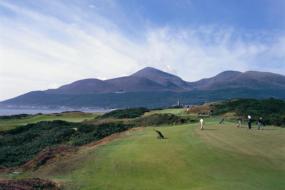
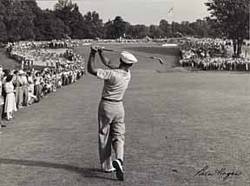
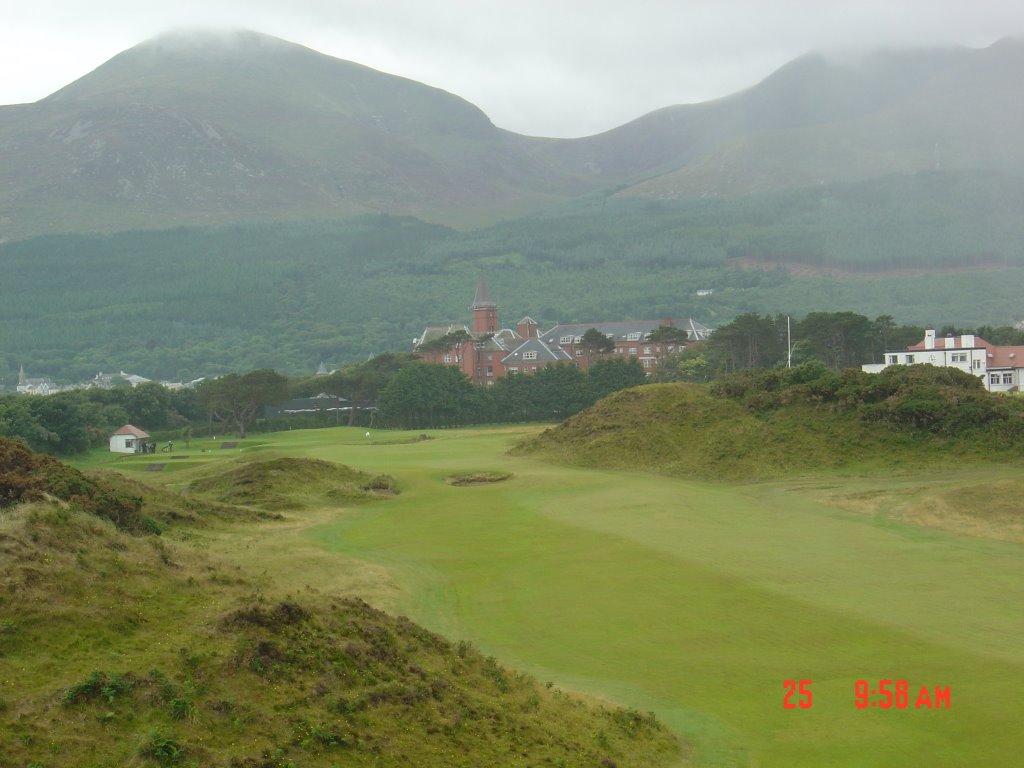
Although located in the same geographic location, the courses have two different personalities. Royal County Down (ranked #10 in the world) is blessed with natural beauty that ranks it among the best in the world for sure. As a backdrop, there are the impressive Mourne mountains which rise up several miles inland and frame the entire area around the course. The course is located on the Irish Sea right next to a lovely beach. Finally, the heather and gorse on the course add to the scenic beauty, but make it quite difficult. If you have the opportunity to play the course when the gorse is in bloom in the Spring, do so. The pictures above and below show the mountains by the sea at County Down.


I have written before that walking up the 9th fairway at Royal County Down is among the most satisfying experiences in golf. Not only do you have a full spectrum of color in all directions, the church steeple rising above the town of Newcastle is on the horizon; the sea is on your left; and the quaint white clubhouse sits in front of you.

The clubhouse at Royal County Down is an understated affair that appropriately befits its Royal patronage. For an American, I always find it quaint to see a picture of the Queen, hanging out of respect. At County Down it is hanging in the bar area that overlooks the course.

Royal County Down was originally designed by Old Tom Morris and was revised by Harry Vardon and still has an old world feel to it. The front nine is the better of the two nines. The back has a weak finish, especially the 17th which is completely out of character with the rest of the course. Imagine how good the rest of the course must be if it ranks this high in the world with 3-4 weak holes. There are many holes on the course where you must hit the ball straight and 200+ yards to carry either a green or a fairway. The 4th hole, a par 3 is one of the most intimidating tee shots you will ever face on a one shot hole. You must hit the ball about 200 yards over a sea of dense gorse. Being short is not an option, since gorse bushes have prickly branches that make retrieving a ball impossible.

There are a couple of blind tee shots where you have to aim over a colored stone placed on a hill. Personally, I like blind shots and for those who think they have no place in golf, I would comment that many courses on the top 100 list have blind shots - including some of the best: Pine Valley, The National Golf Links, Lahinch, Cruden Bay and Muirfield.

If you're not on your game at Royal County Down it will be painful. I have played Royal County Down twice - once in 'fine' conditions as the locals call it and the second time in windy, rainy and cold conditions (in July). Even in miserable conditions it is easy to see that it is a great golf course. I enjoyed both rounds immensely. It is one of the toughest championship links at 7,167 yards from the tips.

Located in County Antrim not far from the Bushmills distillery is The Royal Portrush Golf Club (ranked #12 in the world). The course has been changed several times since its inception, most recently by H.S. Colt. Colt is unquestionably one of the finest architects who ever lived and I personally rank this as his finest effort ahead of Muirfield, Sunningdale and Wentworth (Pine Valley excepted since he only influenced the work of Crump). Along with Carnoustie and Pine Valley it is one of the most imaginative routings in the world. It has a good variety of holes and is challenging.

Portrush hosted the 1951 Open Championship and is worth of hosting one again. Like Royal County Down it does feature a weak finish but again makes up for it on the first 16 holes. The aptly named "Calamity" hole is a demanding par 3 where a sliced ball disappears into a chasm. Look closely at the image below and you can see the green faintly in the distance to the left. The picture is from the tee.


I always advocate taking a caddie for any round of golf if they are available. I especially like caddies in Ireland and Scotland for their wit, humor, wisdom, perspective and charm.

The last time I played Royal Portrush I had a world-class caddie. On one approach shot to the green he told me to hit the ball 150 yards. I was thinking maybe play it an extra 10 yards longer and asked "what if I hit it 160?" His answer I remember to this day - "There's no flag at 160!". This perfectly sums up the best of Irish caddies. They may not be Oxford educated but they have tons of wisdom and dispense it succinctly. If I played with him all the time, I'm sure my handicap would be five points lower.

Each hole at Portrush has a name, and you can only imagine what playing the hole called "Purgatory" is like.There are several holes at Portrush that border on the Irish Sea along the famous Causeway Coastline. The coastline is dramatic and falls away quickly to the sea creating some stunning views. They are nicknamed "The White Rocks" due to their color.

I first visited Northern Ireland in September 1998, not long after the deadly Omagh bombings. Never-the-less, the country did not have a police-state feel to it. There were no border crossing checkpoints or obvious problems. The only noticeable differences to the South are better roads in the North and the police stations look like fortified bunkers with barbed wire. Today, you will still see an occasional IRA or Protestant mural painted on the side of a building. Otherwise, the reality is it's very much like the Irish Republic to the south from a golfers standpoint.

My hope is that both courses remain forever in the top 15 in the world rankings where they belong.

Sunday, March 05, 2006

A Message From the Creator

It was with great interest that I read George Peper's article in the March 2006 issue of Links Magazine. Peper was the editor of Golf Magazine when it launched the original top 100 world rankings. Thus, it was Peper as much as anyone who can claim to have created what is now a mania. The article is basically Peper's equivalent of going to confession.

His comments are not to be dismissed since he is a thoughtful observer of the golf world. There does seem to be an obession among developers and designers to get a course into the top 100 rankings. We agree that actively courting raters and trying to influence the outcome is wrong. It remains to be seen how the longevity of many of the new entrants onto the list will survive long term, especially some of them built to have host major championships. Peper says "Egomanicial developers now say, 'build me a top 100 course no matter what it costs." Hmmm. Sounds like a certain New York based developer we know who has bad hair and who finally bought his way into the top 100 with Trump National at #87. Luckily, we are playing the 2003 list so don't have to play it. No doubt it will be off the list in three or four years anyway.

I agree with Peper that it has gotten stupid. So you buy your way onto the list or onto a major championship. The past is littered with courses no one has heard of that hosted one major in the past: Anyone remember Champions Golf Course in Houston, host of the 1969 US Open or Pecan Valley in San Antonio, host of the 1968 PGA?

One of the other problems with having all these new made-for-major courses appear on the list is that you risk pushing off some truly world class courses. It would be a shame if some of the hidden gems on the list such as Cruden Bay, Ganton or Woodhall Spa were someday displaced by all these new designs. The history of the game is important and should be respected. There needs to be a balance between older courses and newer courses and it seems to me that the balance is shifting toward newer, which isn't necessarily a good thing.

For those who have read my write-up of the Fishers Island Club the quote from one of their spokesman is perfect (see our January 2006 archive by clicking here: Fishers Island). At the end of the article, Peper lists the 10 most over-rated courses in the world. This is his list, not mine. Although I agree with him precisely on Muirfield, Baltusrol, The K-Club and Royal Troon. I would have to disagree about Pinehurst and Pine Valley, though.

I also accept his criticism of people who are "conspicuous course collectors". Bless me father, for I have sinned!

Below is the article as published:

Hey, it seemed like a good idea at the time. The magazine got great publicity and sold more ads and copies, and I was proud of our biennial list, the first to rank courses from one to 100. Over time, however, I came to realize I’d created a monster.

“You’ve done our club a tremendous disservice,” Pine Valley president Ernie Ransom told me after we pegged his course as No. 1 in the world. “Everyone wants to play here now, and 99 percent of the requests can’t be granted.” Indeed, clubs like Pine Valley, Cypress Point and Seminole—ultra-private enclaves that had long flown under the radar—suddenly gained rock-star status, with their exclusionary practices bared for the world to see. Some didn’t handle it well.

“We do not wish our course to be ranked, visited or for that matter, known. Please convey that message to your panelists,” said a representative of Fishers Island, the remote and remarkable Seth Raynor course accessible only by ferry from New London, Connecticut.

Others milked their status and bilked their visitors. The best example is surely Pebble Beach. In 1980 you could play there for $50. Now it costs $450, and I can’t help thinking that about $150 of that is attributable to Pebble’s position among the world’s top handful of courses.

Among today’s golf architects, getting a course into the Top 100 (on either GOLF’s “Top 100 Courses in the World” list or Golf Digest’s “America’s 100 Greatest Golf Courses”) is what winning a major is to a tour pro in terms of prestige and marketability. Egomaniacal developers who once said, “Build me a great course,” now say, “Build me a Top 100 course, no matter the cost,” knowing that a sufficiently grand creation will buy a gander from the judges. As an absurd consequence, course designers have become multimillionaires and multimillionaires have become course designers.

Among golfers, we’ve seen the spawning of a new species: the conspicuous course collector, whose life mission is to play as many of the Top 100 as possible. Then there is the subspecies, the conspicuous club joiner, who collects Top 100 memberships as if they were bag tags—which essentially they are.

This wretched excess would be harmless if not for two problems. First, the lists are inherently flawed. No matter how experienced and knowledgeable, a selection panel will not—cannot—get the ratings right, simply because there is no “right.” Rankings are no more than a collective guess, an objective average of subjective opinions.

The magazines do their best to screen raters; GOLF vets candidates by asking them which courses they’ve seen from the current ballot. My recollection is that the minimum standard is 55 percent of the World list and 40 percent of the courses on the ballot. The problem, of course, is that there is no way to verify whether candidates have actually visited all the courses they claim.

The GOLF panel is small and elite—fewer than 100 people—to keep the levels of knowledge and discernment high. The risk is that they don’t see enough courses. The group includes golf course architects—among them Tom Doak (who ran the rankings until his design career presented a conflict), Pete Dye, Jack Nicklaus—under the theory that they are the most perceptive judges. There is a stipulation that they may not vote for their own courses, but I’m not sure that does the whole job.

My suspicion always has been that competitive instinct compels architects to give low grades to each other’s courses, to the benefit of Donald Ross, Alister Mackenzie, et al., who are not competitors for contracts. Nicklaus once asked me why more of his courses weren’t on the list. (At the time, he didn’t realize his votes for his own courses didn’t count.) “It’s partly because we have people like you on the panel,” I replied.

The GOLF panel also includes public relations execs, resort owners, tour operators, photographers, writers and others with close links to courses. The last I knew, all these conflict-of-interest votes counted. I have little knowledge of the Golf Digest panel, except that it includes more than 800 low-handicap golfers, whose identities, unlike GOLF’s panelists, are kept anonymous. With a group that size, some raters inevitably will be more knowledgeable and responsible than others. I’m also not sure whether all low handicappers may be able to judge the capacity of a course to be enjoyed by all levels of player. But the aspect I’ve always questioned is their ultra-anal grading system. Whereas GOLF simply asks panelists to rate each course from A to F, using his or her own definition of greatness, Golf Digest requires a grade from one to 10 in eight different categories. I can assure you that giving even a single mark to several hundred courses requires a fair amount of concentration. I can’t imagine filling in several thousand boxes, at least not with any sustained diligence and accuracy. It’s no wonder the rankings are a source of constant consternation to the magazines.

Over the last two decades Golf Digest has tweaked its methodology more often than Katie Couric has changed her hairdo, and GOLF quietly began a wholesale re-evaluation of its ranking system recently.The second weakness of the rankings is more important. The magic number—100—is simply too small. There are more than 30,000 courses in the world; to celebrate only 100 is ludicrous. Hell, there are 100 great courses within a three-hour drive of Manhattan! As a consequence, countless courses have gone without the recognition they deserve.

I’d like to repair the mess I’ve made, but I don’t really see a solution. I could rank the 100 most underrated courses, but the moment that list was published, those would no longer be the 100 most underrated. All I can do is try to figure out why some deserving courses miss out, and give a kiss to a few of the fairest bridesmaids. I can think of six reasons that great courses are ignored. The first three, as in real estate, involve location.


The 10 Most Overrated Courses in the World

1. Pinehurst Resort & C.C. (No. 2), Pinehurst, N.C. Sorry, those greens are borderline Goofy Golf.

2. Royal Melbourne G.C. (Composite), Melbourne, Australia. The ranked course is a composite of two 18s that no one plays.

3. The Country Club (Composite), Brookline, Mass. Same situation—a composite used only for major tournaments.

4. Muirfield Golf Club, Gullane, Scotland. A fine, straightforward test of championship golf—
and utterly charmless.

5. Baltusrol Golf Club (Lower), Springfield, N.J.
America’s Muirfield.

6. Augusta National Golf Club, Augusta, Ga. If it’s so great, why do they change it every year?

7. Pine Valley Golf Club, Pine Valley, N.J. Superb, but not No. 1—too many holes where you don’t see a tee shot land.

8. Royal Troon Golf Club, Troon, Scotland. Six dull holes—six interesting holes—six dull holes.

9. Seminole Golf Club, Juno Beach, Fla. Elite membership, world-class locker room, typical Florida golf course.

10. The K Club, Straffan, Ireland. Dublin meets Doral.

Thursday, March 02, 2006

The Observations of One Who Has Completed The Quest

The following was published by Golf Magazine in 2005:

100-Course Meal

One GOLF MAGAZINE reader made it his mission to play every course on our Top 100 in the World. Then we changed it on him!

By LISA TADDEO Editorial Assistant, GOLF MAGAZINE

At 3 P.M. on April 26, Leon Wentz, a 68-year-old California businessman with a 10 handicap, putted out on the final green at Augusta National for a round of 85. It wasn't his best score on a great course, but it was an achievement nonetheless -- with that round, Wentz had played all of the courses on GOLF MAGAZINE's Top 100 Courses in the World. From backtracking to faraway countries to keeping clear of falling monkeys, Wentz braved a lot to play them all. We asked about the highs and lows of his globe-trotting quest, which began at Pebble Beach in 1996.

Playing the Top 100 Courses in the World is a fantasy for most golfers.

What made you do it for real?
I was flipping through GOLF MAGAZINE, saw the Top 100 World list, and thought, "Now, here's a challenge!" I asked my wife if it would be okay if I made this my chore for the next few years, and she said to go for it. I lost 11 courses because of the list changing. For example, I had to go back to New Zealand three months ago to play one that came up on the last list. I wanted to play the current list, not an old list.


What were some of the adventures along the way?
I traveled 28,000 miles to South Africa for one course. I had to network for three years to get on some private courses in Japan. I've had monkeys fall out of trees onto my tee box, snakes cross my path on the fairway.

What was the best course?
Shinnecock Hills was pure golf. It was the best for me.

The most overrated?
El Saler in Spain, Winged Foot East, Paraparauma Beach in New Zealand.

How about the friendliest?
Ganton, in England. The people were beautiful and I had the greatest time.

Which course would you most want to join?
Shinnecock.

Which course would you never play again?
El Saler. No offense to your panel, but it's just not a world-class course. There are only two holes that justify its existence on the list, and it's not even well-conditioned.

What were your best and worst rounds?
Best was at Quaker Ridge, I shot a 74. Worst was at Pine Valley, I had a 90.

What's the toughest course?
Pine Valley, for sure.

And the most beautiful?
Cypress Point.

What's the hardest course to find without a member guiding you?
Morfontaine in France.

Which one has the best bar?
Jefferson's Bar at Shinnecock.

What was your longest journey to play a course on the list?
28,000 miles round-trip from San Francisco to Durban, South Africa.

What was the worst weather you experienced?
I used five gloves at Lahinch. Four inches of rain fell in four hours.

Saturday, February 25, 2006

Sunningdale Golf Club


Located right down the road from the Wentworth Estate in Ascot, Surrey, outside of London is Sunningdale, one of the world's great golf courses. Sunningdale Old (ranked #44 in the world) was designed by William Park Jr. in 1901 and was tinkered with over the years by H.S. Colt who served as the secretary at Sunningdale for many years. Once you are inside the electronic entrance gates, you are in an oasis. The clubhouse, locker room, pro shop and property have a good feel to them and the course has an intangible quality that gets the adrenaline going.

Sunningdale has scenic beauty to stack up against most of the world's best. It achieves a high ranking in the world without being located near the water and without having hosted any Open Championships. The terrain, sand, birch trees, heather, gorse, pines and water come together beautifully to create a unique environment. Heathland courses such as Sunningdale were developed due primarily to the underlying land's resemblance to seaside links courses. Sandy soil, the absence of mud in the winter and good drainage. Most of the area around London has a clay base and thus is not ideally suited for golf. The exception is the Surrey heathland where Sunningdale, Wentworth and Walton Heath are all located.

The course starts with a relatively easy par five opening hold with an O.B. on the right bordering the roadway. After you putt and to to the 2nd tee box you are in peaceful isolation for the rest of the round. I would imagine some people wouldn't like Sunningdale because it has some blind shots and several short holes. The stretch of holes beginning at the 5th and continuing to the 8th are as good a stretch of holes as you can find on any golf course. What makes them good is the risk/reward nature of them combined with their natural beauty. They are a cross between strategic design and penal design that works. As you play Sunningdale you are reminded as much as anything of Pine Valley. You can see the similarities between Pine Valley and Sunningdale throughout the round. This is not surprising given Colt's influence on the design at Pine Valley.


Sunningdale Old 10th hole


Sunningdale was built at a time when it was not in vogue to actively move terrain. Willie Park, Jr. is an important architect in the history of golf. He was the first to move earth to create raised greens and thus Sunningdale is an important historic course in addition to being so spectacularly beautiful. The old course follows the natural contours of the land brilliantly. This type of design principle has largely been lost on new courses, especially in the top 100 courses designed by Pete Dye and Tom Fazio. We are optimistic that architects such as Tom Doak (Pacific Dunes, Barnbougle Dunes) and Kyle Phillips (Kingsbarns) represent a new breed that are returning to this brilliant, traditional design style. I also liked the use of bunkers 60 to 80 yards from the green which make for a difficult up and down if you are in them. His mixture of long holes, short holes, uphill and downhill is the ideal combination. The 277 yard 9th is another very good example of a risk/reward hole with an extremely large green and bunkers short of the green for those that try to go for it from the tee.

Aside from a world-class golf course, Sunningdale also has a very strong Bobby Jones history. It was on Sunningdale Old during an Open Championship qualifier in 1926 that Jones shot what was described as a perfect round. The standard scratch score on the course at the time was 75. He shot a 66 with a 33 on the front and a 33 on the back. He had 33 full shots and 33 putts. The highest number written on his scorecard was a four. This feat is even more incredible if put into its proper context. He was using hickory shafted clubs and a golf ball that was nowhere near those of today's standard. On ten holes he hit his shot to the green with a two iron or a wood. The more I learn about Bobby Jones, the more I see why he is a golf legend.


Sunningdale's 8th hole

One of the problems I am finding writing this blog is that it is difficult not to repeat superlatives again and again. Any course that has made it onto the list has fine attributes (although Royal Troon only has one) and it is easy to wear out words like great, special and best when describing them. Sunningdale not only has all the attributes necessary for greatness but combines them all together into a package that makes it world class. I have been very lucky indeed thus far in my attempt to play the top 100 courses in the world. It is exposing me to experiences and places that are very privileged and special. Sunningdale has a very healthy attitude regarding visitors who will respect their rules. We wish more of America's private clubs would open up a bit more and allow visitors to share some of the world's great courses. I was fortunate to play Sunningdale on a nice crisp Fall day with the temperature in the high 50s. At the risk of over-using superlatives: I have had few finer experiences than sitting in the Sunningdale clubhouse after the round of golf with a pint of Guinness reflecting back on a brilliant days golf.

Sunningdale is a special place.


Sunningdale's home page

Wednesday, February 22, 2006

Cruden Bay Golf Club

At several of the top 100 courses I have played, I've been disappointed upon seeing the course for the first time. St. Andrews, Carnoustie and Hoylake fit into this category. Not to say they are bad courses, quite the contrary, but when you first look at them they look flat and dull.

The anthesis of this is Cruden Bay (ranked # 76 in the world). When you drive into the parking lot for the first time you are simply stunned. Below you in a valley is set a collection of massive sand dunes. Among the dunes weaves a golf course bordering on the North Sea. Not any golf course, but a golf course that you will probably have more fun on than any other course you've ever played. Cruden Bay is located along the Aberdeen coast of Scotland about two hours drive north of Carnoustie. If there was ever an apt description of the term hidden gem, then Cruden Bay is it. The golf writer James Finegan says of Cruden Bay: "Outsized, non conformist, unpredictable and flamboyant".

In the world of golf there are much stearner tests such as Carnoustie, Oakmont and Olympic. Muirfield, Merion and Shinnecock are more historic. Turnberry, Pebble Beach and Kingsbarns are more scenic. But for pure fun, Cruden Bay cannot be beat. The course defies being pigeonholed. So far I have developed some broad classifications that courses have fit into as I'm playing the top 100:

1. International/National membership courses - Pine Valley, Loch Lomond, Cypress Point and the ultimate: Augusta. These clubs transcend their geography.

2. Historic courses - Merion, Chicago, The National, Lahinch

3. Championship courses - Generally all the courses on the British and U.S. Open rotations

4. The ultra-wealthy and low-key clubs - Maidstone and Fishers Island

5. The heathland courses - Ganton, Sunningdale, Wentworth, Woodhall, Walton Heath

6. The new school - Kingsbarns, Pacific Dunes, Bandon Dunes

7. Those that honor greats in the game - Muirfield Village (Nicklaus), Colonial (Hogan), Pinehurst (Ross), East Lake and Peachtree (Bobby Jones)

8. Pete Dye Courses

9. Courses designed by legendary designers - Quaker Ridge, Prarie Dunes, Camargo, Southern Hills

10. Courses designed by Alister Mackenzie

Cruden Bay doesn't fit neatly into any category. It is a truly unique location and a one of a kind golf course. Golf at its simplest is a game. Over time, you can lose sight of that as you get more competitive in matches; try to beat your personal best; try to tinker with your game or perfect your swing.

I found Cruden Bay to be a refreshing and enlightening experience. The point of golf after all is to have fun and enjoy yourself. Cruden Bay would be ranked #1 in the world if you used this as your only measurement criteria. It makes you see golf like through the eyes of a five year old. If you haven't been around a five year old lately I'll remind you: everything is exciting; there is a sense of discovery around every corner; life is good and full of promise.


I've spoken to a lot of well traveled golfers and it's no surprise to me that almost all of them rank Cruden Bay among their personal favorite courses. To be sure, Cruden Bay is quirky. There are a lot of blind shots; there are back to back par threes; some really short par 4's including one that is 258 (the 8th hole plays uphill); the course is only 6,300 yards long. You hit out of valleys up onto the tops of hills and then down into them. There are times when the Cruden Bay landscape almost seems lunar and surreal. On the 10th tee box if you look north over the beach and ocean you can see the ruins of a castle. Slains Castle provided the inspiration to Bram Stoker when he wrote Dracula. It is all truly unique and brilliant fun!

The course is located in a rather isolated location away from any real population center and as a result the members serve as caddies for visitors. The are a very welcoming and friendly group who are happy to share their wonder of the golfing world with visitors. As an added bonus I recommend staying at the Udny Arms located in nearby Newburgh. A family owned B and B, it is cozy and inviting. Being isolated you might assume they would serve basic meat and potatoes fare. In fact, the food is world class. The bar areas are cigar friendly and the wait staff makes you feel at home. Don't expect American size rooms or 200 channels of cable television. As is typical in Britain the amenities are basic, the showers are tiny but there is a facility to make a cup of tea in each room. It is one of my favorite places to stay in the world.

The first time I saw Cruden Bay was on a golf trip with eight of us touring Scotland. This was prior to my now obsessive quest to play the top 100. We were so enamored with the place that on the spot we changed our plans to stay an extra day so we could play the course over and over again. On every trip to Scotland I try to play Cruden Bay.

Cruden Bay's home page:

Friday, February 10, 2006

Merion - The Vatican of Golf


Most major cities have their well healed suburbs - in New York Greenwich and Darien. In Chicago, the communities along the North Shore of Lake Michigan. In Philadelphia, the affluent leafy suburbs are known as The Main line. Named after the train line west of the city, the Main Line is old world, understated and rich. Merion is located in the heart of Philadelphia's Main Line and plays the part well. The land the course and clubhouse are on trace their title back to William Penn.

Memory is not one of my strengths. One minute after meeting someone I don't remember their name. Many times I have had to look at the bag tag of the member I'm playing with every three holes to remember his name and not make a complete fool of myself. And, I have gotten very good at not saying names. "Nice shot" instead of "Nice Shot, Dave", in case his name is in fact Bob.

There is, however a part of my memory that works very well when it sees greatness. I have found that the mark of a truly great course is how well you remember it both immediately after a round and six months later. Using this measure Merion is a truly great course. After playing it once I could describe every hole in detail. The shape, terrain, bunkers, doglegs, green contours, etc. At Pebble Beach you sort of feel compelled to like the course because it is so pretty and everybody raves about. But, if you're being honest with yourself, aside from the 18th hole, can you visually remember all 18 holes at Pebble? I'll bet you can't. Merion is seared into my memory. So far this has happened to me on only three courses in the world: Merion, The National Golf Links of America and Cruden Bay.

What makes Merion so memorable? It is the ultimate strategic golf course. It is not a terribly long course. First, you have to hit the fairways or it will be a long day. Second, you have to be on the correct side of the fairway in order to have a decent shot at the green. And finally, you have to be on the correct part of the green or you're in three putt territory. On every green. Also, the shot variety is really good as are the changes in direction, doglegs and uphill/downhill shots. No monotomy here. As if the golf course itself is not good enough (and it is) you also have the grandeur and majesty of the clubhouse and the Bobby Jones history. When you play the 11th hole, where Jones won the Grand Slam, you have chills up and down your spine. I have, on the half dozen times I've been fortunate enough to play.


If there was ever a course that new equipment has destroyed it is Merion. It is too bad that the U.S.G.A and R. & A. have let the situation get out of hand and length is now the primary driver of competitive golf. It would be a shame if this course is lost from major competition forever. I consider Merion to be the spirtual home of golf in the U.S. due to its greatness, its history, its association with Bobby Jones and the architecture of the course and the clubhouse.

This is the first course Bobby played a major on (the 1916 Amateur), the first course he won a major on (the 1924 Amateur) and the last course he played competitive golf on (the 1930 Amateur), completing the fourth leg of the Grand Slam at Merion in September 1930. Also, the photograph which is the golfing equivalent of the sailor on VJ day kissing a woman in Times Square was taken at Merion.

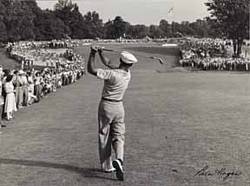
Taken by Life Magazine photographer, Hy Peskin, it shows Ben Hogan hitting a one iron on the 18th hole in the 1950 U.S. Open. It is an iconic picture of this great player at one of the most historic of courses in a perfect finish position. Hogan almost stopped playing during this final round because he was in such a state of fatigue recovering from a near fatal car accident the year before. Hogan hit the one iron onto the green and made a par to qualify for a three man playoff the next day which he would go on to win. It is one of the most heroic finishes of all time.

Merion has many unique characteristics: the red wicker baskets as flags, the bunkers with clumps of grass in the middle (known as the white faces of Merion) and the scene around the first tee. You tee off right next to the outside patio with members and guests about five feet away from the tee box. It is one of the best opening holes in golf. The view in all directions is impressive, the clubhouse building with its white-washed stone and porch, the green awnings, the mature trees, the wicker baskets. Merion also still has what has unfortunately become a rare entity in American golf: Experienced caddies, and lots of them. The clubhouse, which is listed on the National Register of Historic Places is the golfing equivalent of St. Peter's. Also, like the Vatican, Merion upholds the traditional and the conservative in the game and in many ways is truer to the traditions than the governing bodies because they don't have to compromise with the equipment manufacturers.

In the clubhouse and on the course at Merion you naturally speak in hushed tones and in a respectful manner. In sounds absurd but it is close to a religious experience. If you get invited to play Merion, by all means make the pilgrimage.

Merion's web site:

http://www.meriongolfclub.com/default.aspx

Saturday, January 28, 2006

Royal Troon


Royal Troon (ranked #38 in the world) is not one of my favorite courses. The course itself is an out-and-back layout that didn't really grab me as being that special. The Postage Stamp 8th hole is a notable exception. It is a fun, interesting and challenging hole, but otherwise I would rank Troon last among all the Open Championship courses in the British Isles. Sometimes you might not like a course because you played poorly on the day you played it. I can't blame that for my dislike of Troon. I shot the second lowest score of any course in the top 100 so far and played well. We played the course several days after the 2004 Open Championship and I played the 10th (Sandhills) and 11th (Railway) holes, which were the two most difficult in the Championship, in one under par. Since my handicap is in the low double digits, I did alright.

First I would like to go on the record and say that I respect the history of Royal Troon: formed in 1878; the importance of its past professionals: Fernie and Strath, in golf history; host to the Open Championship with Watson, Palmer and Weiskopf as winners; its Royal patronage. However, the current guardians of the course aren't exactly playing up to par.

A true measure of a club's worth is how well it treats its visitors, and Troon doesn't treat you very well. First, it is difficult to get onto; they have many rules to make it hard to schedule a tee time, which is fine. It's their course and they get to make the rules. They limit guest play to only a couple of days a week and for a short time only each day. It appears to me like they are trying to be a Muirfield wanabee, although frankly, they are not even in the same league.

In any event, I was only able to schedule a twosome instead of the full foursome that was on our Scottish trip, so we split our group in two that day. This is primarily because they lost our initial request for a reservation made 11 months in advance; I had an email confirming that they received it. They were quite snooty nonetheless about their error. So a dear friend and I made the drive over from the East Coast of Scotland to play. We had a late afternoon tee time but were scheduled to play the Troon Portland course in the morning. Unlike all other courses in Britain which let you play their championship course only (often times twice), at Troon they pretty much force you to play, or at least pay for, their shite course as a revenue raising venture. We played the Portland course in the morning and it may be the most unimaginative course every built. When they decided to build the course the mandate to the architect must have been "make every hole ruler straight with flat greens and put only two greenside bunkers on each hole." The total budget to build this piece of crap was probably 100 pounds.


The Postage Stamp hole at Troon

After our morning round we went into the clubhouse to have lunch. Our afternoon tee time was scheduled for around 3:00 and the weather was predicted to worsen as the day went on. I went politely to ask the caddy master/starter if we could move up our tee time and he said no, even though there were two-somes going out earlier. Our caddie from the morning round had warned us that he was a jerk and was known to be looking to have his palms greased any way possible. I disappeared for a short while until several members standing nearby left and then slipped him a 20 pound note and said we would appreciate it if he could help us. This was honestly the first time at any golf course worldwide where I have done this or even thought about doing it. The way they have organized the place makes it part of the decorum.

The lunch itself was a terrible joke. They put visitors off in a back room of the clubhouse and the food was pitiful. It was a bad buffet. Bad to the point of being inedible. I almost never skip a meal but did on this day. I couldn't even eat the cookies, which were stale. Although only halfway through my 100 course quest I am now declaring it the worst food to be had anywhere on the journey. Even the state-run Bethpage Black offers a better menu and more ambiance. And for that matter, the Rikers Island prison probably has better food.

How hard is it to treat guests with respect? It's not like playing Troon was cheap compared with the other courses we've had to pay for. In fact, aside from Shadow Creek and Pebble Beach, it may be the most expensive course on the list at 185 pounds. At EVERY other single course I have played in the British Isles including Royal Portrush, Royal County Down, Prestwick, Muirfield, North Berwick, Carnoustie, Sunningdale, Ganton, Woodhall Spa, Wentworth, Kingsbarns, Cruden Bay, Turnberry and Royal Dornoch I was treated well. At two of the most storied, traditional and historic courses in the world (Muirfield and Prestwick) they allow you to sit in the members dining room and have a full course meal. At many of the other courses, the meals may not be elaborate, mostly simple sandwiches to order and a bowl of soup. But at least they give a damn to see that you experience some level of hospitality and don't treat you like a second-class citizen.


Troon with the gorse in bloom on a brilliant day


Back to the golf. Miraculously the caddy master came and found us and said he could indeed get us off earlier. What a surprise! So we played the rather boring layout and were underwhelmed. As a final insult at Troon they make you play from tees that are set at about 6,200 yards. While most courses won't let you play from the tips, they will at least let you play from a reasonable set of tees. Although, given the overall tone of the place, I'm sure it's another ploy to get more money. I'll bet if you slip the caddymaster another 100 pounds you can play further back, but that's just wrong.

So in summary the charms of Troon include:

1. Poor hospitality
2. World-class pompousness
3. Having to play their shite course in addition to the old course
4. The worst food in the golf world
5. Playing from tees way up
6. Being overcharged for the experience

If you're going to play a 6,200 yard course on the top 100 list, my personal vote is to remove Royal Troon entirely from the list and replace it with either Prestwick or North Berwick which are great courses. At those historic gems, you are treated with respect and as an added bonus you don't have to eat dog food or deal with the attitude.

My unsolicited advice to the R and A is drop Royal Troon from the Open Championship rota and add back in Royal Portrush or Kingsbarns, two courses that are worthy.


Post Script


We would note that the original creator of the top 100 worldwide list and a learned golf writer, also believes that Royal Troon is one of the top 10 overrated courses in the world. George Peper's description is more eloquent and concise than mine: "Six dull holes - six interesting holes - six dull holes."


Royal Troon's web site:


Muirfield - The Honourable Company of Edinburgh Golfers

Muirfield (ranked #3 in the world) is no mere golf club. It has a name that distinguishes it from all the rest of the top courses. There is no swimming pool here. This is not a Country Club in the American sense. No kids in the pool. No tennis courts. Just golf. This is the most formal course of them all; with a name that speaks volumes about the seriousness of the endeavor. The name of the golf club is The Honourable Company of Edinburgh Golfers. The course they play on is known as Muirfield. Unless you are fully educated in the traditions of the game it is hard to appreciate how the Honourable Company of Edinburgh Golfers is different. The Honourable Company drew up the original 13 rules of golf in 1744. They are thus entitled to some amount of privilege. They were organized ten years before the governing body of golf in Britain - The Royal and Ancient. It is not like some of these newer ostentatious American clubs that try hard to give themselves history.

The Honourable Company has real history. Arranging to play at Muirfield is quite a chore. Getting on the course requires a precision in its planning closer to a military operation than booking a tee time. You don't just call and simply arrange a tee time on short notice. Such a dignified club guards their privacy and makes it difficult to get on. Most of the Open Championship courses in Great Britain aren't too difficult to get on if you plan ahead. In truth, it took several years to get a tee time at Muirfield, and even then, we had to book it over a year in advance and then built a golf trip around it. The good news is that once you get to play Muirfield they let you make a day of it and play 36 holes, provided you follow their rules. You can play your own ball in the morning if you'd like but in the afternoon you play alternate shot only.

The entry gate at Muirfield

The Honourable Company of Edinburgh Golfers does not have a professional's shop where a visitor can buy merchandise because the club has no professional. This suits them quite well since selling items would introduce an element of crass commercialism into the club that they quite suitably don't want. In fact, they really don't want visitors at all, but the prospect of charging (largely) Americans is apparently too much to resist. And we pay it willingly. It allows the members to essentially belong to the club for a low cost and invest the money back into the course. Visitors are only allowed to play on Tuesdays and Thursdays between 8:30 and 10:00 in the mornings, and then only off the tenth tee. Members and two-balls play off the first tee. They have a very distinct hierarchy of play and it must be adhered to. Tee times are arranged through the Secretary of the club. Secretaries at Muirfield are legendary. Many have been former military commanders and thus they have a great deal of respect for rules and structure. Although the Secretary is appointed by a committee of the members, Muirfield Secretaries have traditionally behaved like it was their course. In their defense, they are trying to maintain order and structure.

You have to be cautious when requesting a tee time not to overdo it. Like courting a woman, you have to go slow and judge each step carefully. Overdo it and you are shut out. Follow their protocol closely and look carefully for clues to get you to the next step. Booking a tee time is more like a master chess game. One previous Secretary was known to use binoculars to monitor the golf course for any infractions. From his office, he could see most of the course. It is said that if you didn't rake the bunkers, he would be watching you and you would be reprimanded when you finished the round. It was something that all members feared. Members of Muirfield are important and powerful gentleman. They are leaders in the business community, the legal establishment, the government and the military. Yet, they all fear the Secretary of the Club. There is another famous story about a Secretary at Muirfield where a group of non-members appear at the course one day. They are publicly recognizable figures, quite distinguished in their field. They ask for permission to play. The Secretary looks over the obviously deserted course and then replies that it would be impossible for them to play because the course was too busy.

It is against this backdrop that you try to get on to Muirfield. It is no ordinary course to get on. In any event, we had booked our tee time, and as luck would have it, it was on my birthday. As soon as you get a date reserved, I suggest calling the Greywalls hotel, which is immediately adjacent to Muirfield. It fills up quickly so you should book it right away since they don't have that many rooms. The Greywalls Hotel is symbiotic with Muirfield. Originally an Edwardian manor home for the Weaver family it was converted into a hotel in 1928. Since it was still affiliated with the aristocracy they provided it with a measure of privilege that has long been a tradition in Britain.

Greywalls Hotel


To let you in on one of golf's great secrets, we learned while staying, that on Monday and Friday mornings there are an undisclosed set of tee times that are given to select guests of the Greywalls. The Greywalls and Muirfield are hard to tell apart. There is even a secret doorway that connects the Greywalls to Muirfield. You can walk directly out the back door of the Greywalls and through a discrete and un-assuming door right into the clubhouse. You can see the Greywalls on TV when the British Open is held at Muirfield. It is right off the 10th tee. It effectively serves as a high-end dormy house for Muirfield. The walk from the hotel courtyard to The Honourable Company is less than 100 yards. It was with great anticipation that we traveled south from St. Andrews to play Muirfield. As you are leaving the village of Gullane on the A198 traveling South you have to know where to turn left or you will not find Muirfield. You turn left onto Duncar road, yet there is no sign.

Once you get the invite to play, you are informed of the situation and you are told where to turn. It looks like an alley-way or a service road. You have no idea you are next to one of the greatest golfing Meccas in the world. Once you make the left, you enter a road of about 500 yards in length. A sign halfway down the road warns you to turn away if you have no business related to the golf course. It doesn't say which golf course, as they don't want to give any clues so as to keep away the curious. You don't know it yet, but you are also being watched on a security camera. Slightly further down the road on the right side of the road, hidden behind tall hedges are covered parking stalls. There are four small buildings hidden into the landscape. Car parks. Very discrete. It is befitting the majesty of the place not to have open car parks that would ruin the atmosphere.

If there is a polar opposite to the public parking lots of a municipal course such as Bethpage, this is it. The extravagance of the parking lots tells you a lot about what is to come. About 100 yards further down the road are the discrete yet majestic stone entrance gates to the Greywalls. As you turn into the Greywalls, the crushed stone underneath the car adds to the feeling of grandeur. Once through the main gate you enter a courtyard with a further set of narrow stone gates that lead you through to the final entrance. Our foursome awoke early the next morning. We had a full Scottish breakfast and were off for the short walk to the club.

You approach the Muirfield gates and again notice a warning sign to step away if you have no business at the course. The black entrance gates are imposing and convey the appropriate sense of decorum. You unlatch a small gate and you enter on foot. You can't see the security cameras that are watching you, but you are being watched. You walk in and immediately see the first tee on the left, guarded by the caddy master. The course unfolds in front of you in a straightforward manner. The front nine forming the perimeter and organized in a clock-wise fashion. The back nine running counter-clockwise inside the back nine. And you begin to see the beginnings of what makes Muirfield so difficult - its bunkers.

There are no cameras or cell phones allowed on the property. The members jealously guard their privacy and their course. Ladies may only play if accompanied by a gentleman player and may not lunch in the Clubhouse. You are required to arrive at Muirfield in a jacket and tie. You walk past the clubhouse and into the drawing rooms, smoking rooms, etc. You are greeted as you walk by an Assistant Secretary who escorts you to the appropriate place within the clubhouse. You leave your bags outside the entrance and enter a foyer with an office on the left. Glancing in (you have to be careful not to stare) as you walk by you see one of the most imposing sights in golf: The desk of the Secretary of the Club at The Honourable Company of Edinburgh Golfers. It is a desk befitting the position.

As imposing as anything you would see at #10 Downing Street or the Oval Office. After you pass the Secretary's desk you come to a hallway that ends. To the left is the locker room, to the right a reception window and further on a smoking room and dining room. You stop at the reception window and have your credentials checked. Not unlike going through the customs process. No idle chit chat. No time for one-liners. Keep a somber look on your face and speak only when spoken to. You present your credentials in a business-like manner when you are asked. You must offer proof that you are worthy enough to play at the H.C.E.G. Your home golf club has previously provided a letter of attestation that you are not an inexperienced golfer off the street. You present your handicap cards and certificates to the women behind the counter. She verifies it against her log sheet to verify who you say you are. No computer generated lists here. A manual log, written in perfect script lettering. No substitutions allowed. You show up with the four golfers whom you said would play with or you don't play. No singles, no three-somes. You do as you are told and you're happy about it. After being checked in you proceed to the locker room and change into your golfing attire. At the appointed time you proceed to the tenth tee and meet your caddies. Four balls (as a group of four golfers playing their own ball is properly called at Muirfield) proceed off the tenth tee only. The standard game at Muirfield is foursomes.

Foursomes is a format where four golfers play with two balls only, alternate shot. The Honourable Company plays this format both because of tradition and because it is efficient. You can get a group around in two and a half hours. After we played the 10th hole (our first) we were about to tee off on the 11th when our caddies became very flustered. Since we were the second group out that day, we were fortunate to have seasoned caddies. One of our caddies had noticed that the group behind us was four women. Women are not allowed to play without a gentleman at Muirfield. Their husbands were behind them on the 10th tee, planning to play as a group. 'If the Secretary sees this he will throw both groups off the course and fire the caddies', 'This is shite', 'No, No, No', were among the more polite things the caddies said. True to tradition, our most senior caddie went up to the group on the 10th green and made them split up. They had to mix up the two groups so that women were accompanied by men. At Muirfield, a rule is a rule.

After completing the morning round we proceeded into the locker room and changed back into jacket and tie to make our way to the member's dining room for a proper lunch. Although the Scots are more properly famous for their full breakfast, lunch at the Honourable Company is an experience in indulgence. The dining room is oblong in shape and contains a series of long slender tables where you eat cafeteria style, although this doesn't capture the appropriate sense of decorum. It's rather like the prep school dining hall seen in the Harry Potter movies. Only with a lot more class. At the end of the room are giant glass windows overlooking the course. The walls are lined with pictures of every past captain of the Honourable Company.


Muirfield's sixteenth hole

The food is organized into five distinct sections, each representing a separate course: drinks and spirits; soup; carvery; cheeses and sweets. You sit at the galley tables and gorge yourselves. The room is quite steamy as the water baths from the vegetables and heat lamps from the carvery exude their heat. You wouldn't dare take off your jacket or loosen your tie for fear of being scolded. No matter how hot it gets, and it gets hot, you remain calm. Stiff upper lip. Never let them see you sweat. It is the custom at the Honourable Company of Edinburgh Golfers that the captain of the club wears a red jacket. Much like you see a member of Augusta wearing their green jackets, at Muirfield, the tradition is old. The tradition evolved from when they originally played at Leith Links. At that time, all members had to wear their red jackets or could be fined. It subsequently evolved into only the captains wearing them. After lunch we retired to the smoking room and sat in sumptuous leather chairs, again overlooking the 18th green.

You sit and have more drinks and enjoy cigars and appreciate the splendor of both the room and the scene outside. At the far end of the room above the chimney piece is a painting of William St. Clair of Roslin painted in 1771. It is the centerpiece of the room and is sized proportionally for the large space. It is about 20 feet by 30 feet, painted in oil. William St. Clair of Roslin served as Captain of the Honourable Company of Edinburgh Golfers in 1761-1766, 1770 and 1771. The portrait reminds you more of a portrait of Mozart or George Washington than it does of a golfer. This is clearly a portrait of the 18th century. As you think that members of the Honourable Company were playing golf here before the time of the American revolutionary war, the history of the place begins to bear down on you. You don't need to be told about tradition sitting in this room. A moron could figure it out. Even most Americans. Mounted and framed in the smoke room they have a copy of the original thirteen rules at the club. Framed on the wall is also an original membership certificate for a member of the Leith Links, a predecessor club to Muirfield.

The Honourable Company of Edinburgh Golfers is the name of the golfing society that has been in existence since 1744. The Honourable Company originally played at Leigh Links until they outgrew it. They then moved to Musselburgh, but soon outgrew that as well. Their third course is Muirfield and they are justifiably proud of their heritage. Once you complete your relaxation you are back into the locker room to change back into your golfing attire and then you are off to your afternoon match. You are allowed to play your afternoon match off the first tee. The mandatory format is foursomes.

As was typical given the unstable state of most golfers after the big lunch and drinks, so it was with our group. The first two shots were nowhere near the fairway and ended up in the knee high rough. The alternate shot format we played turned out to be one of the most fun and rewarding golfing experiences all four of us has ever had. What a great tradition. It is a shame that is has largely been lost.

Muirfield's finishing hole

And oh yea, the course was ok. Nothing spectacular when compared with dozens of other top ranked courses. Certainly, the bunkering is a defining characteristic. The scenery is honestly kind of bland; none of the holes are that memorable. You're not that close to the water. But the overall experience is one of the best you could have in golf. The history, tradition, respect, etc. In terms of the golf course itself, does it deserve to be ranked #3 in the world? Certainly not. But when you throw in the whole scene, you can begin to understand its esteemed place in the world of golf. And while I normally don't like to recount shots and scores, I am particularly proud of my birdie at the #1 handicap hole. The eighth is a 443-yard, difficult par four dogleg with severe bunkering. It's Jack Nicklaus's favorite hole on the course, and now mine. I couldn't have asked for a better birthday present.