Sunday, May 31, 2009

From the Rough - Another view of Valderrama

As one of the traveling companions with the blogger, I feel compelled to write a rebuttal to the above, well-written but misguided review. I appreciate and respect the author’s unbridled enthusiasm of his review of Valderrama. I too had that enthusiasm as we pulled into the resort and golfing complex. When there is an individual in uniform controlling the entrance gates to approve (or disapprove) of your playing privileges, you usually are in for a special day. And once inside the gates of Valderrama, you truly believe something special lies ahead. The place is immaculate. It feels like hallowed ground. History was made here. And history will probably be made here again. In short, before you put a tee in the ground, the excitement level is high.

It must be noted that my blogger colleague and I did not play in the same group. He was invited to play with a special, elite traveling group. I played with the third member of our trio of friends, each of whom is on a quest to play the world’s top 100 courses. My golfing partner and I flew into Madrid the day before and drove almost 10 hours south to Spain’s southern coast. Spain is a beautiful country – it is very dry and much more mountainous than ever imagined. Our drive took us through the city of Granada, which is home to the famous Alhambra palace. What shocked us most about Granada was the snow capped mountains that framed the city. These are the Sierra Nevada mountains, not unlike the Sierra Nevadas found in this country. Another highpoint of our day-long trip were the roads in Spain. They are real and spectacular. Perfect condition. No potholes, no traffic. Truly a pleasure to drive in this country. We passed seemingly miles of nothing but olive trees. There are more olive trees than people. Kind of like Scotland where sheep far outnumber humans. Refreshing.


Golfing Letdown

So where did things go wrong? First, as we were about to tee off, we asked the starter if it ever rains in the southern part of Spain. It’s probably a question he doesn’t get too often. After all, they don’t name it the Sun Coast for nothing. But it was a very cloudy this day and it looked darker on the horizon. “No, it never rains in Spain,” he confidently said. I was both pleased and relieved as I had left my rain suit and umbrella in my hotel room. By the third hole, the rain was pelting down. So much for Al Roker sitting in the starter house.

Although the rain was an unwelcome surprise, the bigger let down was the Valderrama golf course itself. This is where the big differences between my blogger colleague and I exist. My second shot on the first hole was my first clue. My drive was on the left edge of the fairway with about 160 meters to the green for a second shot. Not a great drive but certainly playable and acceptable to my level of play. But the second shot would require either a low stinger beneath the cork trees that would have to stop suddenly on a tiny green or a high lofty shot that would have to, by luck, ricochet off the cork trees and drop onto the green (see blogger pictures). It was then that I realized this course was built for Seve, not for Steve, Joe or Jim and their 8 to 14 American handicaps.

The second hole was a bit more ridiculous – cork trees in the middle of the fairway. My drive was where it was supposed to be – in the fairway. My reward for hitting the fairway? A punch shot to advance the ball under the trees. I couldn’t get near the green. And of course there was cork trees overhanging parts of the putting surface.
A quick comment on cork trees. They are fascinating. Never saw them before. Yes, they are spongy like a cork. I like cork, especially when it is released from a lovely bottle of Bordeaux. I don’t like cork when it unfairly obstructs my approach shots to green after green.


By the third hole, I said to my playing partner and traveling companion, “I’ve played this course before. It’s called Harbour Town. Hated that tricked up place and it isn’t worthy of being in the top 100.”

As we reached the fourth hole, the rain didn’t let up but the flow of the round did. We were delayed by the slow play of the two groups ahead of us. This gave us the chance to meet up with a lovely married couple and we joined their twosome. He was from Scotland, she was from Ireland. Golf was obviously in their blood. Money was obviously in their pocket as they were members of both Valderrama and Loch Lomond. Both had game but more importantly they were truly informative about their courses in Spain and Scotland. As for the fourth hole itself, it was more of the same. The picture looks nice but even the blogger admits that part of the green is blocked by overhanging trees.

By the time we got to the ninth hole, the rain was teeming down. Kind of like Octomom when her water broke. It was so intense and unexpected, the rain actually sent our Scottish/Irish friends packing. They had had enough. However, after we shook hands to say goodbye, the Scot, seeing my pathetic frame as if I were in a wet-tee shirt contest, offered me his rain suit. I’m not yet comfortable to jump into another man’s trousers but I quickly seized his waterproof jacket. All I had to do at the end of the round was to return it to Al Roker, who would put it in the Scot’s locker. Another reason to love Scotland, I declared.

The rain on the back nine continued. Admittedly, the golf course improved somewhat. But I think you get the idea that trying to bend and shape shots into covered greens gets old fast. My comments and rebuttal, however, wouldn’t be complete without a note about the “iconic seventeenth hole.” Yes, history was here during the 1997 Ryder Cup. My blogger colleague is correct in saying this is an uncharacteristic hole compared to the others because of the lack of overhanging cork trees around the green (perhaps there was an emergency corkage need for some Contador 2005 Benjamin Romeo). But what was most shocking about the 17th hole was the man-made pond in front of the green. Actually, calling it a pond is an injustice to ponds. If you look closely at the blogger’s second picture, you see the “pond’s” pool liner that is covered by sunken green algae. It’s kind of like the neighbor who has an in-the-ground pool but never cleans it. All that was missing was a diving board and a slide.

19th Hole


I didn’t hate Valderrama. As noted, I was very excited to visit Spain for the first time and play this historical course. I was pumped for a course that I thought would exceed expectations. But with the rain in Spain not staying on the plain and a course that doesn’t reward good shots, my Valerrama golfing experience was disappointing. Plus, and this cannot be ignored, at 300 euros plus 60 euros for a cart, the golf set me back about 480 large. Ouch!

What did I like about Valderrama? I like small greens, and small areolas and Valdy had about 18 of them. Plus the course was in beautiful shape. The scenery was just average – there was a lot of real estate. Keep in mind that this is a resort course. Think Harbour Town, Doral, Palm Desert. If you look really hard, you can see the Mediterranean Sea and the tip of the Rock of Gibraltar. Frankly, the views found within the low country of South Carolina (Yeaman’s Hall), cliffs of Bandon Dunes or windmill at Long Island’s National excite me much more. The biggest plus, as it is with all of our trips, was my playing partner. We were soaked yet thirsty. We reveled in our disappointment of the course yet had a lot of fun. The pops we consumed during and mostly after the round are and will always be a key component of any of our trips.

Finally, perhaps the best way to judge a golfing experience is to ask yourself if you would return. This doesn’t mean a second round in a day – that would be too easy, especially if, like my blogger colleague, money is not an issue (his idea of hard times is no salt on his peanuts or drinking 12-year-old Macallan instead of 15-year-old). Would I make another transatlantic flight to Spain just to play Valderrama? I would do – and have done it – for Scotland, Ireland and England. Spain, despite its rugged beauty and the extreme courteousness of its people, is not a place I would return for another golf experience. There are way too many other places I’ve got to play and re-play.

Friday, May 15, 2009

Galigolf Blogger


Surfing the web recentlyI stumbled across a blogger on the other side of the world that attracted my attention: Gilagolf. Gilagolf is a malay term meaning “Golf Crazy” and this kindred spirit plays golf courses in Malaysia and blogs about them.


There is a real art to writing a critical review, and he has it down. I'm a big fan of this genre and appreciate that not everyone loves every course. He gets an A+ for honesty. Also, him and I philosophically agree that many courses are over-hyped. His writing is very opinionated and is also laugh out loud funny.

Commenting on Fraser's Hill Golf Course: "It’s impossible to recommend this course to anybody, except people who intend to commit suicide. Terrible, terrible experience." On the courses amenities: "No card, no balls, no lockers, no maintenance, no nothing." You won't believe the pictures of the course he has within the post, it looks truly awful. His description of the dog following him around the course is hilarious.

The full write-up of Fraser's Hill is here.

I love his rating system of courses, especially his lowest rating: "Absolutely Astoundingly Crap", which is one rating lower than, "Waste of time and money."

His pictures are truly interesting; While they are obviously playing the same game we play, it looks a lot different. I was particularly struck by the narrowness of most of the courses and some of the geographic land formations (like the one at the top of this post). Malaysia is a mountainous, hot and tropical country that gets a lot of rainfall and the pictures and descriptions show this to great effect. I also like his maps and scorecards within the blog. Getting to courses here looks more like trying to deciper a treasure hunt map than anything else.


His reviews come with warnings on getting to the courses, like this one, "The idea is, DO NOT SPEED in a kampung area unless you have a death wish. Kampung people are very communal so if you mess with their chickens, cats or family, they will likely surround your vehicle and overthrow you."


His descriptions of playing on courses torn apart by wild boars, quicksand and some ridiculously poor course maintenance will offer the armchair traveler much enjoyment.


His write-up of the Selsa Hills Course, also gets extra style points: "The worst fairway in the whole world can be found here, in Selesa Hills Golf Course," and "Please don’t even think about this course. You’re better off standing in a driving range and have people hit their driver straight at you." He pulls no punches, "Make the turn and it descends into being plain, boring and crappy again. The first nine is a like a girl before marriage. After the turn, it’s post marriage, she becomes lazy, fat and hideous."

Like him, I am also always struck by the raving reviews you see in magazines and on web-sites, especially where the actual experience can be so different. In this vain, he re-writes a marketing piece done for the people at Bukit Unggul, replacing the original flowery prose with his own version below:

“Very few golf courses in Malaysia leave a lasting memory… Bukit Unggul Country Club is NOT one of them. Craved into a 65-hectare valley, the par 71 5,858-metre long 18-hole course is an unnatural piece of crap mutated by renowned American architect, Ronald Fream, who is also a suspect in the latest crime of defacing golf courses around the world. Golfers who play here for the first time instantly realize how screwed they are with each hole of wrong yardage and sadistic treelines that eat your balls. Golfballs, that is..”

“Playing he (sic) sadistic course demands a beretta 9mm and a precise shot to the head to end all misery. Here, a non existent fairway and green maintenance programme by the management ensures a muddy, dirty experience for all golfers, and especially for beginners, remind them just how lousy and useless they are and that they should stay home and curse the day they took up a golf club. Its un-maintained Bermuda Tifways fairways and tees, and bouncy Tifdwarf (do we actually give a darn what Tif actually is??!) greens exist harmoniously among a luch, majestic tropical rainforest, filled with wild boars and monkeys who will not hesitate to attack and kill golfers, simply to make play a true test of agony, like middle age torture, or wearing a corset at your crotch.

Bukit Unggul Country Club is simply an forgettable experience. However it will often return randomly as a nightmare that will revisit you night after night until your dying day.”

There, now that is what I call truthful advertising. Enjoy!


Gilagolf blog

Friday, May 01, 2009

Cruden Bay Golf Club

8R1
Victorian beachgoers at the Cruden Bay beach

It's not often I go back and re-write a summary of a course I've played. However, in the case of Cruden Bay (ranked #76 in the world), upon reading my previous write-up, I found it woefully inadequate in expressing my adulation for the course. A large part of any first time experience is how it compares to your expectation. Everybody knows Pine Valley is the top course in the world, and that Pebble Beach and Cypress Point will be spectacular; thus, you go to these courses for the first-time with those expectations. What I have found to be the most rewarding aspect of playing the top 100 courses is finding those that are not widely known and that truly surprise: courses like Yeamans Hall, Woodhall Spa, Morfontaine and most certainly Cruden Bay.

When I first played Cruden Bay early in my golf travels I experienced what the French call coup de foundre, which literally translates into a thunderbolt, or more accurately, love at first sight. Without having had broad exposure to the world's great courses, I found it difficult to immediately articulate exactly what it was about Cruden Bay that I liked so much and that made it so unique. Now that I have seen most of the world's great courses I now understand what makes Cruden Bay so great.

At several of the world's best courses, I've been disappointed upon seeing the course for the first time: St. Andrews, Carnoustie and Hoylake fit into this category. This is not to say that they are bad courses: quite the contrary, I like them all very much; but when you first look at them they look flat and dull. Birkdale and Troon look that way because they are, but let me not get side-tracked.

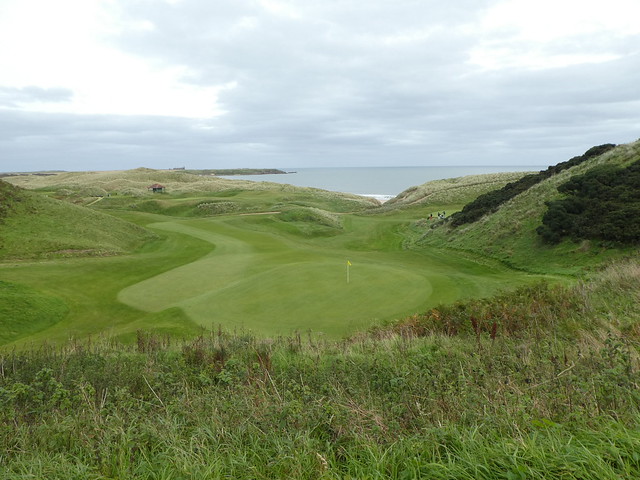
The antithesis of this experience is Cruden Bay. Driving into the car park for the first time is simply stunning. Below you, in a valley, is set a collection of massive sand dunes. Among the dunes weaves a golf course bordering on the North Sea. What makes Cruden Bay different from other links courses is that the parking lot and clubhouse are situated up on a hill, giving you an amazing view of the entire golf course and the over-sized dunes. This panoramic view gives a perspective that the other courses don't have. Arriving at almost all other links courses you are at sea level, depriving you of a birds eye perspective. At Turnberry, you certainly have some perspective from near from the hotel, but the geography at Cruden Bay is more dramatic. It's a compact little valley and the drop in terrain from the top of the hill to the sea nearby is more eye-catching.

Cruden Bay from Carpark (2)

The magnificent setting of Cruden Bay as seen from the carpark


Cruden Bay was originally designed by Old Tom Morris in 1899 and then re-designed by Tom Simpson and Herbert Fowler in 1926. Cruden Bay is located along the Aberdeen coast of Scotland about two hours north of Carnoustie. If there was ever an apt description of the term 'hidden gem,' then Cruden Bay is it. The golf writer James Finegan says of Cruden Bay: "Out sized, non conformist, unpredictable and flamboyant." These same words also describe course re-designer Tom Simpson to a tee, and the combination of Morris' original holes combined with Simpson's flair for the dramatic make this a special place.

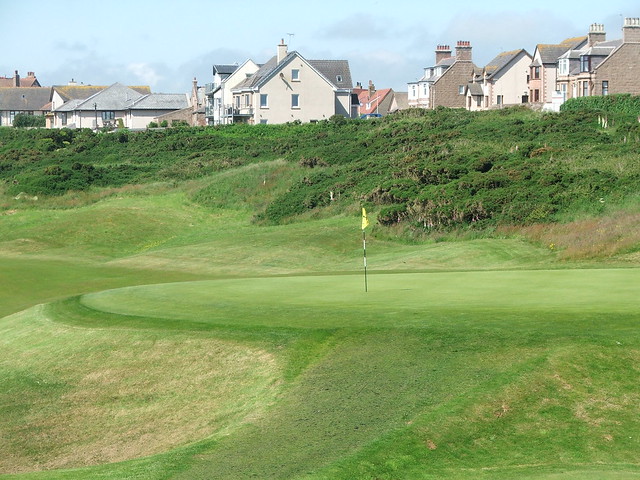
The first two holes are par fours that are similar in style and play from elevated tee boxes, down into a valley, to greens set on a plateau. You are playing alongside the town of Cruden Bay with O.B. along the left side.

The first sign that the course is not going to be traditional starts at the third hole. It is a 285 par four with a big chocolate drop mound in the middle of the fairway 80 yards from the green, making it potentially a driveable green; however, the mound is so large that it is a blind shot if you go for it. The green sits down in a hollow with several hills and hammocks around it and in front.

The fourth is a world-class par three that plays along the village of Port Erroll. Driver is often in order on this ~200 yard hole, depending upon the wind.

Cruden Bay - 2nd Tabletop green
The table top green on the second hole, looking back toward the fairway


To get from the fourth green to the fifth tee you walk between closed-in large dunes up a hill. The fifth is a 445 yard par four that plays from the top of the dunes down into a dramatic narrow snaking valley below you. Although the course is short, holes like the fifth demand long and accurate shots.

The par five sixth requires three shots, even for long hitters, due to its dog-leg and well-protected green sited within a mound of sand hills. You have to make sure you hit over the devilish Bluidy Burn with its dramatic falloff into the water, reminiscent of the Eli Burn on the seventh hole at North Berwick and the Wee Burn running through the 16th hole at Turnberry. Scotland has the most wicked burns in the world, a geographic feature we really don't have in the U.S. We have streams that don't look and feel like these burns do. The burns remind me of Dick Cheney: small, narrow, tricky and truly hazardous.

48730929847_682245c398_o 
The narrow approach to the 7th green

The seventh hole ("Whaupshank") is a par four with an elevated green situated between two dunes. Like all holes at Cruden Bay, it is a whimsical hole that snakes and twists through the dunes with a sharp dog-leg left. There is very little that is conventional on this course.

It is because of holes like the eighth that make Cruden Bay a course that has developed a cult following. It is a 248 yard par four that plays to an elevated green enclosed by dunes. English golf writer Dell Leigh, writing in his 1925 book Golf at its best on the LMS, describes the eighth as sitting "in a valley between stately hills; the hole which produces in the long hitter a frenzy of self-adulation." Leigh was writing about the original Old Tom Morris hole; Simpson had the foresight not to change it so the golfer can experience the same excitement today.

8 from ninth tee

The exhilarating 8th hole looking back from the green, a 258 yard up-hill par four


The world of golf has much sterner tests than Cruden Bay: courses such as Carnoustie, Oakmont and Olympic. Muirfield, Merion and Shinnecock are more historic. Turnberry, Pebble Beach and Kingsbarns are more scenic. But for pure fun, Cruden Bay cannot be beaten. The course defies being pigeonholed because it doesn't fit neatly into any category. It is a one-of-a-kind golf course. Golf at its simplest is a game. I think we sometimes lose sight of that fact. The point of golf after all is to have fun and enjoy yourself. Cruden Bay would be ranked #1 in the world if having fun was the only criteria utilized. There is something about Cruden Bay that lightens your spirits and brightens your mood. It makes me see golf through the eyes of a five year old: everything is exciting; there is a sense of discovery around every corner; life is good and full of promise; curiosity abounds.

The ninth hole atop a hill

Cruden Bay - view from 9th tee (2)
View from the 9th tee with a perfect crescent shaped below below

The ninth and tenth holes play on top of the dunes with dramatic views and shots played down a large hill. There are many times when the Cruden Bay landscape almost seems lunar and surreal. The ninth and tenth tee boxes are two of those places. If you look north over the beach and ocean you can see the ruins of Slains Castle, which provided the inspiration to Bram Stoker when he wrote Dracula.


Slains Castle as seen from Cruden Bay


The fourteenth and fifteenth holes are two of my two favorites on the course. Like Cruden Bay generally, they are full of quirks, but I found them exhilarating. Fourteen has a blind second shot to a bathtub green. What's a bathtub green you ask? One that quite literally is shaped like a bath tub and is sunken down into the ground. Just like the Punchbowl sixteenth green at National Golf Links of America, when you are on the green the outside world is muted. You are totally detached from civilization.

Why don't you see more bathtub style greens? From a practical standpoint, the green most assuredly doesn't work, since it doesn't get the proper amount of air and light, is difficult to maintain and playing shots into it doesn't always distinguish between shots hit well and shots played poorly. Ok, so it's not practical to have holes like these, but it misses the entire point of Cruden Bay. The R & A isn't going to hold a championship here, and it is not a proving ground for your manhood. It's a fun golf course. Personally, I like an occasional hole that has these unique element of playfulness, which has more similarities to billiards or pinball with shots banked off the sides of hills and hollows and crazy kicks of the golf ball.

Fourteen Green
The 'bathtub' 14th green

Cruden Bay - 14th green from 9th tee
The 14th green as seen from above from the high tee on the 9th hole

Look to the right of the bathtub green in the picture and you can see a tee box. This is the tee box for the 200 yard blind par three fifteenth hole. The huge sand dune you see on the left is your target. When you are done playing the hole you ring a bell to let the group behind you know you're done.

I can hear the skeptics now. Blind shots? Ringing bells? Multiple par fours under 290 yards? A bathtub green? Back-to-back par threes? Only two par fives on the whole course? Par is only 70, 6395 yards from the back. Horrors. I understand those that prefer golf courses in the conventional and traditional sense might not like Cruden Bay. Sounds like trickery you say. Well, many of the world's great courses have characteristics just like the ones I describe above. Cypress Point has back-to-back par threes; coincidentally, they both happen to be on the 15th and 16th holes. Quaker Ridge and Chicago Golf Club only have two par fives. Lahinch has its brilliant blind par three Dell hole. Pine Valley and Royal County Down have several blind shots, and you ring bells at Prestwick and the National Golf Links of America.

So these quirky elements in and of themselves are not unique to Cruden Bay and are clear evidence that having quixotic features on a golf course alone don't make it bad. What makes Cruden Bay unique is that it crams all these features into one course. It doesn't have one or two quirky holes like many of the world's best courses mentioned above. The distinction at Cruden Bay is that virtually every hole is quirky or has some kind of unconventional feature. It is this cumulative effect of the design that makes it such a fanciful place to play golf.

Admittedly, Cruden Bay has a weak finish. Sixteen is a downhill par three with a green that slopes away from you, so you must play it short and run it up. Seventeen and eighteen are decidedly weak holes that play back to the clubhouse and are uninteresting.


I've spoken to a lot of well-traveled golfers, and it's no surprise to me that almost all of them rank Cruden Bay among their personal favorite courses. The first time I saw Cruden Bay was on a golf trip with eight men touring Scotland. This was prior to my now obsessive quest to play the top 100. We were so enamored of the place that on the spot we changed our plans to stay an extra day so we could play the course over and over again. On every trip to Scotland I try to play Cruden Bay.

Bernard Darwin wrote of this great course, "I think it is typical of Cruden Bay, which is a place extraordinarily difficult to keep away from for those who have once come under its spell." I'm often asked what I'm going to do when I'm done playing the top 100 golf courses in the world. Well, I'm going to go back to Cruden Bay to play it over and over again!

The Udny Arms Hotel

The course is located in a rather isolated location away from any real population center and as a result the members serve as caddies for visitors. They are a very welcoming and friendly group who are happy to share their wonder of the golfing world with visitors. When we visited we stayed at the Udny Arms located in nearby Newburgh, which is sadly now out of busines. A family owned B & B, it was cozy and inviting. Being isolated you might assume they would serve basic meat and potatoes fare. In fact, the food there is world-class. The bar areas are cigar friendly and the wait staff makes you feel at home. Don't expect American size rooms or 200 channels of cable television. As is typical in Britain the amenities are basic, the showers are tiny but there is a facility to make a cup of tea in each room. It is one of my favorite places to stay in the world. Have the sticky toffee pudding while there and watch one of the three BBC channels provided.

Cruden Bay is also a special remembrance for me because it was the first time I experienced first-hand Sheldon in action. The forthright manner this good looking gentleman asked the Amazon barmaid what time she got off was worth its weight in gold.

Early Lawn Bowling at Cruden Bay

Wednesday, April 15, 2009

Loch Lomond Golf Club


Which golf course is the toughest to get on in the British Isles?

Well, in my case it is Loch Lomond (ranked #56 in the world), located thirty miles north of Glasgow in Scotland. I have completed playing 23 of the 24 courses in the British Isles on the world top 100 list. Although most are private clubs, they follow long-standing tradition and allow visitors to book a round as long as you follow their rules and protocols. The Honourable Company of Edinburgh Golfers (Muirfield) is the second most difficult course to get on, just because they restrict tee times more than any other club. However, they do allow you to play without a member, as do all the others. Loch Lomond Golf Club is a very private affair. You must play with a member, and you cannot just ring up the club and book a round.

Organized in 1994, Loch Lomond was setup in the tradition of Augusta National or Pine Valley; it has an international membership and doesn't really serve as a local golf club in the traditional sense. In fact, Loch Lomond is constituted as a 'destination' club to be 'savored' only a few times a year. Membership is organized around specific geographic regions. The club has appointed specific 'Club Captains' to assume leadership and membership responsibilities for these geographic regions and ensure a particular geographic mix of members.

Loch Lomond has the most pompous approach I have ever seen to membership. They describe themselves as a "private and discerning international golf club." Their P.R. sounds a bit pious to me. They describe Loch Lomond as "a singular place to meet on the world stage...It is a sanctuary not just for golf aficionados but for world thinkers." What does that even mean? World thinkers? So it's the Davos of golf clubs? The U.N. of the links? Get a grip on yourselves, boys.

Also taken from their marketing literature, "Loch Lomond has a state-of-the-art, exceptionally amenitized spa in a walled garden." An exceptionally amenitized spa? What is an amenitized spa? Does that mean they put out a lot of fruit and little shampoo bottles the members can take home? I wonder if colon cleansing is included among the spa treatments? It sounds like some of the people that write the marketing pieces here need to have their pipes cleaned. Perhaps a bit of a high colonic will prevent them from abusing the English language like this. Their marketing piece is like something written by a chain-smoking, over-lipsticked, highly-caffeinated realtor in Nevada: adjectives gone wild. Their rhetoric borders on being as obnoxious as Donald Trump's. One gets the feeling that there are a lot of raised pinkies as they drink their cocktails at Loch Lomond.

Members of this high-minded include Nick Faldo, Ernie Els, Colin Montgomerie and His Royal Highness Prince Andrew. It also has an unusual feature that I have never heard of before. They limit the amount of play that members may have. Most clubs have a limit on guest play, but I've never heard of limiting member play. Members are limited to playing the course no more than fourteen times in any given year. The guest policy is, by definition, restricted since you have to play with a member.


Rossdhu House at Loch Lomond


Although the club is very exclusive, the course is known to the public because each year, the week before the Open Championship, the Scottish Open is played here. This allows outsiders a peek at what has been called the most beautiful setting in the world. Their clubhouse, Rossdhu House, is an 18th century Georgian mansion, and serves as a focal point in the scenery with the loch and the mountains in the background. It looks very special indeed.

Apparently, their approach to running a golf club hasn't work out as planned. They went into receivership in late 2008, making it more difficult for me to play the course. I've known two members over the years but both dropped out due to the increasingly high dues and the restrictions. I was offered a chance to play recently, but I guess they are so desperate for revenue that they're trying to soak anybody that comes near the place. I'm sorry, but a £600 guest green fee is just wrong. This highfalutin, haughty approach is an outrage.

In this era of de-leveraging, the Loch Lomond Golf Club model is coming apart at the seams. How many people can now afford the hundreds of thousands of dollars required to join a vanity club like this?

I take their bombastic approach to things as a challenge to be overcome, which I accept with pleasure. I have done this twice previously and this one should be easier since there is no language barrier like there was when I tried to book a tee time at France's Morfontaine and Japan's Hirono.

I am now singularly focused on getting onto Loch Lomond and I will keep you appraised of my developments.
Maybe this would be a good time to break out some of that "In Residence at the Lodge" letterhead I picked up at Sea Island and write them a letter. Perhaps they will be impressed. I'm working on some florid language of my own to approach the club with.

I'm also dusting off my recording equipment and am about to make some calls...

Wednesday, April 01, 2009

Sea Island (Seaside Course)

Bobby Jones teeing off at the Seaside Course

On a recent trip to Sea Island, Georgia to play Ocean Forest, I also had the opportunity to play the Seaside course. Golf at Sea Island has evolved over the years through the design of four separate nine-hole courses. The first nine hole course was designed by Walter Travis, and the second was a combined design of the original nine-hole Travis course plus a new set of nine holes designed by H.S. Colt and C.H. Alison. Colt and Alison's original design was changed again by Tom Fazio in 1999 as part of Sea Island's plan to change its four original nine-hole courses into two eighteen hole courses.

Having seen a lot of Alison's work in Japan, I think he is one of the finest architects the game has ever seen, though his best work doesn't get a lot of exposure because it is in Japan. His course designs in the United States are hard to see because they are at private clubs such as Burning Tree, Milwaukee Country Club and Century Country Club. Thus, the Seaside course is a rare opportunity to see the work of Alison. The course was designed prior to Alison's trip to Japan in the 1930s so it is some of his early work.

It is difficult to tell how much of the original design features of the Seaside course remains intact today. Having looked at course maps from various points in time, it looks like a meaningful amount has been changed. Yet, many of the original holes Colt and Alison designed do remain, even if some of the routing has changed. Most importantly, what are today's fourth and fifth holes are surviving examples of the original layout. The land the Seaside Course was built on was dredged out of the nearby marsh and steam shovels and mule teams were used to sculpt the land and move dirt.

Even though the private Ocean Forest course is ranked #84 in the world, I liked the public Seaside course better. Ocean Forest is over-rated because of who its members are, and Seaside is under-rated because it doesn't have eighteen great holes. However, the front nine at Seaside are so special that it is worth the trip to play it.

The Golf Course


1st green at Sea Island Seaside Course

The first unique thing you notice about the Seaside course are the distinctive red wicker baskets instead of hole flags, like those at Merion. Most of the green designs are like the first green seen above, with slopes and shaved areas that repel shots hit short away from the green. Most of the greens are small.

Of course, I jinxed myself by mentioning how great the weather was when I played Cypress Point. The golf gods were listening and got even, so the pictures here are not as brilliant as I would have liked, due to the cloudy and foggy day. On the bright side, it gives me an excuse to have to return to Sea Island and play again.

The tee shot on the second hole shows off one of the principal design features the architects had to work with, namely, routing a course through the lowcountry marsh. Many holes have a forced carry off the tee like the one here.

The third green at the Seaside Course

The third green again shows the design feature of an inverted bowl with the oak trees in the background. This is a demanding 200 yard par three that normally plays in a crosswind.

Fourth hole looking toward the green

I've played some good golf holes in my day. The Road Hole at St. Andrews, sixteen, seventeen and eighteen at Carnoustie, the Island Green at Sawgrass, the Postage Stamp at Troon, the 15th and 16th at Cypress Point and the 18th at Pebble Beach. The fourth hole on the Seaside Course is right up there with them. Not only is the design brilliant, but with marsh and ocean as a backdrop, it is visually dramatic as well. A link to the best holes is here.

SI 4 from tee
The 4th looking from the tee toward the flag in the distance to the left

The fourth hole is 421 yards on the card, but is one of the severest dog-legs in all of golf. The hole makes an acute left turn at 300 yards to a green situated on the other side of the marsh at a ninety degree angle from where you are standing on the tee.


The 4th carry off the tee over the marsh


The tee shot is a forced carry over marsh, and the left side of the fairway is preferred because it lessens the length of your second shot to the green. The entire left side of the hole is bordered by the marsh and White Heron Lake. If you play too safely, you end up in the bunkers on the right, so not only is it a nice risk-reward hole, it is one with a severe penalty for being too greedy and a penalty for being too conservative.


The 4th fairway

Your second shot to the green requires you to hit the ball a precise distance. Even if you play more conservatively and aim away from the marsh to the fairway approach, your distance has to be perfect or you will go into the marsh on the other side. The hole requires back-to-back perfectly placed risk-reward shots that places a premium on well struck balls and penalizes poorly struck ones.

The fourth hole was originally named "It Is" which was short for "It is unlucky if played carelessly." Perfectly named.

The 4th approach to the green

The green has big slopes in it and is well protected. The fourth hole is the #1 ranked handicap hole on the course, without question.


The fifth at Seaside, approach to the green

The fifth hole is the mirror opposite of the 4th. It is a 388 yard par four that is a sharp dog leg right over the marsh. It also requires you to hit back-to-back risk-reward shots with a high penalty for error. The fifth hole was originally named "Marsh" and again is both visually dramatic and requires precision. Those playing cautiously away from the marsh have to be careful not to hit too far through the fairway to the left.


The fifth green sited between the marsh and the trees

The creativity required to design two holes like this back-to-back is what makes Colt and Alison such brilliant golf course architects.


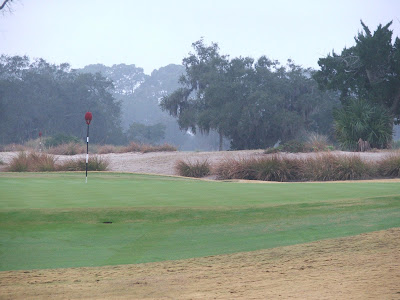
The sixth green shrouded in fog

The sixth hole is a short par three at 164 yards from the back tee. It is a nice respite following the harassing fourth and fifth holes. Such is the brilliance of the design at the Seaside course. The routing of the course through the marsh and dunes is brilliant.


The seventh green falls off at the rear

The seventh hole is a challenging 531 yard par five. The fairway zig zags with sand bordering the left side of the fairway and the marsh down the right side, while the green falls off at the back, penalizing shots hit long.


A shot of the 8th green from the fairway bunker

Eight is a short par four with a tee shot over marsh and a large bunker in play on the right side off the tee. This makes the effective landing area on the left side of the fairway very small. The hole finishes you off with a devilish, well-protected, harshly sloping green.

The ninth hole provides a strong finish to the front nine. The back nine feels like a different course, because it largely is, although the theme of alternating long and short holes, risk-reward shots and forced carries over marsh continues. There are some good holes and the routing is interesting and varied, as is the front, but it lacks the sizzle that the holes on the front nine have. When Bobby Jones played the course, the current front nine played as the back nine on a different composite course. Jones said, "Second nine is one of the very best I have ever seen." Who am I to disagree with Bobby?

The Seaside Course is a really unique place to play golf. We saw several bald eagles, which nest nearby, flying overhead while we played. The feel of the Seaside course is the lowcountry meets Merion; it is a throwback to an old-style design that requires the golfer to do more than just hit the ball long.

Sea Island Resort
The Sea Island resort has been owned and run by the Jones family (no relation to Rees or Bobby) for generations. The current generation, Bill Jones III, runs the business and resort.

No expense was spared when Sea Island was built, including at both the Cloisters hotel and the Lodge. Dark woods are prominently featured, but done tastefully. It is not as overbearing as the Breakers in Palm Beach or the Boca Raton Resort; it has more class. They do a lot of little things right at Sea Island, which adds up to a very nice experience. Bach's Brandenberg concerto was playing on the Bose CD player when I entered my room, for example. The employees all pronounced my simple name correctly, instead of making it two syllables instead of three, like many people do. There was stationery on the desk with my name engraved on it, underneath which "In Residence at the Lodge at Sea Island" was printed. I felt a bit like an English King or Howard Hughes. I imagine they used this type of thing occasionally, dashing off a letter from Balmoral or The Desert Inn, whilst in residence.

There are dozens of real wood-burning fireplaces throughout the resort. It has better service than a Ritz Carlton or Four Seasons, which is a high standard to surpass.

The resort has more five star ratings than The Pentagon has five star generals. At Sea Island, the Lodge, the Cloisters, the Spa and the Georgian Room all have received five stars from Mobil, which is a rare feat. It is also one of the few civilized places in the world where you can still smoke a cigar without persecution. You can smoke in the locker room at Ocean Forest, in the locker room at Sea Island and in the elegant cigar lounge at the Cloisters.


Thursday, March 26, 2009

Australian Golf

I completed playing Australia's top ranked courses in March 2010 and my course writeups will be posted between May and July. For those that can't wait for my impressions, a sneak preview below:

8. Royal Melbourne(Composite)- Australia's Pine Valley
21. Kingston Heath - One of the most bunkered courses in the world
43. New South Wales - A microcosm of the best of the world's golf holes
50. Royal Adelaide - A real sleeper and worthy to be among the world's best

Barnbougle Dunes - Really spectacular and one of the top three in the country

Lost Farms - Wow!

Sunday, March 15, 2009

Ocean Forest (Sea Island)


The Ocean Forest golf course (ranked #84 in the world) is located on St. Simons Island in the resort of Sea Island, Georgia. Although Sea Island is a resort, the Ocean Forest course is private and you must play with a member. The course was designed by the Harvard-Yale educated Rees Jones and opened in 1995. It hosted the Walker Cup matches in 2001, the youngest course to do so. Although Rees has modified or renovated many U.S. Open courses, Ocean Forest is his only course ranked among the world's top 100 courses.

Ocean Forest is a pretty private affair and most people are even unaware of its existence. To get into the Sea Island resort you have to go through a guard gate, which you can do if you are staying at the resort or playing one of the resort courses. Once inside the Sea Island enclave, to get into Ocean Forest you have to go through a second guard gate as well, after driving several miles down to the tip of the island. This is the only course I have played in all my travels with a double guard gate. The entrance only says 'Private' and there are no signs that say Ocean Forest.

The Golf Course Design


The course is located on the end of a barrier island where the Hampton River meets the Atlantic Ocean and the area is blessed with pine trees, sand dunes, oak trees, marshes, wetlands and a river estuary. The principles Jones used to design the course are:

1. Small greens. The average green size is 5,300 square feet. The notable exception is the par three 17th green, which has an 11,000 square foot green
2. Greens with low profiles, in order to maintain playability in high winds
3. Slopes around the greens which direct missed shots away from the hole

To quote Jones, "I learned from Brookline that you don't need extraordinary length if you have small greens. When the targets are smaller, the penalty for missing them is magnified because there is a greater likelihood that they will be missed."

The 12th green at Ocean Forest showing Jones' design philosophy around the greens

Jones' term for the green designs at Ocean Forest is 'straight back', which means that there are no greenside features to throw wayward shots back toward the hole or stop balls that have been played too long.

The greatest dangers at Ocean Forest are behind the greens. What makes the course unique is that it is essentially a links course, but without one of the central features of a links course, which is the ability to bump and run shots up to the green. The way Jones designed the greens, you have to pitch the ball onto them, which requires you to hit the ball high, as opposed to bumping it up. The approaches to most greens are narrow, with bunkers on both sides, making it a demanding course, particularly if the wind is blowing.

Ocean Forest from the air

The routing is good at Ocean Forest; Jones had a lot to work with and used it all: the marsh areas, the sand dunes and the areas along both the river and the ocean. The course starts in marsh and wetlands, then you get a brief glimpse of what is to come as the fifth hole backs up to the river with views of the ocean in the distance. While standing on the fifth green, the land you see across the river is all owned by the arrogant, disgraced, bumbling-idiot, Katrina-style bailout leader, ex-Treasury Secretary Henry Paulson, who both owns the private island and had a personal vendetta against Lehman Brothers. Enjoy your ignominious retirement, Hank. You should hope they don't try to bring criminal charges against you for your incompetence. "You're doing a heck of a job, Brownie!"

Sorry about the tirade, but it did make me feel better.

The Golf Course

Through the first five holes, the views of the water are fleeting; you see only enough to build your interest and curiosity because the course is routed inland again after this hole, playing back through the marsh and dunes. The same thing happens again when you get to the 12th and 13th holes; you think you will now play along the water from then on, but the course is again routed back inland before you re-emerge for the brilliant climax of the 17th and 18th holes along the ocean. Jones saved the best for last.

The opening hole on Ocean Forest follows the design philosophy of both Prestwick and the National Golf Links of America, which is of a short, relatively easy hole. Put a big asterisk next to that, however, since this is your first shot of the day and water is in play. At Prestwick, it's the slice over the stone wall and onto the railroad tracks that can ruin your start; at National, a shot into the high fescue; at Ocean Forest, the trouble manifests itself in the form of the 'Mullet Pond' that borders the left side of the fairway. I call it the 'Mullet Pond' because the pond is full of mullet, and they jump high out of the water with a frenetic frequency. When you hit your second shot on the first hole (and your tee shot off the 9th hole), you will absolutely be distracted by the jumping mullet.

OF 1 Green
The first green at Ocean Forest

The second hole plays along a stand of trees, the third plays by the dunes and the fourth plays by the wetlands.
The 4th hole seen from the tee 

The ninth hole, a 151 yard par three has a Biarritz feature in the front, the jumping mullet, and an occasional crocodile sitting nearby the pond. It's a nice short par three that requires a precise tee shot over water and offers no bailout option.

The 10th hole at Ocean Forest 

The 10th hole was my favorite on the course. Jones calls ten "the most thought provoking, risk-laden hole." The tee shot on this 545 yard par five demands a shot hit to a fairway which is set at an angle, over marsh grasses. It is a classic risk-reward shot. The further to the right you can successfully hit, the closer to the green you are. A shot hit short of the fairway is gone. There is a beautiful marsh along the entire right side of the hole. The green is treacherous, well protected by bunkers and has a lateral hazard on the right and to the rear.


The 10th green 

The 13th, a 381 yard par four, plays along the Hampton River and has a stream running through the fairway, which means most players have to club down off the tee in order to avoid hitting into the hazard.
13th fairway bordering the Hampton River

Fifteen is a short par three at 165 yards. My advice is take one more club on your tee shot. It plays longer, even though it is set on level ground; you have to hit it the entire way there over marsh grasses with a cross-wind blowing across the green.


The par three 15th


The nice par four 16th 

The 16th hole is quite good. It plays 425 yards from the back tees and is a dog-leg left where you have to hit through a chute of trees. The hole requires you to shape your shot off the tee and land on the left side of the fairway. The book The World's 500 Greatest Golf Holes ranks this hole as one of the hardest in the world to get on in regulation. Part of their logic is that there is usually a fresh breeze blowing across the marsh near the green, and the green repels balls. Behind the green, there is no margin for error because there is a shaved area that trickles down into a lateral hazard. I'm a hack and got there in two, so I'm not sure about their assessment.

OF 17


The par three 17th

The first time the course has a hole bordering the Atlantic Ocean is on the long 217 yard par three seventeenth. The seventeenth green backs up to the ocean and is wind-swept, with winds blowing across the marsh nearby.
OF 17 green
The 17th green

Believe it or not, there are only a handful of holes on courses ranked in the top 100 in the United States that play along the Atlantic Ocean. Seminole sorta-kinda has a couple of holes. Maidstone has two or three, The Ocean Course at Kiawah has several and these final two at Ocean Forest. The eighteenth hole is 480 yards, plays along the Atlantic from tee to green, and is a tough finishing hole with a small green that slopes back to front and is well bunkered.

OF 18-5
Approach to the 18th green

Ocean Forest

The locker room at Ocean Forest is among the best I have seen. It is on a par with Seminole, San Francisco and Mayacama. The locker room has its own library; a nook with a giant fireplace and card table; a cozy seating among the lockers, and the top of the room is adorned with animal heads.


Ocean Forest reminded me of another exclusive southern club, The Honors Course. Both encourage walking, have great caddy programs, have a great respect for the traditions of the game, particularly amateur golf, and both exhibit true Southern hospitality.

Walter Hagen once said he didn't want to be a millionaire, he just wanted to live like one. Staying at Sea Island will allow you to fulfull Walter's fantasy. It's expensive, but it is a true five star resort and worth it.

The Seaside course, also located at Sea Island, a few miles from Ocean Forest is not ranked in the top 100 courses in the world, but does rank as one of the top public courses in the country. Personally, I think it is a better course than Ocean Forest and I will do a detailed write-up of the Seaside course next. It is also the easiest way for most people to see the design work of the genius architects H.S. Colt and C.H. Alison, and in particular their unparalleled ability to route a course. Those that followed my travels to Japan know how highly regarded Charles Alison's design skills are. His partner, H.S. Colt, was involved in Royal Portrush and Pine Valley. Playing the Seaside course is a good chance to see how great this pair were without traveling half-way around the world or without gaining access to a private club.

Why is Ocean Forest ranked so high in the world? A little inside-baseball might provide some insight. Gary Galyean, who wrote the club history after the Walker Cup matches in 2001, also serves as chairman of Golf Magazine's top 100 courses jury. Rees Jones also rates courses for the magazine as does the owner of Sea Island, Bill Jones III. It can't hurt to have three people associated with the course on the rating panel. As we say in Brooklyn, "You know what I mean?"

Ultimately, Ocean Forest is like local boy Davis Love III. All the essential elements of greatness are there, but there is just something I can't put my finger on that keeps me from becoming a big fan.

Post Script


There are four courses ranked on the world top 100 in the state of Georgia. I have now finished playing three: East Lake, Peachtree and Ocean Forest. You all know which one I still need.


Driftwood immediately behind the 17th green

Sunday, February 15, 2009

Cypress Point Golf Club


The Cypress Point Golf Club (ranked #2 in the world) is located on the Monterey Peninsula between Pebble Beach and Spyglass Hill on the 17-Mile Drive. This private course has only 250 members, 75 of whom are local. Playing Cypress Point is a dream come true.

After all the good golf I have played, it seems odd to call playing Cypress Point a dream come true because I could say that about any number of the courses I have played or trips I have taken. I'm a lucky man. However, playing Cypress Point really is a once in a lifetime experience. It is a tour-de-force and there is something seductive about playing here. It has an aura about it that almost no other course has, which makes it the zenith of a golfer's experience.

Arriving at Cypress Point you have a real sense of occasion. Once you drive beyond the 'Members Only' sign, the sense of gravitas starts to hit you.


CP 15-16
The distinctive Cypress trees,
the walk from the 15th green to the 16th tee starts by walking under here

I have generally had good weather on my golf travels and been very fortunate, although occasionally I've had to play in rain or heavy wind or cold. As the post office motto goes, "neither rain nor sleet nor gloom of night" has stopped me from playing golf. At Cypress, the weather conditions I played in can best be described as ridiculous. A temperature of 72 degrees with a one-to-two club wind; a cloudless, brilliant day with no fog or humidity. Pilots have a term for the weather conditions I played in: "severe clear." The visibility was unlimited.

Normally I like to write all of the material in the blog myself. With regard to Cypress Point, I have also chosen to quote extensively from the works of others as well, who do a good job of capturing the essence of the place.

I didn't realize that the 17-Mile Drive goes right through Cypress. This scenic tourist highway meanders around the Monterey Peninsula offering stunning views. As you drive along the 17-Mile Drive you travel along a road right between the ocean and the 14th hole. In fact, you also drive right through the first fairway later down the same road. The tee shot on the first hole plays blind from the top of the hill near the clubhouse over a high hedgerow and the 17-Mile Drive, to a fairway set down the hill.

Cypress 14th from tee
The view from the 14th tee with the 17-Mile Drive


Alister Mackenzie, the architect of Cypress Point, said, after seeing the property: "It would be difficult to over-estimate the great possibilities of a golf course at Cypress Point. I am fully acquainted with the world's greatest golf courses and have no hesitation in saying that in the beauty of its surrounding, the magnificence of its sand dunes, its spectacular sea views, its glorious Cypress trees - there is no opportunity of making [a golf course] which should be superior to any other. Cypress Point has interested me more than any land I have ever had to deal with. For the sake of my reputation I should like to make you the best golf links in existence."

I had the first tee jitters pretty bad at Cypress because it is such a special place, but was thrilled to hit a good first drive.


The second hole, seen above, is a par five that turns inland, with a forced carry over a ravine to the tops of the dunes into a narrow landing area, because hitting too far to the right is out of bounds. The further you hit it to the left, the better off you are but brings the ravine into play.

Cypress 4th

The 4th hole at Cypress

One of the many ingenious things Mackenzie did at Cypress was to use his camouflage techniques to full effect. Look at the two pictures of the 4th hole above and below. As you play the hole, there is a legion of bunkers. Notice in the picture below looking backward from the green, you can't see any of them. Almost all of the holes at Cypress are like this: a lot of intimidating bunkering that forces you to think strategically, yet no sign of all the trouble when looking back.

Cypress 4th back

Looking backward from the 4th green


The collection of par threes at Cypress are as good as any in the world. The par three third hole, below, gives you a great sense of how good they are. This 156 yard hole plays slightly downhill but with a cross-wind normally blowing, club selection is very tricky. Do you think any of those bunkers come into your swing thought as you play the hole?


Cypress 3rd Green


The par three 3rd hole


The par three 7th hole, below, is also a ridiculously good hole. It plays 170 yards uphill and at an angle to the tee box. The green is lightning fast if you are above the hole. As our caddy said of a putt down the hill: "code red."


Cypress 7th green
The par three 7th hole

Similar to Augusta, pictures of Cypress don't fully do it justice, since they flatten out the terrain, which is fairly hilly. The 491 yard par five 5th hole, below, plays uphill. Also, this picture highlights how artful the bunkers are at Cypress. The way the bunkering was done on this hole, it looks like the entire right side of the hole is unplayable when in fact it is the preferred side to approach the green from. Again, this illustrates Mackenzie's ability to visually fool the golfer and why he is considered one of the game's greatest designers.

Cypress 5th Fairway

The par five 5th hole


The routing at Cypress Point is another impressive aspect of the course, with a constant change in direction and as good as any in the world. Mackenzie took a bit of an unconventional approach and broke several rules while designing Cypress Point, which is a good thing. For example, there are many elements to the course that aren't normally considered good design: back-to-back par fives (5th and 6th holes), back-to-back short par fours (8th and 9th holes) and back-to-back par threes (15th and 16th holes). There are blind shots on the 1st, 8th and 18th holes. You also have to hit over hedges (1st hole) and tress (17th and 18th holes).

The picture of the sixth green below illustrates why the inland holes at Cypress are so good with the effective use of the sand dunes. On this particular green, as on several others, the slope of the green can fool the golfer who has never played it before. One of the players in our group hit his shot short of this green. The green slopes back to front and the caddies started to yell for the ball to get down, which we couldn't understand. You should want a ball to get up onto the green if it slopes back to front. In this instance, because of the grain, the ball shot to the back of the green, as if defying the laws of physics. The putt back down the green (a pretty good downhill putt) played as if it were an uphill putt. Amazing.


Cypress 6th green
The 6th green at Cypress


Holes eight and nine are short par fours at 369 and 283 yards, respectively. Eight doglegs to the right and offers a blind tee shot. Once you are in the fairway and look back, there is no sight of the tee box you hit from. Nine plays downhill but to the best protected green on the course. I don't know if these two holes had any influence on Coore and Crenshaw, but they reminded me of the short back to back par fours at Sand Hills (7th and 8th).

The stretch of holes starting at thirteen and ending at seventeen is the best stretch of consecutive holes in the world. It has no equal. No equivalent in all of golf. This amazing stretch starts standing on the tee at thirteen which feels a bit like standing on the 17th tee at the National Golf Links of America. That is, you're on top of the world, with the tantalizing hole below you and the azure water out ahead in the distance. Like the 17th at National, the thirteenth at Cypress is a medium length par four with great risk-reward choices.

Cypress 13


The thirteenth green with Monterey Bay behind

Fourteen is a world-class dogleg right hole and one of my favorites. It plays from an elevated tee to a fairway that gets progressively more narrow as it rises up the hill between the trees. Before hitting your tee shot you have to consciously focus on golf because the beauty of the scenery is so inspiring.

Cypress 14th fwy

The 14th hole at Cypress Point

Notice how the sculpted look of the ancient Cypress trees helps to frame the hole and add to the distinctive look. The hole plays longer than its 393 yards due to the elevation and the wind off the bay.

Cypress 14 fairway

The 14th fairway

The elevated, cloistered green is perched on a ridge overlooking the bay. The green is relatively small as are most at Cypress Point. This picture has a particularly tricky pin placement. Balls hit to the rear third of the green tend to trickle off the back due to the grain of the grass growing toward the water. The hole is not wanting in any regard!

Cypress 14th green

The 14th green

To steal a phrase from one of my loyal readers, the 15th at Cypress Point is the sexiest hole in golf. You expect to be blown away by the 16th hole because it gets so much exposure. Sixteen is one of the most photographed holes in the world and well known. The short par three 15th hole is less well known but equally spectacular, sitting in a little alcove high up on the headlands. It is beyond description tucked on a secluded ridge encircled by Cypress trees and a craggy rock formation.


CP 15th-2
The par three 15th hole at Cypress Point

I know some of these photos actually look fake. But they are real and have not been enhanced or changed in any way. It really is almost too good to be true. The fifteenth hole is only 130 yards long but the green is obviously well bunkered and slopes back to front. On this stretch of the course, it is difficult to concentrate because the surroundings look almost surreal.

CO 15th

The par three 15th at Cypress Point


The 16th hole is overwhelming and it lives up to its fierce reputation. The proportions of the hole are as epic as the setting. It's 218 yards of carry. As you see in the picture of sixteen, the green looks far away. That's because it is. You can lay-up on the 16th by hitting to a narrow fairway area to the left of the green. I didn't come to Cypress Point to lay up and I lost my only two balls of an otherwise good round trying to hit it, unsuccessfully. I walked away giddy about it none-the-less.

Cypress 16th hole

16th hole, Cypress Point Club


The 17th hole is similar to the 18th at Pebble Beach but the bay is on the right instead of the left as you stand on the tee. You hit from a high cliff down to the fairway at an angle, over water. Because it follows one of the most famous holes in golf, it is also an underrated hole. On any other course it would easily be the signature hole.

CP 17th hole

Cypress Point 17th hole

The second shot on the 386 yard seventeenth plays over the stand of trees situated in the middle of the fairway. Unless you place your drive perfectly on either side of the trees, you have to hit over them to get to the green.

Cp 17 toward greeen

Cypress Point 17th hole from the fairway


Jimmy Demaret called Cypress Point the best seventeen hole course in the world due to a weak 18th hole. I actually don't agree with him. I liked the 18th hole. It's a bit quirky, as Cypress can be. The tee is along a ridge backing up to the bay. You have to hit your shot over trees and the landing area is blind. The card shows the hole as being only 326 yards long, but it plays much longer because the second shot plays severely uphill. There is a big cypress tree blocking out almost the entire left side of the green forcing you to have to shape your shot off an uneven lie. The green slopes back to front and also has a couple of spots where you could end up with a "code red" putt if you're above the hole. Sound like a bad hole to you?

CP 18th from green backward

The 18th hole looking from the green backwards

Herbert Warren Wind wrote about Cypress Point in the Walker Cup program, which was held here in 1981:

"It should be emphasized that Cypress Point possesses a diversity of terrain possibly unmatched by any other course. It offers not only an unforgettable stretch of cliff-lined holes but some excellent orthodox seaside holes, a few stunning dune-land holes and an arresting sequence of holes that climb inland into hilly terrain, their fairways cut through a forest of Monterey pines. Back in 1929, Bobby Jones, who had come to California to play in the the United States Amateur at Pebble Beach, found the time to get in two rounds at the newly-opened Cypress Point layout. Asked what he thought of the two courses, Jones, with his usual acumen and diplomacy, replied, 'Pebble Beach is more difficult, but Cypress Point is more fun."

CP 15th tee out


The view from the 15th tee with the sixteenth hole in the distance


Selwyn Herson, who completed playing the top 100 golf courses in the world in 2004 sums Cypress Point up perfectly in one sentence: "Playing in heaven: Six holes in the trees, six holes in the sand dunes, six holes by the sea."

If you are ever talking golf with someone and they don't think that Cypress Point ranks as one of the top three golf courses in the world, quietly take the scissors and letter opener off their desk, since they are clearly daft and you are in danger. They belong in one of those white jackets with the crossing sleeves in front.

Cypress Clubhouse

The Cypress Point Clubhouse


Henry Longhurst, the grand master of English golf writing, wrote eloquently about Cypress Point: "Of all the clubhouses I know, I think I should put Cypress Point in the first half-dozen. Perched up near the end of the promontory it opens on both sides to a view of the ocean pounding away on the rocks below. Inside, the simplicity is in strange contrast to the magnificence of so many American Clubs...a golf club and nothing more."

Cypress LR


Cypress Locker Room


The accolades of Cypress Point are all encompassing. The genius of the routing, the uniqueness of the Cypress trees, the artfulness of the bunkers, the understated clubhouse, the color of the sand, the color of the water in the bay, the ingeniousness of the traps, the views from the cliffs and the ridiculous stretch of holes from thirteen through seventeen. And, at only 6509 yards from the back tees, proof that a course doesn't have to be long to be brilliant.

For those golfers who aren't as pathological as I am and want to set a more modest goal than playing the top 100 courses in the world, I offer simple advice. Try to play Cypress Point. It encompasses all that is great in the world's golf courses into eighteen holes.

Post Script

I have now finished playing all eight courses ranked in the top 100 located in the state of California. Did I continue my tradition while in California of having an In-N-Out Burger? As Sara Palin says, "you betcha!"

Interested in learning the methods I used to play all these spectacular golf courses around the world? then my forthcoming book may be of interest, in details how a mortal golfer may be able to do the same

The book is available from Barnesandnoble.com and Amazon.com. Click on the image of the book below to order on Amazon:


I hope you will find it enjoyable and entertaining.